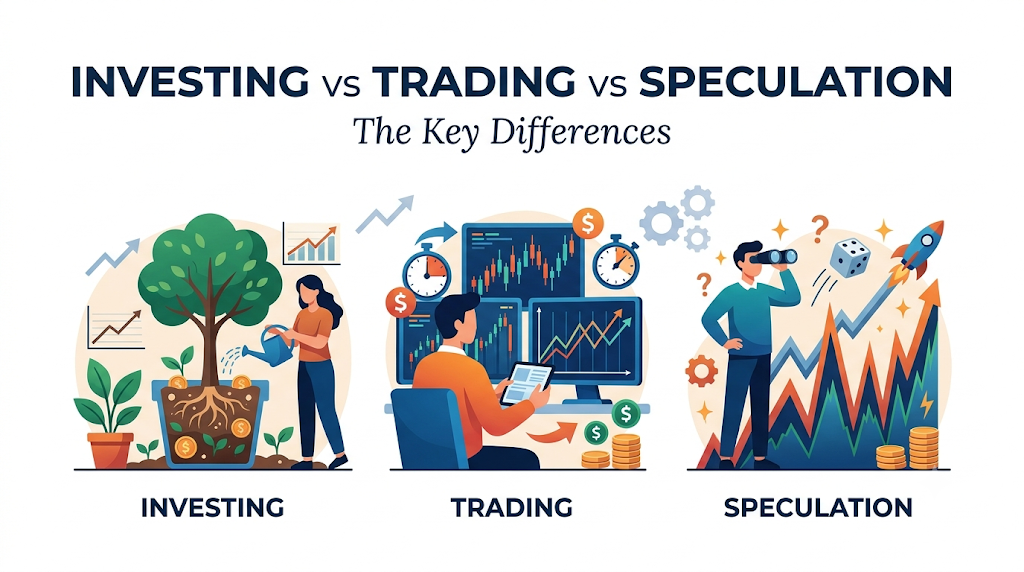
Walk onto any financial forum or watch market commentary for ten minutes, and you will hear people use the words investing, trading, and speculation as if they mean the exact same thing. Someone buys a volatile penny stock hoping it doubles by Friday and calls it an “investment.” Another person holds a blue-chip index fund for fifteen years and talks about “trading the market.”
Mixing up these terms is more than a vocabulary mistake. When your expectations do not match your actual strategy, you end up taking the wrong kind of risk, checking prices at the wrong intervals, and reacting emotionally when markets move.
Each of these three approaches operates on a different timeline, relies on different decision-making tools, and treats risk in its own distinct way. Understanding where one ends and the next begins helps you set realistic expectations before putting a single rupee or dollar to work.
Core Definitions: Three Ways to Participate in Financial Markets
At the surface level, all three activities involve buying and selling financial assets—such as stocks, bonds, commodities, currencies, or derivatives—with the goal of making money. The real distinction lies in why you are buying, how long you plan to hold, and what you expect to drive your return.
What Investing Means
Investing is the process of committing capital to assets with the expectation that they will generate wealth gradually over the long term. Investors focus on the underlying business or asset itself. When you buy shares of a profitable company, you are buying a small piece of its future earnings, cash flows, and asset growth.
Returns in investing typically come from two sources: long-term capital appreciation as the business grows, and regular income such as dividends or interest. Time horizons usually span several years to multiple decades.
What Trading Means
Trading is the active buying and selling of financial instruments to profit from short- to medium-term price movements. A trader cares far less about where a company will be ten years from now and far more about where its price is likely to go over the next few minutes, days, or weeks.
Rather than relying on long-term business expansion, traders look for repeatable patterns in price action, market momentum, liquidity, and supply-and-demand imbalances.
What Speculation Means
Speculation involves putting capital into high-risk, uncertain opportunities in pursuit of outsized, rapid gains. Speculators deliberately take on substantial risk—often involving high volatility, leverage, or binary events—where the probability of a sharp loss is high, but the potential payoff is disproportionately large.
In many cases, the asset being speculated on has little or no proven cash flow, or its price is driven primarily by market sentiment, news catalysts, or crowd behavior rather than measurable intrinsic value.
Side-by-Side Comparison: Investing vs. Trading vs. Speculation
| Factor | Investing | Trading | Speculation |
| Primary Goal | Long-term wealth creation and compounding | Capturing short- to medium-term price swings | Achieving rapid, outsized returns from high-risk bets |
| Typical Time Horizon | Years to decades | Minutes, days, weeks, or a few months | Seconds to a few months (often event-driven) |
| Main Analysis Method | Fundamental analysis (financial statements, moat, management, valuation) | Technical analysis (charts, volume, support/resistance, indicators) | Sentiment analysis, catalyst tracking, momentum, macro bets |
| Risk Profile | Moderate to high (reduced over long periods through diversification) | High (managed tightly through stop-losses and position sizing) | Very high (significant chance of total or near-total capital loss) |
| Source of Return | Business earnings growth, dividends, interest, compounding | Price differentials between entry and exit points | Major market dislocations, hype cycles, binary outcomes |
| Effort & Screen Time | Low to moderate (periodic portfolio reviews) | High (frequent chart monitoring and active execution) | Varies (intense monitoring around specific events or trades) |
| Use of Leverage | Rarely used; mostly cash-funded positions | Frequently used (margin, futures, options) with strict rules | Heavily used, amplifying both potential gains and losses |
Five Practical Differences That Shape Your Results
Comparing definitions on paper is helpful, but the real separation shows up in how you behave once your money is in the market.
1. Ownership Mindset vs. Price-Action Mindset
An investor asks, “Is this a healthy business trading at a fair price?” If the stock drops 15% during a broader market pullback while the company’s revenue and earnings remain strong, an investor often views the dip as an opportunity to buy more shares at a discount.
A trader asks, “Where is the price likely to move next, and where is my exit if I am wrong?” If the stock breaks below a key support level, a disciplined trader exits immediately—regardless of how great the company’s products are—because the trade setup has failed.
A speculator asks, “What happens if this catalyst hits?” They are betting on an uncertain outcome, such as an upcoming regulatory ruling, an unverified turnaround story, or a sudden surge in retail buying interest.
2. How Risk Is Managed
Every market participant faces risk, yet each handles it differently:
- Investors manage risk through asset allocation and diversification. By spreading capital across different sectors, companies, or asset classes—and holding through full economic cycles—they reduce the damage any single bad company can do.
- Traders manage risk mathematically on every single trade. They decide the maximum percentage of capital they are willing to lose before entering a position, place stop-loss orders, and rely on favorable risk-to-reward ratios over hundreds of trades.
- Speculators accept concentrated risk. Because individual speculative bets can drop 50% to 100%, experienced speculators limit risk by allocating only a small, predetermined slice of their overall net worth—money they can afford to lose without disrupting their financial stability.
3. Research and Decision-Making Tools
The tools you use depend entirely on what drives your edge:
- Fundamental Analysis (Investing): Examining balance sheets, income statements, free cash flow, debt levels, return on equity, competitive advantages, and industry growth trends.
- Technical Analysis (Trading): Studying candlestick patterns, moving averages, volume spikes, relative strength, order flow, and historical price levels to time entries and exits.
- Catalyst & Sentiment Tracking (Speculation): Monitoring earnings surprises, clinical trial dates, geopolitical announcements, options open interest, and social momentum.
4. Impact of Transaction Costs and Taxes
Frequency matters more than most beginners realize. Because investors buy and hold for years, they pay brokerage commissions, spreads, and taxes infrequently. Holding assets long term also allows gains to compound uninterrupted and often qualifies for lower long-term capital gains tax rates, depending on local tax laws.
Traders and short-term speculators execute dozens or hundreds of transactions each year. Slippage, bid-ask spreads, brokerage fees, and short-term capital gains taxes directly eat into net returns. A strategy that looks profitable before costs can easily turn negative once friction is accounted for.
5. Emotional and Psychological Demands
Investing tests your patience. The hardest part is sitting still during boring sideways markets or resisting the urge to panic-sell when headlines turn gloomy.
Trading tests your discipline. You must follow your rules without hesitation, take small losses calmly, and avoid revenge-trading after a losing streak.
Speculation tests your emotional control under extreme swings. Rapid gains can trigger overconfidence, while sudden crashes can cause paralysis if you have not defined your exit beforehand.
Real-World Scenarios: How the Same Market Event Looks to Each Participant
Imagine a mid-sized renewable energy company announces plans to build a major battery manufacturing plant, while its stock price swings wildly on heavy volume.
- The Investor reads the company’s annual report, checks whether management can fund the factory without taking on dangerous debt, and estimates how much profit the plant could generate three to five years from now. If the valuation makes sense, the investor buys shares and plans to hold them as the project matures.
- The Trader notices the stock breaking out above a six-month resistance level on triple its normal trading volume. The trader buys the breakout, sets a stop-loss just below the breakout point, and targets a 12% short-term momentum move over the next two weeks.
- The Speculator buys short-dated out-of-the-money call options right before a government subsidy announcement, hoping the stock will jump 30% overnight—knowing the options could expire completely worthless if the news disappoints.
All three participants are looking at the exact same company, yet none of them are playing the same game.
Where the Lines Blur in Real Life
In practice, investing, trading, and speculation sit on a spectrum rather than in airtight boxes. A strategy can shift from one category to another depending on how it is executed:
- Buying a blue-chip stock on heavy margin turns a traditionally safe investment into a leveraged speculation, because a temporary 15% market drop could trigger a margin call and wipe out your position.
- Swing trading fundamentally strong companies blends elements of both investing and trading—using business quality to pick the stock and technical charts to time entries and exits.
- Holding a speculative asset with no exit plan often happens when a short-term trade goes wrong and the trader refuses to take a loss, rebranding a failed trade as a “long-term investment.”
Recognizing when you are crossing from one approach into another keeps you honest about the risks you are actually carrying.
How to Decide Which Approach Fits You
You do not have to lock yourself into a single label forever, though most successful market participants build a clear foundation before branching out.
- Start with investing if your goal is reliable wealth building. If you have a full-time career, limited time to watch screens during market hours, and long-term goals like retirement or financial independence, systematic investing offers the highest historical probability of success with the lowest daily stress.
- Explore trading only if you can treat it like a structured skill. Trading is not effortless passive income. It requires screen time, backtesting, strict risk rules, and emotional resilience. Start with small position sizes and track every trade in a journal.
- Ring-fence any speculative capital. If you enjoy taking high-risk bets on emerging themes, options, or volatile stocks, keep that money in a separate account capped at a small percentage of your portfolio—commonly 5% or less—so a bad outcome never threatens your core financial security.
Frequently Asked Questions (FAQs)
Is trading riskier than investing?
In the short term, yes. Trading involves frequent exposure to sudden price swings, market gaps, and leverage, which can lead to rapid losses if risk controls fail. Over long periods, however, poorly researched investing—such as putting all your money into a single declining company—can also result in permanent capital loss.
Can one person be both an investor and a trader?
Yes. Many market participants keep 80% to 90% of their capital in a long-term investment portfolio (such as index funds and quality stocks) while using a separate, smaller account for active swing trading or short-term opportunities. Keeping the two accounts separate prevents short-term trading decisions from disrupting long-term compounding.
What makes an activity speculation rather than investing?
The key difference is the predictability of underlying value versus reliance on uncertain future events. Benjamin Graham famously described an investment operation as one that, upon thorough analysis, promises safety of principal and an adequate return—and noted that operations not meeting these requirements are speculative.
Do traders and investors use the same brokerage accounts?
They can, though active traders often choose brokers that offer lower per-trade commissions, fast order execution, advanced charting platforms, and margin facilities. Long-term investors generally prioritize low-cost accounts with zero maintenance fees, automatic dividend reinvestment, and strong research tools.
Why do most beginner traders lose money?
Most beginners confuse trading with speculation. They enter positions based on social media tips, risk too much money on a single trade, ignore stop-losses, and trade too frequently without a tested strategy—allowing transaction costs and emotional decisions to drain their capital.
Final Takeaway
Investing, trading, and speculation are three distinct tools designed for completely different jobs. Investing builds wealth steadily by owning productive assets over time; trading captures shorter price movements through disciplined execution and strict risk management; speculation chases asymmetric payoffs in high-uncertainty situations. Before entering any position, define which role you are playing—and make sure your time horizon, research, and risk limits match that choice.