Watching a stock price drop by half overnight without any bad news can startle new investors. Just as often, seeing extra shares appear in a demat or brokerage account feels like getting free money—until the updated share price tells a different story.
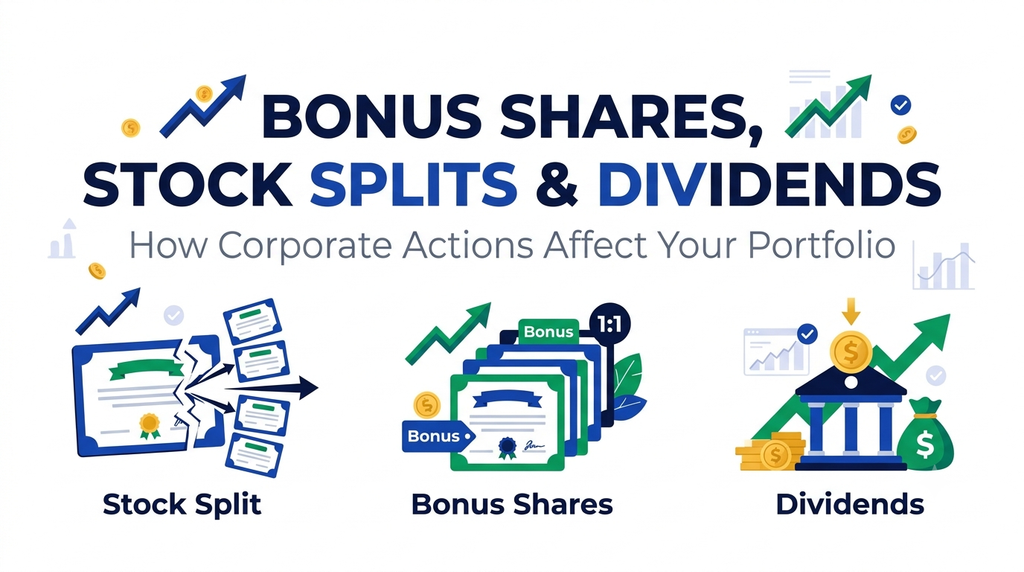
When a listed company decides to reward shareholders or make its shares easier to trade, it usually relies on three corporate actions: dividends, bonus shares, and stock splits. Each one changes either your cash balance, your share count, or the market price per share. Yet they work through very different accounting rules and send different signals about a company’s financial health.
Understanding how these three mechanisms operate prevents costly misunderstandings around record dates, price adjustments, and long-term returns.
Why Companies Use Corporate Actions to Reward or Restructure Shares
Public companies constantly balance two competing priorities: keeping enough cash inside the business to fund expansion, and returning value to the shareholders who own the business. At the same time, management teams pay attention to how accessible their stock is to everyday retail buyers.
Corporate actions help solve both challenges:
- Distributing surplus profits: Mature businesses that generate more cash than they can profitably reinvest often share those earnings directly with investors.
- Improving market liquidity: When a company’s share price grows very high over several years, small investors may hesitate to buy even a single share. Increasing the total share count brings the per-share price into a more comfortable trading range.
- Signaling financial confidence: Consistent cash payouts or share distributions often reflect board-level confidence in steady cash flows and healthy reserves.
While all three actions are approved by a company’s board of directors—and often require shareholder approval—only one puts actual cash into your bank account.
Dividends: Direct Cash Returns From Company Profits
A dividend is a portion of a company’s net profit distributed directly to its shareholders. Instead of keeping every rupee or dollar inside the business, the company pays out a fixed amount per share held.
How Cash Dividends Work in Practice
Suppose you own 200 shares of a company, and the board declares a cash dividend of ₹15 per share (or $1.50 per share). You receive ₹3,000 (or $300) credited directly to your linked bank or brokerage account, while your share count remains unchanged at 200 shares.
Companies typically declare dividends in two ways:
- Interim dividends: Paid during the financial year before final annual accounts are closed, usually following strong quarterly earnings.
- Final dividends: Proposed by the board after full-year financial results are audited and approved by shareholders at the Annual General Meeting (AGM).
Occasionally, a business sitting on an unusually large one-time windfall—such as proceeds from selling a subsidiary—may announce a special dividend, which is a non-recurring payout on top of its regular schedule.
Why the Share Price Drops on the Ex-Dividend Date
A common beginner mistake is buying a stock one day before a dividend payout expecting risk-free profit. Stock exchanges adjust for this automatically.
Because cash leaves the company’s balance sheet to pay shareholders, the company is worth slightly less once the payout is locked in. On the ex-dividend date, the stock typically opens lower by roughly the dividend amount per share. If a ₹500 stock goes ex-dividend for a ₹15 payout, its adjusted reference price becomes ₹485, subject to normal market buying and selling.
Bonus Shares: Turning Company Reserves Into Extra Stock
A bonus issue gives existing shareholders additional shares at zero extra cost, strictly in proportion to the shares they already hold. Unlike a cash dividend, no money leaves the company’s bank account.
The Accounting Behind a Bonus Issue
Over profitable years, companies accumulate undistributed earnings in their free reserves or securities premium account. During a bonus issue, the company capitalizes part of those reserves—meaning it shifts money from its reserve ledger into its share capital account—and issues new shares to investors.
Consider a 1:1 bonus ratio:
- You hold 100 shares trading at ₹800 each (total holding value: ₹80,000).
- The company issues 1 bonus share for every 1 share held.
- Your share count doubles to 200 shares.
- The market price adjusts proportionally to roughly ₹400 per share.
- Your total investment value remains ₹80,000.
Important Characteristics of Bonus Shares
- Face value stays unchanged: If the original share had a face value of ₹10, the new bonus shares also carry a face value of ₹10.
- Future dividend potential rises: Because you now hold twice as many shares, any future per-share dividend declared on the expanded share base applies to all 200 shares.
- Reserves must exist: A loss-making company without sufficient accumulated reserves cannot legally issue bonus shares.
Stock Splits: Dividing Existing Shares Into Smaller Units
A stock split divides each existing share into multiple lower-priced shares without touching the company’s reserves or overall market valuation. It is purely a structural subdivision designed to make high-priced shares easier for smaller investors to buy and sell.
How Face Value Changes During a Split
Every equity share carries a nominal face value (also called par value), such as ₹10 or ₹2. During a stock split, the company reduces this face value proportionally while multiplying the number of shares.
Take a 1:5 stock split on a stock with a ₹10 face value:
- You own 50 shares trading at ₹2,500 each (total value: ₹1,25,000).
- Each ₹10 face-value share splits into 5 shares with a new face value of ₹2 each.
- Your holding increases to 250 shares.
- The market price adjusts to around ₹500 per share.
- Your total position remains ₹1,25,000.
Why Companies Split Their Stock
When a stock climbs into the thousands per share, retail investors with modest budgets cannot easily build positions or average their buying price. Lowering the ticket size broadens participation, tightens bid-ask spreads, and increases daily trading volume. However, a stock split neither creates new earnings nor transfers reserves—it simply cuts the same financial pie into smaller slices.
Bonus Shares vs. Stock Splits vs. Dividends: Side-by-Side Comparison
| Feature | Dividends | Bonus Shares | Stock Splits |
| What the investor receives | Direct cash payout | Additional free shares | Subdivided shares from existing stock |
| Impact on share count | No change | Increases based on bonus ratio | Increases based on split ratio |
| Impact on market share price | Drops roughly by dividend amount on ex-date | Drops proportionally to bonus ratio | Drops proportionally to split ratio |
| Impact on face value | No change | No change | Decreases proportionally |
| Accounting source | Current or accumulated profits (cash outflow) | Free reserves / securities premium | No transfer of funds or reserves |
| Total portfolio value on record date | Cash + adjusted share value equals pre-ex-date value | Unchanged immediately after adjustment | Unchanged immediately after adjustment |
| Primary business purpose | Share surplus cash with owners | Reward shareholders using reserves and improve liquidity | Make expensive shares affordable and boost trading liquidity |
Key Dates Every Shareholder Must Track
Missing a single calendar cutoff can mean missing out on a dividend, bonus issue, or split. Exchanges follow a strict timeline for every corporate action:
- Declaration Date: The date the company’s board announces the dividend amount, bonus ratio, or split ratio, subject to necessary approvals.
- Record Date: The cutoff date on which the company checks its shareholder register to confirm who is eligible for the corporate action.
- Ex-Date (Ex-Dividend / Ex-Bonus / Ex-Split Date): Under modern T+1 settlement cycles, the ex-date usually falls on the same day as the record date (or one business day prior in T+2 markets). To qualify, you must buy the shares before the ex-date so that delivery settles into your account by the record date.
- Payment or Credit Date: The day cash dividends reach your bank account or newly issued bonus/split shares appear in your demat account.
Common Misconceptions That Trip Up Retail Investors
Mistake 1: Treating Bonus Shares and Splits as Instant Wealth
Seeing your share count double does not double your money. Because the exchange automatically adjusts the share price downward on the ex-date, your net worth stays identical on day one. Real wealth comes only if the company continues growing its earnings afterward, pushing the lower-priced shares higher over time.
Mistake 2: Chasing High Dividend Yields Blindly
A remarkably high dividend yield is not always a sign of strength. Sometimes a stock’s yield looks huge simply because its share price has crashed due to falling profits or heavy debt. Always check whether the company generates enough free cash flow to sustain its payouts without borrowing.
Mistake 3: Selling Immediately After the Ex-Date
If you sell your shares on or after the ex-date, you still receive the dividend, bonus shares, or split shares because your name was recorded on the cutoff date. Conversely, buying on the ex-date entitles you to the lower adjusted price, not the upcoming corporate action.
Mistake 4: Ignoring Tax Rules on Dividends and Adjusted Cost Base
In most jurisdictions—including India and the United States—cash dividends are taxable in the hands of the investor in the financial year they are received. Bonus shares and stock splits are generally not taxed at the time of allotment, but they change your average purchase price and holding period calculations when you eventually sell those shares for capital gains.
Frequently Asked Questions
Can a company announce both a dividend and a bonus issue together?
Yes. Companies with strong cash flows and substantial reserves occasionally declare a cash dividend alongside a bonus share issue in the same board meeting, provided both meet corporate law requirements and shareholder approval.
Why do bonus shares sometimes take a few days to show up in my demat account?
On the ex-bonus date, the stock price adjusts immediately, which can temporarily make your portfolio look smaller. The newly allotted bonus shares typically take a few working days to receive exchange listing approval and credit into your demat account, restoring your full portfolio value.
Which is better for long-term investors: dividends or bonus shares?
Neither is automatically superior—it depends on your financial goals and how well the business reinvests money. Retirees or income-focused investors often prefer reliable cash dividends, while growth-oriented investors may favor companies that retain cash for high-return expansion and occasionally reward loyalty through bonus issues.
Does a stock split dilute existing shareholders’ ownership percentage?
No. Because every shareholder receives extra shares in the exact same ratio, your percentage ownership of the company and your voting power remain completely unchanged.
What happens to open limit orders or derivatives contracts during a bonus or split?
Stock exchanges automatically cancel pending buy or sell limit orders prior to the ex-date and adjust strike prices and lot sizes on futures and options contracts so neither buyers nor sellers gain an unfair advantage from the price adjustment.
Putting Corporate Actions Into Perspective
Dividends, bonus shares, and stock splits are mechanical tools—not magic shortcuts to stock market returns. A cash dividend transfers real money from the company to you, a bonus issue converts retained reserves into additional shares, and a stock split divides high-priced shares into smaller units to encourage liquidity.
When evaluating any announcement, look past the excitement of extra shares or a one-time payout. Focus on whether the underlying business is growing its revenue, protecting its profit margins, and generating dependable cash flows year after year.