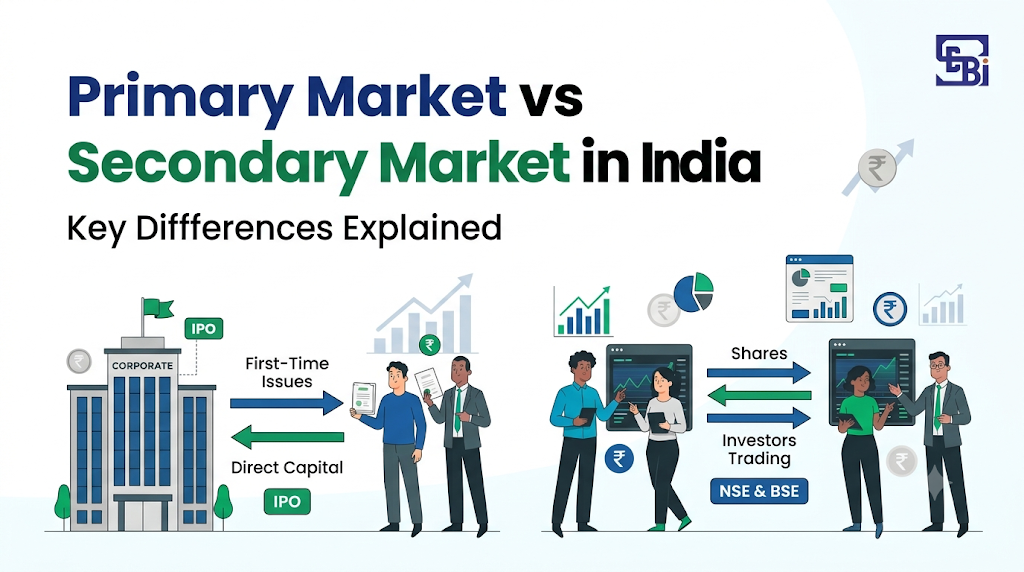
When a company decides to expand its business, build new factories, or reduce debt, it often turns to the public for money. When an individual decides to grow their savings by owning a piece of that business, they turn to the stock market. Both actions happen within the Indian capital market, yet they take place in two distinct spaces: the primary market and the secondary market.
Many new investors confuse buying shares during a company’s public launch with buying those same shares on the National Stock Exchange (NSE) or Bombay Stock Exchange (BSE) a week later. While both involve the same company, the way money flows, how prices are decided, and who sits on the other side of the trade are completely different.
Understanding how the primary and secondary markets operate helps you make informed decisions about where to put your capital, how to evaluate risks, and what to expect once a company goes public.
Understanding the Indian Capital Market Ecosystem
India’s financial system channels savings from households and institutions into productive businesses. The capital market handles medium- and long-term funds, primarily through equity shares and debt instruments like bonds and debentures.
To keep this system transparent and orderly, the Securities and Exchange Board of India (SEBI) regulates both segments of the market. Whether a company is issuing fresh shares for the first time or millions of traders are buying and selling existing shares every second, SEBI sets the disclosure rules, settlement timelines, and investor protection standards.
Think of the two markets as consecutive stages in the lifecycle of a financial security:
- Stage 1 (Creation): Securities are created and sold for the first time in the primary market.
- Stage 2 (Circulation): Those existing securities are traded among investors in the secondary market.
What Happens in the Primary Market?
The primary market—often called the new issue market—is where companies, government bodies, or institutions raise fresh capital directly from investors. In this market, the security is being sold for the very first time.
When you invest in the primary market, your money goes straight into the issuing company’s bank account (minus issue expenses). In return, the company creates new shares or bonds and allots them to you.
Common Ways Companies Raise Money in India
Companies use several regulated routes to issue securities in the primary market:
- Initial Public Offering (IPO): An unlisted private company offers its shares to the general public for the first time and subsequently lists on a stock exchange like the NSE or BSE.
- Follow-on Public Offering (FPO): A company that is already listed on a stock exchange issues additional new shares to the public to raise more funds.
- Rights Issue: A listed company offers new shares exclusively to its existing shareholders, usually at a discounted price, in proportion to their current holdings.
- Private Placement and QIP: Companies sell securities directly to a select group of large investors—such as mutual funds, insurance companies, and foreign portfolio investors—through Qualified Institutional Placements (QIPs) or preferential allotments rather than the retail public.
- Offer for Sale (OFS): Existing promoters or early investors sell their stake to the public through an exchange platform. While technically a transfer of existing shares rather than fresh capital creation, public OFS issues follow primary-style bidding and allotment mechanisms.
How Pricing Works in the Primary Market
Unlike daily stock trading, primary market prices do not fluctuate every second. Issuers and their investment bankers (merchant bankers) decide the price beforehand using one of two methods:
- Fixed Price Issue: The company sets a single, exact price per share before the issue opens. Investors know the exact cost upfront.
- Book Building Issue: The company sets a price band—for example, ₹480 to ₹505 per share. Investors place bids within this range, and the final “cut-off” price is determined based on overall demand once the bidding window closes.
What Happens in the Secondary Market?
Once shares are allotted in the primary market and listed on a stock exchange, they enter the secondary market. This is what most people refer to when they talk about “the stock market.”
In the secondary market, the issuing company is no longer involved in the transaction. Instead, investors buy and sell previously issued securities among themselves. If you purchase 50 shares of Reliance Industries or Infosys through your broker, you are buying them from another investor who decided to sell—not from the companies themselves.
Key Platforms in India’s Secondary Market
India’s secondary market operates largely through electronic, order-driven stock exchanges:
- National Stock Exchange (NSE): The largest exchange in India by trading volume, home to the benchmark Nifty 50 index.
- Bombay Stock Exchange (BSE): Asia’s oldest stock exchange, home to the benchmark S&P BSE Sensex index.
- Over-the-Counter (OTC) Debt Markets: Certain corporate bonds and government securities also trade directly between institutional participants via negotiated platforms regulated by SEBI and the Reserve Bank of India (RBI).
How Pricing Works in the Secondary Market
In the secondary market, no merchant banker fixes the price. Prices move continuously during market hours (9:15 AM to 3:30 PM IST on trading days) based on supply and demand.
Factors such as quarterly earnings, interest rate changes by the RBI, global economic news, sector trends, and investor sentiment cause buyers and sellers to adjust their bids constantly. Today, India operates on a T+1 settlement cycle for equities, meaning shares and funds are settled in investors’ demat and bank accounts one working day after the trade date.
Core Differences Between Primary and Secondary Markets
Comparing the two markets side by side highlights how differently they serve companies and investors.
| Feature | Primary Market | Secondary Market |
|---|---|---|
| Core Purpose | Enables companies and governments to raise fresh capital for expansion, operations, or debt repayment. | Provides liquidity and an exit route for existing investors to buy and sell securities freely. |
| Parties Involved | Direct transaction between the issuing company and the investor. | Transaction between one investor and another investor via stockbrokers. |
| Frequency of Sale | A specific security is sold only once in this market. | The same security can be bought and sold countless times. |
| Price Determination | Determined by the company and merchant bankers (fixed price or book-building price band). | Determined dynamically by market demand and supply on stock exchanges. |
| Capital Formation | Directly contributes to capital formation in the economy by funding businesses. | Indirectly supports capital formation by giving primary investors confidence that they can sell later. |
| Physical Location / Setup | No single physical marketplace; managed through merchant bankers, syndicate members, and ASBA banking channels. | Operates on organized exchanges like the NSE and BSE through registered brokers. |
| Role of Intermediaries | Merchant bankers, registrars to the issue, underwriters, and bankers to the issue. | Stockbrokers, clearing corporations, and depositories (NSDL and CDSL). |
How Both Markets Depend on Each Other
Although they function differently, neither market can thrive without the other.
- Without the primary market, there would be no listed companies or tradable shares for the secondary market to host. Every stock traded on the NSE or BSE today started its public journey as a primary market issuance.
- Without the secondary market, investors would hesitate to invest in IPOs or corporate bonds. Knowing that a liquid secondary market exists allows investors to convert their shares back into cash whenever they need to, making primary issues far more attractive.
Risk and Return Considerations for Indian Investors
Both markets offer wealth-building opportunities, but they carry distinct risks that investors should evaluate before committing funds.
Risks in the Primary Market
- Limited Public Track Record: Many IPO-bound companies have only recently opened their financial history to public scrutiny through their Draft Red Herring Prospectus (DRHP). Retail investors must rely heavily on disclosures and prospectus data.
- Valuation Risk: During bullish market phases, companies may price IPOs aggressively. If the issue price exceeds the business’s underlying fundamentals, the stock price may fall once it lists.
- Allotment Uncertainty: Popular IPOs in India often get oversubscribed many times over. Retail investors are allotted shares through a computerized lottery system, meaning there is no guarantee of receiving shares even if you apply.
Risks in the Secondary Market
- Daily Price Volatility: Share prices react immediately to news, macroeconomic data, and institutional buying or selling, which can lead to sharp short-term swings.
- Liquidity Differences: While large-cap stocks on the Nifty 50 have high daily trading volumes, smaller companies (micro-caps or SME stocks) may have fewer buyers and sellers, making it harder to enter or exit at your preferred price.
- Emotional Decision-Making: Continuous live price tickers can tempt investors into impulsive buying during rallies or panic selling during market corrections.
Frequently Asked Questions (FAQs)
1. Can I participate in both the primary and secondary markets with the same Demat account?
Yes. A single Demat and trading account held with a SEBI-registered depository participant (via NSDL or CDSL) allows you to apply for IPOs in the primary market as well as buy and sell listed stocks in the secondary market.
2. Why do IPO shares sometimes list at a price higher or lower than the issue price?
The IPO issue price is fixed by the company and its bankers before listing. Once trading begins on the exchange, the opening price reflects real-time market demand and supply. Strong demand can push the listing price above the issue price (listing gains), while weak demand can cause it to open below the issue price (listing discount).
3. Does a company earn money when its share price rises in the secondary market?
No. A company receives funds only when it sells shares in the primary market. When its share price rises in the secondary market, existing shareholders benefit from higher portfolio value, and the company’s market capitalization increases—which can help it raise funds more easily in the future—but no cash flows directly into the company from daily trades.
4. What is ASBA in the Indian primary market?
ASBA stands for Application Supported by Blocked Amount. Mandated by SEBI for public issues, ASBA ensures that the application money stays in your bank account and continues earning interest while blocked. The funds are debited only if shares are actually allotted to you.
5. Which market is better for beginners in India?
Neither market is automatically better; both require research. Beginners often find it easier to study established, listed companies in the secondary market because years of quarterly financial results, governance records, and price history are publicly available. Investing systematically in well-researched businesses or index funds helps manage risk while learning how markets behave.
Key Takeaway
The primary market and secondary market serve two complementary roles in India’s financial ecosystem. The primary market is where companies raise fresh capital by introducing new securities to investors, while the secondary market is where investors trade those existing securities with one another based on live supply and demand. Knowing how money moves, how prices are set, and what risks apply in each space allows you to approach both IPO applications and everyday stock investing with clearer expectations.