Introduction
Every time you buy groceries from a supermarket chain, pay a utility bill, or transfer money through a digital banking app, you are interacting with businesses that drive India’s economy. Many of these companies are publicly listed, meaning everyday individuals can buy small pieces of ownership in them. The place where this ownership changes hands—digitally, securely, and in fractions of a second—is the Indian stock market.
For newcomers, financial news channels and market terminals can make stock trading look like a chaotic wall of red and green numbers. Behind the flashing prices, however, lies a structured, heavily regulated system built on straightforward rules of supply, demand, and business performance. Understanding how this ecosystem functions is the first step toward making informed financial decisions.
The Core Idea Behind a Stock Market
At its simplest, a stock market is an organized marketplace where buyers and sellers trade shares of publicly listed companies. A share (also called a stock or equity) represents a unit of ownership in a corporation.
Companies need capital to build factories, launch new products, expand into new cities, or pay off debt. Instead of borrowing all that money from banks—which requires paying fixed interest regardless of how the business performs—a company can invite the public to invest. In exchange for their money, investors receive shares. If the company grows and becomes more profitable over time, the value of those shares typically rises, and the company may also share a portion of its profits with shareholders in the form of dividends. Conversely, if the business struggles, share prices can fall.
Primary vs. Secondary Markets: Where Shares Begin and Trade
The Indian stock market operates through two distinct stages: the primary market and the secondary market.
1. The Primary Market (The Birthplace of Shares)
When a private company decides to raise money from the public for the very first time, it launches an Initial Public Offering (IPO). This happens in the primary market. Here, investors buy shares directly from the company at a fixed price or within a specified price band. Once the IPO closes, the money raised goes straight into the company’s bank accounts to fund its business goals.
2. The Secondary Market (Daily Trading)
After the IPO shares are allotted to investors, the company gets listed on a stock exchange. From that point onward, trading moves to the secondary market. When you hear people talk about “the stock market going up or down,” they are referring to this market. In the secondary market, companies do not receive money from daily trades; instead, investors buy and sell existing shares among themselves.
Key Institutions Powering India’s Stock Market
India has one of the most technologically advanced equity market infrastructures in the world. Several core institutions keep transactions smooth and transparent:
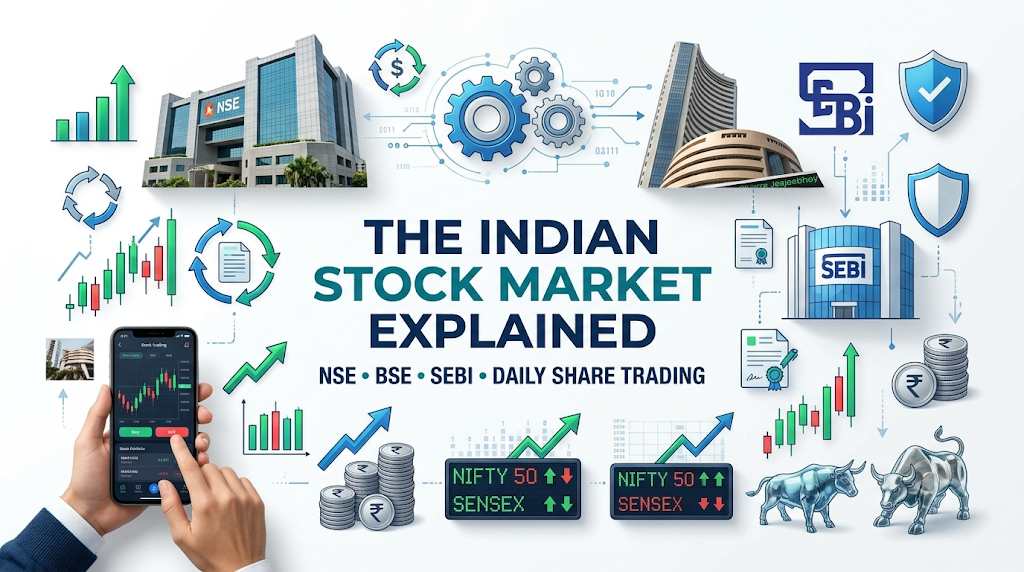
- The Stock Exchanges (NSE and BSE): Stock exchanges are the platforms that match buyers with sellers. India has two primary national exchanges:
- Bombay Stock Exchange (BSE): Established in 1875, the BSE is Asia’s oldest stock exchange and hosts thousands of listed companies.
- National Stock Exchange (NSE): Founded in 1992, the NSE pioneered electronic screen-based trading in India and accounts for the vast majority of daily equity trading volume in the country.
- The Regulator (SEBI): The Securities and Exchange Board of India (SEBI) is the statutory regulatory body overseeing the market. SEBI sets the rules for companies, brokers, and exchanges, penalizes fraud or insider trading, and works to protect the interests of retail investors.
- Depositories (NSDL and CDSL): Decades ago, shares were printed on physical paper certificates that could be lost, damaged, or forged. Today, shares are held electronically in “dematerialized” form. NSDL (National Securities Depository Limited) and CDSL (Central Depository Services Limited) act like digital vaults that safely store your shares.
- Stockbrokers: Individual investors cannot walk directly onto the NSE or BSE to place an order. You must go through a SEBI-registered stockbroker (such as Zerodha, Groww, Angel One, or ICICI Direct), which provides the trading app or website that connects your orders to the exchange.
Understanding Sensex and Nifty: The Market’s Pulse
With thousands of companies listed across Indian exchanges, tracking every single stock individually is impossible. To measure the overall direction of the market, exchanges use benchmark indices—baskets of top-performing, heavily traded companies representing key sectors of the economy.
| Feature | BSE Sensex | NSE Nifty 50 |
| Full Name | Sensitive Index | National Stock Exchange Fifty |
| Parent Exchange | Bombay Stock Exchange (BSE) | National Stock Exchange (NSE) |
| Number of Companies | 30 well-established companies | 50 large, liquid companies |
| Base Year | 1978–79 | 1995 |
| Purpose | Tracks the performance of 30 major stocks across key Indian industries | Tracks 50 leading Indian companies spanning roughly 13–14 sectors |
When headlines say “Nifty rose by 150 points today,” it means the combined value of those 50 major companies increased, signaling generally positive sentiment across the broader market.
How a Stock Trade Actually Happens Step-by-Step
Modern stock transactions in India happen electronically and follow a strict sequence:
- Account Setup: To participate, an investor opens two linked accounts through a broker—a Trading Account (used to place buy and sell orders) and a Demat Account (used to hold the shares electronically)—alongside a linked bank account.
- Placing an Order: Suppose you want to buy 10 shares of a listed company at ₹500 per share. You enter this order on your broker’s app.
- Order Matching: Your broker routes the order to the exchange (NSE or BSE). The exchange’s automated matching engine searches for someone willing to sell 10 shares at ₹500.
- Trade Execution: Once a matching seller is found, the trade is executed instantly, and both parties receive confirmation.
- Settlement (T+1 Cycle): India operates on a T+1 (Trade Date plus one working day) settlement cycle for equities. If you buy shares on a Monday, the money is debited from your account on Monday, and the shares are officially credited to your Demat account by Tuesday.
What Drives Share Prices Up and Down?
Stock prices are determined continuously by supply and demand. If more investors want to buy a stock than sell it, buyers bid higher prices, pushing the stock up. If more people want to sell than buy, sellers lower their asking prices, pulling the stock down.
Several real-world factors influence this supply and demand:
- Company Performance: Quarterly revenue growth, profit margins, new product launches, or leadership changes directly affect investor confidence.
- Macroeconomic Indicators: Inflation rates, GDP growth, monsoon forecasts (which impact rural demand), and employment data shape market sentiment.
- Interest Rate Decisions: When the Reserve Bank of India (RBI) raises interest rates, borrowing becomes costlier for businesses, which can temporarily cool down stock prices. Lower interest rates often encourage investment.
- Global Events: Foreign institutional investor (FII) flows, crude oil prices, currency fluctuations, and geopolitical developments frequently cause short-term price swings in Indian markets.
Common Misconceptions About the Indian Stock Market
- “Investing in stocks is the same as gambling.” Gambling relies purely on chance with no underlying asset. Buying shares means owning a real fraction of an operating business that generates revenue, employs people, and builds assets. While short-term price swings can be unpredictable, long-term value is tied to business fundamentals.
- “You need a large amount of money to start.” You do not need lakhs of rupees to begin. Many reputable Indian companies trade for a few hundred or a few thousand rupees per share, and investors can buy even a single share.
- “A low-priced stock is always cheap, and a high-priced stock is expensive.” A stock trading at ₹50 is not necessarily a bargain compared to one trading at ₹2,000. Valuation depends on the company’s earnings, debt, growth potential, and total number of shares—not just the sticker price of one share.
Risks Every Beginner Should Keep in Mind
While equities have historically helped investors beat inflation over long periods, the stock market carries inherent risks. Share prices fluctuate daily, and capital is never guaranteed. Companies can lose market share, face regulatory hurdles, or suffer during economic downturns, leading to permanent loss of capital if an investor puts money into weak businesses.
New participants should avoid borrowing money to trade, steer clear of unverified “hot tips” on social media, and understand the difference between short-term speculative trading and long-term investing. Consulting a SEBI-registered investment advisor can also help align market participation with personal financial goals and risk tolerance.
Frequently Asked Questions
1. What are the trading hours of the Indian stock market?
Regular trading on both the NSE and BSE takes place Monday through Friday from 9:15 AM to 3:30 PM IST, excluding declared market holidays. A pre-open session runs from 9:00 AM to 9:15 AM to help determine opening prices smoothly.
2. Is it mandatory to have a Demat account to buy shares in India?
Yes. Under SEBI regulations, holding and trading shares in the secondary market requires an active Demat account alongside a trading account and a linked bank account.
3. How much tax do I have to pay on stock market profits in India?
Profits from selling shares are taxed as capital gains. In India, shares held for up to 12 months attract Short-Term Capital Gains (STCG) tax, while shares held for more than 12 months attract Long-Term Capital Gains (LTCG) tax above the annual exemption limit, as per prevailing Income Tax rules.
4. Can I lose more money than I invest in stocks?
If you buy shares directly in the cash (delivery) market using your own funds, your maximum possible loss is limited to the amount you invested. Losses exceeding your initial capital generally occur only in leveraged products like futures, options, or margin trading.
5. What is the difference between trading and investing?
Investing involves buying quality stocks and holding them for years to build wealth alongside the company’s growth. Trading involves buying and selling stocks over shorter timeframes—days, weeks, or even minutes—to profit from short-term price movements.
Bringing It All Together
The Indian stock market is neither a secret club nor a quick-money machine—it is a transparent marketplace connecting growing businesses with people looking to build long-term wealth. By understanding how exchanges match orders, how SEBI enforces market rules, and why business fundamentals matter more than daily noise, beginners can approach Indian equities with clarity, patience, and realistic expectations.