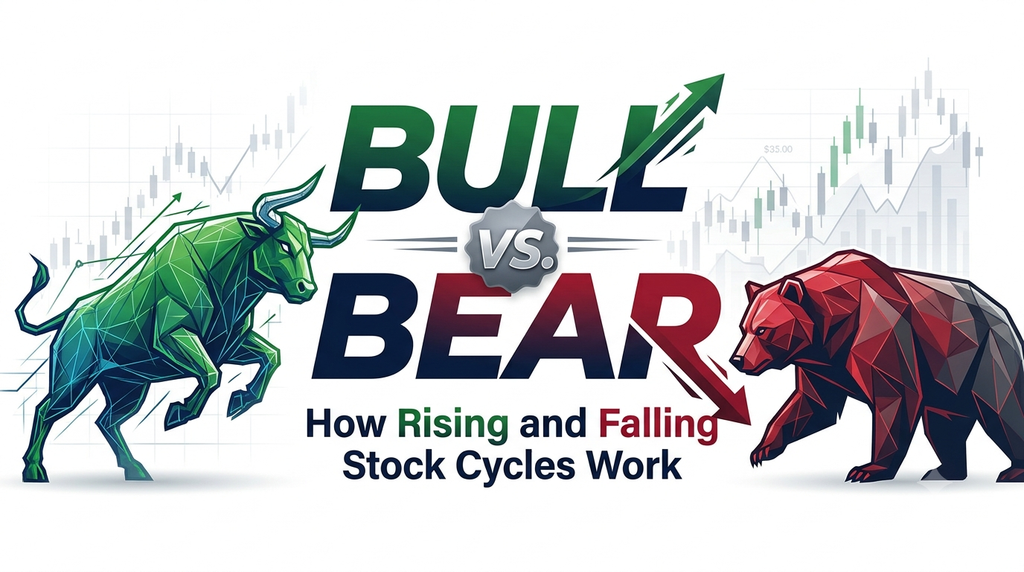
Financial headlines frequently compare the stock market to two animals: a bull and a bear. When share prices climb steadily and investor confidence runs high, analysts call it a bull market. When prices drop sharply and pessimism takes over, they call it a bear market.
These terms describe the two primary long-term directions of financial markets. Understanding how they work helps investors look past daily price swings, recognize broader economic trends, and make calmer, better-informed decisions with their money.
Where the Terms Bull and Bear Come From
The animal labels come from how each creature attacks an opponent. A bull thrusts its horns upward into the air, symbolizing rising stock prices. A bear swipes its paws downward, representing falling prices.
Both terms have appeared in financial writing since the eighteenth century. Early London traders used “bearskin jobbers” to describe middlemen who sold bearskins before the bears were caught, hoping prices would drop before delivery. Over time, “bear” became shorthand for anyone betting on falling prices, while “bull” emerged as its natural opposite.
What Is a Bull Market?
A bull market is an extended period during which investment prices rise consistently. While there is no single strict rule, financial analysts generally define a bull market as a 20% or greater rise in a broad market index—such as the S&P 500 or Nifty 50—following a previous 20% decline, sustained over months or years.
Characteristics of a Bull Market
Bull markets rarely move in a straight line upward, as brief dips still occur along the way. However, they share several recognizable traits:
- Strong economic growth: Gross domestic product (GDP) expands, businesses invest in new projects, and corporate profits rise.
- Low unemployment: Companies hire more workers, giving consumers steadier incomes and higher spending power.
- High investor confidence: Buyers outnumber sellers, pushing share valuations higher and encouraging new companies to launch initial public offerings (IPOs).
- Rising demand for riskier assets: Investors feel comfortable moving cash out of savings accounts or government bonds and into equities.
What Is a Bear Market?
A bear market occurs when a broad market index falls by 20% or more from its most recent high over a sustained period. Unlike a brief market dip, a bear market reflects widespread pessimism and often accompanies a broader economic slowdown.
Bear Market vs. Market Correction
Investors often confuse a market correction with a bear market, though the difference comes down to severity and duration:
- Market pullback: A short-term drop of 5% to 9.9% from a recent peak. Pullbacks happen multiple times in almost every calendar year.
- Market correction: A decline of 10% to 19.9% from a recent peak. Corrections cool down overheated valuations and usually recover within a few months.
- Bear market: A drop of 20% or more from a recent peak, frequently lasting several months to over a year before a new bull cycle begins.
Characteristics of a Bear Market
During a bear market, fear replaces optimism across financial news and trading floors:
- Slowing economic activity: Consumer spending pulls back, corporate earnings shrink, and the economy may enter a recession.
- Rising unemployment: Businesses cut costs and freeze hiring to protect shrinking profit margins.
- Heavy selling pressure: Investors sell shares to avoid further losses, driving prices down even when underlying businesses remain healthy.
- Flight to safety: Capital shifts toward cash, treasury bonds, gold, and defensive sectors like utilities and healthcare.
Bull Market vs. Bear Market: Side-by-Side Comparison
| Feature | Bull Market | Bear Market |
| Price Threshold | Rise of 20% or more from recent lows | Drop of 20% or more from recent highs |
| Investor Sentiment | Optimistic, confident, eager to buy | Fearful, cautious, eager to sell |
| Economic Backdrop | Growing GDP, strong corporate earnings | Slowing economy, possible recession |
| Employment Trends | Low unemployment, active hiring | Rising layoffs, hiring freezes |
| Trading Activity | High buying volume, frequent IPOs | High selling volume, fewer new listings |
| Typical Duration | Often lasts several years | Usually lasts several months to 1.5 years |
What Triggers a Shift Between Bull and Bear Markets?
Market cycles do not change on a fixed schedule. Instead, shifts happen when economic conditions, interest rates, and investor expectations reach a turning point.
- Central bank interest rate changes: When central banks lower interest rates, borrowing becomes cheaper for businesses and consumers, often sparking a bull market. When central banks raise rates aggressively to fight high inflation, borrowing slows down and can trigger a bear market.
- Corporate earnings trends: Stock prices ultimately follow company profits. Several quarters of unexpected earnings growth fuel bull runs, while widespread earnings misses drag markets lower.
- Inflation and supply shocks: Sudden spikes in energy prices, raw materials, or consumer goods squeeze household budgets and company margins.
- Geopolitical events and crises: Wars, trade disputes, banking failures, or global health emergencies create sudden uncertainty, prompting investors to pull money out of stocks rapidly.
How Investors Navigate Bull and Bear Markets
Trying to predict the exact top of a bull market or the exact bottom of a bear market rarely works, even for full-time fund managers. Missing just a handful of the market’s best recovery days can severely reduce long-term returns. Instead, disciplined investors adjust their habits to fit the cycle.
Practical Approaches During a Bull Market
- Rebalance your portfolio: When stocks surge, equities can grow to occupy a much larger share of your portfolio than intended. Selling a portion of top performers and moving gains into bonds or lagging assets locks in profits and controls risk.
- Avoid chasing hype: Late in a bull market, speculative stocks often soar without solid earnings behind them. Stick to companies with proven cash flows and reasonable valuations.
- Keep an emergency fund intact: Rising markets tempt investors to put every spare rupee or dollar into stocks. Maintaining 3 to 6 months of living expenses in cash prevents forced selling if the market turns.
Practical Approaches During a Bear Market
- Use rupee-cost or dollar-cost averaging: Investing a fixed amount at regular intervals means your money automatically buys more shares when prices are low and fewer shares when prices are high.
- Focus on quality businesses: Companies with low debt, steady cash reserves, and essential products weather economic downturns far better than heavily indebted firms.
- Avoid panic selling: Selling after a 25% drop turns a temporary paper loss into a permanent realized loss. Historically, broad stock market indexes have eventually recovered from every bear market and gone on to set new highs, though past performance never guarantees future results.
Frequently Asked Questions (FAQs)
How long do bear markets usually last?
Historically, bear markets are much shorter than bull markets. Looking at historical U.S. stock market data since the 1920s, the average bear market has lasted roughly 9 to 14 months, whereas bull markets have averaged several years.
Can an individual stock be in a bear market while the overall market is bullish?
Yes. Individual stocks and specific sectors frequently enter their own bear markets—dropping 20% or more from their highs—even while broad market indexes continue climbing.
Is it better to invest during a bull market or a bear market?
Both cycles play a role in building wealth. Bull markets grow the value of the investments you already own, while bear markets let long-term investors buy quality shares at discounted prices. Consistent investing across both cycles removes the stress of trying to time the market.
What is a secular bull or bear market?
A secular market trend spans a long period—often 10 to 20 years—driven by major demographic, technological, or economic shifts. Within a single secular bull market, shorter cyclical bear markets can still occur.
Key Takeaway for Investors
Bull and bear markets are normal, repeating phases of investing rather than signs that the financial system is broken. Bull markets reward patience and participation, while bear markets test emotional discipline and create lower entry prices for long-term buyers. By keeping a diversified portfolio, maintaining an emergency cash buffer, and sticking to a consistent investment plan, you can navigate both cycles without letting short-term market mood dictate your financial future.