Introduction
Public Health Surveillance Systems are specialized platforms used by governments, healthcare agencies, research institutions, and public health organizations to monitor, collect, analyze, and respond to health-related data across populations. These systems help detect disease outbreaks, monitor epidemiological trends, track vaccinations, manage reporting workflows, and support emergency response coordination.
Modern public health environments require real-time visibility into infectious diseases, chronic health conditions, environmental risks, and healthcare resource utilization. Traditional manual reporting methods are often too slow to handle rapidly evolving health crises. Today’s surveillance platforms integrate AI-driven analytics, cloud infrastructure, laboratory reporting systems, GIS mapping, mobile data collection, and predictive modeling to improve public health response capabilities.
Real-world use cases include:
- Infectious disease outbreak monitoring
- Vaccination and immunization tracking
- Epidemiological reporting and analytics
- Environmental and community health monitoring
- Emergency preparedness and pandemic response
Buyers evaluating Public Health Surveillance Systems should focus on:
- Real-time reporting and analytics
- Data interoperability and integrations
- Disease outbreak monitoring capabilities
- GIS and geospatial visualization support
- Security and compliance readiness
- Scalability for large populations
- Automation of alerts and workflows
- Mobile accessibility for field teams
- Public health reporting standards support
- AI and predictive analytics capabilities
Best for: Government health departments, national public health agencies, hospitals, research organizations, laboratories, and NGOs managing large-scale health monitoring and disease surveillance operations.
Not ideal for: Small clinics or organizations that only require basic patient record management without population-level health monitoring requirements.
Key Trends in Public Health Surveillance Systems
- AI-powered outbreak prediction and risk analysis improving early detection
- Real-time data sharing between hospitals, labs, and government agencies
- Cloud-native surveillance platforms replacing fragmented legacy systems
- GIS-based disease mapping becoming critical for response planning
- Mobile surveillance applications improving field data collection
- Integration with wearable devices and remote health monitoring systems
- Automation of laboratory reporting and public health notifications
- Increased focus on interoperability standards for healthcare data exchange
- Predictive analytics for pandemic preparedness and healthcare planning
- Stronger cybersecurity requirements for sensitive health data protection
How We Selected These Tools (Methodology)
- Adoption across public health agencies and healthcare organizations
- Strength of disease monitoring and analytics capabilities
- Scalability for regional and national health programs
- Integration support for labs, hospitals, and government systems
- Real-time alerting and reporting functionality
- Security, privacy, and compliance readiness
- GIS and geospatial intelligence capabilities
- AI and predictive analytics features
- Vendor support and implementation ecosystem
- Flexibility for both emergency response and long-term health monitoring
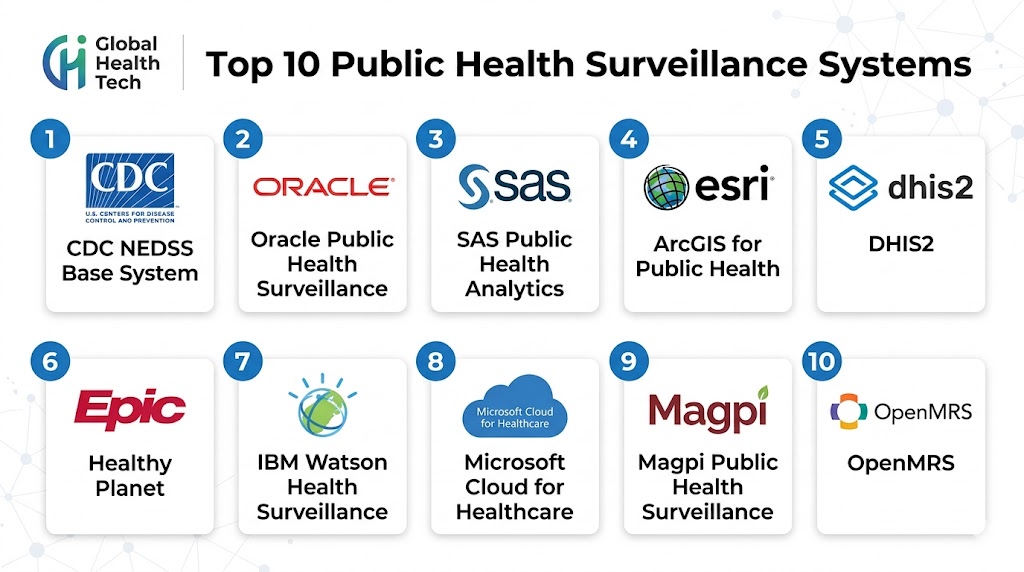
Top 10 Public Health Surveillance Systems
1- Oracle Public Health Surveillance System
Short description:
Oracle Public Health Surveillance System supports large-scale disease monitoring, reporting, and outbreak management for government health agencies and national healthcare programs.
Key Features
- Disease outbreak monitoring
- Real-time public health reporting
- Automated alerting workflows
- Epidemiological analytics
- Vaccination tracking
- Laboratory data integration
- GIS-based visualization
Pros
- Highly scalable architecture
- Strong analytics capabilities
- Enterprise-grade integrations
Cons
- Complex implementation
- High operational cost
- Requires enterprise IT expertise
Platforms / Deployment
- Web
- Cloud / Hybrid
Security & Compliance
Supports encryption, RBAC, audit logging, MFA, and enterprise security controls.
Integrations & Ecosystem
Integrates with hospital systems, laboratories, ERP platforms, and analytics tools.
- EHR systems
- Laboratory systems
- GIS platforms
- Government databases
- API integrations
Support & Community
Strong enterprise implementation and public sector support ecosystem.
2- SAS Public Health Analytics
Short description:
SAS Public Health Analytics provides advanced data analysis and predictive modeling tools for disease surveillance, population health monitoring, and outbreak response planning.
Key Features
- Predictive analytics
- AI-driven outbreak detection
- Population health monitoring
- Real-time dashboards
- Risk scoring models
- Statistical reporting
- Data visualization
Pros
- Powerful analytics engine
- Strong predictive modeling
- Excellent reporting tools
Cons
- Steep learning curve
- Premium pricing
- Requires analytics expertise
Platforms / Deployment
- Web / Windows
- Cloud / Hybrid
Security & Compliance
Supports enterprise-grade encryption, RBAC, and compliance management capabilities.
Integrations & Ecosystem
Integrates with healthcare systems, public health databases, and analytics environments.
- Healthcare databases
- EHR platforms
- Reporting systems
- GIS tools
- APIs
Support & Community
Strong enterprise support with advanced analytics training programs.
3- DHIS2
Short description:
DHIS2 is an open-source health data platform widely used for public health reporting, disease surveillance, and immunization management in government health programs worldwide.
Key Features
- Disease surveillance workflows
- Vaccination tracking
- Mobile health data collection
- GIS dashboards
- Real-time reporting
- Health program management
- Data visualization
Pros
- Open-source flexibility
- Strong global adoption
- Excellent public health focus
Cons
- Requires technical expertise
- Customization complexity
- Support varies by implementation partner
Platforms / Deployment
- Web / Android
- Cloud / Self-hosted
Security & Compliance
Supports RBAC, encryption, and audit tracking capabilities.
Integrations & Ecosystem
DHIS2 integrates with healthcare systems, mobile applications, and reporting tools.
- Mobile health apps
- GIS systems
- EHR systems
- APIs
- Government databases
Support & Community
Large global public health community with strong NGO and government adoption.
4- Epic Healthy Planet
Short description:
Epic Healthy Planet is a population health and surveillance platform designed for healthcare organizations and public health agencies managing large patient populations.
Key Features
- Population health analytics
- Disease surveillance tools
- Care coordination workflows
- Predictive risk modeling
- Vaccination management
- Reporting dashboards
- Clinical data integration
Pros
- Strong healthcare integration
- Advanced patient analytics
- Scalable enterprise platform
Cons
- Best suited for Epic environments
- High implementation complexity
- Expensive enterprise deployment
Platforms / Deployment
- Web
- Cloud / Hybrid
Security & Compliance
Supports enterprise healthcare security standards and access management controls.
Integrations & Ecosystem
Deep integration with Epic EHR and healthcare ecosystems.
- Epic EHR
- Clinical systems
- Healthcare APIs
- Reporting tools
- Analytics platforms
Support & Community
Large healthcare support ecosystem with extensive implementation services.
5- IBM Watson Health Surveillance Solutions
Short description:
IBM Watson Health solutions provide AI-assisted analytics and surveillance tools for public health monitoring, outbreak prediction, and healthcare intelligence.
Key Features
- AI-powered health analytics
- Disease trend prediction
- Real-time monitoring dashboards
- Natural language processing
- Public health reporting
- Data aggregation tools
- Population analytics
Pros
- Strong AI capabilities
- Advanced analytics engine
- Enterprise scalability
Cons
- Complex implementation
- Requires significant data integration
- Premium pricing model
Platforms / Deployment
- Web
- Cloud / Hybrid
Security & Compliance
Supports enterprise encryption, RBAC, and audit management features.
Integrations & Ecosystem
Integrates with healthcare systems, cloud infrastructure, and analytics environments.
- EHR systems
- Cloud infrastructure
- Healthcare databases
- APIs
- Analytics tools
Support & Community
Enterprise support with healthcare consulting services.
6- Palantir Foundry for Public Health
Short description:
Palantir Foundry provides large-scale data integration and analytics capabilities used by governments and healthcare organizations for public health surveillance and crisis response.
Key Features
- Large-scale data integration
- Real-time analytics dashboards
- Predictive outbreak analysis
- Workflow orchestration
- GIS visualization
- Cross-agency collaboration tools
- Data governance controls
Pros
- Excellent data integration capabilities
- Highly scalable architecture
- Strong analytics performance
Cons
- Complex deployment
- Requires specialized expertise
- High enterprise cost
Platforms / Deployment
- Web
- Cloud / Hybrid
Security & Compliance
Supports enterprise-grade security controls, RBAC, encryption, and audit logging.
Integrations & Ecosystem
Integrates with healthcare systems, government databases, and analytics tools.
- EHR systems
- GIS platforms
- Government systems
- APIs
- Data lakes
Support & Community
Strong enterprise support with specialized implementation teams.
7- Epi Info
Short description:
Epi Info is a public health software toolkit widely used for epidemiological investigations, outbreak tracking, and health data analysis.
Key Features
- Epidemiological analysis tools
- Outbreak investigation workflows
- Data collection forms
- Statistical reporting
- GIS mapping support
- Survey management
- Health analytics
Pros
- Free public health toolkit
- Strong epidemiology focus
- Lightweight deployment
Cons
- Limited enterprise scalability
- Older interface design
- Basic workflow automation
Platforms / Deployment
- Windows
- Self-hosted
Security & Compliance
Varies depending on deployment environment.
Integrations & Ecosystem
Supports data imports and exports with common public health systems.
- Reporting tools
- GIS systems
- Databases
- CSV integrations
Support & Community
Strong academic and public health research community.
8- Meditech Population Health Surveillance
Short description:
Meditech offers population health management and surveillance capabilities for healthcare providers and regional health organizations.
Key Features
- Population health monitoring
- Public health reporting
- Care coordination workflows
- Risk stratification
- Analytics dashboards
- Data integration
- Clinical surveillance tools
Pros
- Strong healthcare workflow integration
- Good usability
- Reliable reporting tools
Cons
- Limited outside Meditech ecosystem
- Moderate customization flexibility
- Smaller analytics ecosystem
Platforms / Deployment
- Web
- Cloud / Hybrid
Security & Compliance
Supports healthcare-grade access controls and encryption.
Integrations & Ecosystem
Integrates with clinical systems, EHRs, and reporting platforms.
- EHR integrations
- Analytics tools
- Clinical systems
- APIs
Support & Community
Established healthcare support ecosystem.
9- OpenMRS Public Health Modules
Short description:
OpenMRS is an open-source healthcare platform with modules supporting public health surveillance and disease monitoring initiatives.
Key Features
- Open-source architecture
- Disease surveillance modules
- Health reporting tools
- Mobile data support
- Patient tracking
- Workflow customization
- Community-driven extensibility
Pros
- Low-cost deployment
- Flexible customization
- Strong NGO adoption
Cons
- Requires technical resources
- Limited enterprise support
- Variable implementation quality
Platforms / Deployment
- Web / Mobile
- Self-hosted / Cloud
Security & Compliance
Varies based on implementation and infrastructure setup.
Integrations & Ecosystem
Supports APIs and healthcare interoperability standards.
- Healthcare databases
- APIs
- Mobile apps
- Reporting systems
Support & Community
Strong open-source healthcare community with global NGO participation.
10- Esri ArcGIS for Public Health
Short description:
Esri ArcGIS provides GIS-based public health surveillance capabilities for disease mapping, environmental health monitoring, and emergency response planning.
Key Features
- GIS disease mapping
- Real-time geospatial dashboards
- Spatial analytics
- Environmental health monitoring
- Mobile field data collection
- Public health visualization
- Emergency response coordination
Pros
- Industry-leading GIS capabilities
- Excellent visualization tools
- Strong integration flexibility
Cons
- Requires GIS expertise
- Can be expensive at scale
- Advanced setup complexity
Platforms / Deployment
- Web / Mobile
- Cloud / Hybrid
Security & Compliance
Supports enterprise authentication, RBAC, MFA, and encryption.
Integrations & Ecosystem
Integrates with public health systems, GIS databases, and analytics tools.
- Healthcare systems
- GIS databases
- APIs
- Analytics tools
- Government systems
Support & Community
Large global GIS and public health community with strong partner ecosystem.
Comparison Table
| Tool Name | Best For | Platforms Supported | Deployment | Standout Feature | Public Rating |
|---|---|---|---|---|---|
| Oracle PHSS | National surveillance | Web | Cloud / Hybrid | Enterprise outbreak monitoring | N/A |
| SAS Public Health | Advanced analytics | Web, Windows | Cloud / Hybrid | Predictive analytics | N/A |
| DHIS2 | Government health programs | Web, Android | Cloud / Self-hosted | Open-source public health platform | N/A |
| Epic Healthy Planet | Healthcare networks | Web | Cloud / Hybrid | Population health analytics | N/A |
| IBM Watson Health | AI-driven monitoring | Web | Cloud / Hybrid | AI health analytics | N/A |
| Palantir Foundry | Large-scale public health data | Web | Cloud / Hybrid | Massive data integration | N/A |
| Epi Info | Epidemiology investigations | Windows | Self-hosted | Statistical outbreak analysis | N/A |
| Meditech | Healthcare surveillance | Web | Cloud / Hybrid | Clinical integration | N/A |
| OpenMRS | NGO health programs | Web, Mobile | Self-hosted | Open-source flexibility | N/A |
| ArcGIS Public Health | GIS disease mapping | Web, Mobile | Cloud / Hybrid | Spatial health analytics | N/A |
Evaluation & Scoring of Public Health Surveillance Systems
| Tool Name | Core 25% | Ease 15% | Integrations 15% | Security 10% | Performance 10% | Support 10% | Value 15% | Weighted Total |
|---|---|---|---|---|---|---|---|---|
| Oracle PHSS | 9.6 | 7.5 | 9.5 | 9.4 | 9.5 | 9.3 | 7.5 | 8.8 |
| SAS Public Health | 9.5 | 7.4 | 9.2 | 9.1 | 9.4 | 9.2 | 7.8 | 8.7 |
| DHIS2 | 8.9 | 8.2 | 8.7 | 8.5 | 8.6 | 8.9 | 9.4 | 8.8 |
| Epic Healthy Planet | 9.2 | 7.8 | 9.0 | 9.2 | 9.3 | 9.0 | 7.4 | 8.6 |
| IBM Watson Health | 9.4 | 7.2 | 9.1 | 9.3 | 9.2 | 8.9 | 7.2 | 8.5 |
| Palantir Foundry | 9.5 | 7.0 | 9.6 | 9.4 | 9.5 | 8.8 | 7.0 | 8.6 |
| Epi Info | 7.8 | 8.0 | 7.2 | 7.4 | 7.8 | 8.2 | 9.5 | 7.9 |
| Meditech | 8.6 | 8.1 | 8.5 | 8.7 | 8.5 | 8.4 | 8.2 | 8.4 |
| OpenMRS | 8.2 | 7.9 | 8.1 | 7.8 | 8.0 | 8.4 | 9.3 | 8.2 |
| ArcGIS Public Health | 9.0 | 7.5 | 9.1 | 8.9 | 9.0 | 9.0 | 7.8 | 8.5 |
These scores are comparative and intended to help organizations evaluate strengths across analytics, scalability, integrations, usability, security, and long-term operational value. Enterprise systems generally lead in scalability and governance, while open-source platforms offer stronger flexibility and cost efficiency.
Which Public Health Surveillance System Is Right for You?
Solo / Research Teams
Best suited: Epi Info, OpenMRS
These tools are cost-effective and practical for academic research and smaller surveillance programs.
SMB / Regional Health Programs
Best suited: DHIS2, Meditech, ArcGIS
These provide strong reporting and operational visibility without extreme enterprise complexity.
Mid-Market Public Health Agencies
Best suited: SAS Public Health, DHIS2, ArcGIS
These platforms balance analytics, scalability, and workflow automation.
Enterprise / National Programs
Best suited: Oracle PHSS, Palantir Foundry, IBM Watson Health
These provide advanced analytics, large-scale integration, and high scalability.
Budget vs Premium
Budget-friendly: DHIS2, OpenMRS, Epi Info
Premium enterprise: Oracle, IBM, Palantir
Feature Depth vs Ease of Use
Deep analytics: SAS, Palantir, Oracle
Simpler usability: DHIS2, Meditech
Integrations & Scalability
Best integrations: Oracle, Palantir, Epic
Best scalability: Oracle, IBM, Palantir
Security & Compliance Needs
Public health organizations handling sensitive health data should prioritize platforms with strong encryption, RBAC, MFA, audit logging, and healthcare compliance readiness.
Frequently Asked Questions
1. What is a Public Health Surveillance System?
It is a digital platform used to collect, monitor, analyze, and respond to health-related data across populations and communities.
2. Why are these systems important?
They help detect outbreaks early, improve public health planning, and support emergency response coordination.
3. Can these systems integrate with hospitals and labs?
Yes, most modern surveillance systems support integrations with EHRs, laboratory systems, and healthcare databases.
4. Are cloud-based deployments common?
Yes, many organizations are moving toward cloud and hybrid deployments for scalability and real-time accessibility.
5. What security features are essential?
Encryption, RBAC, MFA, audit logging, and secure APIs are critical for protecting sensitive public health data.
6. How long does implementation take?
Implementation timelines vary from months to years depending on deployment complexity and data integration requirements.
7. Are open-source platforms reliable?
Yes, platforms like DHIS2 and OpenMRS are widely used globally, especially in government and NGO programs.
8. What are common implementation challenges?
Data standardization, interoperability, staff training, and migration from legacy systems are common challenges.
9. Do these systems support GIS mapping?
Many modern systems include GIS capabilities or integrate with platforms like ArcGIS for spatial disease monitoring.
10. How should organizations select a platform?
Organizations should evaluate scalability, analytics depth, integrations, compliance requirements, usability, and long-term operational costs.
Conclusion
Public Health Surveillance Systems have become essential infrastructure for governments, healthcare organizations, and public health agencies managing population-level health monitoring and disease response programs. Modern platforms now combine real-time reporting, predictive analytics, GIS mapping, AI-assisted insights, and integrated healthcare workflows to improve public health outcomes and emergency preparedness. Enterprise solutions like Oracle PHSS, IBM Watson Health, and Palantir Foundry provide deep analytics and large-scale integration capabilities, while open-source platforms such as DHIS2 and OpenMRS offer flexible and cost-effective alternatives for government and NGO programs. The best choice ultimately depends on organizational scale, technical expertise, integration requirements, compliance needs, and long-term digital health strategy. A careful evaluation process combined with pilot implementation and interoperability testing can significantly improve deployment success and operational efficiency over time.