Introduction
Smart City IoT Platforms help governments, municipalities, utilities, transportation agencies, and urban infrastructure operators connect, monitor, automate, and analyze city-wide systems through Internet of Things technologies. These platforms collect and process data from sensors, cameras, traffic systems, smart lighting, environmental monitors, water systems, public transportation, energy grids, parking infrastructure, and public safety networks.
As cities continue to modernize infrastructure and improve citizen services, Smart City IoT Platforms are becoming critical for improving operational efficiency, sustainability, traffic management, public safety, environmental monitoring, and energy optimization. These platforms allow cities to unify disconnected systems into centralized operational environments while improving real-time visibility and decision-making.
Real-world use cases include:
- Smart traffic and transportation monitoring
- Intelligent street lighting management
- Environmental and air quality monitoring
- Smart water and utility infrastructure management
- Public safety and emergency response optimization
Buyers evaluating Smart City IoT Platforms should consider:
- IoT device and sensor compatibility
- Real-time analytics and dashboards
- Scalability across city-wide infrastructure
- Edge computing and low-latency support
- Security and privacy controls
- Integration with GIS and operational systems
- AI and predictive analytics capabilities
- Open APIs and interoperability
- Multi-agency operational support
- Compliance and governance visibility
Best for: Municipal governments, smart infrastructure operators, transportation agencies, utilities, public safety organizations, urban planners, telecom providers, sustainability teams, and enterprises involved in smart city modernization projects.
Not ideal for: Small organizations without distributed infrastructure requirements or cities that only need isolated smart systems without centralized integration and analytics capabilities.
Key Trends in Smart City IoT Platforms
- AI-driven traffic optimization and predictive analytics are becoming more common.
- Edge computing is improving real-time response for smart infrastructure systems.
- Smart city cybersecurity and device identity management are growing priorities.
- Digital twins are increasingly used for urban planning and infrastructure simulation.
- Sustainability analytics and carbon monitoring are becoming core smart city requirements.
- Open interoperability standards are improving cross-vendor integration.
- 5G-enabled IoT infrastructure is expanding across transportation and public services.
- Video analytics and AI-based public safety monitoring are increasing.
- Unified operational dashboards are replacing fragmented city monitoring systems.
- Citizen engagement and mobile service integration are becoming more important.
How We Selected These Tools
The tools in this list were selected based on smart city functionality, scalability, interoperability, ecosystem maturity, analytics depth, and operational value.
Selection criteria included:
- IoT device and infrastructure support
- Real-time monitoring and analytics capabilities
- Smart city operational use cases
- AI and automation functionality
- Security and governance features
- Integration with urban infrastructure systems
- Scalability across large deployments
- Cloud and edge deployment flexibility
- Ecosystem and partner support
- Suitability for municipal and enterprise smart city operations
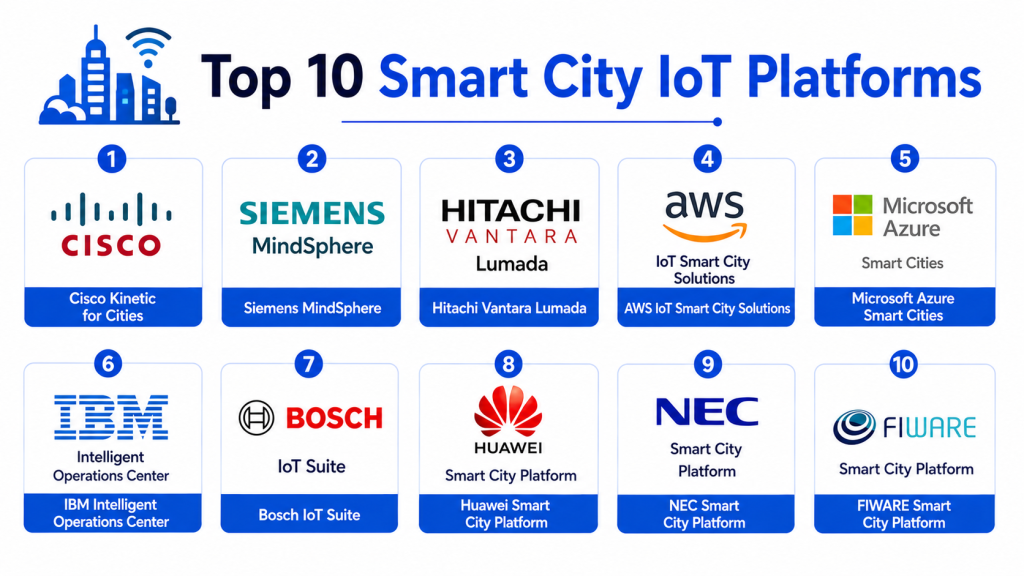
Top 10 Smart City IoT Platforms
1- Cisco Kinetic for Cities
Short description: Cisco Kinetic for Cities helps municipalities connect and manage urban infrastructure systems, IoT devices, sensors, transportation networks, and operational data across smart city environments.
Key Features
- Smart infrastructure integration
- IoT device management
- Real-time analytics
- Traffic and transportation monitoring
- Smart lighting support
- Data orchestration
- Operational dashboards
Pros
- Strong networking ecosystem integration
- Good city-wide operational visibility
- Useful transportation and infrastructure analytics
Cons
- Enterprise-focused deployment model
- Best value with Cisco ecosystems
- Complex implementation for large projects
Platforms / Deployment
- Web / IoT devices / Edge infrastructure
- Cloud / Hybrid
Security & Compliance
- RBAC
- Encryption
- Audit logs
- Device authentication
- Network security integration
- Compliance visibility
Integrations & Ecosystem
Cisco Kinetic integrates with networking, transportation, security, and urban operations ecosystems.
- Cisco networking
- Traffic systems
- Edge infrastructure
- Video analytics
- APIs
- Urban operational platforms
Support & Community
Cisco provides enterprise support, implementation services, technical documentation, and large smart infrastructure ecosystem support.
2- Microsoft Azure Smart Cities Platform
Short description: Microsoft Azure Smart Cities solutions provide cloud-based IoT infrastructure, analytics, AI services, and operational visibility for connected urban systems and municipal infrastructure.
Key Features
- IoT device connectivity
- AI and analytics services
- Digital twin support
- Smart infrastructure monitoring
- Cloud scalability
- Edge computing support
- Real-time dashboards
Pros
- Strong cloud and AI ecosystem
- Good scalability for large city deployments
- Useful analytics and reporting capabilities
Cons
- Requires Azure expertise
- Large deployments can become operationally complex
- Licensing and scaling require planning
Platforms / Deployment
- Web / IoT devices / Edge gateways
- Cloud / Hybrid
Security & Compliance
- RBAC
- Encryption
- Audit logs
- Microsoft Entra ID integration
- Device authentication
- Compliance reporting support
Integrations & Ecosystem
Azure integrates with analytics, AI, GIS, and enterprise operational systems.
- Azure IoT services
- Power BI
- Azure Digital Twins
- AI services
- GIS systems
- Public infrastructure systems
Support & Community
Strong Microsoft support ecosystem, enterprise services, documentation, and partner availability.
3- AWS Smart City Solutions
Short description: AWS provides cloud-native smart city infrastructure solutions for transportation, utilities, environmental monitoring, public safety, and connected urban operations.
Key Features
- IoT device management
- Cloud-scale analytics
- Real-time data ingestion
- Edge computing support
- AI and machine learning
- Smart infrastructure integration
- Operational dashboards
Pros
- Strong cloud scalability
- Excellent analytics ecosystem
- Good AI and automation capabilities
Cons
- Requires AWS operational expertise
- Large-scale deployments can become complex
- Costs require careful management
Platforms / Deployment
- Web / IoT devices / Edge infrastructure
- Cloud / Hybrid
Security & Compliance
- Encryption
- IAM integration
- Audit logs
- Device authentication
- Security monitoring
- Compliance controls
Integrations & Ecosystem
AWS integrates with IoT, analytics, AI, and operational city systems.
- AWS IoT Core
- Amazon QuickSight
- SageMaker
- GIS systems
- Edge computing platforms
- Security services
Support & Community
AWS provides enterprise support, cloud training resources, and large partner ecosystem access.
4- Siemens MindSphere
Short description: Siemens MindSphere is an industrial IoT platform used for smart infrastructure, utilities, transportation, energy systems, and city-wide operational monitoring.
Key Features
- Industrial IoT monitoring
- Asset performance analytics
- Smart utility integration
- Transportation analytics
- Edge connectivity
- Real-time operational dashboards
- Predictive maintenance support
Pros
- Strong industrial infrastructure support
- Good operational analytics depth
- Useful utility and transportation monitoring
Cons
- Best suited for industrial and infrastructure-heavy environments
- Enterprise operational complexity
- Requires technical implementation expertise
Platforms / Deployment
- Web / Industrial infrastructure / Edge gateways
- Cloud / Hybrid
Security & Compliance
- RBAC
- Encryption
- Audit logs
- Operational monitoring
- Device identity controls
- Compliance support
Integrations & Ecosystem
MindSphere integrates with industrial infrastructure, utilities, and operational technology systems.
- Siemens infrastructure systems
- Utilities platforms
- Transportation systems
- Industrial analytics
- APIs
- Edge environments
Support & Community
Strong industrial ecosystem support, implementation services, and infrastructure expertise are available.
5- Hitachi Vantara Lumada
Short description: Hitachi Vantara Lumada provides smart city analytics, IoT connectivity, infrastructure monitoring, and operational intelligence for urban environments and public infrastructure systems.
Key Features
- IoT data integration
- Smart infrastructure monitoring
- AI-driven analytics
- Operational dashboards
- Asset visibility
- Edge analytics
- Public infrastructure optimization
Pros
- Strong operational analytics
- Good industrial and urban monitoring support
- Useful AI-driven infrastructure insights
Cons
- Enterprise deployment complexity
- Large-scale customization may require services
- Smaller ecosystem than hyperscale cloud providers
Platforms / Deployment
- Web / IoT infrastructure / Edge systems
- Cloud / Hybrid
Security & Compliance
- RBAC
- Encryption
- Audit logs
- Operational monitoring
- Device authentication
- Compliance support
Integrations & Ecosystem
Lumada integrates with industrial, transportation, and city infrastructure systems.
- Transportation systems
- Utility platforms
- Edge infrastructure
- Analytics systems
- APIs
- Operational technology environments
Support & Community
Enterprise support, infrastructure expertise, and operational guidance resources are available.
6- IBM Intelligent Operations Center
Short description: IBM Intelligent Operations Center helps cities centralize operational monitoring, analytics, infrastructure management, and emergency response coordination across smart city environments.
Key Features
- Centralized city operations monitoring
- Incident management
- Real-time analytics
- Infrastructure visibility
- Public safety coordination
- Data integration
- Operational dashboards
Pros
- Strong operational coordination capabilities
- Good public sector focus
- Useful emergency response visibility
Cons
- Enterprise deployment model
- Requires operational planning
- Complex integrations for large environments
Platforms / Deployment
- Web / Urban infrastructure systems
- Cloud / Hybrid
Security & Compliance
- RBAC
- Encryption
- Audit logs
- Operational governance
- Identity controls
- Compliance reporting
Integrations & Ecosystem
IBM integrates with operational systems, public safety infrastructure, and analytics environments.
- Public safety systems
- GIS platforms
- Infrastructure monitoring tools
- Analytics systems
- APIs
- Enterprise operations platforms
Support & Community
IBM provides enterprise support, implementation services, and public sector operational expertise.
7- Huawei Smart City Solution
Short description: Huawei Smart City Solution provides integrated IoT, AI, networking, cloud, and operational technologies for urban infrastructure modernization and city-wide digital transformation initiatives.
Key Features
- Smart infrastructure management
- AI-powered analytics
- IoT connectivity
- Video surveillance integration
- Transportation optimization
- Utility monitoring
- Unified operational dashboards
Pros
- Broad infrastructure ecosystem
- Good AI and networking integration
- Useful city-wide operational visibility
Cons
- Regional deployment considerations
- Enterprise-scale operational complexity
- Regulatory considerations may vary by country
Platforms / Deployment
- Web / IoT devices / Edge systems
- Cloud / Hybrid
Security & Compliance
- Encryption
- RBAC
- Audit logs
- Device identity management
- Security analytics
- Compliance support varies by region
Integrations & Ecosystem
Huawei integrates networking, cloud, AI, and urban infrastructure environments.
- Networking systems
- AI analytics
- Transportation platforms
- Edge infrastructure
- Video systems
- Smart utility systems
Support & Community
Enterprise support, smart infrastructure services, and regional implementation ecosystems are available.
8- Oracle Smart City Platform
Short description: Oracle Smart City Platform provides analytics, IoT connectivity, operational visibility, and infrastructure intelligence for connected urban systems and municipal operations.
Key Features
- IoT infrastructure monitoring
- Data analytics
- Smart utility integration
- Transportation visibility
- Operational dashboards
- Cloud scalability
- Data management capabilities
Pros
- Strong enterprise data management
- Good analytics and reporting
- Useful cloud scalability
Cons
- Enterprise licensing complexity
- Requires Oracle operational expertise
- Advanced integrations may require services
Platforms /Deployment
- Web / IoT infrastructure / Enterprise systems
- Cloud / Hybrid
Security & Compliance
- RBAC
- Encryption
- Audit logs
- Identity management
- Data governance
- Compliance reporting
Integrations & Ecosystem
Oracle integrates with enterprise analytics, cloud, and infrastructure systems.
- Oracle Cloud
- Analytics systems
- Utility systems
- GIS platforms
- APIs
- Enterprise applications
Support & Community
Oracle provides enterprise support, cloud services, and operational documentation resources.
9- NEC Smart City Platform
Short description: NEC Smart City Platform provides public safety, urban analytics, transportation optimization, and connected infrastructure capabilities for smart city modernization projects.
Key Features
- Public safety analytics
- Transportation monitoring
- AI-powered city analytics
- Smart infrastructure visibility
- Facial recognition support
- Emergency response coordination
- Data integration capabilities
Pros
- Strong public safety capabilities
- Good transportation monitoring support
- Useful AI-based operational analytics
Cons
- Enterprise-focused deployment model
- Regional ecosystem differences
- Large-scale deployments require planning
Platforms / Deployment
- Web / Smart infrastructure / Edge systems
- Cloud / Hybrid
Security & Compliance
- Encryption
- RBAC
- Audit logs
- Identity management
- Operational security monitoring
- Compliance reporting support
Integrations & Ecosystem
NEC integrates with public safety, transportation, and operational infrastructure systems.
- Video surveillance systems
- Transportation infrastructure
- AI analytics
- Emergency response systems
- APIs
- Smart infrastructure environments
Support & Community
Enterprise support, operational guidance, and public sector expertise are available.
10- FIWARE
Short description: FIWARE is an open-source smart city platform supporting IoT interoperability, context data management, smart infrastructure integration, and open urban innovation initiatives.
Key Features
- Open-source smart city framework
- Context data management
- IoT interoperability
- API-driven architecture
- Smart infrastructure integration
- Real-time data processing
- Open standards support
Pros
- Strong interoperability focus
- Open-source flexibility
- Good smart city ecosystem support
Cons
- Requires technical expertise
- Enterprise support varies by implementation
- Advanced deployments require customization
Platforms / Deployment
- Linux / IoT infrastructure / Cloud environments
- Cloud / Self-hosted / Hybrid
Security & Compliance
- RBAC
- Encryption
- API security
- Identity integration
- Audit visibility varies by deployment
- Compliance support depends on implementation
Integrations & Ecosystem
FIWARE integrates with open smart city ecosystems and interoperable urban infrastructure systems.
- Open APIs
- GIS systems
- IoT devices
- Smart infrastructure
- Edge systems
- Urban analytics platforms
Support & Community
Strong open-source community, smart city ecosystem participation, and technical documentation availability.
Comparison Table
| Tool Name | Best For | Platforms Supported | Deployment | Standout Feature | Public Rating |
|---|---|---|---|---|---|
| Cisco Kinetic for Cities | City-wide infrastructure operations | IoT devices / Edge infrastructure | Cloud / Hybrid | Integrated urban networking visibility | N/A |
| Microsoft Azure Smart Cities Platform | Cloud-native smart city analytics | IoT devices / Edge gateways | Cloud / Hybrid | AI and digital twin integration | N/A |
| AWS Smart City Solutions | Scalable urban analytics | IoT devices / Edge infrastructure | Cloud / Hybrid | Cloud-scale data processing | N/A |
| Siemens MindSphere | Smart infrastructure and utilities | Industrial infrastructure / Edge gateways | Cloud / Hybrid | Industrial operational analytics | N/A |
| Hitachi Vantara Lumada | Urban operational intelligence | IoT infrastructure / Edge systems | Cloud / Hybrid | AI-driven infrastructure insights | N/A |
| IBM Intelligent Operations Center | Centralized city operations | Urban infrastructure systems | Cloud / Hybrid | Unified operational monitoring | N/A |
| Huawei Smart City Solution | Integrated smart city ecosystems | IoT devices / Edge systems | Cloud / Hybrid | AI and networking convergence | N/A |
| Oracle Smart City Platform | Enterprise smart infrastructure analytics | IoT infrastructure / Enterprise systems | Cloud / Hybrid | Large-scale data management | N/A |
| NEC Smart City Platform | Public safety and transportation | Smart infrastructure / Edge systems | Cloud / Hybrid | AI-powered public safety analytics | N/A |
| FIWARE | Open smart city interoperability | Linux / IoT infrastructure | Cloud / Self-hosted / Hybrid | Open standards and interoperability | N/A |
Evaluation & Scoring of Smart City IoT Platforms
| Tool Name | Core 25% | Ease 15% | Integrations 15% | Security 10% | Performance 10% | Support 10% | Value 15% | Weighted Total |
|---|---|---|---|---|---|---|---|---|
| Cisco Kinetic for Cities | 9.1 | 7.6 | 9.0 | 9.0 | 8.9 | 8.8 | 7.9 | 8.72 |
| Microsoft Azure Smart Cities Platform | 9.2 | 7.9 | 9.3 | 9.2 | 9.1 | 8.9 | 8.1 | 8.91 |
| AWS Smart City Solutions | 9.3 | 7.8 | 9.4 | 9.1 | 9.2 | 8.8 | 8.0 | 8.90 |
| Siemens MindSphere | 8.9 | 7.3 | 8.7 | 9.0 | 9.0 | 8.7 | 7.8 | 8.58 |
| Hitachi Vantara Lumada | 8.8 | 7.5 | 8.5 | 8.9 | 8.8 | 8.5 | 7.9 | 8.48 |
| IBM Intelligent Operations Center | 8.9 | 7.4 | 8.6 | 9.0 | 8.9 | 8.7 | 7.7 | 8.53 |
| Huawei Smart City Solution | 8.8 | 7.6 | 8.8 | 8.8 | 8.9 | 8.5 | 8.0 | 8.55 |
| Oracle Smart City Platform | 8.6 | 7.5 | 8.7 | 8.8 | 8.7 | 8.4 | 7.8 | 8.41 |
| NEC Smart City Platform | 8.7 | 7.4 | 8.4 | 8.8 | 8.7 | 8.5 | 7.9 | 8.40 |
| FIWARE | 8.4 | 7.1 | 8.8 | 8.3 | 8.5 | 8.0 | 9.0 | 8.33 |
These scores are comparative and intended to help organizations evaluate operational fit rather than identify a universal winner. Cloud-native platforms score highly for scalability and analytics integration, while infrastructure-focused platforms perform strongly in transportation, utilities, and operational monitoring. Buyers should align platform selection with urban infrastructure priorities, interoperability needs, security requirements, and operational complexity.
Which Smart City IoT Platform Is Right for You?
Solo / Freelancer
Independent consultants and small smart infrastructure teams often prioritize interoperability, API flexibility, and affordability. FIWARE is useful for experimentation, prototypes, and open smart city projects requiring customization.
SMB
Smaller municipalities and regional infrastructure projects typically need scalable monitoring, analytics, and manageable operational visibility without excessive complexity. Microsoft Azure Smart Cities Platform and AWS Smart City Solutions provide strong cloud-native operational flexibility.
Mid-Market
Mid-sized cities and transportation operators often require centralized operational dashboards, IoT integration, analytics, and security monitoring. Cisco Kinetic, Hitachi Vantara Lumada, and Oracle Smart City Platform are strong options depending on infrastructure strategy.
Enterprise
Large metropolitan environments and national infrastructure projects usually require high-scale analytics, transportation optimization, AI-driven operations, public safety integration, and utility monitoring. Azure Smart Cities Platform, AWS Smart City Solutions, Siemens MindSphere, IBM Intelligent Operations Center, and Cisco Kinetic are strong enterprise-focused choices.
Budget vs Premium
FIWARE provides open-source flexibility for technically capable teams. Cloud-native solutions reduce infrastructure overhead, while industrial and enterprise platforms such as Siemens, Cisco, IBM, and Hitachi offer deeper operational capabilities with higher implementation investment.
Feature Depth vs Ease of Use
Cloud-native platforms are generally easier to scale and integrate with analytics services, while industrial and operational platforms provide deeper infrastructure and utility monitoring capabilities. Open-source frameworks provide flexibility but require more technical management.
Integrations & Scalability
Organizations already invested in AWS, Azure, Cisco, Oracle, or Siemens ecosystems should prioritize platforms aligned with those environments to simplify integration and operational workflows.
Security & Compliance Needs
Security-focused cities should prioritize encryption, audit logging, RBAC, device identity management, operational monitoring, Zero Trust access controls, and integration with public safety and SOC systems. Cisco, Microsoft, AWS, Siemens, and IBM provide strong governance and enterprise security capabilities.
Frequently Asked Questions
1. What is a Smart City IoT Platform?
A Smart City IoT Platform connects, monitors, analyzes, and manages urban infrastructure systems through connected sensors, devices, analytics engines, and operational dashboards.
2. Why are Smart City IoT Platforms important?
They help cities improve operational efficiency, reduce infrastructure costs, optimize transportation, improve sustainability, strengthen public safety, and deliver better citizen services.
3. What systems are commonly integrated into smart city platforms?
Common integrations include transportation systems, smart lighting, utility infrastructure, environmental monitoring, parking systems, emergency response systems, and public safety networks.
4. Can Smart City IoT Platforms improve sustainability?
Yes. These platforms help optimize energy usage, reduce traffic congestion, monitor emissions, improve utility efficiency, and support environmental sustainability initiatives.
5. What role does AI play in smart city platforms?
AI helps improve predictive analytics, traffic optimization, anomaly detection, infrastructure forecasting, public safety monitoring, and operational automation.
6. Are these platforms only for large cities?
No. Smaller municipalities, campuses, industrial parks, transportation agencies, and regional infrastructure operators also use smart city IoT platforms depending on operational needs.
7. What are common implementation mistakes?
Common mistakes include poor interoperability planning, fragmented infrastructure deployment, insufficient cybersecurity controls, weak data governance, and lack of operational coordination between agencies.
8. Can Smart City IoT Platforms improve public safety?
Yes. They can support emergency response coordination, AI-based monitoring, traffic management, environmental alerts, infrastructure risk monitoring, and operational visibility.
9. Should organizations choose open-source or enterprise platforms?
Open-source platforms provide flexibility and interoperability but require technical expertise. Enterprise platforms provide stronger support, analytics, and operational integration capabilities.
10. What should buyers evaluate before selecting a platform?
Buyers should evaluate scalability, analytics depth, interoperability, IoT compatibility, security controls, operational dashboards, edge computing support, API flexibility, support quality, and total deployment complexity.
Conclusion
Smart City IoT Platforms are transforming how cities manage infrastructure, transportation, utilities, sustainability initiatives, public safety systems, and citizen services. The right platform can improve operational visibility, automate infrastructure management, optimize energy and transportation systems, strengthen public safety, and support long-term urban modernization initiatives. Azure Smart Cities Platform and AWS Smart City Solutions provide highly scalable cloud-native analytics environments, while Cisco Kinetic and Siemens MindSphere deliver strong infrastructure and operational technology integration. IBM Intelligent Operations Center supports centralized urban coordination, Hitachi Lumada enhances operational intelligence, and FIWARE offers flexible open interoperability for smart city ecosystems. The best choice depends on infrastructure scale, cloud strategy, interoperability requirements, security expectations, and operational maturity. Shortlist two or three platforms, validate integrations with existing infrastructure systems, test analytics and operational dashboards carefully, and ensure the chosen solution can scale effectively with long-term smart city modernization goals.