Introduction
IoT Security Platforms help organizations secure connected devices, industrial systems, edge infrastructure, smart equipment, medical devices, sensors, gateways, and operational technology environments from cyber threats, unauthorized access, malware, and operational vulnerabilities. These platforms provide visibility, threat detection, device identity management, network monitoring, anomaly detection, policy enforcement, and risk assessment across distributed IoT ecosystems.
As organizations deploy more connected devices across manufacturing, healthcare, energy, logistics, retail, transportation, utilities, and smart infrastructure environments, the attack surface expands significantly. Many IoT devices operate with limited security controls, outdated firmware, weak credentials, or long operational lifecycles, making centralized security management essential.
Real-world use cases include:
- Monitoring industrial IoT environments for anomalies
- Securing connected medical devices in hospitals
- Detecting unauthorized devices on operational networks
- Enforcing Zero Trust access for edge devices
- Managing risk across smart building infrastructure
Buyers evaluating IoT Security Platforms should consider:
- Device discovery and inventory visibility
- Threat detection and anomaly monitoring
- Device identity and access controls
- Vulnerability and risk assessment
- Network segmentation capabilities
- Firmware and patch visibility
- Compliance and audit reporting
- Integration with SIEM and SOC workflows
- Scalability across large IoT environments
- Cloud, edge, and OT deployment compatibility
Best for: Security operations teams, industrial cybersecurity teams, healthcare IT teams, telecom providers, utilities, manufacturing organizations, smart city operators, enterprise security architects, and businesses managing large connected device ecosystems.
Not ideal for: Very small environments with minimal connected devices or organizations without centralized network visibility and IoT security management requirements.
Key Trends in IoT Security Platforms
- Zero Trust security models are becoming standard for connected device environments.
- AI-driven anomaly detection is improving visibility into unusual device behavior.
- Asset discovery and passive network monitoring are becoming critical for unmanaged IoT environments.
- IoT and OT security convergence is increasing in industrial environments.
- Secure device identity and certificate management are becoming more important.
- Cloud-native IoT security platforms are scaling rapidly across distributed environments.
- Firmware vulnerability visibility is becoming a core operational requirement.
- Regulatory and compliance requirements for connected devices are increasing globally.
- Edge computing security is becoming tightly integrated with IoT security workflows.
- Security platforms are increasingly integrating with SIEM, SOAR, and XDR ecosystems.
How We Selected These Tools
The tools in this list were selected based on IoT security depth, device visibility, threat detection capabilities, ecosystem maturity, scalability, and operational value.
Selection criteria included:
- IoT asset discovery and inventory capabilities
- Threat detection and anomaly monitoring
- Device identity and access management support
- Vulnerability assessment and risk visibility
- Integration with enterprise security ecosystems
- Scalability across distributed IoT environments
- Industrial and operational technology compatibility
- Cloud and hybrid deployment flexibility
- Compliance and audit reporting support
- Ease of operational integration
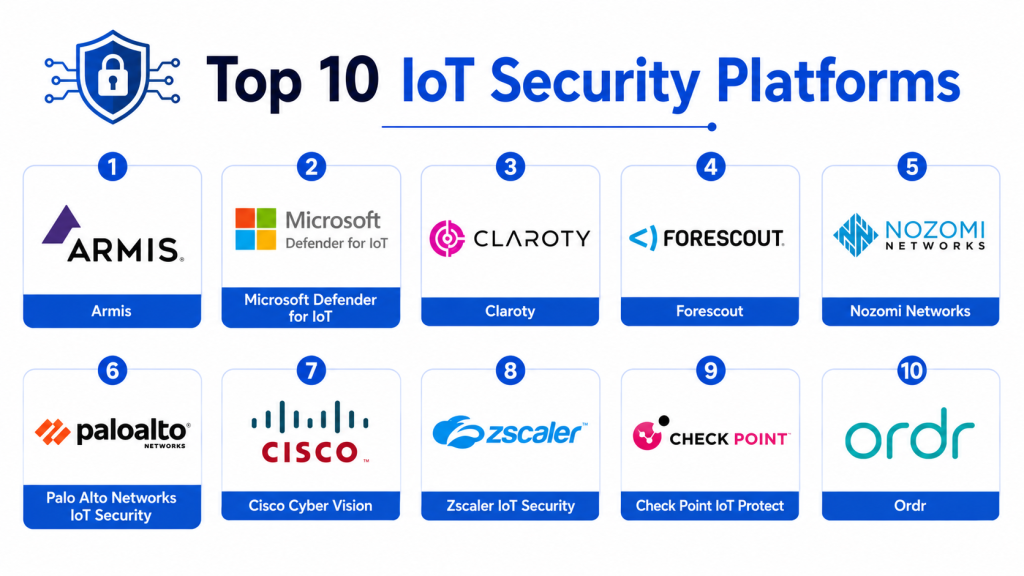
Top 10 IoT Security Platforms
1- Armis
Short description: Armis is a leading IoT and cyber exposure management platform that provides device visibility, threat detection, risk assessment, and security monitoring across enterprise, healthcare, industrial, and operational technology environments.
Key Features
- Agentless device discovery
- IoT and OT asset visibility
- Behavioral anomaly detection
- Vulnerability assessment
- Risk prioritization
- Network segmentation guidance
- Security policy enforcement
Pros
- Strong visibility across unmanaged devices
- Excellent healthcare and industrial support
- Good passive monitoring capabilities
Cons
- Enterprise-focused pricing
- Large deployments require planning
- Advanced workflows may require SOC integration
Platforms / Deployment
- Web / IoT devices / OT networks
- Cloud / Hybrid
Security & Compliance
- RBAC
- Audit logs
- Encryption
- Risk monitoring
- Device behavior analytics
- Compliance reporting
Integrations & Ecosystem
Armis integrates with enterprise security, networking, and SOC environments.
- SIEM platforms
- SOAR tools
- NAC systems
- Firewalls
- CMDB platforms
- Vulnerability management systems
Support & Community
Strong enterprise support, healthcare and industrial expertise, technical documentation, and partner ecosystem availability.
2- Claroty
Short description: Claroty is an industrial cybersecurity platform focused on securing IoT, OT, and cyber-physical systems across manufacturing, healthcare, utilities, and industrial operations.
Key Features
- Industrial asset discovery
- OT network visibility
- Threat detection
- Secure remote access
- Vulnerability management
- Risk assessment
- Industrial protocol monitoring
Pros
- Strong industrial cybersecurity focus
- Good OT protocol visibility
- Useful operational risk monitoring
Cons
- Best suited for industrial environments
- Enterprise operational complexity
- Premium deployment model
Platforms / Deployment
- Industrial systems / OT networks / Web
- Cloud / Self-hosted / Hybrid
Security & Compliance
- RBAC
- Audit logs
- Encryption
- Secure remote access
- OT risk assessment
- Compliance monitoring
Integrations & Ecosystem
Claroty integrates with industrial operations, security systems, and enterprise monitoring environments.
- SIEM platforms
- Firewalls
- Industrial control systems
- SOC workflows
- Vulnerability management tools
- CMDB systems
Support & Community
Strong industrial security expertise, enterprise support, and implementation services.
3- Microsoft Defender for IoT
Short description: Microsoft Defender for IoT provides agentless IoT and OT security monitoring, device discovery, threat analytics, and integration with Microsoft security ecosystems.
Key Features
- IoT and OT asset discovery
- Threat detection analytics
- Network traffic monitoring
- Vulnerability visibility
- Device behavior analytics
- Security alerting
- Integration with Microsoft security tools
Pros
- Strong Microsoft ecosystem integration
- Good enterprise security workflows
- Useful agentless monitoring
Cons
- Best suited for Microsoft-oriented environments
- Advanced OT deployments may require planning
- Licensing can become complex
Platforms / Deployment
- Web / IoT devices / OT networks
- Cloud / Hybrid
Security & Compliance
- RBAC
- Encryption
- Audit logs
- Threat analytics
- Microsoft Entra ID integration
- Compliance reporting support
Integrations & Ecosystem
Defender for IoT integrates with Microsoft security and cloud ecosystems.
- Microsoft Sentinel
- Microsoft Defender
- Azure environments
- SIEM systems
- Identity systems
- Security operations workflows
Support & Community
Strong Microsoft enterprise support, technical documentation, and security ecosystem resources.
4- Palo Alto Networks IoT Security
Short description: Palo Alto Networks IoT Security provides connected device discovery, behavioral analytics, threat prevention, and policy enforcement across enterprise and industrial IoT environments.
Key Features
- Device identification
- Behavioral anomaly detection
- Risk scoring
- Policy recommendations
- Network segmentation support
- Threat intelligence integration
- Automated device classification
Pros
- Strong network security ecosystem
- Good automated device visibility
- Useful policy enforcement guidance
Cons
- Best value with Palo Alto ecosystems
- Enterprise operational complexity
- Premium pricing model
Platforms / Deployment
- IoT devices / Enterprise networks / Web
- Cloud / Hybrid
Security & Compliance
- RBAC
- Encryption
- Threat intelligence
- Audit logs
- Risk monitoring
- Device policy controls
Integrations & Ecosystem
Palo Alto Networks IoT Security integrates with enterprise networking and SOC ecosystems.
- Palo Alto firewalls
- Cortex ecosystem
- SIEM platforms
- NAC systems
- Security analytics
- Threat intelligence platforms
Support & Community
Enterprise support, security operations expertise, and large cybersecurity ecosystem integration are available.
5- Forescout Platform
Short description: Forescout provides device visibility, network access control, IoT security monitoring, and policy enforcement across enterprise, healthcare, industrial, and operational technology environments.
Key Features
- Device discovery
- IoT and OT visibility
- Network access control
- Risk assessment
- Policy enforcement
- Device classification
- Security automation workflows
Pros
- Strong network visibility
- Useful NAC integration
- Good unmanaged device monitoring
Cons
- Deployment complexity can increase at scale
- Best results require network integration
- Enterprise operational model
Platforms / Deployment
- Enterprise networks / OT environments / Web
- Cloud / Self-hosted / Hybrid
Security & Compliance
- RBAC
- Audit logs
- Encryption
- Policy enforcement
- Risk visibility
- Compliance support
Integrations & Ecosystem
Forescout integrates with networking, SIEM, NAC, and enterprise security operations environments.
- SIEM platforms
- Firewalls
- NAC systems
- Vulnerability scanners
- CMDB tools
- Security automation platforms
Support & Community
Enterprise support, operational guidance, and extensive security integration resources are available.
6- Nozomi Networks
Short description: Nozomi Networks specializes in OT and IoT cybersecurity, delivering operational visibility, anomaly detection, asset monitoring, and industrial threat analysis for critical infrastructure environments.
Key Features
- OT and IoT asset discovery
- Threat detection
- Operational anomaly monitoring
- Industrial protocol analysis
- Risk assessment
- Vulnerability visibility
- Critical infrastructure monitoring
Pros
- Strong industrial monitoring depth
- Good operational visibility
- Useful critical infrastructure support
Cons
- Primarily focused on OT environments
- Enterprise implementation complexity
- Requires industrial operational knowledge
Platforms / Deployment
- Industrial networks / OT systems / Web
- Cloud / Self-hosted / Hybrid
Security & Compliance
- RBAC
- Encryption
- Audit logs
- Industrial risk analytics
- Threat monitoring
- Compliance reporting
Integrations & Ecosystem
Nozomi integrates with industrial security, SOC, and operational monitoring ecosystems.
- SIEM systems
- Firewalls
- Industrial control systems
- Security analytics
- Vulnerability platforms
- OT operations tools
Support & Community
Strong industrial cybersecurity support, operational guidance, and infrastructure expertise.
7- Cisco Cyber Vision
Short description: Cisco Cyber Vision provides IoT and industrial network visibility, threat monitoring, asset discovery, and security analytics for operational technology and connected environments.
Key Features
- Industrial asset discovery
- Network traffic analysis
- Threat detection
- Vulnerability visibility
- Device classification
- Security segmentation support
- Operational monitoring
Pros
- Strong networking ecosystem integration
- Good industrial visibility
- Useful operational analytics
Cons
- Best suited for Cisco-centric environments
- Enterprise operational complexity
- Premium infrastructure model
Platforms / Deployment
- Industrial systems / Enterprise networks / Web
- Cloud / Hybrid
Security & Compliance
- RBAC
- Encryption
- Audit logs
- Threat analytics
- Device risk visibility
- Compliance support
Integrations & Ecosystem
Cisco Cyber Vision integrates with Cisco networking, SOC, and security operations ecosystems.
- Cisco networking
- SIEM systems
- Firewalls
- Identity systems
- Security analytics
- Industrial monitoring environments
Support & Community
Cisco provides enterprise support, operational expertise, and large networking ecosystem resources.
8- AWS IoT Device Defender
Short description: AWS IoT Device Defender helps organizations audit IoT configurations, monitor device behavior, detect anomalies, and strengthen security across AWS-connected IoT environments.
Key Features
- Device behavior monitoring
- Security audits
- Policy enforcement
- Threat detection
- Device metrics analysis
- Alerting workflows
- Cloud-native security monitoring
Pros
- Strong AWS integration
- Good cloud-native scalability
- Useful automated audit workflows
Cons
- Best suited for AWS IoT environments
- Requires AWS operational expertise
- Less broad OT focus than industrial platforms
Platforms / Deployment
- IoT devices / Edge gateways / Web
- Cloud
Security & Compliance
- Encryption
- IAM integration
- Audit logs
- Device authentication
- Security policy controls
- Threat monitoring
Integrations & Ecosystem
AWS IoT Device Defender integrates with AWS cloud and IoT infrastructure services.
- AWS IoT Core
- CloudWatch
- AWS Lambda
- AWS security services
- SIEM tools
- Analytics workflows
Support & Community
AWS provides cloud security documentation, training resources, and enterprise support options.
9- Zscaler Zero Trust Exchange for IoT and OT
Short description: Zscaler extends Zero Trust network access and security controls to IoT and OT environments, helping organizations secure connected devices and operational systems through cloud-native security policies.
Key Features
- Zero Trust access control
- Device segmentation
- Threat prevention
- Secure remote connectivity
- Policy enforcement
- Risk visibility
- Cloud-native security controls
Pros
- Strong Zero Trust architecture
- Good remote access security
- Useful cloud-native deployment model
Cons
- Requires network and identity planning
- Best value with Zscaler ecosystem integration
- Advanced industrial use cases may need customization
Platforms / Deployment
- IoT devices / OT systems / Enterprise networks
- Cloud
Security & Compliance
- RBAC
- Encryption
- Zero Trust controls
- Audit logs
- Identity integration
- Threat prevention
Integrations & Ecosystem
Zscaler integrates with cloud security, networking, and identity management ecosystems.
- Identity providers
- SIEM systems
- Firewalls
- Cloud environments
- Security operations tools
- Network access controls
Support & Community
Enterprise support, cloud security guidance, and Zero Trust operational expertise are available.
10- Trend Micro IoT Security
Short description: Trend Micro IoT Security helps organizations monitor, secure, and manage connected devices through threat detection, vulnerability assessment, network visibility, and operational security analytics.
Key Features
- IoT device visibility
- Threat detection
- Vulnerability analysis
- Security monitoring
- Device behavior analytics
- Risk scoring
- Security alerting
Pros
- Strong cybersecurity heritage
- Good visibility for connected devices
- Useful threat monitoring workflows
Cons
- Enterprise deployment complexity
- Advanced industrial integrations may vary
- Large-scale customization may require services
Platforms / Deployment
- IoT devices / Enterprise networks / Web
- Cloud / Hybrid
Security & Compliance
- RBAC
- Encryption
- Audit logs
- Threat intelligence
- Vulnerability monitoring
- Compliance visibility
Integrations & Ecosystem
Trend Micro integrates with enterprise cybersecurity and security operations environments.
- SIEM systems
- SOC platforms
- Threat intelligence feeds
- Cloud environments
- APIs
- Security monitoring workflows
Support & Community
Trend Micro provides enterprise support, cybersecurity expertise, and technical documentation resources.
Comparison Table
| Tool Name | Best For | Platforms Supported | Deployment | Standout Feature | Public Rating |
|---|---|---|---|---|---|
| Armis | Enterprise IoT visibility | IoT devices / OT networks | Cloud / Hybrid | Agentless device discovery | N/A |
| Claroty | Industrial cybersecurity | Industrial systems / OT networks | Cloud / Self-hosted / Hybrid | Industrial protocol monitoring | N/A |
| Microsoft Defender for IoT | Microsoft-centric IoT security | IoT devices / OT networks | Cloud / Hybrid | Integrated Microsoft security analytics | N/A |
| Palo Alto Networks IoT Security | Network-driven IoT protection | IoT devices / Enterprise networks | Cloud / Hybrid | Automated device classification | N/A |
| Forescout Platform | Network access control and visibility | Enterprise networks / OT environments | Cloud / Self-hosted / Hybrid | IoT-aware NAC integration | N/A |
| Nozomi Networks | Critical infrastructure protection | Industrial networks / OT systems | Cloud / Self-hosted / Hybrid | Operational anomaly detection | N/A |
| Cisco Cyber Vision | Industrial network monitoring | Industrial systems / Enterprise networks | Cloud / Hybrid | Cisco-integrated OT visibility | N/A |
| AWS IoT Device Defender | AWS-native IoT security | IoT devices / Edge gateways | Cloud | Automated security audits | N/A |
| Zscaler Zero Trust Exchange | Zero Trust IoT access control | IoT devices / OT systems | Cloud | Cloud-native Zero Trust security | N/A |
| Trend Micro IoT Security | Connected device threat detection | IoT devices / Enterprise networks | Cloud / Hybrid | Threat analytics for IoT environments | N/A |
Evaluation & Scoring of IoT Security Platforms
| Tool Name | Core 25% | Ease 15% | Integrations 15% | Security 10% | Performance 10% | Support 10% | Value 15% | Weighted Total |
|---|---|---|---|---|---|---|---|---|
| Armis | 9.4 | 8.0 | 9.0 | 9.4 | 9.0 | 8.9 | 8.0 | 8.88 |
| Claroty | 9.2 | 7.5 | 8.7 | 9.5 | 9.1 | 8.8 | 7.8 | 8.75 |
| Microsoft Defender for IoT | 9.0 | 8.0 | 9.2 | 9.2 | 8.9 | 8.7 | 8.1 | 8.76 |
| Palo Alto Networks IoT Security | 9.1 | 7.8 | 9.0 | 9.4 | 9.0 | 8.8 | 7.9 | 8.78 |
| Forescout Platform | 8.9 | 7.6 | 8.8 | 9.0 | 8.8 | 8.6 | 8.0 | 8.56 |
| Nozomi Networks | 9.0 | 7.4 | 8.5 | 9.3 | 9.1 | 8.7 | 7.8 | 8.63 |
| Cisco Cyber Vision | 8.8 | 7.7 | 8.9 | 9.0 | 8.9 | 8.7 | 7.9 | 8.58 |
| AWS IoT Device Defender | 8.7 | 7.9 | 9.1 | 9.0 | 8.8 | 8.6 | 8.1 | 8.56 |
| Zscaler Zero Trust Exchange | 8.8 | 7.8 | 8.8 | 9.4 | 8.8 | 8.5 | 8.0 | 8.58 |
| Trend Micro IoT Security | 8.5 | 7.9 | 8.4 | 8.9 | 8.7 | 8.5 | 8.2 | 8.43 |
These scores are comparative and intended to help organizations evaluate operational fit rather than identify a universal winner. Industrial security platforms score highly for OT visibility and operational monitoring, while cloud-native platforms perform strongly in scalability and ecosystem integration. Buyers should align platform selection with network architecture, IoT scale, operational technology exposure, and security maturity.
Which IoT Security Platform Is Right for You?
Solo / Freelancer
Solo consultants and small IoT developers usually need lightweight visibility and practical security monitoring rather than full industrial security platforms. AWS IoT Device Defender and Trend Micro IoT Security can provide manageable cloud-oriented protection for smaller deployments.
SMB
SMBs typically need device discovery, anomaly detection, vulnerability visibility, and manageable security workflows without excessive operational complexity. Microsoft Defender for IoT, Trend Micro IoT Security, and AWS IoT Device Defender provide practical security coverage for growing connected environments.
Mid-Market
Mid-market organizations often require stronger SOC integration, policy enforcement, industrial visibility, and scalable threat monitoring. Armis, Palo Alto Networks IoT Security, Forescout, and Cisco Cyber Vision are strong options depending on existing networking and security ecosystems.
Enterprise
Large enterprises usually require comprehensive asset visibility, industrial protocol monitoring, Zero Trust segmentation, compliance reporting, and integration with enterprise SOC operations. Armis, Claroty, Nozomi Networks, Palo Alto Networks IoT Security, and Microsoft Defender for IoT are strong enterprise-focused choices.
Budget vs Premium
AWS IoT Device Defender and cloud-native monitoring workflows can reduce infrastructure overhead for cloud-oriented environments. Claroty, Armis, Nozomi, and Palo Alto Networks provide deeper enterprise and industrial functionality but require larger operational investment.
Feature Depth vs Ease of Use
Cloud-native platforms are generally easier to scale but may provide less OT-specific depth. Industrial security platforms deliver richer protocol visibility and operational monitoring but require specialized deployment and operational expertise.
Integrations & Scalability
Organizations heavily invested in Microsoft, AWS, Cisco, Palo Alto Networks, or Zscaler ecosystems should prioritize tools aligned with those environments for simpler integration and operational consistency.
Security & Compliance Needs
Security-focused organizations should prioritize passive monitoring, asset inventory, network segmentation, Zero Trust controls, vulnerability visibility, audit logging, device identity management, and integration with SIEM and SOC workflows. Claroty, Armis, Nozomi, Palo Alto Networks, and Microsoft Defender for IoT are strong options for governance-heavy environments.
Frequently Asked Questions
1. What is an IoT Security Platform?
An IoT Security Platform helps organizations monitor, secure, and manage connected devices, operational technology systems, and edge infrastructure through visibility, threat detection, risk analysis, and policy enforcement.
2. Why are IoT Security Platforms important?
Connected devices often lack strong built-in security controls and can become attack vectors. IoT security platforms help organizations detect threats, identify vulnerabilities, and improve operational security across distributed device environments.
3. What is agentless IoT monitoring?
Agentless monitoring identifies and analyzes devices through passive network traffic analysis instead of installing software agents directly on devices. This is useful for unmanaged and legacy systems.
4. Can these platforms secure industrial systems?
Yes. Many IoT security platforms support operational technology and industrial control system environments, including manufacturing, utilities, transportation, and critical infrastructure operations.
5. What integrations are most important?
Important integrations include SIEM platforms, SOAR tools, firewalls, NAC systems, identity providers, CMDB systems, vulnerability management platforms, and security analytics tools.
6. What are common implementation mistakes?
Common mistakes include incomplete asset visibility, weak network segmentation, poor device inventory management, insufficient monitoring coverage, and failing to integrate IoT security into broader SOC operations.
7. Can IoT Security Platforms improve compliance?
Yes. They help organizations improve audit visibility, monitor device security posture, track vulnerabilities, enforce policies, and support regulatory and operational security requirements.
8. Are these tools only for large enterprises?
No. SMBs, hospitals, schools, factories, retailers, and smart building operators also use IoT security platforms depending on device volume and operational risk exposure.
9. Should organizations choose cloud-native or industrial-focused platforms?
Cloud-native platforms work well for scalable connected environments integrated with cloud ecosystems, while industrial-focused platforms provide deeper operational technology visibility and protocol analysis.
10. What should buyers evaluate before selecting a platform?
Buyers should evaluate asset discovery capabilities, threat detection depth, industrial protocol support, scalability, integration flexibility, compliance visibility, deployment model, SOC integration, support quality, and operational complexity.
Conclusion
IoT Security Platforms are becoming essential for organizations managing connected devices, industrial systems, edge infrastructure, and operational technology environments at scale. The right platform can improve asset visibility, detect threats earlier, reduce cyber exposure, strengthen device security, and simplify operational monitoring across distributed networks. Armis, Claroty, and Nozomi Networks are strong choices for enterprise and industrial visibility, while Microsoft Defender for IoT, Palo Alto Networks IoT Security, and Cisco Cyber Vision integrate well into broader security ecosystems. Forescout adds strong network access visibility, AWS IoT Device Defender supports cloud-native IoT security operations, and Zscaler extends Zero Trust controls into connected environments. The best choice depends on device diversity, industrial exposure, cloud strategy, SOC maturity, and security governance requirements. Shortlist two or three platforms, validate visibility and detection capabilities in real environments, test integrations with existing security operations workflows, and ensure the chosen solution can scale securely with your long-term IoT and edge infrastructure strategy.