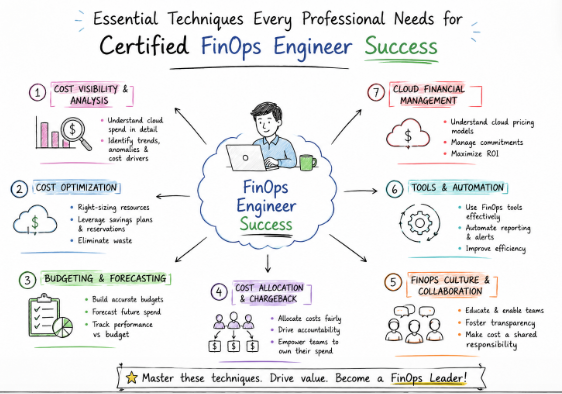
Introduction
Cloud adoption has completely changed how infrastructure is managed by engineering teams. In a variable cloud spending model, a single line of unoptimized code or an oversized virtual instance can lead to massive financial waste. Traditional finance teams cannot see these real-time infrastructure changes, and engineering teams often lack visibility into the financial impact of their deployments.
This gap is bridged by cloud financial operations. Engineering decisions are directly connected to business value through this discipline. The development of specialized expertise is required to manage these modern environments effectively. This master guide is developed to provide a comprehensive look at the premier technical credential in this space, helping engineering professionals navigate their learning path and career outcomes.
What is Certified FinOps Engineer
The Certified FinOps Engineer is a practical, technical certification designed for professionals who build, architect, and manage cloud infrastructure. This validation ensures that an engineer knows how to manage cloud financial operations from a practical engineering perspective. It moves beyond theoretical concepts to focus heavily on hands-on optimization, visibility, and cost governance.
This program teaches engineers how cloud resources generate costs and how those costs can be controlled using automated practices. Rather than restricting engineers from provisioning resources, it empowers them to build cost-aware architectures that remain high-performing and highly scalable.
Why it matters today?
In today’s cloud ecosystem, infrastructure budgets are being heavily scrutinized by management. Organizations are realizing that automated scaling and standard management tools are not enough to prevent cloud bill inflation. Cloud expenses are growing faster than corporate revenue in many enterprises.
Engineers who only focus on uptime and performance are no longer meeting all the needs of modern businesses. A major competitive edge is gained by professionals who can build architectures that are both technically reliable and financially optimal. This certification matters today because it shifts an engineer’s role from a simple resource provider to a strategic driver of corporate efficiency.
Why Certified FinOps Engineer certifications are important
Securing a validation in this domain provides major benefits for both the professional and the hiring enterprise. The key reasons why these certifications are essential include:
- Measurable Business Impact: Certified professionals can demonstrate immediate return on investment by identifying infrastructure waste that automated security or monitoring tools often miss.
- Career Longevity: The framework and principles taught in this program remain highly relevant even when cloud provider interfaces or billing structures change over time.
- Improved Team Collaboration: The communication gap between engineering teams and non-technical finance teams is successfully closed.
- Architectural Accountability: A healthy culture of cost accountability is established within engineering squads, ensuring that spending is tracked during the design phase rather than after the monthly bill arrives.
Why choose Finopsschool?
FinOpsSchool has established itself as a premier destination for learning cloud financial management. The curriculum is built entirely around practical, real-world scenarios rather than dry theoretical documentation.
The training programs are designed by working industry experts to meet the exact operational demands of the modern enterprise market. Every course features hands-on exercises, budget tracking labs, and scenario-based evaluations. By choosing this platform, learners get access to a structured process that takes them from basic awareness to advanced cloud financial governance.
Certification Deep-Dive
What is this certification?
The Certified FinOps Engineer validation tests an individual’s ability to apply cost-management frameworks to live cloud environments. It focuses on engineering practices, data analytics, automated cost remediation, and cloud accountability.
Who should take this certification?
This program is ideal for DevOps engineers, cloud engineers, platform engineers, site reliability engineers, data engineers, and engineering managers who deal directly with cloud infrastructure deployment and budgeting.
Certification Overview Table
| Track | Level | Who it’s for | Prerequisites | Skills Covered | Recommended Order |
| FinOps Foundation | Foundation | Beginners, Analysts, Entry-level Engineers | Basic Cloud Awareness | FinOps Framework, Billing Vocab, Tagging Basics | 1st |
| FinOps Engineer | Professional | Cloud & DevOps Engineers, SREs | Foundational Knowledge | Cost Optimization, Automation, Dashboarding | 2nd |
| FinOps Advanced | Advanced | Senior Engineers, Lead Architects | Professional Certification | Multi-Cloud Governance, Anomaly Detection | 3rd |
| FinOps Architect | Expert | Enterprise Architects, Practice Leads | Advanced Certification | Unit Economics, Global Policy Design, ROI | 4th |
Skills you will gain
The practical capabilities obtained through this learning process include:
- Deep understanding of multi-cloud billing mechanics and cost allocation strategies.
- Ability to implement complex infrastructure tagging and tracking structures.
- Knowledge of how to calculate advanced unit economics for specific applications or services.
- Skills to configure automated systems that detect and alert teams to sudden spending anomalies.
- Expertise in evaluating and maximizing commitment discounts like Savings Plans and Reserved Instances.
Real-world projects you should be able to do after this certification
Upon successful completion, the following engineering tasks can be completed:
- Automated Non-Prod Shuddering: Develop configuration scripts that automatically power down non-production cloud workloads during non-business hours.
- Kubernetes Chargeback Setup: Build a complete showback or chargeback model to track and allocate shared resource costs inside a multi-tenant Kubernetes cluster.
- Spot Instance Migration: Orchestrate the safe migration of stateless production workloads to Spot instances to capture high cost savings without risking application uptime.
- Custom Cost Dashboards: Create real-time cost transparency dashboards that map cloud billing APIs directly to internal business KPIs.
Preparation plan
7–14 days plan
- Days 1-5: The official terminology and core pillars of the cloud finance framework are reviewed thoroughly.
- Days 6-10: Cloud provider billing structures, pricing rules, and common sources of basic infrastructure waste are studied.
- Days 11-14: Foundational practice quizzes are taken to lock in the standardized cloud spending vocabulary.
30 days plan
- Days 1-10: Deep dives into tagging rules, data allocation strategies, and multi-tenant environment setups are completed.
- Days 11-20: Hands-on labs are performed to practice creating custom dashboards using simulated cloud billing datasets.
- Days 21-30: Case studies detailing successful enterprise cost optimization strategies are analyzed to understand real-world patterns.
60 days plan
- Days 1-20: Advanced programming scripts are written to interface with public cloud billing APIs and automated alerting tools.
- Days 21-40: Complete mock financial policy frameworks are created, including automated budget remediation workflows for sandbox environments.
- Days 41-60: Comprehensive mock exams are taken, and advanced multi-cloud governance scenarios are reviewed to ensure final test readiness.
Common mistakes to avoid
The typical pitfalls that should be avoided during preparation and execution are:
- Focusing purely on financial theory while ignoring the practical command-line and API automation scripts.
- Assuming cost tracking is a one-time project rather than a continuous engineering lifecycle process.
- Implementing strict cost-cutting scripts that accidentally degrade application performance or breach service level agreements.
- Neglecting the cultural communication side of the framework, which is vital for getting team buy-in on tagging compliance.
Best next certification after this
- Same track: Certified FinOps Engineer – Professional
- Cross-track: Certified Site Reliability Engineer – Foundation
- Leadership / management: Cloud Governance Certification
Choose Your Learning Path
DevOps Path
This path is customized for automation experts who want to bake cost tracking directly into deployment pipelines. It is best for DevOps engineers who want to use Infrastructure as Code to ensure all new cloud resources are automatically tagged, monitored, and optimized from the moment they are provisioned.
DevSecOps Path
This track is designed for systems security professionals who realize that financial waste and unmanaged cloud sprawl represent significant security risks. It is best for security engineers looking to integrate cost-aware policy gates into continuous delivery pipelines alongside standard security compliance checks.
Site Reliability Engineering (SRE) Path
This strategy is built for reliability professionals who need to balance application uptime and performance with strict budget limitations. It is best for SREs who want to map service level indicators directly against cloud spending metrics to ensure maximum platform efficiency.
AIOps / MLOps Path
This path focuses on data science and machine learning infrastructure operations where training models can generate massive, unexpected cloud bills. It is best for ML engineers who need to monitor high-cost GPU computing clusters and implement automated, budget-conscious training workflows.
DataOps Path
This sequence is created for data pipeline developers who manage massive data storage pools and complex analytical data warehouses. It is best for data engineers who want to implement granular cost allocation and data lifecycle rules to prevent data storage costs from spiralling out of hand.
FinOps Path
This is the direct specialty path for professionals who want cloud financial operations to become the absolute core of their career identity. It is best for cloud cost analysts and cloud consultants who aim to lead enterprise-wide financial governance teams and manage massive cloud portfolios.
Role → Recommended Certifications Mapping
| Role | Recommended Certifications | Primary Focus Area |
| DevOps Engineer | Certified FinOps Engineer | Automated Pipeline Optimization |
| Site Reliability Engineer (SRE) | Certified FinOps Architect | Balancing Reliability with Cost Metrics |
| Platform Engineer | Certified FinOps Engineer | Internal Developer Tool Cost Visibility |
| Cloud Engineer | Certified FinOps Professional | Core Cloud Cost Allocation & Tagging |
| Security Engineer | Cloud Governance Certification | Sprawl Elimination and Compliance Gates |
| Data Engineer | Certified FinOps Engineer | Data Warehouse Budgeting & Lifecycle Rules |
| FinOps Practitioner | Certified FinOps Professional | Enterprise Cost Strategy & Frameworks |
| Engineering Manager | Certified FinOps Manager | Team Accountability and Stakeholder ROI |
Next Certifications to Take
An individual same-track certification can be pursued by moving toward advanced levels where strategic enterprise forecasting and complex multi-cloud policy enforcement are mastered.
A single cross-track certification can be taken by choosing a system validation like a platform engineering program, which expands an engineer’s capability to build highly scalable automation frameworks.
One leadership-focused certification can be completed by selecting an executive governance course, which focuses on driving cultural change across large engineering departments and managing vendor agreements.
Training & Certification Support Institutions
DevOpsSchool
Highly practical, project-based training programs are provided by this global institution to prepare candidates for modern IT operational challenges. The courses are structured around deep engineering automation scenarios that help working professionals build real technical expertise.
Cotocus
Specialized career enablement and technical consulting paths are delivered by this platform to help squads modernize their delivery frameworks. The training focus is directed heavily toward cloud infrastructure architecture, systems reliability engineering, and continuous integration models.
ScmGalaxy
A rich library of technical tutorials, operational blueprints, and certification preparation resources is maintained by this platform for community learning. It serves as an informative hub for systems administrators and engineers looking to upgrade their technical skill set.
BestDevOps
Structured, step-by-step training tracks are offered here to guide enterprise teams through the complexities of cloud engineering adoption. The learning paths focus on removing operational friction, improving software deployment frequency, and mastering modern tracking methodologies.
devsecopsschool.com
This platform is dedicated entirely to teaching the critical intersection of software security and automated pipeline engineering. Comprehensive resources are provided to ensure compliance gates can be written natively into cloud deployment workflows.
sreschool.com
Educational programs focused on advanced platform metrics, infrastructure resilience, and observability engineering are delivered through this site. It serves as a specialized space for engineers aiming to master system uptime and reliable distributed systems architecture.
aiopsschool.com
Learning tracks centered on machine learning implementations, artificial intelligence infrastructure, and automated IT operations are hosted by this training portal. It guides professionals in using automated data insights to optimize system monitoring and cluster scaling.
dataopsschool.com
Blueprints and structured methodologies for managing modern enterprise data pipelines are provided by this learning institution. Engineers are trained on how to apply agility principles to large data warehouses while maintaining high analytical data quality.
finopsschool.com
This premier destination is focused exclusively on cloud financial operations, cloud cost optimization, and enterprise corporate accountability frameworks. It provides the structured testing and validation paths required to build recognized authority in managing cloud budgets.
FAQs Section
Q1: What is the general difficulty level of these tracking validations?
A1: The foundational levels are highly accessible to beginners, while the engineer and architect tracks are moderately challenging and require solid hands-on experience with cloud infrastructure.
Q2: How much time is required to prepare for the main engineering exam?
A2: A period of 30 to 60 days is generally recommended for working professionals to comfortably cover all the automated labs and billing scenarios.
Q3: What are the necessary technical prerequisites for the track?
A3: A basic familiarity with public cloud computing concepts and standard deployment environments is highly helpful before beginning the technical track.
Q4: In what sequence should these specialized certifications be taken?
A4: The process should always begin with the foundational overview course, move into the engineer or professional track, and conclude with the architect or manager programs.
Q5: What long-term career value is offered by this specific accreditation?
A5: Significant market value is gained as organizations actively search for technical professionals who can verifiably reduce enterprise infrastructure expenses.
Q6: Which job roles see the most significant growth from this validation?
A6: Cloud engineers, platform architects, and DevOps specialists experience great career advancement by adding financial optimization capabilities to their skill sets.
Q7: Are hands-on programming labs included in the testing process?
A7: Yes, the engineering-level evaluations include specific scenarios where budget alerting scripts and cost tracking structures must be configured.
Q8: Does this training program focus on only one cloud vendor?
A8: No, universal frameworks and principles are taught that can be applied across AWS, Google Cloud, Azure, and hybrid data center architectures.
Additional Certified FinOps Engineer Questions
- Can an engineering manager successfully complete this certification track?
Yes, the curriculum is structured to help managers gain the visibility needed to track squad resource utilization and validate cloud return on investment. - How does this program help improve daily deployment tasks?
Engineers learn to select the most cost-efficient resource sizes and storage patterns as a natural part of their daily development cycle. - Is re-certification required over time to keep the credential valid?
Yes, periodic renewals or continuing education credits are utilized to ensure certified individuals stay updated with the latest cloud billing mechanics. - How are the official examinations delivered to the candidates?
The evaluations are delivered through a secure online platform hosted directly by the official training portal. - What specific focus area sets the Certified FinOps Engineer exam apart?
A deep focus is placed on coding automation, billing APIs, script-based cost remediation, and direct cloud engineering practices. - How does the Certified FinOps Engineer track address Kubernetes infrastructure?
Specific methods are covered to analyze container pod resources and create accurate shared-cost allocation models for clusters. - What is the main preparation focus for the Certified FinOps Engineer test?
Time should be spent mastering the integration of cost optimization steps into continuous delivery pipelines and infrastructure templates. - Are automated script failures covered in the Certified FinOps Engineer syllabus?
Yes, engineers are trained to write safe automated cost-cutting policies that do not interrupt active production database operations.
Testimonials
The ability to track shared container costs was completely transformed after going through this training. An immediate reduction in monthly cloud waste was achieved using the automated scripts.
— Aarav
Deep clarity was brought to our infrastructure budgeting process by this framework. Performance bottlenecks and infrastructure spending can now be evaluated together during development.”
— Deepak
A huge boost in professional confidence was felt after mastering these multi-cloud billing mechanics. The cloud optimization skills learned were applied directly to our migration project.
— — Meera
The gap between our development work and corporate finance expectations was successfully closed. Real value is now added by building highly cost-aware infrastructure patterns.
— Vikram
Clear visibility into team resource usage was unlocked by this course. The capability to guide developers toward accurate tagging compliance has significantly improved our delivery velocity.
— Priyanka
Conclusion
The Certified FinOps Engineer validation has become a crucial milestone for technical professionals who want to lead modern cloud transformations. It provides the exact engineering frameworks and optimization practices needed to ensure that enterprise infrastructure scales efficiently without creating financial waste.
Significant long-term career benefits are unlocked by securing this specialized knowledge, making it a vital asset for any engineer operating in modern cloud environments. Strategic learning plans and certification journeys should be prioritized by working professionals to remain competitive and highly relevant in today’s performance-and-cost-conscious market.