Introduction
Level design tools are specialized software used to create, edit, and refine environments, maps, and interactive spaces in games and simulations. These tools help designers build structured gameplay experiences by shaping terrain, placing assets, and defining how players interact with a virtual world.
With increasing demand for immersive experiences, faster production cycles, and cross-platform compatibility, level design tools have become a critical part of modern development workflows. They now go beyond simple editors, offering real-time collaboration, procedural generation, and integration with complete game development ecosystems.
Common use cases include:
- Designing maps and gameplay environments for video games
- Prototyping level layouts and mechanics
- Creating training simulations and virtual environments
- Developing AR/VR interactive spaces
- Building modding content and custom game levels
Key evaluation criteria buyers should consider:
- Ease of use and learning curve
- Integration with game engines
- Collaboration and version control
- Asset management capabilities
- Performance and scalability
- Procedural and AI-assisted features
- Cross-platform compatibility
- Plugin ecosystem and extensibility
- Pricing and licensing flexibility
Best for: Game designers, developers, indie creators, studios, simulation designers, and AR/VR teams looking to build structured, interactive environments.
Not ideal for: Users needing only static visuals or basic design tools. General 3D modeling or graphic design software may be more suitable in those cases.
Key Trends in Level Design Tools
- AI-assisted workflows: Procedural generation and smart placement tools are reducing manual effort
- Real-time collaboration: Teams can co-edit levels simultaneously across locations
- Cloud-enabled pipelines: Remote access and scalable infrastructure are becoming standard
- Deep engine integration: Native compatibility with leading game engines improves efficiency
- Cross-platform deployment: Tools support multiple platforms including mobile, console, and XR
- Modular design systems: Reusable assets and prefabs speed up production
- Performance optimization tools: Built-in analytics help optimize levels early
- Procedural terrain generation: Automated landscape creation is widely adopted
- Flexible pricing models: Freemium, subscription, and royalty-based models are common
- Security awareness: Role-based access and data controls are increasingly expected
How We Selected These Tools (Methodology)
- Considered industry adoption and popularity across developers and studios
- Evaluated feature completeness for level design workflows
- Reviewed performance and reliability indicators in production use
- Assessed integration capabilities with engines and pipelines
- Included tools for different user segments (beginner to enterprise)
- Analyzed community support and ecosystem strength
- Focused on active development and long-term relevance
- Balanced ease of use with advanced capabilities
- Prioritized tools with real-world production usage
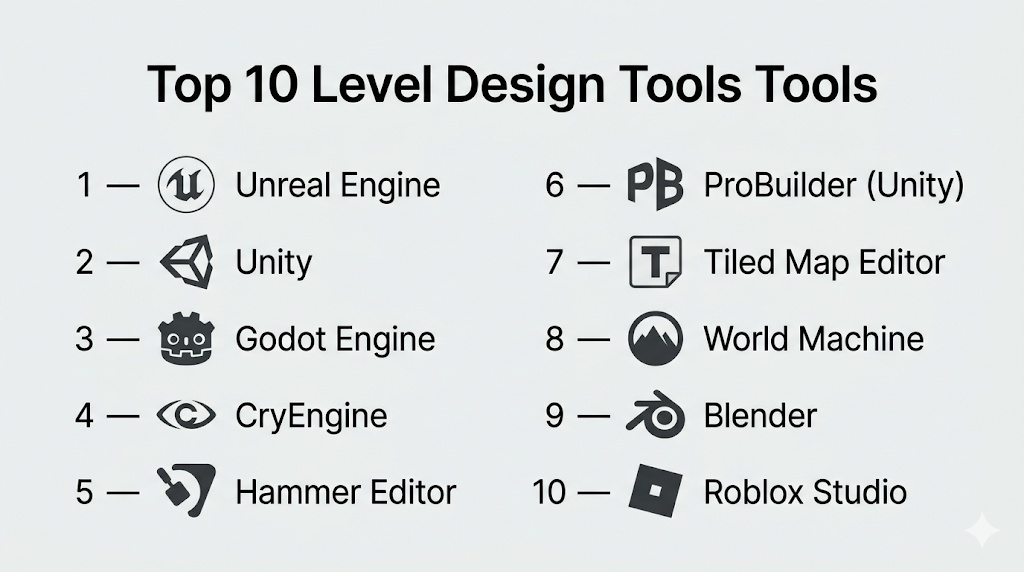
Top 10 Level Design Tools Tools
#1 — Unreal Engine
Short description: A high-end game engine offering advanced level design tools for creating detailed and realistic environments.
Key Features
- Visual scripting system
- Advanced lighting and rendering
- Terrain and landscape editing
- Real-time preview
- Physics and animation systems
- Asset marketplace
Pros
- Exceptional visual quality
- Strong ecosystem and tools
Cons
- Steep learning curve
- High system requirements
Platforms / Deployment
Windows / macOS / Linux
Cloud / Local
Security & Compliance
Not publicly stated
Integrations & Ecosystem
Supports a wide range of tools and workflows.
- Blender, Maya, 3ds Max
- Version control systems
- VR/AR platforms
- Plugin marketplace
Support & Community
Large global community with extensive documentation and support resources.
#2 — Unity
Short description: A flexible engine widely used for building 2D and 3D levels across multiple platforms.
Key Features
- Scene editor with real-time updates
- Cross-platform support
- Asset store integration
- Terrain and lighting tools
- Scriptable workflows
- Collaboration features
Pros
- Beginner-friendly
- Strong mobile and cross-platform support
Cons
- Performance tuning can require effort
- Licensing complexity for some users
Platforms / Deployment
Windows / macOS / Linux
Cloud / Local
Security & Compliance
Not publicly stated
Integrations & Ecosystem
Broad integration ecosystem.
- Development IDEs
- 3D modeling tools
- Version control systems
- Third-party plugins
Support & Community
Extensive tutorials, community forums, and marketplace support.
#3 — Godot Engine
Short description: An open-source engine offering simple and efficient level design tools for indie developers.
Key Features
- Node-based scene system
- Lightweight editor
- Built-in scripting
- 2D and 3D capabilities
- Open-source customization
Pros
- Free to use
- Easy to learn
Cons
- Smaller ecosystem
- Limited support for large-scale projects
Platforms / Deployment
Windows / macOS / Linux
Self-hosted
Security & Compliance
Not publicly stated
Integrations & Ecosystem
Flexible but smaller ecosystem.
- Version control tools
- Community plugins
- Custom scripting
Support & Community
Active open-source community with growing resources.
#4 — CryEngine
Short description: A powerful engine known for creating realistic environments and detailed level design.
Key Features
- Real-time rendering engine
- Terrain editing tools
- Environmental effects
- Sandbox editor
- Physics system
Pros
- High visual realism
- Strong environmental tools
Cons
- Complex interface
- Smaller user base
Platforms / Deployment
Windows
Local
Security & Compliance
Not publicly stated
Integrations & Ecosystem
Supports standard content pipelines.
- 3D modeling tools
- Asset workflows
- Custom plugins
Support & Community
Moderate documentation and community support.
#5 — Hammer Editor
Short description: A classic level editor used for building maps in Source-based games.
Key Features
- Brush-based level design
- Entity system
- Real-time previews
- Engine integration
Pros
- Simple and proven workflow
- Strong modding support
Cons
- Outdated interface
- Limited modern features
Platforms / Deployment
Windows
Local
Security & Compliance
Not publicly stated
Integrations & Ecosystem
Focused on Source engine ecosystem.
- Game SDK tools
- Modding platforms
Support & Community
Legacy community with available tutorials and guides.
#6 — ProBuilder (Unity)
Short description: A built-in Unity tool for rapid level prototyping and geometry creation.
Key Features
- In-editor modeling
- Geometry editing
- UV mapping
- Fast prototyping tools
Pros
- Seamless Unity integration
- Speeds up iteration
Cons
- Limited advanced modeling features
- Requires Unity
Platforms / Deployment
Windows / macOS
Local
Security & Compliance
Not publicly stated
Integrations & Ecosystem
Part of Unity ecosystem.
- Asset store
- Third-party extensions
Support & Community
Supported through Unity documentation and community.
#7 — Tiled Map Editor
Short description: A lightweight tool for creating 2D tile-based levels.
Key Features
- Tilemap editing
- Layer-based design
- Object placement
- Export options
Pros
- Easy to use
- Ideal for 2D games
Cons
- Limited to 2D
- Basic feature set
Platforms / Deployment
Windows / macOS / Linux
Local
Security & Compliance
Not publicly stated
Integrations & Ecosystem
Compatible with multiple engines.
- Unity
- Godot
- Custom engines
Support & Community
Strong indie developer community.
#8 — World Machine
Short description: A specialized tool for creating realistic terrain and landscapes.
Key Features
- Procedural terrain generation
- Erosion simulation
- Node-based workflow
- Heightmap export
Pros
- High-quality terrain creation
- Powerful procedural tools
Cons
- Steep learning curve
- Limited to terrain design
Platforms / Deployment
Windows
Local
Security & Compliance
Not publicly stated
Integrations & Ecosystem
Exports to major engines and tools.
- Game engines
- GIS tools
Support & Community
Niche but dedicated user base.
#9 — Blender
Short description: A comprehensive 3D creation tool used for building assets and environments for levels.
Key Features
- 3D modeling
- Sculpting tools
- Rendering engine
- Node-based materials
Pros
- Free and powerful
- Large ecosystem
Cons
- Not focused solely on level design
- Complex interface
Platforms / Deployment
Windows / macOS / Linux
Local
Security & Compliance
Not publicly stated
Integrations & Ecosystem
Extensive ecosystem.
- Game engines
- Add-ons
- Rendering tools
Support & Community
Very large global community and extensive tutorials.
#10 — Roblox Studio
Short description: A beginner-friendly platform for creating and publishing interactive levels and games.
Key Features
- Drag-and-drop editor
- Scripting support
- Built-in asset library
- Multiplayer testing
Pros
- Easy to learn
- Integrated publishing
Cons
- Platform limitations
- Less control for advanced users
Platforms / Deployment
Windows / macOS
Cloud
Security & Compliance
Not publicly stated
Integrations & Ecosystem
Focused ecosystem.
- Built-in assets
- Community plugins
Support & Community
Very active community with strong learning resources.
Comparison Table (Top 10)
| Tool Name | Best For | Platform(s) Supported | Deployment | Standout Feature | Public Rating |
|---|---|---|---|---|---|
| Unreal Engine | High-end games | Windows/macOS/Linux | Hybrid | Advanced rendering | N/A |
| Unity | Cross-platform | Windows/macOS/Linux | Hybrid | Versatility | N/A |
| Godot | Indie developers | Windows/macOS/Linux | Self-hosted | Open-source flexibility | N/A |
| CryEngine | Realistic worlds | Windows | Local | Visual fidelity | N/A |
| Hammer Editor | Modding | Windows | Local | Classic workflows | N/A |
| ProBuilder | Rapid prototyping | Windows/macOS | Local | In-editor modeling | N/A |
| Tiled | 2D games | Windows/macOS/Linux | Local | Tile-based editing | N/A |
| World Machine | Terrain design | Windows | Local | Procedural terrain | N/A |
| Blender | Asset creation | Windows/macOS/Linux | Local | 3D modeling | N/A |
| Roblox Studio | Beginners | Windows/macOS | Cloud | Easy publishing | N/A |
Evaluation & Scoring of Level Design Tools
| Tool Name | Core (25%) | Ease (15%) | Integrations (15%) | Security (10%) | Performance (10%) | Support (10%) | Value (15%) | Weighted Total |
|---|---|---|---|---|---|---|---|---|
| Unreal Engine | 10 | 6 | 9 | 6 | 10 | 9 | 8 | 8.6 |
| Unity | 9 | 8 | 9 | 6 | 8 | 9 | 8 | 8.3 |
| Godot | 7 | 9 | 6 | 5 | 7 | 7 | 10 | 7.6 |
| CryEngine | 8 | 5 | 6 | 5 | 9 | 6 | 7 | 7.1 |
| Hammer Editor | 6 | 7 | 5 | 4 | 6 | 6 | 7 | 6.1 |
| ProBuilder | 7 | 8 | 7 | 5 | 7 | 7 | 8 | 7.3 |
| Tiled | 6 | 9 | 6 | 5 | 6 | 7 | 9 | 7.0 |
| World Machine | 8 | 6 | 6 | 5 | 8 | 6 | 7 | 7.1 |
| Blender | 9 | 6 | 9 | 5 | 8 | 10 | 10 | 8.5 |
| Roblox Studio | 7 | 9 | 6 | 5 | 7 | 8 | 9 | 7.6 |
How to interpret the scores:
- Scores are comparative and reflect overall balance
- Higher scores indicate stronger all-around capability
- Choose based on your priorities, not just total score
- Enterprise users should weigh integrations and performance more
- Beginners should prioritize ease of use and value
Which Level Design Tools Tool Is Right for You?
Solo / Freelancer
- Best options: Godot, Tiled, Roblox Studio
- Focus on affordability and ease of learning
SMB
- Best options: Unity, ProBuilder
- Good balance between cost and flexibility
Mid-Market
- Best options: Unity, Unreal Engine
- Need scalability and integration support
Enterprise
- Best options: Unreal Engine, Unity
- Require performance, collaboration, and ecosystem
Budget vs Premium
- Budget: Godot, Blender, Tiled
- Premium: Unreal Engine, Unity
Feature Depth vs Ease of Use
- Deep tools: Unreal Engine, CryEngine
- Easy tools: Roblox Studio, Tiled
Integrations & Scalability
- Strong: Unity, Unreal Engine
- Limited: Hammer Editor, Tiled
Security & Compliance Needs
- Most tools: Not publicly stated
- Enterprises should validate internally before adoption
Frequently Asked Questions (FAQs)
What are level design tools?
They are software tools used to create and structure interactive environments in games and simulations.
Are these tools free?
Some are free or open-source, while others use subscriptions or licensing models.
Which tool is best for beginners?
Roblox Studio and Unity are commonly recommended for beginners.
Do I need coding skills?
Not always. Many tools provide visual scripting or drag-and-drop features.
Can I combine multiple tools?
Yes, many workflows use multiple tools together for best results.
Are these tools suitable for mobile games?
Yes, especially engines that support cross-platform development.
How long does it take to learn?
It depends on the tool. Basic tools can be learned quickly, while advanced engines take more time.
Are cloud-based tools available?
Some tools offer cloud features, but many still rely on local setups.
What are common mistakes when choosing a tool?
Choosing based only on popularity instead of specific project needs.
Can I switch tools later?
Yes, but switching may require reworking assets and workflows.
Conclusion
Level design tools play a central role in building engaging and interactive experiences. From lightweight editors to full-scale game engines, each tool offers unique strengths depending on your goals, skill level, and project scope.