Introduction
Finite Element Analysis (FEA) software helps engineers simulate how products, materials, and structures behave under real-world conditions such as stress, heat, vibration, and pressure. Instead of relying solely on physical prototypes, teams can test designs digitally, identify weaknesses, and optimize performance before manufacturing.
FEA has become essential as products grow more complex and development cycles shorten. Engineering teams across industries now depend on simulation-driven design to reduce costs, improve safety, and accelerate innovation.
Common use cases include:
- Structural analysis of buildings, bridges, and machinery
- Thermal simulation in electronics and energy systems
- Crash and safety testing in automotive engineering
- Aerospace component stress and fatigue analysis
- Product optimization and lightweight design
Key evaluation criteria:
- Simulation accuracy and solver strength
- Ease of use and learning curve
- CAD and PLM integration
- Performance for large-scale models
- Multi-physics capabilities
- Automation and workflow efficiency
- Deployment flexibility (cloud vs on-premise)
- Pricing and licensing model
- Support and documentation quality
Best for: Mechanical engineers, simulation specialists, product designers, R&D teams, and engineering firms working on complex systems.
Not ideal for: Non-technical users or teams that only need simple calculations. In such cases, basic analytical tools may be more appropriate.
Key Trends in Finite Element Analysis (FEA) Software
- AI-assisted simulation setup: Automation of meshing, boundary conditions, and result interpretation
- Cloud-based simulation platforms: Increasing adoption of browser-based tools for scalability and collaboration
- Real-time simulation feedback: Faster solvers enabling quicker design iterations
- Digital twin integration: Linking simulations with real-world data for predictive insights
- Multi-physics convergence: Unified platforms combining structural, thermal, and fluid analysis
- Low-code workflows: Simplifying simulation for non-expert users
- High-performance computing (HPC): Leveraging GPUs and distributed computing
- Improved interoperability: Seamless integration with CAD, PLM, and IoT systems
- Flexible pricing models: Subscription-based and usage-based licensing
- Compliance-focused simulation: Increased emphasis on safety and regulatory requirements
How We Selected These Tools (Methodology)
- Evaluated market adoption and industry usage
- Assessed feature completeness across simulation types
- Reviewed performance and scalability for complex models
- Analyzed integration capabilities with engineering ecosystems
- Considered ease of use for different skill levels
- Examined deployment options (cloud vs self-hosted)
- Reviewed support, documentation, and training resources
- Considered security posture where publicly known
- Included tools across enterprise, SMB, and open-source segments
- Ensured broad applicability across industries
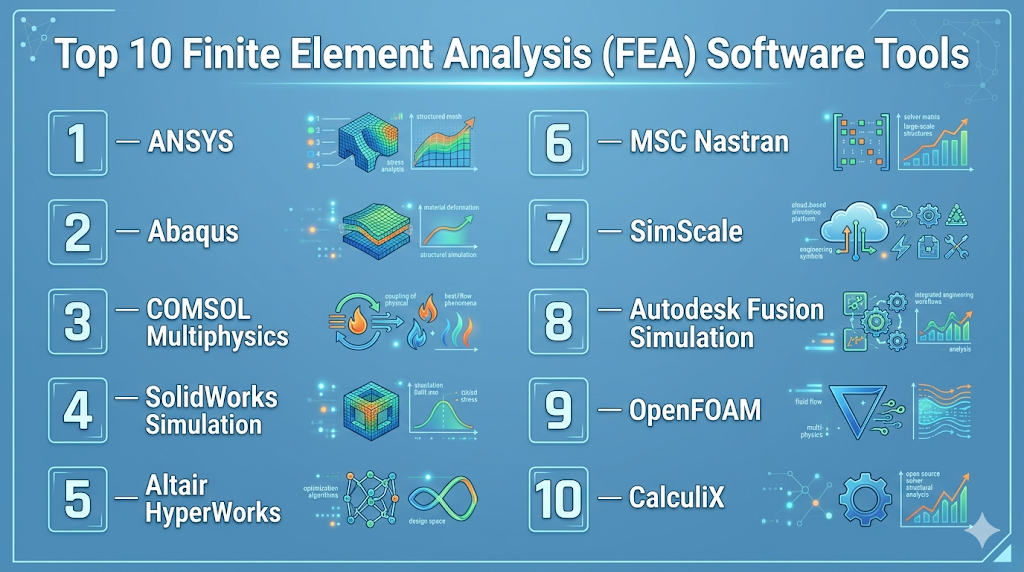
Top 10 Finite Element Analysis (FEA) Software Tools
#1 — ANSYS
Short description: A widely used enterprise-grade simulation platform for advanced multi-physics analysis across industries.
Key Features
- Structural, thermal, and fluid simulation
- High-performance solvers
- Multi-physics capabilities
- Advanced material modeling
- Digital twin support
- Simulation automation tools
Pros
- Highly accurate simulations
- Scales well for complex models
Cons
- Steep learning curve
- High cost for full capabilities
Platforms / Deployment
- Windows / Linux
- Cloud / Self-hosted
Security & Compliance
- Not publicly stated
Integrations & Ecosystem
ANSYS integrates with major engineering tools and enterprise workflows.
- CAD platforms
- PLM systems
- APIs and scripting tools
- HPC environments
Support & Community
Extensive documentation, training programs, and a large global user base.
#2 — Abaqus
Short description: A high-end simulation tool known for handling nonlinear and complex engineering problems.
Key Features
- Nonlinear structural analysis
- Dynamic and impact simulations
- Advanced material modeling
- Multi-step simulations
- Python scripting
Pros
- Strong for complex simulations
- Highly customizable
Cons
- Difficult for beginners
- Interface can be complex
Platforms / Deployment
- Windows / Linux
- Self-hosted
Security & Compliance
- Not publicly stated
Integrations & Ecosystem
Part of a larger engineering ecosystem with strong interoperability.
- CAD integrations
- PLM systems
- Scripting APIs
Support & Community
Strong academic and enterprise support network.
#3 — COMSOL Multiphysics
Short description: A flexible platform designed for custom multi-physics simulations across engineering disciplines.
Key Features
- Multi-physics modeling
- Custom physics interfaces
- Application builder
- Advanced visualization
- Scripting support
Pros
- Highly flexible
- Suitable for research and innovation
Cons
- Requires domain expertise
- Higher cost
Platforms / Deployment
- Windows / macOS / Linux
- Self-hosted
Security & Compliance
- Not publicly stated
Integrations & Ecosystem
Supports custom workflows and integrations.
- MATLAB integration
- APIs
- Custom simulation apps
Support & Community
Strong documentation and academic usage.
#4 — SolidWorks Simulation
Short description: A simulation solution integrated within a popular CAD environment, ideal for design engineers.
Key Features
- Integrated CAD simulation
- Linear and nonlinear analysis
- Fatigue and motion analysis
- User-friendly interface
- Visualization tools
Pros
- Easy to learn
- Seamless CAD workflow
Cons
- Limited advanced simulation capabilities
- Not ideal for very large models
Platforms / Deployment
- Windows
- Self-hosted
Security & Compliance
- Not publicly stated
Integrations & Ecosystem
Works within its native CAD ecosystem.
- CAD tools
- Product data management systems
- Add-ons
Support & Community
Large user base with strong documentation.
#5 — Altair HyperWorks
Short description: A comprehensive simulation suite known for optimization and advanced engineering workflows.
Key Features
- Multi-physics simulation
- Design optimization tools
- HPC support
- Data analytics integration
- Visualization capabilities
Pros
- Strong optimization features
- Scalable for enterprise use
Cons
- Complex interface
- Licensing complexity
Platforms / Deployment
- Windows / Linux
- Cloud / Self-hosted
Security & Compliance
- Not publicly stated
Integrations & Ecosystem
Supports a wide engineering ecosystem.
- CAD integrations
- APIs
- Data tools
Support & Community
Good enterprise-level support and training.
#6 — MSC Nastran
Short description: A well-established simulation solver widely used in aerospace and automotive industries.
Key Features
- Structural analysis
- Dynamic simulation
- Linear and nonlinear capabilities
- Reliable solver performance
- Industry-standard workflows
Pros
- Proven reliability
- Widely trusted in critical industries
Cons
- Outdated interface
- Requires expertise
Platforms / Deployment
- Windows / Linux
- Self-hosted
Security & Compliance
- Not publicly stated
Integrations & Ecosystem
Compatible with various simulation tools.
- CAD integrations
- Pre/post processors
- APIs
Support & Community
Strong legacy support and industry adoption.
#7 — SimScale
Short description: A cloud-based simulation platform focused on accessibility and collaboration.
Key Features
- Browser-based simulation
- Multi-physics capabilities
- Collaboration tools
- Scalable cloud computing
- No installation required
Pros
- Easy to access
- Supports remote collaboration
Cons
- Requires stable internet
- Limited offline capabilities
Platforms / Deployment
- Web
- Cloud
Security & Compliance
- Not publicly stated
Integrations & Ecosystem
Designed for cloud workflows.
- CAD imports
- APIs
- Collaboration features
Support & Community
Growing documentation and user community.
#8 — Autodesk Fusion Simulation
Short description: An integrated design and simulation tool suitable for product development teams.
Key Features
- Cloud-based simulation
- Integrated CAD and CAM
- Generative design
- Stress and thermal analysis
- Collaboration tools
Pros
- All-in-one platform
- Accessible for smaller teams
Cons
- Limited advanced simulation depth
- Performance limitations
Platforms / Deployment
- Web / Windows / macOS
- Cloud
Security & Compliance
- Not publicly stated
Integrations & Ecosystem
Part of a broader design ecosystem.
- CAD tools
- Cloud storage
- APIs
Support & Community
Strong community and documentation.
#9 — OpenFOAM
Short description: An open-source platform focused on computational fluid dynamics with high customization.
Key Features
- CFD simulation
- Custom solver development
- Parallel computing
- Open-source flexibility
- Large community
Pros
- Free and customizable
- Highly flexible
Cons
- Steep learning curve
- Limited graphical interface
Platforms / Deployment
- Linux / Windows
- Self-hosted
Security & Compliance
- Not publicly stated
Integrations & Ecosystem
Extensible through custom development.
- APIs
- HPC integration
- Community tools
Support & Community
Strong open-source community.
#10 — CalculiX
Short description: A lightweight open-source FEA tool suitable for basic to intermediate simulations.
Key Features
- Structural analysis
- Nonlinear simulation
- Lightweight performance
- Open-source
- Compatible input formats
Pros
- Free to use
- Simple setup
Cons
- Limited advanced features
- Minimal user interface
Platforms / Deployment
- Windows / Linux
- Self-hosted
Security & Compliance
- Not publicly stated
Integrations & Ecosystem
Works with open-source tools.
- Pre/post processors
- APIs
- Community plugins
Support & Community
Smaller but active community.
Comparison Table (Top 10)
| Tool Name | Best For | Platform(s) Supported | Deployment | Standout Feature | Public Rating |
|---|---|---|---|---|---|
| ANSYS | Enterprise simulation | Windows, Linux | Hybrid | Multi-physics depth | N/A |
| Abaqus | Complex analysis | Windows, Linux | Self-hosted | Nonlinear simulation | N/A |
| COMSOL | Custom modeling | Windows, macOS, Linux | Self-hosted | Flexibility | N/A |
| SolidWorks Simulation | CAD users | Windows | Self-hosted | CAD integration | N/A |
| Altair HyperWorks | Optimization | Windows, Linux | Hybrid | Design optimization | N/A |
| MSC Nastran | Aerospace | Windows, Linux | Self-hosted | Reliability | N/A |
| SimScale | Cloud simulation | Web | Cloud | Browser-based | N/A |
| Autodesk Fusion Simulation | SMB teams | Web, Desktop | Cloud | Integrated workflow | N/A |
| OpenFOAM | Developers | Linux, Windows | Self-hosted | Open-source | N/A |
| CalculiX | Budget users | Windows, Linux | Self-hosted | Lightweight | N/A |
Evaluation & Scoring of Finite Element Analysis (FEA) Software
| Tool Name | Core (25%) | Ease (15%) | Integrations (15%) | Security (10%) | Performance (10%) | Support (10%) | Value (15%) | Weighted Total (0–10) |
|---|---|---|---|---|---|---|---|---|
| ANSYS | 10 | 6 | 9 | 7 | 10 | 9 | 6 | 8.4 |
| Abaqus | 9 | 6 | 8 | 7 | 9 | 8 | 6 | 8.0 |
| COMSOL | 9 | 7 | 8 | 7 | 8 | 8 | 6 | 8.0 |
| SolidWorks | 7 | 9 | 7 | 6 | 7 | 8 | 8 | 7.6 |
| Altair | 9 | 6 | 8 | 7 | 9 | 8 | 7 | 8.2 |
| MSC Nastran | 8 | 5 | 7 | 7 | 9 | 7 | 6 | 7.5 |
| SimScale | 7 | 9 | 7 | 6 | 7 | 7 | 8 | 7.6 |
| Fusion Simulation | 7 | 9 | 7 | 6 | 7 | 8 | 9 | 7.8 |
| OpenFOAM | 8 | 4 | 6 | 6 | 8 | 6 | 10 | 7.2 |
| CalculiX | 6 | 5 | 5 | 5 | 6 | 5 | 10 | 6.4 |
How to interpret scores:
- These scores are comparative, not absolute benchmarks.
- Enterprise tools excel in performance and core capabilities.
- Open-source tools score higher in value but lower in usability.
- Ease of use often trades off with advanced functionality.
- Choose based on your workflow, not just the highest score.
Which Finite Element Analysis (FEA) Software Tool Is Right for You?
Solo / Freelancer
- Best options: Fusion Simulation, SimScale
- Focus on ease of use and affordability
SMB
- Best options: SolidWorks Simulation, Fusion Simulation
- Balanced performance and usability
Mid-Market
- Best options: COMSOL, Altair HyperWorks
- Flexible and scalable solutions
Enterprise
- Best options: ANSYS, Abaqus
- High-performance and advanced simulation capabilities
Budget vs Premium
- Budget: OpenFOAM, CalculiX
- Premium: ANSYS, Abaqus
Feature Depth vs Ease of Use
- Easy: Fusion Simulation, SolidWorks
- Advanced: ANSYS, COMSOL
Integrations & Scalability
- Strong: ANSYS, Altair
- Moderate: Fusion Simulation
Security & Compliance Needs
- Enterprise tools generally offer better governance
- Cloud tools require careful evaluation of data policies
Frequently Asked Questions (FAQs)
What is FEA software used for?
FEA software simulates how materials and structures behave under physical forces like stress, heat, and vibration.
Is FEA software expensive?
Costs vary widely. Enterprise tools are expensive, while open-source options are free.
Can beginners use FEA tools?
Yes, beginner-friendly tools exist, but advanced platforms require training.
What industries rely on FEA?
Automotive, aerospace, construction, electronics, and manufacturing industries use FEA extensively.
Is cloud-based FEA reliable?
It can be reliable, depending on infrastructure and connectivity.
What is multi-physics simulation?
It combines multiple physical effects, such as thermal and structural analysis, into one model.
Do I need programming skills?
Not always, but scripting can enhance advanced workflows.
Can FEA replace physical testing?
It reduces the need but does not completely replace real-world testing.
How long do simulations take?
Time depends on model complexity and computing resources.
Are open-source FEA tools viable?
Yes, but they require technical expertise and manual setup.
Conclusion
Finite Element Analysis software plays a critical role in modern engineering by enabling simulation-driven design and reducing reliance on costly prototypes. From powerful enterprise solutions like ANSYS and Abaqus to accessible platforms like Fusion Simulation and SimScale, the market offers a wide range of options.