Introduction
In the modern field of software engineering, security is no longer treated as a final, isolated step in the production line. Instead, a transformation is being observed where security is integrated into every phase of the development lifecycle. For many years, software was built by developers and then handed over to a separate security team for testing. This traditional method is now being replaced by a more unified approach. This shift is driven by the necessity for faster releases and the growing complexity of cyber threats. A specialized role has emerged to lead this change: the DevSecOps Architect.
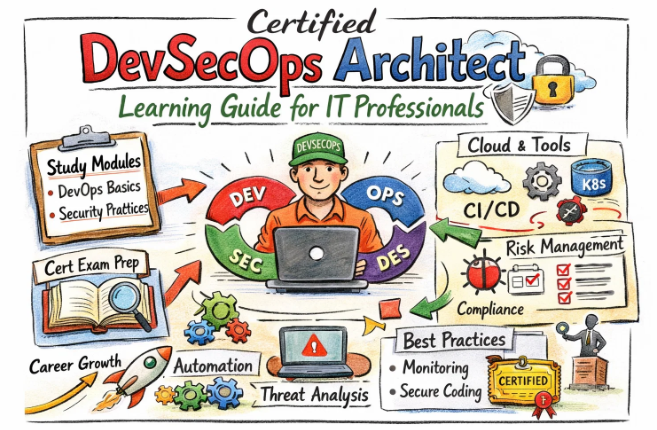
A Certified DevSecOps Architect is an individual who is responsible for designing the blueprints of a secure automation pipeline. High-level strategies are developed by these professionals to ensure that security is woven into every layer of the infrastructure. In the current industry, manual security interventions are seen as a risk to both speed and accuracy. Therefore, architectural solutions are being implemented to make security invisible yet omnipresent.
What is Certified DevSecOps Architect?
The Certified DevSecOps Architect is an advanced professional designation. It is intended for those who wish to master the strategic side of security automation. While an engineer might focus on the implementation of tools, the Architect is responsible for the overall vision and design of the ecosystem.
A deep understanding of how development, operations, and security interact is provided through this program. Mastery over cloud-native security, infrastructure as code, and automated governance is achieved by the candidates. It is recognized as a mark of technical authority, signifying that an individual can design systems that are both agile and resilient.
Why it Matters Today?
The global digital landscape is currently facing an unprecedented rise in sophisticated cyberattacks. Data breaches are reported frequently, causing massive financial and reputational damage to organizations. Because of this, security is being prioritized at the highest levels of corporate leadership.
Software is being released at a pace that was previously thought impossible. If security is not automated at an architectural level, the risk of a vulnerability reaching production is significantly increased. DevSecOps is being adopted to move security “to the left,” ensuring that risks are mitigated at the earliest possible stage. A Certified DevSecOps Architect is required to ensure this shift is both scalable and effective.
Why Certified DevSecOps Architect Certifications are Important?
Professional validation is provided when a certification of this level is earned. It is viewed by global employers as proof that a candidate possesses specialized skills that go beyond basic scriptwriting. In a competitive job market, certified architects are often selected for high-level leadership and advisory roles.
Furthermore, a standardized framework for security architecture is provided by this certification. Best practices are followed, leading to the creation of more robust and secure applications. Knowledge gaps are often closed during the rigorous certification process. Complex security challenges are solved more effectively when a structured, expert-led path has been followed. It is a long-term investment in a professional’s career stability.
Why Choose DevSecOpsSchool?
A specialized focus on security-integrated automation is provided by DevSecOpsSchool. Unlike generalist platforms, this institution is dedicated entirely to the niche of DevSecOps, SRE, and cloud-native security. A practical, hands-on learning environment is offered where real-world industry scenarios are replicated for the benefit of the learners.
The curriculum at DevSecOpsSchool is governed by industry veterans who have spent a significant amount of time securing enterprise environments. Continuous support is provided to all candidates, ensuring they are prepared for both the exam and their daily professional duties. Lifetime access to a rich library of learning materials and technical forums is included. For engineers in India and across the global market, DevSecOpsSchool is recognized as a trusted partner for mastering advanced security architecture.
Certification Deep-Dive: Certified DevSecOps Architect
What is this certification?
The Certified DevSecOps Architect is a high-level credential that validates an individual’s expertise in designing secure software delivery pipelines. It focuses on the automation of security testing, compliance as code, and the creation of secure cloud-native architectures.
Who should take this certification?
This program is highly recommended for senior software engineers, DevOps leads, and cloud architects. Security professionals who want to master automation and platform engineers who need to embed security into their infrastructure should also consider this certification.
Certification Overview Table
| Track | Level | Who it’s for | Prerequisites | Skills Covered | Recommended Order |
| DevSecOps | Architect | Senior Engineers | DevOps Basics | Security Design, GRC, IaC Security | 2nd or 3rd |
| DevOps | Professional | Cloud Engineers | Linux & Scripting | CI/CD, Automation, Monitoring | 1st |
| SRE | Professional | Ops Engineers | DevOps Knowledge | Reliability, Error Budgets, Metrics | 2nd |
| AIOps/MLOps | Advanced | Data Scientists | Python & Cloud | ML Pipelines, AI Monitoring | 4th |
| DataOps | Advanced | Data Engineers | SQL & Big Data | Data Pipelines, Governance | 4th |
| FinOps | Professional | Managers/Finance | Cloud Billing | Cost Optimization, Accountability | 5th |
Skills You Will Gain
- The ability to design “secure-by-design” systems is mastered.
- Automated security gates are integrated into high-speed CI/CD pipelines.
- Infrastructure as Code (IaC) is secured using automated scanning and policy enforcement.
- Sensitive data and secrets are managed using enterprise-grade vaulting solutions.
- Compliance as Code is implemented to meet international regulatory standards.
- Advanced threat modeling techniques are applied to identify risks during the design phase.
- Vulnerability management programs are automated across multi-cloud environments.
- Security monitoring and real-time alerting systems are architected for maximum visibility.
Real-World Projects
- A fully automated secure CI/CD pipeline is designed and implemented from scratch.
- Security scanning tools are integrated into a multi-cluster Kubernetes environment.
- Automated compliance audits are conducted on a large-scale enterprise infrastructure.
- A centralized secrets management system is architected for a microservices platform.
- Real-time security observability dashboards are created for proactive threat detection.
Preparation Plan
7–14 Days Plan
- The core concepts of DevSecOps architecture are reviewed during the first few days.
- Official training materials and architectural patterns are studied with focus.
- Short-duration practice labs are completed to understand tool-to-tool integration.
- Mock exams are taken to identify and improve specific technical weak points.
30 Days Plan
- One hour is spent every day on theoretical study and architectural design review.
- Hands-on practice sessions are conducted twice a week for deeper tool mastery.
- Real-world security case studies are analyzed to learn from common industry failures.
- The final week is dedicated to intensive revision and final practice examinations.
60 Days Plan
- A deep exploration of each individual security domain is conducted over several weeks.
- Multiple complex projects are built from the ground up to gain extensive practical experience.
- Active participation in technical security forums is encouraged to stay updated on new threats.
- Group study sessions are joined to discuss complex architectural challenges with peers.
Common Mistakes to Avoid
- Security is often treated as a simple checklist rather than a core cultural shift.
- Excessive reliance is placed on automated tools without understanding underlying principles.
- The importance of cross-team collaboration is frequently underestimated by architects.
- Basic prerequisites are often skipped, leading to confusion in advanced technical modules.
- Monitoring and logging are sometimes ignored during the initial design phase.
Best Next Certification After This
Same Track:
- Certified DevSecOps Expert (for those seeking the highest level of technical specialization).
Cross-Track:
- Certified Site Reliability Engineer (to balance security with extreme system reliability).
Leadership / Management:
- Certified Engineering Manager (for moving into executive leadership and strategy roles).
Choose Your Learning Path
DevOps Path
This path is best for individuals who want to master the flow of software from development to production. Automation of the entire delivery lifecycle is the main focus. It is ideal for those who enjoy improving operational efficiency and speed.
DevSecOps Path
This path is designed for engineers who are passionate about security and automation. The integration of security checks into every stage of the pipeline is emphasized. It is best for those who want to ensure that every release is safe and compliant.
Site Reliability Engineering (SRE) Path
Reliability, availability, and scalability are the primary goals of this path. It is best for professionals who want to apply software engineering practices to solve complex operational problems. Incident management and system performance are key topics.
AIOps / MLOps Path
This path is best for data professionals and engineers working with artificial intelligence. The deployment and management of machine learning models are automated. It is ideal for those who want to work with cutting-edge AI technologies in production.
DataOps Path
The management of data pipelines and data quality is focused on here. It is best for data architects and engineers who want to bring agility and security to the data management process. Efficiency and accuracy in data delivery are prioritized.
FinOps Path
Financial accountability and cloud cost optimization are the core of this path. It is best for managers and engineers who want to ensure that cloud spending is perfectly aligned with business objectives. Efficiency in resource usage is mastered.
Role → Recommended Certifications Mapping
| Role | Primary Certification | Secondary Certification |
| DevOps Engineer | Certified DevOps Professional | Certified DevSecOps Architect |
| SRE | Certified SRE Professional | Certified DevSecOps Architect |
| Platform Engineer | Certified Kubernetes Expert | Certified DevSecOps Architect |
| Cloud Engineer | Certified Cloud Architect | Certified DevSecOps Architect |
| Security Engineer | Certified DevSecOps Architect | Certified DevSecOps Expert |
| Data Engineer | Certified DataOps Professional | Certified MLOps Professional |
| FinOps Practitioner | Certified FinOps Professional | Certified Cloud Architect |
| Engineering Manager | Certified Engineering Manager | Certified FinOps Professional |
Next Certifications to Take
For DevOps Learners
- Same-track: Master in DevOps Engineering.
- Cross-track: SRE Certified Professional.
- Leadership-focused: Certified IT Director.
For Security Learners
- Same-track: DevSecOps Certified Professional.
- Cross-track: Certified Cloud Security Engineer.
- Leadership-focused: Chief Information Security Officer training.
For Data Professionals
- Same-track: Certified DataOps Architect.
- Cross-track: Certified MLOps Professional.
- Leadership-focused: Executive Master in Tech Leadership.
Training & Certification Support Institutions
DevOpsSchool
A wide range of certifications in DevOps and automation is offered here. Practical, project-based learning is provided to all students globally. It is considered a pioneer in technical training.
Cotocus
Professional consulting and training services are delivered by this institution. Specialized tracks for cloud-native technologies and containerization are maintained for enterprise teams.
ScmGalaxy
A massive repository of technical knowledge and community-driven blogs is hosted here. Deep technical expertise in software configuration management is shared with the global community.
BestDevOps
Practical career guidance and skill development are the primary focus of this platform. The curriculum is designed to meet the specific needs of the current high-demand job market.
devsecopsschool.com
Dedicated training for security automation and architecture is hosted on this site. Deep dives into vulnerability management, secure CI/CD design, and automated compliance are provided. The curriculum is built to transform engineers into high-level security architects who can lead enterprise transformations.
sreschool.com
A strong focus is placed on reliability engineering and operational excellence. The principles of error budgets, toil reduction, and incident management are taught in depth. This platform is ideal for those who wish to ensure that systems remain stable under extreme pressure.
aiopsschool.com
The intersection of AI and operations is explored in depth through specialized courses. Automation driven by machine learning and anomaly detection is a core focus. It is designed for forward-thinking professionals who want to apply artificial intelligence to solve operational challenges.
dataopsschool.com
Mastery of data pipelines and DataOps methodologies is offered to data professionals. The entire lifecycle of data, from ingestion to production, is covered with an emphasis on agility and quality. This site is the go-to resource for data engineers moving into the DevOps world.
finopsschool.com
Professional training in cloud financial management and cost optimization is provided. The culture of financial accountability in the cloud is promoted through specialized certifications. It is intended for those who need to balance technical performance with business value and cost efficiency.
FAQs Section
- Is the Certified DevSecOps Architect exam considered difficult?
The exam is known for its advanced difficulty, testing practical design skills rather than simple theory. - How much time is generally needed for preparation?
Usually, 30 to 60 days of consistent study is recommended for most working professionals. - What are the recommended prerequisites for the Architect level?
A basic understanding of DevOps principles and cloud platforms is expected before starting. - In what order should these certifications be pursued?
A professional-level certification is often earned first, followed by the architect-level program. - What is the perceived value of this certification in the job market?
A significant increase in career opportunities and salary is often observed by certified architects. - Which job roles can be applied for after successful certification?
Roles such as Security Architect, Lead DevSecOps Engineer, and Principal Architect are commonly pursued. - Is this certification recognized by international employers?
Yes, it is recognized globally as it follows international standards for security and automation. - Can a technical manager benefit from this certification?
Yes, managers who want to understand the architectural design of secure systems will find it very beneficial. - Are real-world labs included as part of the training?
Yes, hands-on lab sessions are a mandatory and core part of the learning process. - What specific tools are covered in the architect track?
Tools for threat modeling, vaulting, and automated security scanning are extensively covered. - Is post-certification support provided to the candidates?
Access to alumni networks and updated technical resources is usually provided by the institution. - How frequently is the course content updated?
The curriculum is updated regularly to ensure that the latest industry threats and tools are included.
Additional FAQs: Certified DevSecOps Architect
- Is coding knowledge required for a DevSecOps Architect?
A basic understanding of scripting is necessary because security is implemented as code. - Does this certification cover multi-cloud security environments?
Yes, security principles for AWS, Azure, and Google Cloud are all included in the curriculum. - What is the required passing score for the certification?
A score of 70% or higher is generally required to pass the exam and earn the certificate. - Is re-certification required after a certain period?
Periodic updates are encouraged every few years to maintain up-to-date technical skills. - How are the certification exams delivered to the candidates?
Exams are typically delivered online in a secure and proctored environment. - Are flexible payment options available for the course fee?
Various payment plans are often provided by the institution to make the training accessible. - Is threat modeling a major component of the training?
Yes, identifying potential security risks through threat modeling is a key skill taught in this program. - Can this certification help in moving toward a CISO role?
A strong technical and architectural foundation is provided, which is essential for future executive roles.
Testimonials
Arjun
A complete shift in perspective regarding security automation was experienced. The skills gained are now applied daily to design secure and resilient cloud infrastructures.
Sneha
The practical nature of the labs provided a real-world experience that was extremely valuable. Complex concepts like Compliance as Code were made easy to understand.
Vikram
Career clarity was achieved through the mentorship provided during the training. A much better understanding of how to lead a security transformation was gained.
Ananya
Confidence in designing secure pipelines for microservices grew significantly. The focus on architectural decision-making was the most beneficial part of the entire program.
Rahul
The ability to automate security gates has completely changed the way my team operates. This certification is highly recommended for any senior engineer or lead.
Conclusion
The importance of the Certified DevSecOps Architect certification is growing as the world moves toward more automated and cloud-native systems. Security can no longer be an afterthought; it must be built into the very foundation of the software. Long-term career benefits are enjoyed by those who take the time to master these advanced architectural skills. Strategic learning and careful certification planning are encouraged for everyone in the IT industry. The shift toward DevSecOps is a continuous journey, and becoming a certified architect is a major milestone in that professional path.