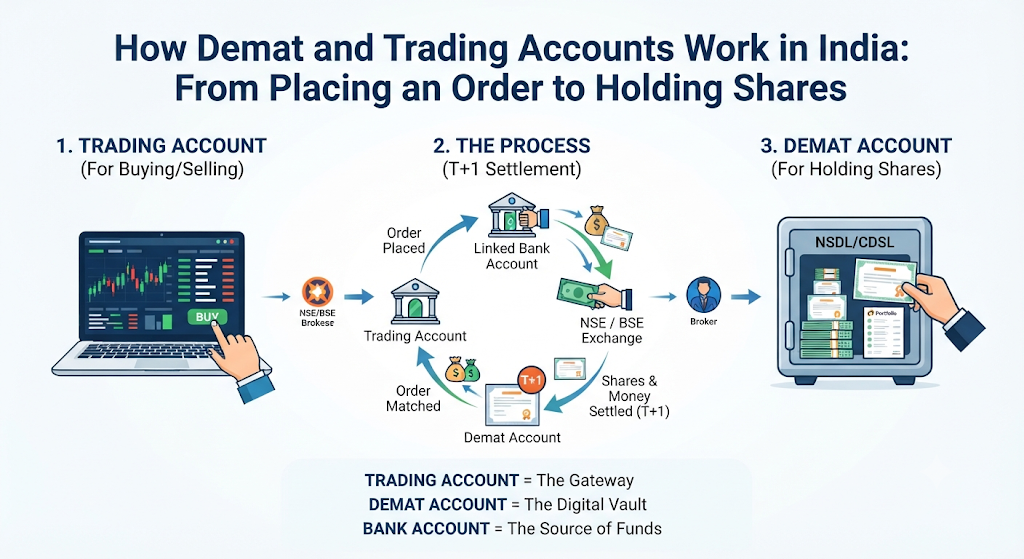
Buying shares in the Indian stock market takes just a few taps on a mobile screen. Behind that simple action, however, three separate accounts work together in real time: your bank account, your trading account, and your Demat account.
Many first-time investors open these accounts as a single bundle without knowing what each one actually does. Understanding how money and shares move between these accounts helps you avoid unexpected charges, track your holdings properly, and make sense of market settlement rules.
The Three-Pillar Setup Behind Every Stock Trade
Think of participating in the Indian equity market like shopping online with a digital locker. You need a wallet to pay, a checkout counter to place the order, and a secure vault to store what you bought.
- Your Savings Bank Account: Holds your cash. You transfer funds from here when buying shares, and you receive payouts here when selling shares or earning dividends.
- Your Trading Account: Acts as the bridge between your bank and the stock exchanges—the National Stock Exchange (NSE) and the Bombay Stock Exchange (BSE). It lets you place buy and sell orders during market hours.
- Your Demat (Dematerialized) Account: Works like a digital vault. Instead of holding physical paper share certificates, it stores your stocks, exchange-traded funds (ETFs), bonds, and mutual fund units in electronic form.
A stockbroker registered with the Securities and Exchange Board of India (SEBI) typically opens both the trading and Demat accounts for you at the same time and links them to your existing bank account.
Demat Account vs. Trading Account: Core Differences
Although brokers bundle them together, these two accounts perform completely different jobs.
| Feature | Trading Account | Demat Account |
| Primary Function | Executes buy and sell orders on NSE/BSE | Stores securities safely in electronic format |
| Analogy | A current account used for active transactions | A bank locker or savings vault for storage |
| Managed By | SEBI-registered stockbrokers | Depositories (NSDL or CDSL) via Depository Participants |
| Holding Period | Holds nothing overnight; processes daily trades | Holds investments for days, months, or decades |
| Main Charges | Brokerage fees, exchange fees, and statutory taxes | Annual Maintenance Charges (AMC) and debit transaction fees |
Who Actually Holds Your Shares? NSDL, CDSL, and DPs
A common worry among new investors is what happens to their shares if their stockbroker shuts down. Your shares do not sit on your broker’s personal servers.
In India, electronic securities are held centrally by two government-regulated depositories:
- NSDL (National Securities Depository Limited)
- CDSL (Central Depository Services Limited)
You cannot open an account directly with NSDL or CDSL. Instead, you access them through an intermediary called a Depository Participant (DP)—which is usually your stockbroker or bank. The DP provides the app or web portal you use to view your portfolio, while the depository keeps the official legal record of your ownership. Even if a broker closes operations, your shares remain safe with NSDL or CDSL and can be transferred to another DP.
Step-by-Step: What Happens When You Buy and Sell Shares
To see how both accounts interact, follow the lifecycle of a standard delivery trade on the Indian exchanges.
Phase 1: Buying Shares
- Adding Funds: You transfer ₹10,000 from your linked bank account into your trading account ledger via UPI or net banking.
- Placing the Order: You log into your broker’s trading terminal and place a buy order for 10 shares of a company at ₹1,000 each.
- Order Matching: Your broker routes the order to the NSE or BSE. The exchange matches your buy order with someone willing to sell at ₹1,000.
- Settlement (T+1 Cycle): India follows a T+1 settlement cycle, where “T” stands for the trading day. Once the trade executes on Day T, the clearing corporation processes the exchange of cash and shares. By the next working day (T+1), the ₹10,000 is paid out to the seller, and the 10 shares are credited directly into your Demat account.
Phase 2: Selling Shares
- Order Execution: When you decide to sell those 10 shares, you place a sell order through your trading account.
- Authorization (DDPI or e-DIS): Because shares are leaving your Demat vault, you must authorize the debit. Investors do this either by submitting a Demat Debit and Pledge Instruction (DDPI) or by verifying the sale using a CDSL TPIN and one-time password (OTP) on the day of the trade.
- Payout: The shares are debited from your Demat account and delivered to the buyer. On T+1, the sale proceeds are credited to your trading ledger, from where you can withdraw the funds back to your bank account.
Costs You Should Expect
Operating these accounts involves two distinct sets of expenses:
- Trading Costs: Paid every time you buy or sell. These include your broker’s commission (zero or flat-fee for delivery on many discount brokers), Securities Transaction Tax (STT), SEBI turnover charges, exchange transaction fees, stamp duty, and GST.
- Demat Costs: Paid for maintaining and moving securities in your depository account. Most DPs charge an Annual Maintenance Charge (AMC) ranging from ₹0 to ₹1,000 per year depending on the broker and account tier. Additionally, whenever you sell shares from your Demat account, the DP charges a small flat fee per company (known as DP charges) to debit the shares.
Practical Scenarios: When You Need One or Both
Not every market activity uses both accounts in the exact same way:
- Long-Term Stock Investing: Uses both accounts. You buy through the trading account and hold in the Demat account.
- Intraday Equity Trading: Uses only the trading account for execution. Because you buy and sell the shares on the exact same day before the market closes, the shares never enter or leave your Demat account.
- Applying for an IPO: Uses your bank account (via ASBA/UPI mandate) to block funds and your Demat account to receive allotted shares. You only need the trading account later when you decide to sell those shares on the exchange.
- Mutual Funds: Can be held in either Demat form (requiring a Demat account) or Statement of Account (SoA) form directly with the Asset Management Company without needing a Demat account.
Frequently Asked Questions
Can I open a Demat account without a trading account?
Yes. If you only plan to apply for Initial Public Offerings (IPOs), hold sovereign gold bonds, or receive gifted shares without actively buying and selling on the stock exchange, you can open a standalone Demat account. However, you will not be able to sell those shares on the open market until you link a trading account.
Is it legal to have multiple Demat and trading accounts in India?
Yes, an individual can open multiple Demat and trading accounts with different SEBI-registered brokers using the same PAN card. However, you cannot open two Demat accounts with the exact same Depository Participant under the same name, and each account may carry separate annual maintenance charges.
What happens if I do not use my Demat or trading account for a long time?
If you place no trades for 12 to 24 months (depending on broker policies and SEBI guidelines), your trading account is marked as dormant or inactive to protect against unauthorized access. Your shares inside the Demat account remain completely safe, and you can reactivate the trading account anytime by completing a quick re-KYC verification.
Do dividends go into my Demat account or my bank account?
Cash dividends go directly into your linked savings bank account. Your Demat account simply records how many shares you own on the company’s record date so the company knows where to send the payout. Bonus shares and stock splits, however, are credited directly into your Demat account.
What is a 3-in-1 account?
A 3-in-1 account combines a savings bank account, a trading account, and a Demat account under one banking group. It allows seamless, automated fund transfers during trades without needing manual UPI or net banking top-ups, though brokerage rates on traditional bank-based 3-in-1 accounts are often higher than standalone discount brokers.
Getting Started Safely
Before opening your accounts, compare brokers based on their brokerage structure, annual Demat maintenance fees, and reliability during peak market hours. Always verify that your chosen broker and Depository Participant are registered with SEBI, enable two-factor authentication on your trading app, and never share your CDSL/NSDL TPIN or OTPs with anyone.