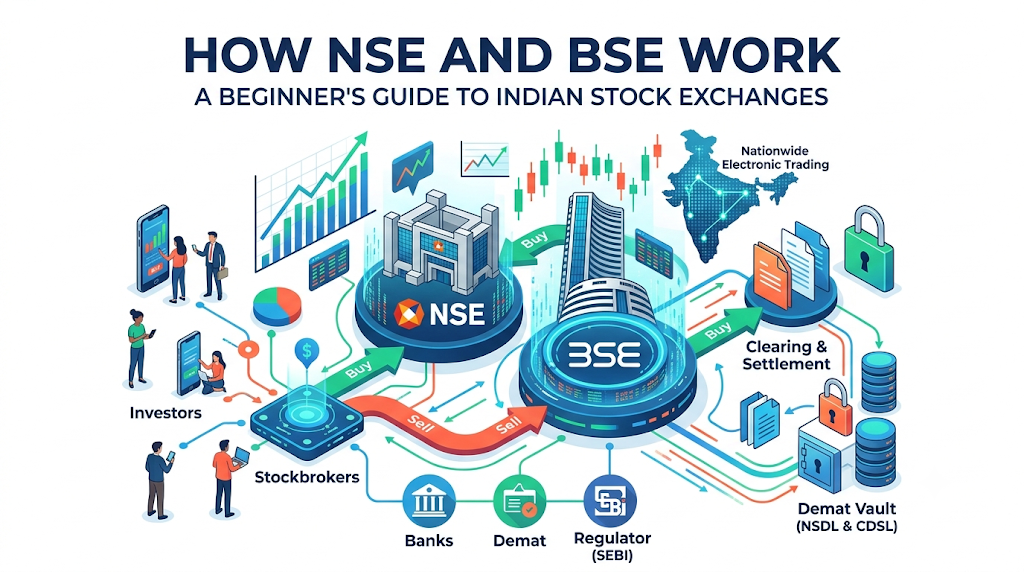
When you buy shares of an Indian company through a trading app, the transaction feels almost instantaneous. You tap a button, enter a price, and within seconds, the shares appear in your account. Behind that simple screen sits a tightly regulated digital infrastructure connecting millions of buyers, sellers, brokers, and banks across the country.
In India, almost all equity trading happens on two primary platforms: the National Stock Exchange (NSE) and the Bombay Stock Exchange (BSE). Understanding how these exchanges operate helps beginners see where their money goes, how share prices move, and what protects their investments.
What Are NSE and BSE?
At their core, NSE and BSE are organized marketplaces. Just as a local market brings farmers and grocery shoppers together, a stock exchange brings people who want to buy company shares together with people who want to sell them.
- Bombay Stock Exchange (BSE): Established in 1875, BSE is the oldest stock exchange in Asia. Located on Dalal Street in Mumbai, it transitioned from traditional open-outcry floor trading to a fully electronic system called BOLT (BSE On-Line Trading) in 1995. Its benchmark index is the S&P BSE Sensex, which tracks 30 large, well-established companies.
- National Stock Exchange (NSE): Founded in 1992 and operational since 1994, NSE introduced screen-based, nationwide electronic trading to India. It quickly became the country’s largest exchange by daily trading volume, particularly in the equity derivatives segment. Its flagship index is the Nifty 50, which tracks 50 major companies across key sectors of the Indian economy.
Most large Indian companies—such as Reliance Industries, TCS, and HDFC Bank—are listed on both exchanges. Because both platforms are electronically connected to brokers across India, share prices on NSE and BSE stay nearly identical at any given second.
The Key Players Behind Every Trade
You cannot walk into the NSE or BSE building and buy shares directly. To keep markets secure and organized, trading flows through a structured network of regulated intermediaries:
- Investors and Traders: Individuals and institutions looking to buy or sell shares.
- Stockbrokers: SEBI-registered intermediaries (such as Zerodha, Groww, Angel One, or ICICI Direct) that provide trading platforms and route your orders to the exchange.
- The Stock Exchanges (NSE & BSE): The central matching engines that pair buy orders with sell orders fairly based on price and time.
- Clearing Corporations: Subsidiaries like NSE Clearing Limited and Indian Clearing Corporation Limited (ICCL) that guarantee every trade is honored, even if one party defaults.
- Depositories (NSDL & CDSL): Digital vaults that hold your shares electronically in your Demat account, eliminating the need for physical paper certificates.
- SEBI (Securities and Exchange Board of India): The market regulator that sets rules, monitors unusual activity, and protects investor interests.
Step-by-Step: What Happens When You Place an Order?
To see how NSE and BSE function in practice, follow the lifecycle of a single trade from the moment you click “Buy” to the moment you own the shares.
1. Order Placement
Suppose you want to buy 10 shares of Infosys at ₹1,500 per share. You open your broker’s app, select the exchange (NSE or BSE), enter your quantity and price, and submit the order.
2. Broker Verification and Routing
Before forwarding your request, your broker’s automated risk-management system checks whether you have enough money in your trading account to cover the ₹15,000 purchase plus applicable taxes and brokerage fees. Once verified, the broker routes your order over a high-speed leased line to the exchange’s servers.
3. The Electronic Order Book and Price-Time Priority
NSE and BSE use automated order-matching engines. Every incoming buy and sell order enters an electronic order book and is matched strictly using Price-Time Priority:
- Price Priority: The highest buy price (bid) and the lowest sell price (ask) always get matched first. If two buyers want the same stock, the buyer willing to pay more stands first in line.
- Time Priority: If two buyers offer the exact same price, the order that arrived at the exchange’s server earlier gets filled first.
The moment a seller agrees to sell Infosys at ₹1,500 (or lower), the exchange engine executes the trade automatically in fractions of a millisecond.
4. Clearing and Risk Management
Once the trade executes, the clearing corporation steps in as a central counterparty. It becomes the buyer to every seller and the seller to every buyer. This system ensures that even if the person who sold you the shares fails to deliver them, the clearing corporation will still fulfill your order.
5. Settlement (T+1 Cycle)
Executing a trade happens in seconds, while the actual exchange of cash and shares is called settlement. India operates on a T+1 settlement cycle (Trade Day plus one working day).
If you buy shares on a Monday, the money is deducted from your broker’s pool account and the shares are credited to your Demat account by Tuesday. (Note: Indian regulators have also introduced an optional T+0 same-day settlement framework for select stocks and brokers, though T+1 remains the standard for most retail trades.)
NSE vs. BSE: Key Differences at a Glance
While both exchanges perform the exact same core function, beginners often notice a few structural differences when choosing which exchange to select on their trading app.
| Feature | National Stock Exchange (NSE) | Bombay Stock Exchange (BSE) |
| Established | 1992 (Operations started in 1994) | 1875 (Oldest exchange in Asia) |
| Benchmark Index | Nifty 50 (Top 50 companies) | S&P BSE Sensex (Top 30 companies) |
| Trading Volume & Liquidity | Higher daily volume in equities and derivatives | Lower overall volume compared to NSE, though strong in mid/small-cap listings |
| Listed Companies | Over 2,200 listed companies | Over 5,000 listed companies (largest by count) |
| Trading System | NEAT (National Exchange for Automated Trading) | BOLT (BSE On-Line Trading) |
Which Exchange Should Beginners Choose?
For buying and holding long-term shares of major companies, either exchange works well. Many beginners prefer NSE for active trading because higher trading volume leads to better liquidity—meaning there are more buyers and sellers available, which reduces the gap between buying and selling prices (known as the bid-ask spread). However, hundreds of smaller companies are listed exclusively on BSE, making BSE essential if you want to invest in those specific businesses.
How Share Prices Move on NSE and BSE
A common misconception among beginners is that the stock exchange or the company sets the share price every morning. In reality, neither NSE nor BSE decides what a stock is worth.
Share prices are driven continuously by supply and demand:
- When more investors want to buy a stock than sell it (perhaps due to strong quarterly earnings or a new product launch), buyers bid higher prices to get their orders filled, pushing the stock price up.
- When more investors want to sell than buy (due to weak financial results, rising interest rates, or broader economic concerns), sellers lower their asking prices to attract buyers, pushing the price down.
To prevent extreme panic or manipulation, NSE and BSE enforce circuit breakers and price bands. If an individual stock or the broader market index rises or falls beyond a fixed percentage limit (such as 5%, 10%, or 20%) within a single day, trading pauses temporarily or stops further price movement beyond that threshold.
What You Need Before You Can Trade
To participate in trading on NSE or BSE, you need three linked accounts, often opened together as a “3-in-1” or integrated package through a SEBI-registered broker:
- Bank Account: Holds your cash and transfers funds to and from your broker.
- Trading Account: Acts as the interface where you place buy and sell orders on NSE or BSE.
- Demat (Dematerialized) Account: Stores your purchased shares safely in electronic form with NSDL or CDSL.
Risks and Things Beginners Should Keep in Mind
While NSE and BSE provide a transparent and heavily regulated environment, investing in the stock market carries inherent financial risks:
- Market Volatility: Share prices fluctuate every second based on news, company performance, and global events. There are no guaranteed returns in equity investing.
- Liquidity Risk in Smaller Stocks: While top Nifty 50 or Sensex stocks can be bought and sold easily, thinly traded stocks on either exchange may have few buyers, making it harder to exit your position quickly at your desired price.
- Transaction Costs: Every trade involves statutory charges beyond brokerage, including Securities Transaction Tax (STT), exchange transaction charges, GST, SEBI turnover fees, and stamp duty.
Frequently Asked Questions (FAQs)
1. Can I buy a share on BSE and sell it on NSE?
Yes. Because your shares are stored centrally in your Demat account (with NSDL or CDSL) rather than on the exchange itself, you can buy a dual-listed stock on BSE and sell it on NSE, or vice versa. However, for intraday trading (buying and selling on the same day), you must square off your position on the exact same exchange where you initiated the trade.
2. Why is the price of the same stock slightly different on NSE and BSE?
Small price differences of a few paise happen because NSE and BSE maintain separate order books. Different buyers and sellers are active on each platform at any millisecond. However, automated arbitrage traders quickly buy on the cheaper exchange and sell on the slightly more expensive one, keeping prices closely aligned.
3. What are the regular trading hours for NSE and BSE?
Both exchanges follow identical market timings Monday through Friday (excluding declared market holidays):
- Pre-Open Session: 9:00 AM to 9:15 AM (used to determine opening prices smoothly)
- Normal Market Session: 9:15 AM to 3:30 PM
- Closing Session: 3:30 PM to 4:00 PM
4. Is my money safe if my stockbroker shuts down?
Your shares are held in your Demat account with central depositories (NSDL or CDSL), not with your broker. Even if a broker faces financial trouble, your dematerialized shares remain safe in your depository account and can be transferred to another SEBI-registered broker.
5. Do companies have to list on both NSE and BSE?
No. A company can choose to list exclusively on BSE, exclusively on NSE, or on both exchanges simultaneously, provided it meets the minimum capital, track record, and compliance criteria set by SEBI and the respective exchange.
Summary Takeaway
NSE and BSE serve as the digital backbone of India’s financial markets. By matching orders through strict price-time priority, backing every transaction through clearing corporations, and settling shares digitally under SEBI’s supervision, both exchanges allow everyday investors to participate in India’s corporate growth safely and transparently. Understanding how orders flow through this system gives you a solid foundation before placing your first trade.