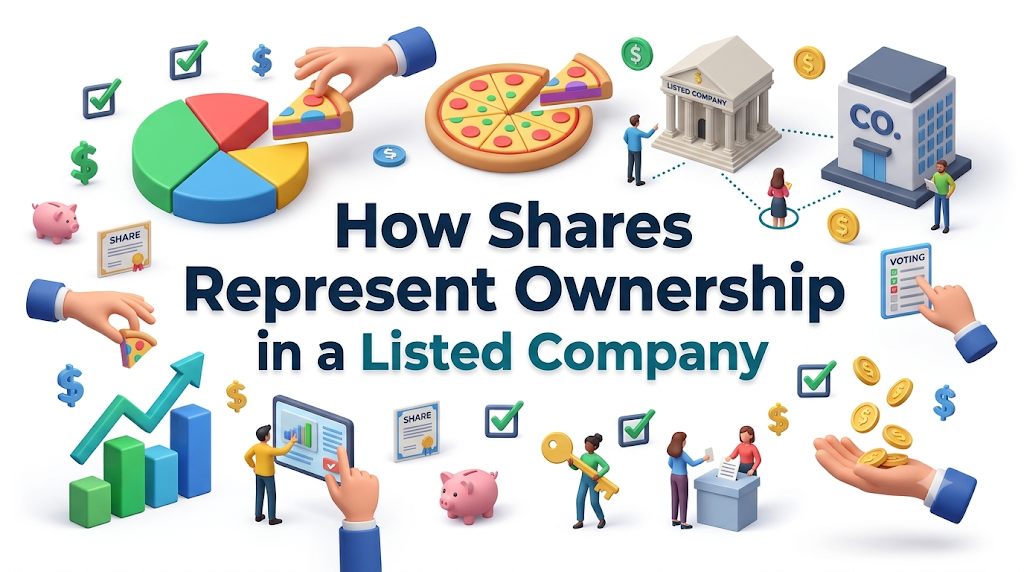
Buying a single share of a publicly traded company does not entitle you to walk into its headquarters, demand a desk, or tell the chief executive how to run daily operations. Yet legally and financially, you have become a part-owner of that business.
For many retail investors, the link between a ticker symbol moving on a screen and actual business ownership feels abstract. Understanding how shares divide a company’s equity—and where your influence begins and ends—turns stock investing from price speculation into genuine business ownership.
Breaking Down Equity: From Whole Business to Individual Shares
When a company incorporates, its total ownership value is called equity or share capital. Rather than keeping that ownership locked in a single undivided block, the business splits its equity into equal, standardized units called shares (also known as stocks or equities).
Think of a company’s total equity as a pizza sliced into millions of equal pieces. If a listed company has 100 million shares outstanding and you purchase 1,000 of them, you own exactly 0.001% of that company.
To make this ownership transferable to the public, the company lists its shares on a regulated stock exchange—such as the New York Stock Exchange (NYSE), Nasdaq, the National Stock Exchange of India (NSE), or the London Stock Exchange (LSE). Once listed, shares can move freely between buyers and sellers without disrupting the underlying business. Your ownership stake is recorded electronically through depositories and brokerage accounts rather than paper certificates.
Authorized, Issued, and Outstanding Shares
Not every share a company creates is actively held by investors. Looking at a company’s balance sheet or regulatory filings reveals three distinct tiers:
- Authorized Shares: The maximum number of shares a company is legally permitted to issue under its corporate charter.
- Issued Shares: The portion of authorized shares that the company has actually distributed to founders, employees, institutional backers, and public investors.
- Outstanding Shares: Issued shares currently held by external shareholders, excluding treasury stock (shares the company has bought back from the open market).
Your percentage of ownership is always calculated against outstanding shares, not authorized shares. If a company buys back its own shares and cancels them, the total pie shrinks—meaning your existing shares automatically represent a slightly larger slice of the business.
Tangible Rights Attached to Share Ownership
Because a share is a legal unit of ownership, corporate law grants shareholders specific economic and governance rights. While exact rules vary slightly by country and corporate charter, owning standard public shares generally gives you four core entitlements.
1. Voting Power on Major Corporate Decisions
Shareholders do not manage day-to-day operations; they elect a Board of Directors to hire executives and oversee strategy on their behalf. Most common shares carry one vote per share. Through annual general meetings (AGMs) or proxy ballots, shareholders vote on:
- Electing or removing board members.
- Approving major mergers, acquisitions, or the sale of core assets.
- Ratifying independent auditors.
- Approving executive compensation packages and stock-based pay plans.
- Authorizing changes to the company’s charter or share structure.
2. A Claim on Distributed Profits (Dividends)
When a business generates profits, management can either reinvest that cash into growth—such as building new factories or funding research—or distribute a portion directly to owners as dividends. If the board declares a dividend of $0.50 per share and you hold 400 shares, you receive $200. Dividends are never guaranteed for common shareholders, as the board decides whether retaining cash serves the business better.
3. Residual Claim on Company Assets
If a listed company shuts down, liquidates its assets, and pays off all obligations, any remaining money belongs to its shareholders. However, equity holders sit at the very back of the payout line. Bondholders, banks, suppliers, employees, and tax authorities must be paid in full before shareholders see a cent. Because equity absorbs losses first, shareholders carry higher risk than lenders—and demand higher potential returns in exchange.
4. Preemptive Rights and Information Access
In many jurisdictions, existing shareholders receive preemptive rights (often executed through rights issues), allowing them to buy newly issued shares before the general public so their ownership percentage is not diluted against their will. Additionally, public companies are legally required to publish audited financial statements, quarterly earnings, and material business updates so every owner has equal access to core performance data.
Common Shares vs. Preferred Shares: How Ownership Differs
Not all shares carry the exact same ownership privileges. Publicly traded companies primarily issue two classes of stock, each balancing control and cash-flow priority differently.
| Ownership Feature | Common Shares | Preferred Shares |
| Voting Rights | Usually 1 vote per share on board and major corporate matters | Typically no voting rights |
| Dividend Priority | Paid only after preferred shareholders; amounts vary | Paid first at a fixed rate before common dividends |
| Capital Appreciation | Unlimited upside tied directly to business growth | Limited price movement; behaves closer to a bond |
| Liquidation Priority | Last in line after creditors and preferred holders | Paid before common shareholders, after debt holders |
| Best Suited For | Investors seeking long-term growth and governance voice | Investors prioritizing steady income and lower volatility |
Some companies also create dual-class common shares (such as Class A and Class B shares). In these setups, founders or insiders hold shares carrying 10 votes each, while public investors buy shares carrying 1 vote—or even zero votes—per share. Both classes represent equal economic ownership of profits, even though voting control remains concentrated with insiders.
What Owning Shares Does Not Give You
Misunderstanding the boundary between the corporation and its owners is one of the quickest ways new investors get tripped up. A listed company is a separate legal entity distinct from the people who own its stock.
- No Direct Control Over Assets: Owning shares in an airline does not entitle you to a free seat, nor can you claim a specific piece of machinery at a manufacturing plant. You own a proportional stake in the corporate entity, not its individual physical assets.
- No Personal Liability for Corporate Debt: Just as you cannot personally seize company property, creditors cannot seize your personal bank account or home if the company goes bankrupt. Your financial risk is strictly capped at the amount you invested in the shares—a protection known as limited liability.
- No Operational Interference: Individual retail shareholders cannot demand confidential internal records, dictate product pricing, or instruct employees. Governance works strictly through formal board elections and shareholder resolutions.
How Ownership Translates Into Investment Returns
Because your shares represent a fractional claim on a living business, your financial return comes from two direct channels:
- Capital Appreciation: As a company grows its revenue, expands profit margins, and strengthens its competitive position, the underlying value of the entire business rises. Other market participants become willing to pay more for each slice of that equity, pushing the share price higher.
- Income Distribution: Mature, cash-generative companies routinely return excess earnings to owners through cash dividends or share buybacks.
Conversely, if a company loses market share, takes on unsustainable debt, or suffers declining earnings, the value of your ownership stake falls alongside the business’s fundamentals. Market sentiment causes short-term price swings, but over multi-year periods, share prices track the underlying economic performance of the business you own.
Frequently Asked Questions
If I own 51% of a listed company’s voting shares, do I control the company?
Yes. Holding more than 50% of the voting shares gives you majority control. You can elect the entire board of directors, approve or block major corporate actions, and steer strategic direction, though you must still follow securities laws and respect minority shareholder protections.
Does my ownership percentage shrink when a company issues new shares?
Yes, this is called share dilution. When a company issues additional shares to raise capital or pay employees via stock options, the total number of outstanding shares increases. Unless you buy a proportional amount of the new shares, your percentage slice of the company becomes smaller.
Do stock splits change my ownership in a company?
No. In a 2-for-1 stock split, your share count doubles while the price per share drops by half. Because every shareholder’s count adjusts equally, your total investment value and your exact percentage ownership of the company remain unchanged.
Can a listed company take away my shares without my permission?
Under normal market operations, no. Exceptions occur only during formal corporate restructurings—such as a mandatory buyout in an approved acquisition (where you receive cash or acquiring-company shares in exchange) or a court-supervised bankruptcy cancellation.
Why do some profitable companies never pay dividends to their owners?
Fast-growing companies often generate higher returns for shareholders by reinvesting profits back into expansion, technology, or debt reduction rather than paying cash dividends. Owners still benefit if that reinvestment increases the long-term market value of their shares.
Conclusion
Owning shares in a listed company means stepping into the role of a silent business partner: you share proportionally in the company’s long-term profits and growth, exercise governance through board elections, and stay shielded from corporate debts by limited liability. Looking past daily ticker fluctuations to evaluate the underlying business—its earnings power, share structure, and capital allocation—is what turns share ownership into a disciplined investing framework.