Introduction
Single Pane of Glass IT Dashboards are centralized monitoring and management platforms that provide unified visibility across infrastructure, applications, networks, cloud services, security systems, and operational environments through a single interface. Instead of switching between multiple monitoring tools and dashboards, IT teams can view performance metrics, alerts, incidents, logs, security events, and operational health from one consolidated platform.
As modern IT environments become increasingly distributed across cloud platforms, containers, SaaS applications, edge devices, and hybrid infrastructure, centralized operational visibility has become essential for reducing downtime, improving collaboration, and accelerating incident response. Single Pane of Glass platforms help organizations reduce operational silos while improving observability, governance, and automation across IT ecosystems.
Common real-world use cases include:
- Unified infrastructure monitoring
- Cloud and hybrid operations management
- Centralized incident management
- Security and compliance visibility
- DevOps and SRE observability workflows
Buyers evaluating Single Pane of Glass IT Dashboards should focus on:
- Multi-platform integration support
- Real-time observability capabilities
- Dashboard customization flexibility
- AI-driven analytics and automation
- Security monitoring integrations
- Scalability across hybrid environments
- Alerting and incident workflows
- API and extensibility support
- Reporting and compliance visibility
- Ease of deployment and usability
Best for: Enterprises, MSPs, cloud-native organizations, DevOps teams, NOC and SOC environments, SRE teams, and organizations managing hybrid or multi-cloud infrastructure.
Not ideal for: Very small businesses with limited infrastructure or organizations operating isolated single-platform environments without centralized observability needs.
Key Trends in Single Pane of Glass IT Dashboards
- AI-assisted observability and anomaly detection are becoming standard capabilities.
- Unified observability platforms are replacing fragmented monitoring tools.
- Cloud-native telemetry integration is rapidly expanding.
- Security observability and operational monitoring are converging.
- Real-time topology mapping is improving root-cause analysis.
- Infrastructure-as-Code visibility is becoming more important.
- Cost observability and FinOps integrations are increasing.
- Unified DevSecOps dashboards are improving operational collaboration.
- API-driven extensibility is becoming a critical buying factor.
- Hybrid and multi-cloud operational visibility remains a major enterprise priority.
How We Selected These Tools Methodology
The tools in this list were selected based on enterprise observability maturity, operational visibility capabilities, and ecosystem adoption.
- Evaluated unified observability and monitoring capabilities
- Assessed cloud and hybrid infrastructure support
- Reviewed dashboard customization flexibility
- Considered AI-assisted analytics and automation
- Evaluated scalability and operational performance
- Reviewed security and compliance integrations
- Assessed incident management and alerting workflows
- Considered ecosystem integrations and APIs
- Evaluated usability and onboarding complexity
- Reviewed enterprise adoption and support quality
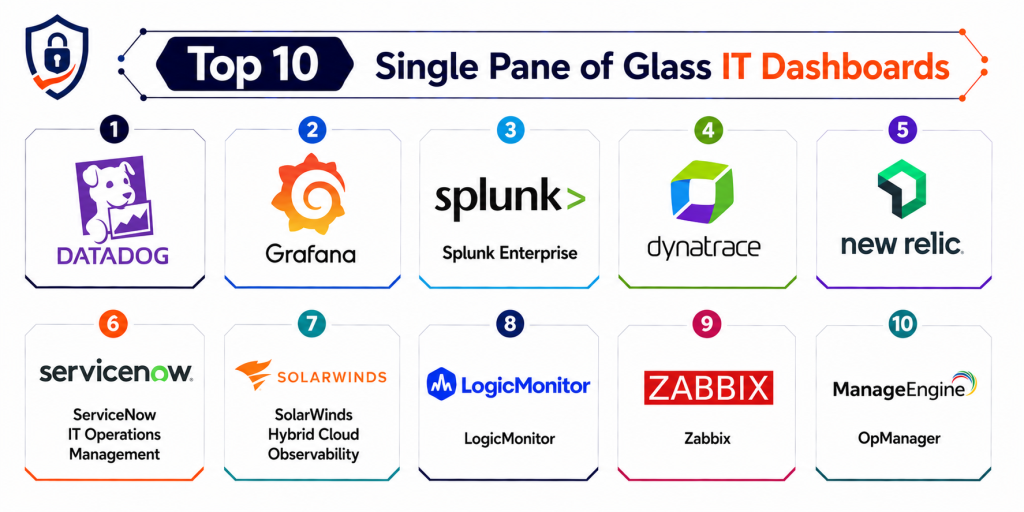
Top 10 Single Pane of Glass IT Dashboards
1- ServiceNow IT Operations Management
Short description: ServiceNow ITOM provides enterprise-wide operational visibility across infrastructure, cloud environments, applications, incidents, and workflows through centralized operational dashboards.
Key Features
- Unified IT operations dashboards
- CMDB integration
- Event correlation and analytics
- Incident management workflows
- Cloud infrastructure visibility
- Service mapping
- AI-assisted operational insights
Pros
- Strong enterprise workflow integration
- Excellent CMDB and ITSM capabilities
- Broad operational visibility
Cons
- Enterprise pricing structure
- Complex implementation workflows
- Requires operational expertise
Platforms / Deployment
- Web
- Cloud / Hybrid
Security & Compliance
- SSO/SAML
- RBAC
- Audit logging
- Encryption support
Integrations & Ecosystem
ServiceNow integrates deeply with enterprise infrastructure, cloud providers, and ITSM ecosystems.
- AWS
- Azure
- VMware
- Kubernetes
- APIs
- SIEM platforms
Support & Community
Large enterprise ecosystem with mature operational documentation and implementation support.
2- Datadog
Short description: Datadog is a cloud-native observability platform providing unified monitoring across infrastructure, applications, logs, cloud environments, and security operations.
Key Features
- Unified metrics, logs, and traces
- Real-time dashboards
- AI-assisted anomaly detection
- Kubernetes visibility
- Cloud infrastructure monitoring
- Security monitoring
- Custom visualizations
Pros
- Fast deployment experience
- Excellent cloud-native integrations
- Strong observability capabilities
Cons
- Pricing can scale rapidly
- Large deployments may become expensive
- Advanced tuning requires expertise
Platforms / Deployment
- Web
- Cloud
Security & Compliance
- SSO/SAML
- Audit logs
- Encryption support
- SOC 2 support
- GDPR support
Integrations & Ecosystem
Datadog supports one of the broadest integration ecosystems in observability.
- AWS
- Azure
- Google Cloud
- Kubernetes
- Docker
- APIs
Support & Community
Strong cloud observability community with extensive operational documentation.
3- Splunk Observability Cloud
Short description: Splunk Observability Cloud consolidates logs, metrics, traces, and operational analytics into centralized enterprise observability dashboards.
Key Features
- Unified observability dashboards
- Log analytics and search
- AI-driven anomaly detection
- Real-time operational insights
- Distributed tracing
- Incident analytics
- Custom reporting
Pros
- Excellent analytics capabilities
- Strong compliance visibility
- Mature enterprise observability
Cons
- Steep learning curve
- Licensing complexity
- Advanced workflows require expertise
Platforms / Deployment
- Web
- Cloud / Hybrid
Security & Compliance
- SSO/SAML
- Audit trails
- Encryption support
- SOC support
- GDPR support
Integrations & Ecosystem
Splunk integrates with enterprise infrastructure and security ecosystems.
- AWS
- Azure
- Kubernetes
- SIEM tools
- APIs
- DevOps platforms
Support & Community
Large enterprise observability ecosystem with strong community adoption.
4- Grafana Enterprise
Short description: Grafana Enterprise is a highly customizable visualization and observability platform used to create unified dashboards across diverse monitoring data sources.
Key Features
- Custom dashboard creation
- Multi-source observability
- Real-time visualizations
- Alerting and notifications
- Plugin ecosystem
- Advanced query customization
- Role-based access controls
Pros
- Extremely flexible dashboards
- Strong open-source foundation
- Broad integration ecosystem
Cons
- Setup and maintenance complexity
- Advanced enterprise features require licensing
- Native automation capabilities may vary
Platforms / Deployment
- Linux / Windows / macOS
- Cloud / Self-hosted / Hybrid
Security & Compliance
- RBAC
- SSO support
- Encryption support
- Audit logging
Integrations & Ecosystem
Grafana integrates broadly with observability, cloud, and infrastructure ecosystems.
- Prometheus
- Kubernetes
- AWS
- Azure
- Elasticsearch
- APIs
Support & Community
Massive open-source community with strong enterprise support availability.
5- New Relic
Short description: New Relic provides full-stack observability dashboards designed to unify infrastructure, applications, user experience, and operational analytics.
Key Features
- Full-stack observability
- Unified operational dashboards
- Application performance monitoring
- Real-time alerting
- Distributed tracing
- Business metric correlation
- Cloud-native monitoring
Pros
- Clean and modern interface
- Strong APM capabilities
- Good operational visibility
Cons
- Pricing complexity
- Dashboard customization less flexible than Grafana
- Large-scale tuning may require expertise
Platforms / Deployment
- Web
- Cloud
Security & Compliance
- SSO/SAML
- Encryption support
- Audit logging
- SOC support
Integrations & Ecosystem
New Relic integrates with cloud providers, DevOps tools, and observability ecosystems.
- AWS
- Azure
- Kubernetes
- GitHub
- APIs
- CI/CD tools
Support & Community
Strong operational documentation with broad developer adoption.
6- Dynatrace
Short description: Dynatrace provides AI-driven observability and operational dashboards with automated topology discovery and intelligent root-cause analysis.
Key Features
- Automatic topology discovery
- AI-powered root cause analysis
- End-to-end observability
- Unified infrastructure dashboards
- Real-time analytics
- Cloud-native monitoring
- Security observability
Pros
- Excellent automation capabilities
- Strong AI-assisted analytics
- Minimal manual configuration
Cons
- Premium enterprise pricing
- Less manual tuning flexibility
- Advanced workflows require training
Platforms / Deployment
- Web
- Cloud / Hybrid
Security & Compliance
- SSO/SAML
- RBAC
- Audit logs
- Encryption support
Integrations & Ecosystem
Dynatrace integrates deeply with cloud-native and enterprise infrastructure ecosystems.
- AWS
- Azure
- Kubernetes
- OpenTelemetry
- APIs
- DevOps platforms
Support & Community
Strong enterprise support with mature AI observability documentation.
7- Elastic Observability
Short description: Elastic Observability combines logs, metrics, traces, and search analytics into centralized dashboards for enterprise monitoring and troubleshooting.
Key Features
- Unified observability dashboards
- Log and metrics analytics
- Distributed tracing
- Search-powered investigations
- Machine learning analytics
- Infrastructure monitoring
- Security observability
Pros
- Strong search and analytics capabilities
- Flexible deployment options
- Open-source foundation
Cons
- Operational complexity for large deployments
- Advanced tuning requires expertise
- Enterprise features may require licensing
Platforms / Deployment
- Linux / Windows
- Cloud / Self-hosted / Hybrid
Security & Compliance
- RBAC
- Audit logging
- Encryption support
- SSO support
Integrations & Ecosystem
Elastic integrates broadly with infrastructure and analytics ecosystems.
- Kubernetes
- AWS
- Azure
- Beats
- APIs
- SIEM platforms
Support & Community
Large open-source observability community with strong enterprise support options.
8- SolarWinds Hybrid Cloud Observability
Short description: SolarWinds Hybrid Cloud Observability provides centralized visibility across infrastructure, networks, databases, applications, and cloud environments.
Key Features
- Hybrid infrastructure monitoring
- Network observability
- Application monitoring
- Database visibility
- Centralized alerts
- Performance analytics
- Capacity planning dashboards
Pros
- Broad infrastructure visibility
- Strong network monitoring capabilities
- Good mid-market operational value
Cons
- Interface complexity may vary
- Advanced analytics less mature than newer competitors
- Large-scale deployments require tuning
Platforms / Deployment
- Windows / Linux
- Cloud / Hybrid
Security & Compliance
- RBAC
- Audit logs
- Encryption support
Integrations & Ecosystem
SolarWinds integrates with infrastructure, networking, and cloud monitoring ecosystems.
- VMware
- AWS
- Azure
- APIs
- Network devices
- Databases
Support & Community
Large IT operations community with mature documentation resources.
9- ManageEngine OpManager Plus
Short description: ManageEngine OpManager Plus provides integrated dashboards for network, server, application, and infrastructure monitoring.
Key Features
- Unified infrastructure monitoring
- Centralized alerting
- Performance monitoring
- Network visualization
- Reporting dashboards
- Workflow automation
- Capacity management
Pros
- Competitive pricing
- Broad IT operations visibility
- Good mid-market functionality
Cons
- UI can feel cluttered
- Less advanced AI analytics
- Customization depth may vary
Platforms / Deployment
- Windows / Linux
- Cloud / Self-hosted
Security & Compliance
- RBAC
- Audit logging
- Encryption support
Integrations & Ecosystem
ManageEngine integrates with IT management and infrastructure ecosystems.
- VMware
- AWS
- Azure
- ServiceDesk Plus
- APIs
- Network devices
Support & Community
Strong IT operations support ecosystem with broad documentation.
10- Zabbix
Short description: Zabbix is an open-source monitoring platform used to create centralized operational dashboards across servers, networks, cloud environments, and applications.
Key Features
- Infrastructure monitoring
- Real-time dashboards
- Alerting and notifications
- Distributed monitoring
- Custom visualizations
- API integrations
- Performance analytics
Pros
- Free and open-source
- Highly customizable
- Strong infrastructure monitoring capabilities
Cons
- Requires operational expertise
- UI less modern than commercial competitors
- Large deployments require optimization
Platforms / Deployment
- Linux / Windows
- Self-hosted / Hybrid
Security & Compliance
- RBAC
- Encryption support
- Audit logging
Integrations & Ecosystem
Zabbix integrates with infrastructure, cloud, and networking ecosystems.
- VMware
- AWS
- Kubernetes
- SNMP devices
- APIs
- Databases
Support & Community
Large global open-source monitoring community with extensive documentation.
Comparison Table
| Tool Name | Best For | Platform(s) Supported | Deployment | Standout Feature | Public Rating |
|---|---|---|---|---|---|
| ServiceNow ITOM | Enterprise IT operations | Web, Hybrid | Cloud, Hybrid | CMDB and workflow integration | N/A |
| Datadog | Cloud-native observability | Multi-cloud | Cloud | Unified observability | N/A |
| Splunk Observability Cloud | Enterprise analytics | Cloud, Hybrid | Cloud, Hybrid | Advanced analytics | N/A |
| Grafana Enterprise | Custom dashboards | Multi-platform | Cloud, Hybrid | Dashboard flexibility | N/A |
| New Relic | Full-stack monitoring | Cloud | Cloud | Full-stack observability | N/A |
| Dynatrace | AI-driven observability | Multi-cloud | Cloud, Hybrid | AI root-cause analysis | N/A |
| Elastic Observability | Search-powered monitoring | Multi-platform | Cloud, Hybrid | Unified search analytics | N/A |
| SolarWinds Hybrid Cloud Observability | Infrastructure visibility | Windows, Linux | Cloud, Hybrid | Hybrid monitoring coverage | N/A |
| ManageEngine OpManager Plus | Mid-market IT monitoring | Windows, Linux | Cloud, Self-hosted | Operational affordability | N/A |
| Zabbix | Open-source monitoring | Linux, Windows | Self-hosted, Hybrid | Open-source flexibility | N/A |
Evaluation & Scoring of Single Pane of Glass IT Dashboards
| Tool Name | Core 25% | Ease 15% | Integrations 15% | Security 10% | Performance 10% | Support 10% | Value 15% | Weighted Total |
|---|---|---|---|---|---|---|---|---|
| ServiceNow ITOM | 9 | 7 | 9 | 9 | 8 | 9 | 6 | 8.05 |
| Datadog | 9 | 9 | 10 | 8 | 9 | 8 | 7 | 8.65 |
| Splunk Observability Cloud | 9 | 6 | 9 | 9 | 9 | 9 | 6 | 8.00 |
| Grafana Enterprise | 8 | 7 | 10 | 8 | 8 | 8 | 9 | 8.30 |
| New Relic | 8 | 8 | 8 | 8 | 8 | 8 | 7 | 7.85 |
| Dynatrace | 9 | 8 | 9 | 9 | 9 | 8 | 6 | 8.25 |
| Elastic Observability | 8 | 6 | 8 | 8 | 8 | 7 | 8 | 7.65 |
| SolarWinds Hybrid Cloud Observability | 8 | 7 | 7 | 7 | 8 | 8 | 8 | 7.65 |
| ManageEngine OpManager Plus | 7 | 7 | 7 | 7 | 7 | 8 | 9 | 7.40 |
| Zabbix | 7 | 5 | 7 | 7 | 8 | 7 | 10 | 7.15 |
These scores are comparative rather than absolute. Higher scores generally indicate broader observability coverage, stronger integrations, and more mature enterprise operational capabilities. Open-source and mid-market tools may still provide exceptional value depending on operational complexity and infrastructure scale.
Which Single Pane of Glass IT Dashboard Is Right for You?
Solo / Freelancer
Independent operators and small technical teams often benefit from lightweight and affordable monitoring platforms such as Zabbix or ManageEngine because of their lower operational cost and flexibility.
SMB
Small and medium businesses should prioritize deployment simplicity, unified visibility, and manageable operational overhead. ManageEngine and Grafana provide strong functionality with reasonable operational complexity.
Mid-Market
Mid-market organizations often require broader observability, workflow automation, and cloud-native monitoring. Datadog and New Relic provide scalable observability capabilities with strong integrations.
Enterprise
Large enterprises typically need centralized governance, AI-driven analytics, compliance visibility, and hybrid cloud observability. ServiceNow ITOM, Dynatrace, and Splunk Observability Cloud are strong enterprise-focused choices.
Budget vs Premium
Open-source and mid-market tools generally provide lower operational costs and strong flexibility. Enterprise-grade observability platforms offer advanced analytics, AI automation, and broader operational visibility but usually require larger budgets.
Feature Depth vs Ease of Use
Platforms such as Splunk and Dynatrace provide deep analytics and automation but may require operational expertise. Datadog and New Relic emphasize usability and faster onboarding.
Integrations & Scalability
Organizations with mature infrastructure should prioritize integrations with cloud providers, Kubernetes, SIEM systems, APIs, DevOps workflows, and infrastructure automation platforms.
Security & Compliance Needs
Regulated industries should focus on audit logging, RBAC, encryption support, operational analytics, incident visibility, and compliance reporting capabilities.
Frequently Asked Questions FAQs
1. What is a Single Pane of Glass IT Dashboard?
A Single Pane of Glass dashboard centralizes visibility across infrastructure, applications, cloud environments, networks, and operational systems into one unified interface.
2. Why are Single Pane of Glass platforms important?
These platforms reduce operational silos, improve troubleshooting speed, simplify monitoring workflows, and help teams gain centralized operational visibility.
3. What data sources can these dashboards monitor?
Most platforms monitor logs, metrics, traces, infrastructure devices, cloud resources, containers, applications, networks, and security telemetry.
4. Are these platforms suitable for hybrid cloud environments?
Yes. Most modern platforms support hybrid and multi-cloud infrastructure monitoring across on-premise and cloud-native environments.
5. What integrations are most important?
Important integrations include cloud providers, Kubernetes, SIEM platforms, DevOps tools, APIs, databases, networking systems, and SaaS applications.
6. How do AI-assisted observability features help?
AI-assisted analytics help identify anomalies, correlate incidents, prioritize alerts, and accelerate root-cause analysis across distributed environments.
7. Which industries benefit most from unified IT dashboards?
Financial services, healthcare, SaaS providers, government agencies, telecom companies, MSPs, and large enterprises commonly benefit from these platforms.
8. What are common deployment mistakes?
Common mistakes include excessive dashboard complexity, incomplete integrations, poor alert tuning, weak access controls, and insufficient operational training.
9. Are open-source dashboard platforms reliable?
Yes. Open-source tools such as Grafana and Zabbix are widely used and highly reliable when properly managed and optimized.
10. Can a single dashboard truly replace all monitoring tools?
Not always. Many organizations still use specialized monitoring solutions alongside centralized observability dashboards for advanced or niche operational requirements.
Conclusion
Single Pane of Glass IT Dashboards have become essential operational platforms for organizations managing increasingly complex cloud-native, hybrid, and distributed infrastructure environments. These platforms help IT operations, DevOps, SRE, and security teams reduce operational silos, accelerate troubleshooting, improve observability, and centralize visibility across infrastructure, applications, networks, and cloud services through unified dashboards and analytics. Enterprise buyers should carefully evaluate integration breadth, observability depth, AI-driven analytics, operational scalability, dashboard flexibility, and automation capabilities before selecting a platform. Datadog, Dynatrace, and Splunk Observability Cloud provide strong enterprise-grade observability and analytics capabilities, while Grafana and Zabbix remain highly valuable for organizations prioritizing flexibility and open-source customization. ServiceNow ITOM continues to stand out for enterprise workflow orchestration and operational governance. The best solution ultimately depends on infrastructure complexity, cloud maturity, operational expertise, compliance requirements, and budget priorities. Shortlist a few platforms, run pilot deployments across your infrastructure stack, validate integrations with cloud and security ecosystems, and evaluate operational workflows before making a long-term observability and dashboard investment decision.
Informative article about IT dashboard platforms with practical comparisons. The breakdown of features and benefits makes research easier.