Introduction
Utility Billing Software helps utilities, municipalities, energy providers, water companies, waste management organizations, and property management businesses automate customer billing, meter data management, payment processing, usage tracking, compliance reporting, and revenue operations. These platforms are designed to manage complex billing cycles, variable consumption models, tariffs, taxes, customer service workflows, and regulatory requirements across electricity, gas, water, sewer, broadband, and multi-utility operations.
As utility operations become increasingly digital and customer expectations continue evolving, organizations require more advanced systems than legacy billing applications and spreadsheet-based workflows. Modern utility billing platforms now combine smart meter integrations, AI-driven analytics, customer self-service portals, cloud-native operations, automated collections, GIS integration, mobile workforce management, and real-time usage visibility to improve operational efficiency and customer experience.
Real-world use cases include:
- Electricity and water billing management
- Smart meter and AMI integrations
- Municipal utility revenue operations
- Customer self-service and payment portals
- Multi-service utility billing and compliance management
Buyers evaluating Utility Billing Software should focus on:
- Meter data and AMI integration support
- Billing automation and tariff flexibility
- Customer self-service capabilities
- Payment processing and collections management
- ERP and financial system integrations
- Scalability for large customer bases
- Cloud deployment and operational flexibility
- Reporting and compliance capabilities
- Security and governance controls
- Mobile workforce and field service integration support
Best for: Utilities, municipalities, water companies, energy providers, telecom operators, waste management organizations, property managers, and enterprise billing operations requiring scalable customer billing and revenue management workflows.
Not ideal for: Small businesses requiring only lightweight invoicing systems without meter integrations, tariff management, or enterprise customer operations.
Key Trends in Utility Billing Software
- Smart meter and AMI integrations becoming standard capabilities
- AI-driven usage forecasting improving billing accuracy
- Cloud-native utility platforms replacing legacy on-premise systems
- Customer self-service portals improving digital engagement
- Mobile workforce integrations supporting field operations
- Real-time usage analytics improving operational visibility
- Automated payment workflows reducing revenue leakage
- GIS integrations improving infrastructure and service management
- ESG and sustainability reporting expanding utility analytics capabilities
- Cybersecurity becoming critical for utility infrastructure systems
How We Selected These Tools (Methodology)
- Adoption across utility and municipal organizations
- Billing automation and tariff management depth
- Smart meter and AMI integration capabilities
- Customer portal and payment processing support
- ERP and operational integration flexibility
- Reporting and compliance functionality
- Scalability for enterprise customer operations
- Security and governance capabilities
- Cloud deployment and operational resilience support
- Balance between enterprise, municipal, and cloud-native solutions
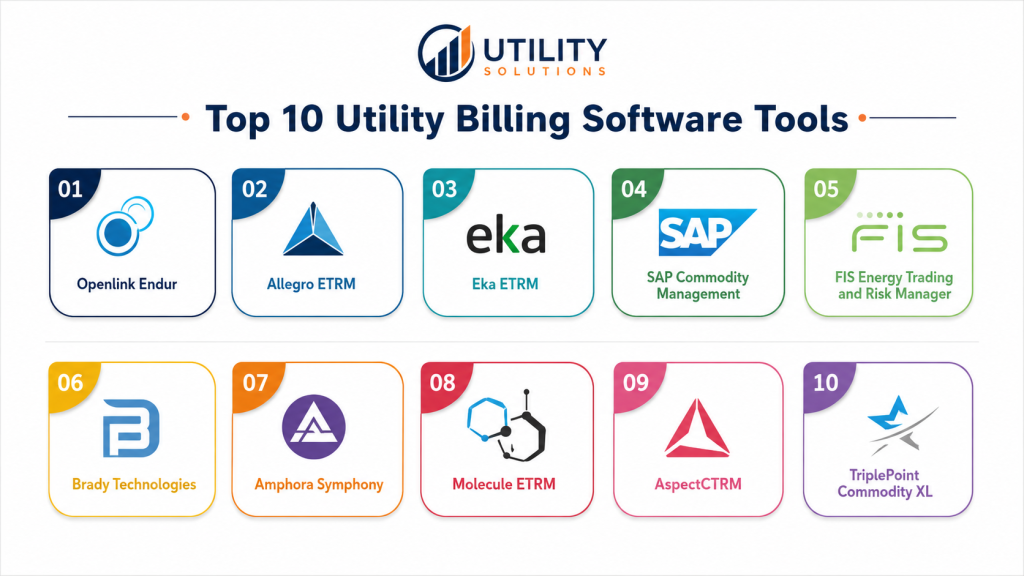
Top 10 Utility Billing Software Tools
1- Oracle Utilities Customer Care and Billing
Short description:
Oracle Utilities Customer Care and Billing is an enterprise-grade utility billing platform designed for large-scale electricity, water, gas, and municipal utility operations.
Key Features
- Multi-utility billing management
- Smart meter integrations
- Customer self-service portals
- Revenue and collections management
- Tariff and pricing automation
- Regulatory compliance reporting
- Real-time operational dashboards
Pros
- Strong enterprise scalability
- Excellent utility-specific functionality
- Reliable operational reporting
Cons
- Complex enterprise implementation
- Premium licensing costs
- Requires experienced utility IT teams
Platforms / Deployment
- Web
- Cloud / Hybrid
Security & Compliance
Supports RBAC, MFA, encryption, audit logging, and enterprise governance controls.
Integrations & Ecosystem
Integrates with ERP systems, AMI platforms, GIS tools, payment gateways, and operational utility infrastructure.
- APIs
- ERP systems
- GIS platforms
- Payment gateways
- Smart meter systems
Support & Community
Large enterprise utility ecosystem with global partner support.
2- SAP IS-U
Short description:
SAP IS-U provides utility billing, customer management, meter data processing, and operational workflows for energy and water utility organizations.
Key Features
- Utility billing automation
- Meter data management
- Customer account workflows
- Financial and ERP integration
- Smart meter support
- Compliance reporting
- Operational analytics dashboards
Pros
- Excellent SAP ecosystem integration
- Strong enterprise operational visibility
- Reliable scalability for utilities
Cons
- Best suited for SAP environments
- Complex implementation requirements
- Premium enterprise pricing
Platforms / Deployment
- Web
- Cloud / Hybrid
Security & Compliance
Supports enterprise authentication, RBAC, encryption, and governance workflows.
Integrations & Ecosystem
- SAP ecosystem
- APIs
- GIS platforms
- Financial systems
Support & Community
Large global SAP utility ecosystem.
3- Harris Utilities CIS
Short description:
Harris Utilities CIS provides customer information, billing automation, and revenue management workflows for municipal and regional utility providers.
Key Features
- Customer information management
- Utility billing workflows
- Meter integrations
- Payment processing support
- Collections management
- Customer service dashboards
- Compliance reporting tools
Pros
- Strong municipal utility workflows
- Good customer management capabilities
- Reliable billing automation
Cons
- Traditional UI design
- Limited advanced AI capabilities
- Smaller ecosystem than Oracle or SAP
Platforms / Deployment
- Web / Windows
- Cloud / Self-hosted
Security & Compliance
Supports secure authentication, encryption, and operational governance controls.
Integrations & Ecosystem
- APIs
- Payment gateways
- Meter systems
- Financial platforms
Support & Community
Strong municipal utility support ecosystem.
4- Advanced Utility Systems
Short description:
Advanced Utility Systems provides billing, customer management, and operational workflows for utility and municipal organizations.
Key Features
- Utility billing management
- Customer service workflows
- Meter data integrations
- Mobile workforce support
- Revenue analytics
- Payment management
- Reporting and compliance tools
Pros
- Good operational flexibility
- Strong municipal support
- Reliable billing workflows
Cons
- Smaller enterprise ecosystem
- Less advanced AI analytics
- Traditional enterprise deployment model
Platforms / Deployment
- Web
- Cloud / Hybrid
Security & Compliance
Supports secure APIs, encryption, and enterprise governance controls.
Integrations & Ecosystem
- Payment systems
- APIs
- GIS platforms
- Utility infrastructure tools
Support & Community
Established municipal and utility operations ecosystem.
5- Cayenta Utility Billing
Short description:
Cayenta Utility Billing provides enterprise billing and customer management capabilities for utilities and public-sector organizations.
Key Features
- Multi-service utility billing
- Customer account management
- Smart meter support
- Collections workflows
- Financial reporting
- GIS integration support
- Compliance management
Pros
- Strong public-sector workflows
- Good scalability support
- Reliable customer management capabilities
Cons
- Enterprise deployment complexity
- Premium pricing structure
- Requires implementation expertise
Platforms / Deployment
- Web
- Cloud / Self-hosted
Security & Compliance
Supports RBAC, encryption, secure authentication, and governance controls.
Integrations & Ecosystem
- APIs
- ERP systems
- GIS tools
- Payment gateways
Support & Community
Strong utility and government operations ecosystem.
6- Utilmate
Short description:
Utilmate is a cloud-based utility billing and customer management platform designed for modern utility providers and service organizations.
Key Features
- Cloud-native billing workflows
- Customer self-service portals
- Automated invoicing
- Payment processing support
- Smart meter integrations
- Usage analytics dashboards
- Reporting automation
Pros
- Modern cloud-native architecture
- Easy deployment workflows
- Good customer experience tools
Cons
- Smaller enterprise ecosystem
- Less extensive customization depth
- Limited advanced utility analytics
Platforms / Deployment
- Web
- Cloud
Security & Compliance
Supports encrypted communications and secure operational workflows.
Integrations & Ecosystem
- APIs
- Payment platforms
- Meter systems
- CRM tools
Support & Community
Growing cloud utility operations ecosystem.
7- MuniBilling
Short description:
MuniBilling provides utility billing and payment management workflows for municipalities, water districts, and local government organizations.
Key Features
- Utility invoicing automation
- Customer payment management
- Meter reading workflows
- Online payment portals
- Reporting dashboards
- Collections management
- Service request tracking
Pros
- Strong municipal focus
- Easy operational workflows
- Good customer payment visibility
Cons
- Limited enterprise-scale functionality
- Less advanced integrations
- Smaller ecosystem than larger vendors
Platforms / Deployment
- Web
- Cloud
Security & Compliance
Supports secure payment processing and encrypted communications.
Integrations & Ecosystem
- Payment gateways
- APIs
- Meter systems
- Municipal tools
Support & Community
Strong municipal billing support ecosystem.
8- SilverBlaze Utility Billing
Short description:
SilverBlaze provides customer engagement, billing automation, and payment processing workflows for utility providers and municipalities.
Key Features
- Utility billing management
- Customer self-service portals
- Mobile payment support
- Meter data integrations
- Customer communication tools
- Reporting dashboards
- Collections automation
Pros
- Strong customer engagement capabilities
- Good payment processing workflows
- Easy self-service portal management
Cons
- Smaller enterprise ecosystem
- Less advanced AI analytics
- Limited large-scale utility customization
Platforms / Deployment
- Web / Mobile
- Cloud
Security & Compliance
Supports encrypted transactions and secure operational access controls.
Integrations & Ecosystem
- Payment systems
- APIs
- Meter infrastructure
- CRM platforms
Support & Community
Growing utility customer experience ecosystem.
9- Fluentgrid CIS
Short description:
Fluentgrid CIS provides utility billing, customer management, and smart utility operations for electricity and municipal service providers.
Key Features
- Utility customer management
- Billing and invoicing workflows
- Smart meter integrations
- GIS support
- Payment processing
- Mobile workforce workflows
- Reporting and analytics tools
Pros
- Strong smart utility capabilities
- Good GIS integration support
- Reliable operational visibility
Cons
- Enterprise deployment complexity
- Smaller global ecosystem
- Requires utility operations expertise
Platforms / Deployment
- Web / Mobile
- Cloud / Hybrid
Security & Compliance
Supports secure APIs, encryption, RBAC, and governance controls.
Integrations & Ecosystem
- GIS platforms
- APIs
- Payment systems
- Smart meter infrastructure
Support & Community
Growing smart utility ecosystem.
10- VertexOne Utility Billing
Short description:
VertexOne provides cloud-based utility customer engagement, billing automation, and digital service workflows for utilities and municipalities.
Key Features
- Cloud utility billing workflows
- Customer engagement tools
- Digital payment support
- Usage analytics dashboards
- Automated invoicing
- Mobile accessibility
- Operational reporting tools
Pros
- Strong cloud deployment flexibility
- Good customer experience workflows
- Modern user interface
Cons
- Smaller enterprise ecosystem
- Limited deep customization capabilities
- Advanced operational workflows may require services support
Platforms /Deployment
- Web / Mobile
- Cloud
Security & Compliance
Supports secure authentication, encrypted communications, and operational governance workflows.
Integrations & Ecosystem
- APIs
- CRM systems
- Payment gateways
- Meter platforms
Support & Community
Growing cloud utility billing ecosystem.
Comparison Table
| Tool Name | Best For | Platforms Supported | Deployment | Standout Feature | Public Rating |
|---|---|---|---|---|---|
| Oracle Utilities Customer Care and Billing | Enterprise utilities | Web | Hybrid | Multi-utility operations | N/A |
| SAP IS-U | SAP utility environments | Web | Hybrid | ERP integration | N/A |
| Harris Utilities CIS | Municipal utilities | Web, Windows | Hybrid | Customer management workflows | N/A |
| Advanced Utility Systems | Municipal billing | Web | Hybrid | Operational flexibility | N/A |
| Cayenta Utility Billing | Public-sector utilities | Web | Hybrid | Government utility workflows | N/A |
| Utilmate | Cloud utility operations | Web | Cloud | Modern cloud architecture | N/A |
| MuniBilling | Local municipalities | Web | Cloud | Easy billing management | N/A |
| SilverBlaze Utility Billing | Customer engagement | Web, Mobile | Cloud | Self-service portals | N/A |
| Fluentgrid CIS | Smart utility operations | Web, Mobile | Hybrid | GIS integrations | N/A |
| VertexOne Utility Billing | Digital utility services | Web, Mobile | Cloud | Customer experience workflows | N/A |
Evaluation & Scoring of Utility Billing Software
| Tool Name | Core 25% | Ease 15% | Integrations 15% | Security 10% | Performance 10% | Support 10% | Value 15% | Weighted Total |
|---|---|---|---|---|---|---|---|---|
| Oracle Utilities Customer Care and Billing | 9.5 | 7.8 | 9.4 | 9.5 | 9.3 | 9.3 | 8.0 | 9.0 |
| SAP IS-U | 9.4 | 7.7 | 9.5 | 9.4 | 9.3 | 9.2 | 7.9 | 8.9 |
| Harris Utilities CIS | 8.8 | 8.2 | 8.5 | 8.8 | 8.8 | 8.7 | 8.5 | 8.6 |
| Advanced Utility Systems | 8.7 | 8.3 | 8.4 | 8.7 | 8.7 | 8.6 | 8.6 | 8.5 |
| Cayenta Utility Billing | 9.0 | 8.0 | 8.8 | 9.0 | 8.9 | 8.8 | 8.2 | 8.7 |
| Utilmate | 8.5 | 8.9 | 8.2 | 8.4 | 8.6 | 8.4 | 8.9 | 8.5 |
| MuniBilling | 8.2 | 8.8 | 7.9 | 8.2 | 8.4 | 8.3 | 9.0 | 8.3 |
| SilverBlaze Utility Billing | 8.4 | 8.7 | 8.1 | 8.4 | 8.5 | 8.4 | 8.8 | 8.4 |
| Fluentgrid CIS | 8.8 | 8.2 | 8.7 | 8.8 | 8.8 | 8.6 | 8.4 | 8.6 |
| VertexOne Utility Billing | 8.5 | 8.8 | 8.2 | 8.5 | 8.6 | 8.5 | 8.8 | 8.5 |
These scores are comparative and intended to help organizations evaluate utility billing platforms based on operational functionality, integrations, customer management capabilities, compliance workflows, scalability, security, and long-term billing efficiency.
Which Utility Billing Software Is Right for You?
Small Municipal Utilities
Best suited: MuniBilling, Utilmate
These provide easier onboarding and affordable operational workflows.
SMB Utility Providers
Best suited: SilverBlaze, VertexOne, Harris Utilities CIS
These balance billing automation, customer engagement, and operational visibility.
Mid-Market Utility Organizations
Best suited: Cayenta Utility Billing, Fluentgrid CIS
These provide stronger integrations and smart utility workflows.
Large Enterprise Utilities
Best suited: Oracle Utilities Customer Care and Billing, SAP IS-U
These offer enterprise scalability, ERP integration depth, and advanced operational intelligence.
Budget vs Premium
Budget-friendly: MuniBilling, Utilmate
Premium enterprise: Oracle Utilities, SAP IS-U
Feature Depth vs Ease of Use
Deep enterprise functionality: Oracle Utilities, SAP IS-U
Ease of use: Utilmate, VertexOne
Integrations & Scalability
Best integrations: Oracle Utilities, SAP IS-U
Best scalability: Oracle Utilities, SAP IS-U
Security & Compliance Needs
Utilities managing critical infrastructure and customer financial data should prioritize platforms supporting RBAC, MFA, encryption, audit logging, and secure payment processing controls.
Frequently Asked Questions
1. What is Utility Billing Software?
It is software used to automate utility billing, customer account management, meter data processing, and payment workflows.
2. Why is utility billing software important?
It helps utilities improve billing accuracy, reduce revenue leakage, automate customer operations, and improve operational efficiency.
3. Can these platforms integrate with smart meters?
Yes, most modern utility billing systems support AMI and smart meter integrations.
4. Are cloud-based utility billing systems common?
Yes, cloud-native utility billing platforms are increasingly popular because they improve scalability and operational flexibility.
5. What industries use utility billing software?
Electricity providers, water utilities, municipalities, telecom operators, waste management organizations, and property management companies heavily rely on these platforms.
6. What security features are important?
RBAC, MFA, encryption, secure payment processing, and audit logging are critical for protecting customer and operational data.
7. Can these platforms support customer self-service?
Yes, many modern systems include customer portals, online payments, mobile applications, and service request management.
8. What are common implementation challenges?
Meter integration complexity, tariff configuration, data migration, and operational customization are common deployment challenges.
9. Can utility billing platforms support multi-service billing?
Yes, many enterprise systems support electricity, water, gas, sewer, broadband, and municipal service billing workflows.
10. How should organizations choose a utility billing platform?
Organizations should evaluate scalability, billing flexibility, integrations, customer experience capabilities, security, and long-term operational requirements.
Conclusion
Utility Billing Software has become essential infrastructure for utilities, municipalities, and service providers managing increasingly complex customer operations and revenue workflows. Modern platforms now combine smart meter integrations, AI-driven analytics, customer self-service portals, cloud-native operations, GIS visibility, automated payment processing, and operational intelligence to support scalable and efficient utility management. Enterprise solutions such as Oracle Utilities Customer Care and Billing and SAP IS-U provide deep operational functionality and large-scale scalability, while platforms like Utilmate and VertexOne offer modern cloud-native workflows for evolving utility environments. The best solution ultimately depends on operational scale, integration requirements, customer engagement priorities, compliance needs, and long-term utility modernization strategy. A structured evaluation process combined with pilot deployments and operational workflow validation can significantly improve billing accuracy, customer satisfaction, and long-term operational efficiency.