Introduction
Enterprise Service Bus (ESB) Platforms are middleware solutions that enable communication and integration between different applications, services, and systems within an organization. They act as a centralized “bus” that routes messages, transforms data formats, and ensures seamless interaction across systems.
In complex enterprise environments—where legacy systems, cloud services, APIs, and databases must work together—ESB platforms reduce integration complexity and improve interoperability. Instead of point-to-point connections, ESBs provide a unified integration backbone for efficient data flow and orchestration.
Common Use Cases
- Integrating legacy systems with modern applications
- Orchestrating business workflows across departments
- Real-time message routing and transformation
- Centralized integration governance
- Multi-system transaction processing
What Buyers Should Evaluate
- Supported protocols and data formats
- Message routing and transformation capabilities
- Scalability and performance
- Security and governance features
- Ease of configuration and maintenance
- Deployment flexibility (cloud, on-premise, hybrid)
- Monitoring and logging capabilities
- Long-term architectural fit
Best for: Enterprises, IT architects, integration engineers, and industries with complex system landscapes like banking, healthcare, and telecom.
Not ideal for: Small teams or organizations fully adopting lightweight microservices or event-driven architectures where ESB may add unnecessary complexity.
Key Trends in ESB Platforms
- Shift from traditional ESB to cloud-native integration platforms
- Integration with API management and iPaaS solutions
- Adoption of event-driven architectures alongside ESB
- Increased focus on hybrid and multi-cloud deployments
- Evolution toward microservices-friendly ESB designs
- Enhanced security and compliance controls
- Growth of open-source ESB solutions
- Support for real-time data processing and streaming
- Integration with DevOps pipelines and automation tools
- Gradual transition toward lightweight integration alternatives
How We Selected These Tools (Methodology)
- Market adoption and enterprise usage
- Feature completeness across integration lifecycle
- Performance and scalability signals
- Security and governance capabilities
- Integration ecosystem and extensibility
- Deployment flexibility (cloud, hybrid, on-prem)
- Developer experience and usability
- Community and enterprise support
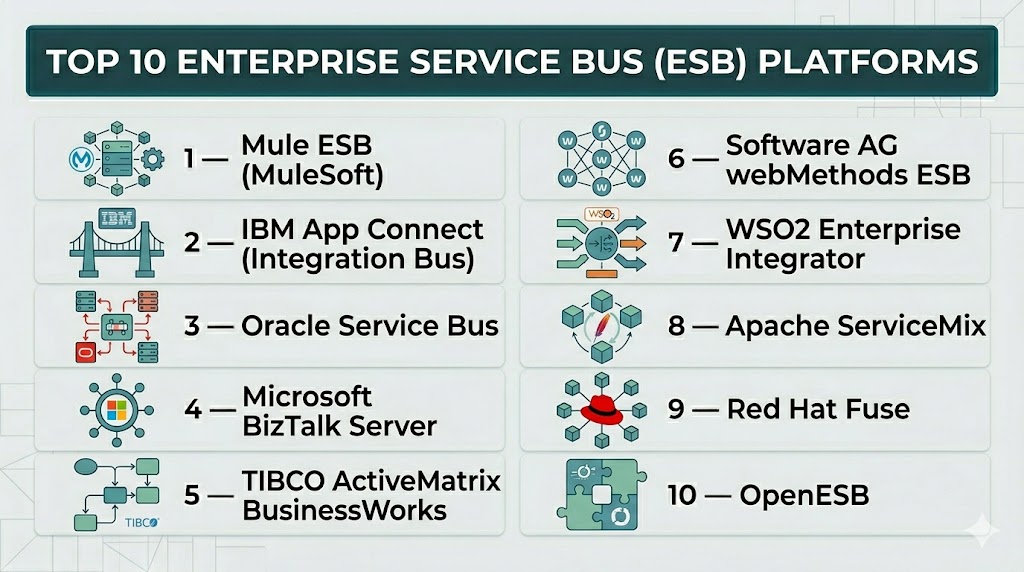
Top 10 Enterprise Service Bus (ESB) Platforms
#1 — Mule ESB (MuleSoft)
Short description: A widely adopted ESB platform offering strong integration, API management, and enterprise scalability.
Key Features
- API-led connectivity
- Data transformation tools
- Pre-built connectors
- Workflow orchestration
- Hybrid deployment
Pros
- Enterprise-grade features
- Strong integration ecosystem
Cons
- Expensive
- Complex setup
Platforms / Deployment
Cloud / Hybrid
Security & Compliance
Enterprise-grade security
Integrations & Ecosystem
Mule ESB integrates with enterprise systems and APIs.
- CRM
- ERP
- Databases
Support & Community
Strong enterprise support
#2 — IBM App Connect (Integration Bus)
Short description: A powerful ESB solution for enterprise integration and message transformation.
Key Features
- Message routing
- Data transformation
- API integration
- Event-driven processing
- Monitoring tools
Pros
- Robust enterprise capabilities
- Strong governance
Cons
- Complex configuration
- High cost
Platforms / Deployment
Cloud / On-premise
Security & Compliance
Access control, encryption
Integrations & Ecosystem
- IBM Cloud
- Enterprise systems
Support & Community
Enterprise-level support
#3 — Oracle Service Bus
Short description: An enterprise integration platform designed for SOA-based architectures.
Key Features
- Service orchestration
- Message transformation
- Protocol mediation
- Monitoring tools
- Security policies
Pros
- Strong SOA capabilities
- Reliable performance
Cons
- Requires expertise
- Licensing cost
Platforms / Deployment
On-premise / Cloud
Security & Compliance
Authentication, policy enforcement
Integrations & Ecosystem
- Oracle ecosystem
- Enterprise apps
Support & Community
Strong enterprise support
#4 — Microsoft BizTalk Server
Short description: A long-standing ESB platform for integrating Microsoft-based systems.
Key Features
- Workflow automation
- Message transformation
- Integration adapters
- Business rules engine
- Monitoring tools
Pros
- Strong Microsoft integration
- Mature platform
Cons
- Limited cloud-native features
- Requires maintenance
Platforms / Deployment
On-premise / Hybrid
Security & Compliance
Enterprise-grade security
Integrations & Ecosystem
- Microsoft ecosystem
- Enterprise systems
Support & Community
Large enterprise community
#5 — TIBCO ActiveMatrix BusinessWorks
Short description: A high-performance ESB platform focused on enterprise integration and automation.
Key Features
- Workflow orchestration
- Data transformation
- Integration connectors
- Event-driven processing
- Monitoring
Pros
- High performance
- Scalable
Cons
- Complex setup
- Expensive
Platforms / Deployment
Cloud / On-premise
Security & Compliance
Enterprise-grade security
Integrations & Ecosystem
- APIs
- Enterprise systems
Support & Community
Enterprise support
#6 — Software AG webMethods ESB
Short description: A comprehensive integration platform combining ESB and API management.
Key Features
- Integration workflows
- Data transformation
- API integration
- Monitoring and analytics
- Governance tools
Pros
- Strong integration features
- Enterprise-ready
Cons
- Complex UI
- Costly
Platforms / Deployment
Cloud / Hybrid
Security & Compliance
Access control, security policies
Integrations & Ecosystem
- APIs
- SaaS tools
Support & Community
Enterprise support
#7 — WSO2 Enterprise Integrator
Short description: An open-source ESB platform with strong API and integration capabilities.
Key Features
- API integration
- Message routing
- Data transformation
- Event processing
- Monitoring
Pros
- Open-source
- Flexible
Cons
- Requires setup expertise
- Smaller enterprise adoption
Platforms / Deployment
Cloud / Self-hosted
Security & Compliance
Authentication, access control
Integrations & Ecosystem
- APIs
- Enterprise systems
Support & Community
Active open-source community
#8 — Apache ServiceMix
Short description: An open-source ESB built on Apache integration technologies.
Key Features
- Message routing
- Service orchestration
- Integration components
- Open-source framework
- Modular architecture
Pros
- Free and open-source
- Flexible
Cons
- Requires technical expertise
- Limited UI
Platforms / Deployment
Self-hosted
Security & Compliance
Not publicly stated
Integrations & Ecosystem
- Apache ecosystem
- APIs
Support & Community
Open-source community
#9 — Red Hat Fuse
Short description: A lightweight ESB platform designed for containerized and cloud-native environments.
Key Features
- Integration framework
- Container support
- Data transformation
- API integration
- DevOps integration
Pros
- Cloud-native
- Flexible
Cons
- Requires setup
- Learning curve
Platforms / Deployment
Cloud / Hybrid / Self-hosted
Security & Compliance
Enterprise-grade security
Integrations & Ecosystem
- Kubernetes
- APIs
Support & Community
Strong enterprise and open-source support
#10 — OpenESB
Short description: An open-source ESB platform for integrating enterprise applications.
Key Features
- Service orchestration
- Message routing
- Data transformation
- Integration support
- Standards-based architecture
Pros
- Open-source
- Cost-effective
Cons
- Limited modern features
- Smaller ecosystem
Platforms / Deployment
Cross-platform (Self-hosted)
Security & Compliance
Not publicly stated
Integrations & Ecosystem
- XML
- Web services
Support & Community
Community-driven support
Comparison Table (Top 10)
| Tool Name | Best For | Platform(s) Supported | Deployment | Standout Feature | Public Rating |
|---|---|---|---|---|---|
| Mule ESB | Enterprise | Web | Cloud/Hybrid | API-led integration | N/A |
| IBM App Connect | Enterprises | Web | Cloud/On-prem | Message transformation | N/A |
| Oracle Service Bus | SOA | Web | Cloud/On-prem | Protocol mediation | N/A |
| BizTalk | Microsoft users | Web | Hybrid | Workflow automation | N/A |
| TIBCO | High performance | Web | Cloud/On-prem | Event processing | N/A |
| webMethods | Integration | Web | Cloud/Hybrid | Governance | N/A |
| WSO2 | Open-source | Web | Cloud/Self-hosted | Flexibility | N/A |
| ServiceMix | Developers | CLI/Web | Self-hosted | Open-source | N/A |
| Red Hat Fuse | Cloud-native | Web | Hybrid | Container support | N/A |
| OpenESB | Budget | Web | Self-hosted | Standards-based | N/A |
Evaluation & Scoring of ESB Platforms
| Tool Name | Core (25%) | Ease (15%) | Integrations (15%) | Security (10%) | Performance (10%) | Support (10%) | Value (15%) | Weighted Total |
|---|---|---|---|---|---|---|---|---|
| Mule ESB | 10 | 5 | 10 | 9 | 9 | 9 | 5 | 8.5 |
| IBM App Connect | 9 | 6 | 9 | 9 | 9 | 9 | 6 | 8.4 |
| Oracle Service Bus | 9 | 6 | 9 | 9 | 8 | 8 | 6 | 8.2 |
| BizTalk | 8 | 7 | 8 | 8 | 8 | 8 | 7 | 8.0 |
| TIBCO | 9 | 6 | 9 | 9 | 9 | 8 | 6 | 8.3 |
| webMethods | 9 | 6 | 9 | 8 | 8 | 8 | 6 | 8.1 |
| WSO2 | 8 | 7 | 8 | 7 | 8 | 7 | 8 | 7.9 |
| ServiceMix | 7 | 6 | 7 | 6 | 7 | 7 | 9 | 7.3 |
| Red Hat Fuse | 8 | 6 | 8 | 8 | 8 | 8 | 7 | 7.9 |
| OpenESB | 7 | 6 | 7 | 6 | 7 | 6 | 9 | 7.2 |
How to interpret scores:
- Enterprise tools score higher in features and security
- Open-source tools offer flexibility and cost advantages
- Ease of use varies significantly across platforms
- Choose based on integration complexity and team expertise
Which ESB Platform Is Right for You?
Solo / Freelancer
- Best: OpenESB, ServiceMix
- Low-cost and simple setups
SMB
- Best: WSO2, Red Hat Fuse
- Balance of flexibility and cost
Mid-Market
- Best: webMethods, TIBCO
- Need scalability and integrations
Enterprise
- Best: MuleSoft, IBM, Oracle
- Require governance and reliability
Budget vs Premium
- Budget: Open-source tools
- Premium: MuleSoft, IBM
Feature Depth vs Ease of Use
- Advanced: MuleSoft, IBM
- Easier: WSO2
Integrations & Scalability
- Strong: MuleSoft, IBM, TIBCO
- Moderate: Open-source tools
Security & Compliance Needs
- Enterprise: IBM, Oracle
- Basic: Open-source
Frequently Asked Questions (FAQs)
What is an ESB platform?
An ESB is middleware that integrates applications by routing and transforming messages between systems.
How does ESB work?
It receives messages, transforms them, and routes them to the correct destination systems.
Why use ESB?
To simplify integration and reduce point-to-point complexity.
Is ESB still relevant?
Yes, especially in legacy and hybrid enterprise environments.
How is ESB different from iPaaS?
ESB focuses on on-premise and SOA integration, while iPaaS is cloud-based.
Can ESB support microservices?
Yes, but modern architectures may prefer API gateways or event streaming.
Is ESB secure?
Yes, it includes authentication, routing control, and monitoring features.
What are the disadvantages of ESB?
Complexity, latency, and potential single point of failure.
Are there open-source ESB tools?
Yes, examples include Apache ServiceMix and OpenESB.
What are alternatives to ESB?
iPaaS, API gateways, and event streaming platforms.
Conclusion
Enterprise Service Bus platforms remain a powerful solution for integrating complex enterprise systems and managing data flow across diverse environments. While newer architectures are emerging, ESBs still play a critical role in legacy integration and hybrid environments. The right platform depends on your system complexity, scalability needs, and architectural direction. Focus on flexibility, performance, and long-term maintainability when choosing a solution. Start by evaluating a few platforms and testing them within your infrastructure.