Introduction
Project Management Software helps teams plan, execute, and track projects efficiently from start to finish. These tools centralize tasks, timelines, resources, and communication, enabling teams to stay aligned and deliver projects on time. Instead of relying on disconnected tools like spreadsheets or emails, project management platforms bring everything into one unified system for better visibility and control.
With the rise of remote work and complex workflows, project management tools have become essential for organizations of all sizes. They improve collaboration, reduce delays, and ensure accountability by assigning clear ownership and deadlines for every task.
Common use cases include:
- Project planning and scheduling
- Task assignment and tracking
- Resource management
- Team collaboration and communication
- Progress reporting and analytics
What buyers should evaluate:
- Ease of use and onboarding
- Task and workflow management features
- Reporting and analytics capabilities
- Integration ecosystem
- Scalability
- Security and access control
- Automation capabilities
- Pricing and value
Best for: Project managers, development teams, marketing teams, agencies, and enterprises managing structured or complex workflows.
Not ideal for: Individuals needing only simple to-do lists or minimal task tracking.
Key Trends in Project Management Software
- AI-powered project planning and automation
- Integration with DevOps and collaboration tools
- Real-time dashboards and reporting
- Increased focus on remote team collaboration
- Workflow automation and smart notifications
- Hybrid project management (Agile + Waterfall)
- Mobile-first project tracking
- Enhanced security and access controls
How We Selected These Tools (Methodology)
- High market adoption and credibility
- Feature completeness across planning, tracking, and collaboration
- Reliability and performance
- Integration ecosystem strength
- Security and enterprise readiness
- Usability across different team sizes
- Innovation in automation and AI
- Customer feedback and product maturity
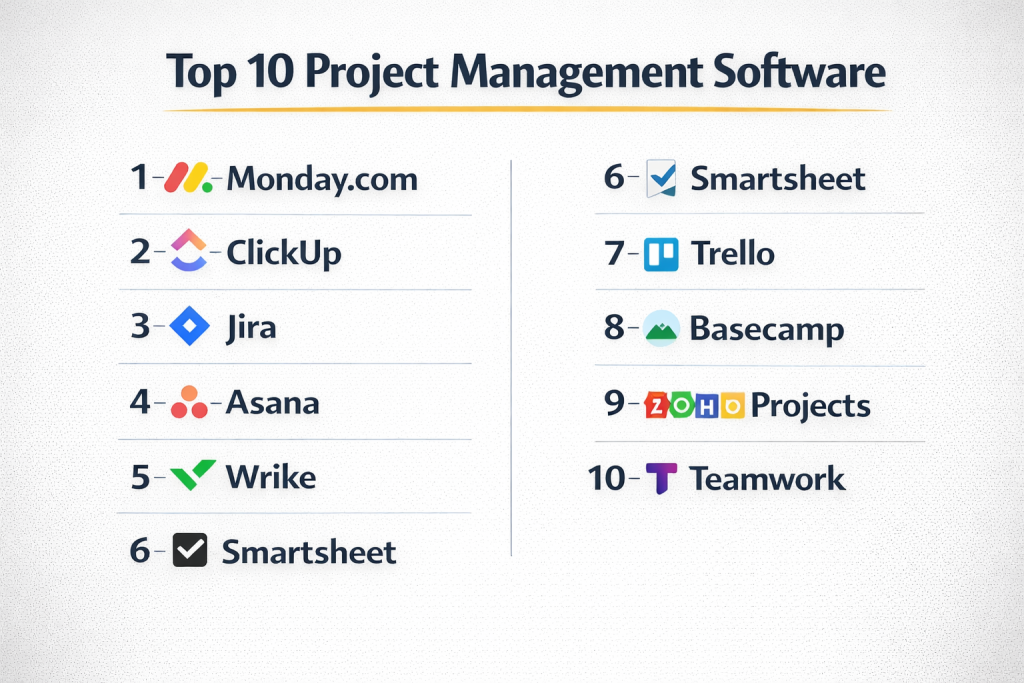
Top 10 Project Management Software
#1 — Monday.com
Short description: Visual project management platform designed for teams needing flexible workflows and dashboards.
Key Features
- Custom workflows
- Visual dashboards
- Automation tools
- Task tracking
- Collaboration features
Pros
- Easy to use
- Highly customizable
Cons
- Expensive at scale
- Learning curve
Platforms / Deployment
Web / Mobile / Cloud
Security & Compliance
Not publicly stated
Integrations & Ecosystem
- CRM tools
- APIs
Support & Community
Good customer support
#2 — ClickUp
Short description: All-in-one productivity platform combining project management, tasks, and automation.
Key Features
- Task hierarchies
- Agile boards
- Time tracking
- Automation
- Reporting
Pros
- Feature-rich
- Cost-effective
Cons
- Complex UI
- Learning curve
Platforms / Deployment
Web / Mobile / Cloud
Security & Compliance
Not publicly stated
Integrations & Ecosystem
- Productivity tools
- APIs
Support & Community
Active community
#3 — Jira
Short description: Powerful project management tool focused on Agile and software development workflows.
Key Features
- Scrum and Kanban boards
- Sprint planning
- Issue tracking
- Automation
- Reporting dashboards
Pros
- Highly customizable
- Strong ecosystem
Cons
- Steep learning curve
- Complex setup
Platforms / Deployment
Web / Mobile / Cloud / Self-hosted
Security & Compliance
SSO, RBAC, encryption; other details Not publicly stated
Integrations & Ecosystem
- DevOps tools
- APIs
Support & Community
Large global community
#4 — Asana
Short description: Flexible project management tool suitable for teams of all sizes.
Key Features
- Task management
- Timeline view
- Automation
- Reporting
- Collaboration
Pros
- Easy to use
- Versatile
Cons
- Limited advanced features
- Pricing tiers
Platforms / Deployment
Web / Mobile / Cloud
Security & Compliance
Not publicly stated
Integrations & Ecosystem
- CRM tools
- Collaboration apps
Support & Community
Strong support
#5 — Wrike
Short description: Enterprise-grade project management tool focused on collaboration and reporting.
Key Features
- Task tracking
- Workflow automation
- Reporting dashboards
- Resource management
- Collaboration tools
Pros
- Strong reporting
- Flexible workflows
Cons
- Complex interface
- Pricing tiers
Platforms / Deployment
Web / Mobile / Cloud
Security & Compliance
Not publicly stated
Integrations & Ecosystem
- Business tools
- APIs
Support & Community
Professional support
#6 — Smartsheet
Short description: Spreadsheet-style project management tool for structured workflows and reporting.
Key Features
- Task tracking
- Automation
- Reporting
- Templates
- Collaboration
Pros
- Familiar interface
- Strong reporting
Cons
- Learning curve
- Limited Agile features
Platforms / Deployment
Web / Mobile / Cloud
Security & Compliance
Not publicly stated
Integrations & Ecosystem
- Business tools
- APIs
Support & Community
Good support
#7 — Trello
Short description: Simple Kanban-based tool for visual project management.
Key Features
- Boards and cards
- Drag-and-drop interface
- Automation
- Collaboration
- Workflow tracking
Pros
- Easy to use
- Flexible
Cons
- Limited advanced features
- Not ideal for large teams
Platforms / Deployment
Web / Mobile / Cloud
Security & Compliance
Not publicly stated
Integrations & Ecosystem
- Productivity tools
- APIs
Support & Community
Strong community
#8 — Basecamp
Short description: Project management tool focused on communication and team collaboration.
Key Features
- Task lists
- Messaging
- File sharing
- Scheduling
- Collaboration
Pros
- Simple interface
- Strong communication tools
Cons
- Limited advanced features
- Basic reporting
Platforms / Deployment
Web / Mobile / Cloud
Security & Compliance
Not publicly stated
Integrations & Ecosystem
- Collaboration tools
- APIs
Support & Community
Strong support
#9 — Zoho Projects
Short description: Budget-friendly project management tool with good integrations and features.
Key Features
- Task tracking
- Time tracking
- Reporting
- Collaboration
- Automation
Pros
- Affordable
- Good integrations
Cons
- UI limitations
- Limited advanced features
Platforms / Deployment
Web / Mobile / Cloud
Security & Compliance
Not publicly stated
Integrations & Ecosystem
- Zoho ecosystem
- APIs
Support & Community
Reliable support
#10 — Teamwork
Short description: Project management platform designed for client work and collaboration.
Key Features
- Task management
- Time tracking
- Collaboration
- Reporting
- Project planning
Pros
- Great for client projects
- Strong collaboration
Cons
- Complex setup
- Pricing tiers
Platforms / Deployment
Web / Mobile / Cloud
Security & Compliance
Not publicly stated
Integrations & Ecosystem
- Business tools
- APIs
Support & Community
Reliable support
Comparison Table (Top 10)
| Tool Name | Best For | Platform(s) Supported | Deployment | Standout Feature | Public Rating |
|---|---|---|---|---|---|
| Monday.com | Visual workflows | Web/Mobile | Cloud | Dashboards | N/A |
| ClickUp | All-in-one teams | Web/Mobile | Cloud | Feature-rich | N/A |
| Jira | Agile teams | Web/Mobile | Cloud/Self-hosted | Custom workflows | N/A |
| Asana | Flexible teams | Web/Mobile | Cloud | Ease of use | N/A |
| Wrike | Enterprise | Web/Mobile | Cloud | Reporting | N/A |
| Smartsheet | Structured teams | Web/Mobile | Cloud | Spreadsheet style | N/A |
| Trello | Beginners | Web/Mobile | Cloud | Kanban boards | N/A |
| Basecamp | Collaboration | Web/Mobile | Cloud | Simplicity | N/A |
| Zoho Projects | Budget teams | Web/Mobile | Cloud | Cost-effective | N/A |
| Teamwork | Client projects | Web/Mobile | Cloud | Collaboration | N/A |
Evaluation & Scoring of Project Management Software
| Tool Name | Core (25%) | Ease (15%) | Integrations (15%) | Security (10%) | Performance (10%) | Support (10%) | Value (15%) | Weighted Total |
|---|---|---|---|---|---|---|---|---|
| Monday.com | 8 | 8 | 8 | 7 | 8 | 8 | 7 | 8.0 |
| ClickUp | 9 | 7 | 8 | 7 | 8 | 7 | 9 | 8.2 |
| Jira | 9 | 7 | 9 | 8 | 9 | 8 | 7 | 8.3 |
| Asana | 8 | 9 | 8 | 7 | 8 | 8 | 7 | 8.1 |
| Wrike | 8 | 7 | 8 | 7 | 8 | 8 | 7 | 7.9 |
| Smartsheet | 7 | 7 | 7 | 7 | 8 | 7 | 7 | 7.4 |
| Trello | 7 | 9 | 7 | 6 | 7 | 7 | 8 | 7.6 |
| Basecamp | 6 | 9 | 6 | 6 | 7 | 7 | 8 | 7.1 |
| Zoho Projects | 7 | 8 | 7 | 7 | 7 | 7 | 8 | 7.5 |
| Teamwork | 8 | 7 | 8 | 7 | 8 | 7 | 7 | 7.8 |
Scores are comparative and reflect overall balance across usability, features, and value.
Which Project Management Software Is Right for You?
Solo / Freelancer
Trello or Basecamp
SMB
ClickUp or Asana
Mid-Market
Monday.com or Wrike
Enterprise
Jira or Smartsheet
Budget vs Premium
Budget tools focus on simplicity; premium tools offer advanced features
Feature Depth vs Ease of Use
Simple tools are easier; advanced tools require training
Integrations & Scalability
Enterprise tools provide stronger integrations
Security & Compliance Needs
Large teams should prioritize secure platforms
Frequently Asked Questions (FAQs)
What is project management software?
It helps plan, track, and manage projects efficiently.
Why is it important?
It improves collaboration and ensures timely delivery.
Which tool is best for beginners?
Trello and Asana are beginner-friendly.
Are these tools expensive?
Pricing varies based on features and scale.
Can they be used for remote teams?
Yes, they are ideal for remote collaboration.
Do they support integrations?
Most tools support integrations.
Are they secure?
Security varies by platform.
Can I switch tools easily?
Depends on migration complexity.
Do they support automation?
Yes, most tools offer automation features.
What are alternatives?
Spreadsheets or manual tracking methods.
Conclusion
Project management software has become essential for teams looking to improve efficiency, collaboration, and project visibility in today’s fast-paced work environment. While powerful platforms like Jira and ClickUp offer deep customization and advanced capabilities, simpler tools like Trello and Basecamp provide ease of use for smaller teams. The right tool depends on your team size, workflow complexity, and integration needs rather than a single universal solution. It is important to evaluate tools based on usability, scalability, and long-term value before making a decision. Shortlisting a few options and testing them in real scenarios can help identify the best fit for your organization. Choosing the right platform ultimately leads to better productivity and successful project delivery.