Introduction
Music notation software allows users to write, edit, arrange, and publish sheet music digitally. Instead of manually writing notes on paper, these tools provide structured interfaces to compose music, generate clean scores, and playback compositions for review.
In today’s digital-first creative landscape, music notation tools are no longer limited to composers. Educators, content creators, game developers, and musicians increasingly rely on them for faster workflows, accurate engraving, and seamless collaboration. Modern tools also integrate MIDI input, AI-assisted transcription, and cloud sharing—making them more powerful and accessible than ever.
Common use cases include:
- Composing orchestral, film, and game music
- Arranging songs for bands, choirs, and ensembles
- Music education and teaching
- Transcribing audio into sheet music
- Publishing and printing professional scores
Key evaluation criteria buyers should consider:
- Notation accuracy and engraving quality
- MIDI input and playback realism
- Ease of use vs advanced control
- Support for large ensembles and orchestration
- Export formats (MusicXML, PDF, MIDI)
- AI-assisted transcription or notation
- Collaboration and cloud sharing
- Performance with large scores
- Plugin and sound library support
Best for: Composers, arrangers, music educators, students, and production teams working with sheet music and scoring.
Not ideal for: Users focused purely on audio production—DAWs are better suited for recording and mixing rather than notation.
Key Trends in Music Notation Software
- AI-powered transcription: Converting audio into sheet music automatically
- Cloud-based notation tools: Real-time collaboration and sharing
- Improved playback engines: More realistic instrument sounds
- Integration with DAWs: Seamless export/import between audio and notation tools
- Mobile and tablet workflows: Writing music on the go
- Automation of engraving tasks: Cleaner scores with less manual effort
- MusicXML standardization: Better interoperability between tools
- Hybrid workflows: Combining notation + audio production
- Educational integrations: Tools for teaching theory and composition
- Generative AI composition assistance: Suggesting harmonies and arrangements
How We Selected These Tools (Methodology)
- Evaluated industry adoption among composers and educators
- Assessed engraving quality and notation accuracy
- Reviewed performance with complex scores and orchestration
- Considered AI and modern workflow features
- Included tools for beginners to professionals
- Analyzed integration with DAWs and MIDI devices
- Evaluated ease of learning and usability
- Reviewed community support and documentation
- Balanced free, open-source, and premium tools
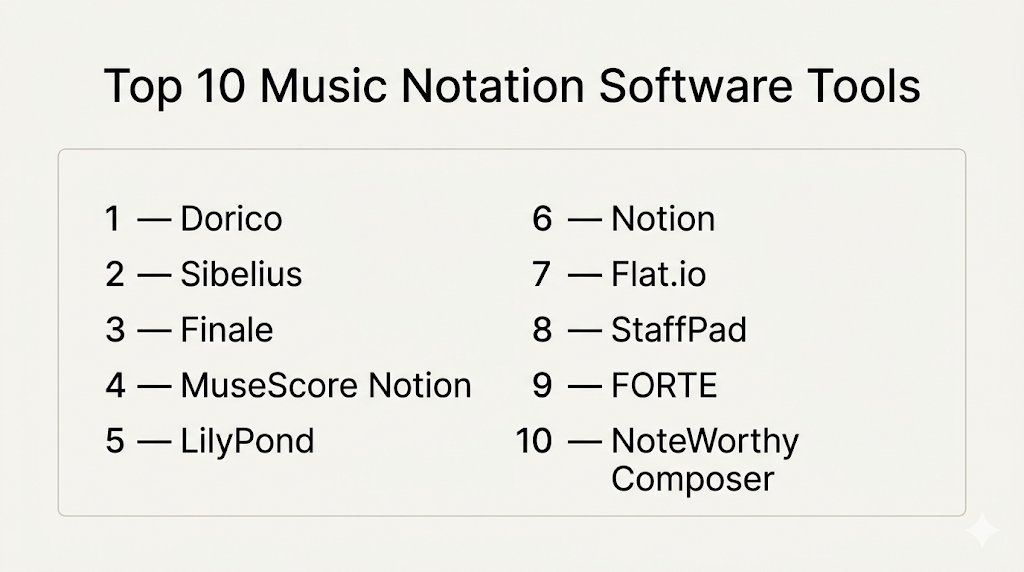
Top 10 Music Notation Software Tools
#1 — Dorico
Short description: A modern, high-end notation software known for its advanced engraving and intelligent workflow.
Key Features
- Intelligent note input system
- Advanced engraving engine
- Flow-based project management
- Built-in audio engine
- MIDI and VST support
- Automatic score condensing
Pros
- Best-in-class engraving quality
- Excellent for complex compositions
Cons
- Learning curve
- Premium pricing
Platforms / Deployment
Windows / macOS / iPad
Local
Security & Compliance
Not publicly stated
Integrations & Ecosystem
Strong integration with music production tools.
- VST plugins
- MIDI devices
- Audio engines
Support & Community
Growing professional community with strong documentation.
#2 — Sibelius
Short description: A widely used notation software offering a balance of usability and professional features.
Key Features
- Advanced score editing
- Dynamic parts and layouts
- MIDI input support
- Cloud sharing
- Built-in sound library
Pros
- User-friendly interface
- Industry recognition
Cons
- Subscription model
- Limited compared to Dorico in some areas
Platforms / Deployment
Windows / macOS
Cloud / Local
Security & Compliance
Not publicly stated
Integrations & Ecosystem
Strong ecosystem.
- Avid tools
- Plugins
- Cloud collaboration
Support & Community
Large global user base.
#3 — Finale
Short description: A long-standing notation software known for deep customization and professional publishing.
Key Features
- Advanced engraving control
- Flexible layout tools
- MIDI and playback support
- Plugin extensions
- Publishing tools
Pros
- Highly customizable
- Professional-grade output
Cons
- Complex interface
- Slower workflow
Platforms / Deployment
Windows / macOS
Local
Security & Compliance
Not publicly stated
Integrations & Ecosystem
Extensive plugin ecosystem.
- Plugins
- MIDI tools
Support & Community
Established professional community.
#4 — MuseScore
Short description: A popular free and open-source notation software with strong community support.
Key Features
- Drag-and-drop notation
- Built-in sound playback
- MusicXML support
- Plugin support
- Cross-platform
Pros
- Free and accessible
- Beginner-friendly
Cons
- Limited advanced engraving
- Performance issues on large scores
Platforms / Deployment
Windows / macOS / Linux
Local
Security & Compliance
Not publicly stated
Integrations & Ecosystem
Open-source ecosystem.
- Plugins
- Community libraries
Support & Community
Very large global community.
#5 — Notion
Short description: A notation tool focused on integration with audio workflows and DAWs.
Key Features
- Real-time playback
- MIDI input
- DAW integration
- Built-in sounds
- Score editing
Pros
- Great for hybrid workflows
- Easy to use
Cons
- Limited engraving features
- Smaller ecosystem
Platforms / Deployment
Windows / macOS / iOS
Local
Security & Compliance
Not publicly stated
Integrations & Ecosystem
Integration with production tools.
- DAWs
- MIDI devices
Support & Community
Moderate support resources.
#6 — LilyPond
Short description: A text-based notation software focused on high-quality engraving.
Key Features
- Code-based notation input
- High-quality engraving output
- Automation of formatting
- Open-source
- Scriptable workflows
Pros
- Exceptional engraving quality
- Free and customizable
Cons
- Steep learning curve
- Not beginner-friendly
Platforms / Deployment
Windows / macOS / Linux
Local
Security & Compliance
Not publicly stated
Integrations & Ecosystem
Developer-friendly ecosystem.
- Scripts
- Export formats
Support & Community
Strong niche community.
#7 — Flat.io
Short description: A cloud-based notation tool designed for collaboration and education.
Key Features
- Real-time collaboration
- Web-based interface
- MusicXML support
- Sharing and publishing
- Classroom tools
Pros
- Easy collaboration
- No installation required
Cons
- Internet dependency
- Limited advanced features
Platforms / Deployment
Web
Cloud
Security & Compliance
Not publicly stated
Integrations & Ecosystem
Cloud-first integrations.
- Google Classroom
- LMS tools
Support & Community
Strong in education sector.
#8 — StaffPad
Short description: A tablet-focused notation app using handwriting recognition.
Key Features
- Handwriting recognition
- Realistic playback
- Touch interface
- MIDI support
- Audio integration
Pros
- Natural writing experience
- Innovative workflow
Cons
- Device-specific
- Expensive
Platforms / Deployment
Windows / iPad
Local
Security & Compliance
Not publicly stated
Integrations & Ecosystem
Supports modern workflows.
- Audio tools
- MIDI
Support & Community
Growing creative community.
#9 — FORTE
Short description: A flexible notation tool designed for beginners to professionals with scanning capabilities.
Key Features
- Score scanning and editing
- MIDI input
- Multi-instrument support
- Export formats
- Virtual orchestra playback
Pros
- Easy to learn
- Supports scanning
Cons
- Smaller ecosystem
- Less widely adopted
Platforms / Deployment
Windows / macOS
Local
Security & Compliance
Not publicly stated
Integrations & Ecosystem
Supports music workflows.
- MIDI
- Export tools
Support & Community
Moderate support.
#10 — NoteWorthy Composer
Short description: A lightweight notation tool focused on simple composition and MIDI workflows.
Key Features
- MIDI input and playback
- Score editing
- Transposition tools
- Export formats
- Lightweight design
Pros
- Simple and efficient
- Low system requirements
Cons
- Limited advanced features
- Windows-focused
Platforms / Deployment
Windows
Local
Security & Compliance
Not publicly stated
Integrations & Ecosystem
Basic ecosystem.
- MIDI support
- Export tools
Support & Community
Small but dedicated community.
Comparison Table (Top 10)
| Tool Name | Best For | Platform(s) Supported | Deployment | Standout Feature | Public Rating |
|---|---|---|---|---|---|
| Dorico | Advanced composers | Win/macOS/iPad | Local | Engraving engine | N/A |
| Sibelius | Professionals | Win/macOS | Hybrid | Ease + power | N/A |
| Finale | Publishing | Win/macOS | Local | Customization | N/A |
| MuseScore | Beginners | Multi-platform | Local | Free open-source | N/A |
| Notion | Hybrid workflows | Multi-platform | Local | DAW integration | N/A |
| LilyPond | Engraving experts | Multi-platform | Local | Code-based precision | N/A |
| Flat.io | Collaboration | Web | Cloud | Real-time editing | N/A |
| StaffPad | Tablet users | Windows/iPad | Local | Handwriting input | N/A |
| FORTE | Beginners/pros | Win/macOS | Local | Score scanning | N/A |
| NoteWorthy | Lightweight use | Windows | Local | Simplicity | N/A |
Evaluation & Scoring of Music Notation Software
| Tool Name | Core (25%) | Ease (15%) | Integrations (15%) | Security (10%) | Performance (10%) | Support (10%) | Value (15%) | Weighted Total |
|---|---|---|---|---|---|---|---|---|
| Dorico | 10 | 6 | 9 | 6 | 9 | 8 | 8 | 8.6 |
| Sibelius | 9 | 8 | 9 | 6 | 8 | 9 | 7 | 8.4 |
| Finale | 10 | 5 | 8 | 6 | 8 | 8 | 7 | 8.0 |
| MuseScore | 7 | 9 | 7 | 5 | 7 | 9 | 10 | 7.9 |
| Notion | 8 | 8 | 8 | 5 | 7 | 7 | 8 | 7.7 |
| LilyPond | 9 | 4 | 7 | 5 | 8 | 7 | 10 | 7.6 |
| Flat.io | 7 | 9 | 7 | 5 | 7 | 7 | 8 | 7.5 |
| StaffPad | 8 | 8 | 7 | 5 | 8 | 6 | 7 | 7.5 |
| FORTE | 7 | 8 | 6 | 5 | 7 | 6 | 8 | 7.1 |
| NoteWorthy | 6 | 9 | 5 | 5 | 6 | 6 | 8 | 6.9 |
How to interpret the scores:
- Higher scores indicate balanced capabilities across key criteria
- Professionals should prioritize engraving and core features
- Beginners should prioritize ease of use and value
- Open-source tools score high in value but may lack polish
- Always choose based on workflow needs
Which Music Notation Software Tool Is Right for You?
Solo / Freelancer
- Best options: MuseScore, Flat.io
- Focus on ease and affordability
SMB
- Best options: Sibelius, Notion
- Balanced workflows and usability
Mid-Market
- Best options: Dorico, Finale
- Need advanced features and scalability
Enterprise
- Best options: Dorico, Sibelius
- Require professional-grade engraving
Budget vs Premium
- Budget: MuseScore, LilyPond
- Premium: Dorico, Finale
Feature Depth vs Ease of Use
- Advanced: Dorico, Finale
- Easy: MuseScore, Flat.io
Integrations & Scalability
- Strong: Sibelius, Dorico
- Limited: NoteWorthy
Security & Compliance Needs
- Most tools: Not publicly stated
- Enterprises should validate internally
Frequently Asked Questions (FAQs)
What is music notation software?
It is software used to create and edit sheet music digitally.
Which software is best for beginners?
MuseScore and Flat.io are beginner-friendly options.
Is there free notation software?
Yes, MuseScore and LilyPond are free.
What is MusicXML?
A file format for sharing notation between tools.
Can I convert audio to sheet music?
Yes, some tools use AI for transcription.
Which tool is best for professionals?
Dorico and Sibelius are widely used professionally.
Do notation tools support MIDI?
Yes, most tools support MIDI input and playback.
Can I collaborate with others?
Yes, cloud tools like Flat.io support collaboration.
Is engraving important?
Yes, it ensures professional-quality sheet music.
Can I integrate with DAWs?
Yes, many tools support export/import with DAWs.
Conclusion
Music notation software plays a critical role in modern music creation, enabling composers and educators to produce high-quality scores efficiently. From free beginner tools to advanced professional platforms, there is a wide range of options depending on your needs.