Introduction
IC (Integrated Circuit) Design & Verification tools are specialized Electronic Design Automation (EDA) software used to design, simulate, verify, and prepare semiconductor chips for fabrication. These tools cover the full chip development lifecycle—from RTL design and synthesis to physical layout, timing analysis, and sign-off verification.
As modern chips grow increasingly complex—often containing billions of transistors—IC design tools have become essential for ensuring functionality, performance, and manufacturability. They are widely used in industries such as semiconductors, AI hardware, automotive electronics, telecommunications, and consumer devices.
Common use cases include:
- Designing digital and analog integrated circuits
- RTL simulation and functional verification
- Static timing and power analysis
- Physical design (placement and routing)
- Sign-off verification (DRC, LVS, reliability checks)
Key evaluation criteria:
- Simulation accuracy and verification depth
- Scalability for large SoC designs
- Support for HDL workflows (Verilog, VHDL, SystemVerilog)
- Integration across full IC design flow
- Performance and compute efficiency
- Ease of use and automation capabilities
- Ecosystem and foundry compatibility
- Support for advanced nodes and multi-die designs
- Licensing flexibility and cost
Best for: VLSI engineers, ASIC/SoC designers, verification engineers, semiconductor startups, and research labs.
Not ideal for: Beginners without hardware background or teams working on simple PCB or embedded projects.
Key Trends in IC Design & Verification Tools
- AI-driven chip design: Automation in synthesis, layout, and verification workflows
- Cloud-based EDA environments: Enabling distributed design teams and scalable compute
- Chiplet and multi-die design support: Managing modular architectures
- Advanced node support: Tools optimized for FinFET and beyond
- Verification automation: Increased use of UVM and coverage-driven methodologies
- Digital twin integration: Linking chip behavior with system-level simulation
- Open-source IC design movement: Tools like OpenROAD gaining traction
- Hardware security verification: Detecting vulnerabilities at RTL and gate level
- HPC acceleration: Distributed simulation and regression testing
- Unified design platforms: End-to-end workflows from RTL to sign-off
How We Selected These Tools (Methodology)
- Evaluated industry adoption across semiconductor companies
- Assessed coverage of full IC design flow
- Reviewed simulation and verification capabilities
- Analyzed performance for large-scale designs
- Considered integration with foundries and PDKs
- Evaluated ease of use and automation features
- Reviewed support and training ecosystem
- Included both commercial and open-source tools
- Considered digital, analog, and mixed-signal coverage
- Ensured relevance across multiple industries
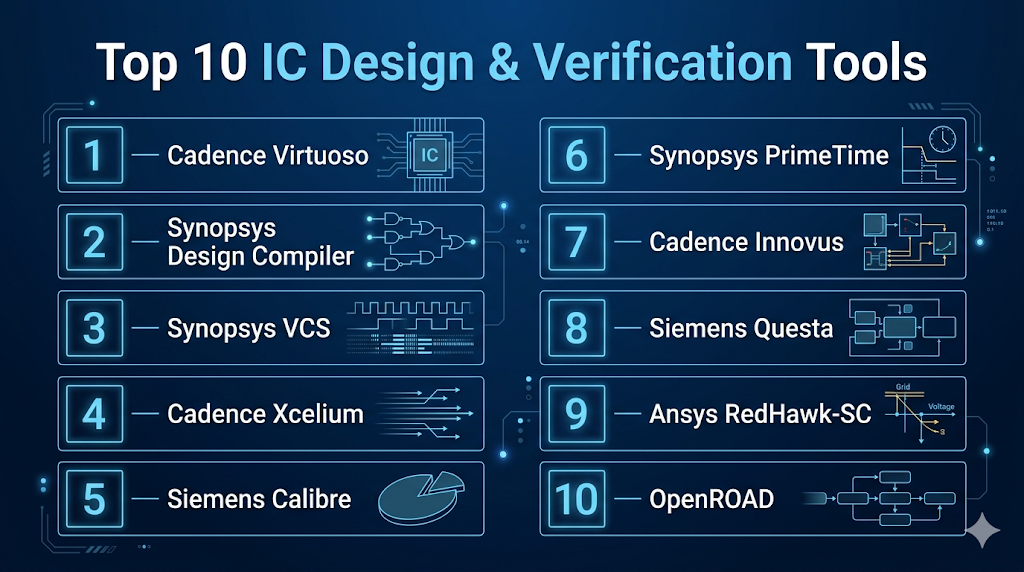
Top 10 IC Design & Verification Tools
#1 — Cadence Virtuoso
Short description: A leading platform for analog, mixed-signal, and custom IC design with deep verification capabilities.
Key Features
- Schematic-driven layout
- Advanced analog simulation
- Real-time design rule checking
- Multi-physics integration
- AI-assisted layout automation
- Foundry PDK support
Pros
- Industry-standard for analog design
- Highly accurate simulations
Cons
- Expensive
- Complex interface
Platforms / Deployment
- Windows / Linux
- Self-hosted / Cloud
Security & Compliance
- Not publicly stated
Integrations & Ecosystem
Deep integration with semiconductor workflows.
- Foundry PDKs
- Simulation tools
- APIs
- Verification suites
Support & Community
Strong enterprise support and widespread academic use.
#2 — Synopsys Design Compiler
Short description: A widely used logic synthesis tool for transforming RTL into gate-level designs.
Key Features
- RTL-to-gate synthesis
- Timing optimization
- Power optimization
- Constraint management
- Scalability for large designs
Pros
- High-quality synthesis results
- Widely adopted
Cons
- Expensive
- Requires expertise
Platforms / Deployment
- Linux
- Self-hosted
Security & Compliance
- Not publicly stated
Integrations & Ecosystem
Core part of Synopsys ecosystem.
- Verification tools
- Timing analysis tools
- APIs
Support & Community
Strong enterprise documentation and support.
#3 — Synopsys VCS
Short description: A high-performance RTL simulation and verification tool for large-scale digital designs.
Key Features
- SystemVerilog simulation
- UVM-based verification
- Coverage-driven testing
- Debugging tools
- Scalable regression testing
Pros
- Excellent for large verification workloads
- Mature ecosystem
Cons
- Complex setup
- Expensive
Platforms / Deployment
- Linux
- Self-hosted
Security & Compliance
- Not publicly stated
Integrations & Ecosystem
Strong integration with verification workflows.
- Debug tools
- APIs
- Automation scripts
Support & Community
Widely used in enterprise verification teams
#4 — Cadence Xcelium
Short description: A unified simulation platform for digital and mixed-signal verification.
Key Features
- High-speed simulation
- Mixed-language support
- Coverage analysis
- Debugging tools
- UVM support
Pros
- Strong performance
- Supports complex workflows
Cons
- Learning curve
- Licensing cost
Platforms / Deployment
- Linux
- Self-hosted
Security & Compliance
- Not publicly stated
Integrations & Ecosystem
Works within Cadence ecosystem.
- Verification tools
- Simulation frameworks
- APIs
Support & Community
Strong enterprise support.
#5 — Siemens Calibre
Short description: A leading tool for physical verification and sign-off checks in IC design.
Key Features
- Design rule checking (DRC)
- Layout vs schematic (LVS)
- Parasitic extraction
- Reliability analysis
- Sign-off verification
Pros
- Industry-standard for sign-off
- Highly accurate
Cons
- Complex workflows
- Expensive
Platforms / Deployment
- Linux
- Self-hosted
Security & Compliance
- Not publicly stated
Integrations & Ecosystem
Integrated with design flows.
- Foundry workflows
- CAD tools
- APIs
Support & Community
Strong enterprise adoption.
#6 — Synopsys PrimeTime
Short description: A widely used static timing analysis tool for validating chip performance.
Key Features
- Static timing analysis
- Power analysis
- Sign-off validation
- Multi-mode multi-corner analysis
- Advanced timing optimization
Pros
- Accurate timing analysis
- Industry standard
Cons
- Complex setup
- High cost
Platforms / Deployment
- Linux
- Self-hosted
Security & Compliance
- Not publicly stated
Integrations & Ecosystem
Works across IC design flows.
- Synthesis tools
- Verification tools
- APIs
Support & Community
Strong enterprise support.
#7 — Cadence Innovus
Short description: A digital implementation platform for placement and routing in IC design.
Key Features
- Place and route (PnR)
- Timing optimization
- Power optimization
- Floorplanning tools
- Multi-core scalability
Pros
- Strong performance
- Scalable
Cons
- Complex workflows
- Requires expertise
Platforms / Deployment
- Linux
- Self-hosted
Security & Compliance
- Not publicly stated
Integrations & Ecosystem
Part of Cadence ecosystem.
- Verification tools
- Timing tools
- APIs
Support & Community
Strong enterprise support.
#8 — Siemens Questa
Short description: A verification platform for simulation, formal verification, and debugging.
Key Features
- RTL simulation
- Formal verification
- Coverage analysis
- Debugging tools
- UVM support
Pros
- Strong verification capabilities
- Mature ecosystem
Cons
- Expensive
- Learning curve
Platforms / Deployment
- Windows / Linux
- Self-hosted
Security & Compliance
- Not publicly stated
Integrations & Ecosystem
Supports verification workflows.
- Simulation tools
- APIs
- Debug tools
Support & Community
Strong enterprise usage.
#9 — Ansys RedHawk-SC
Short description: A power integrity and reliability analysis tool for advanced IC designs.
Key Features
- Power integrity analysis
- Thermal analysis
- Reliability modeling
- Electromigration analysis
- HPC support
Pros
- Strong reliability analysis
- Scalable
Cons
- Specialized use case
- Expensive
Platforms / Deployment
- Linux
- Self-hosted
Security & Compliance
- Not publicly stated
Integrations & Ecosystem
Works with IC design flows.
- Simulation tools
- APIs
- HPC systems
Support & Community
Enterprise-level support.
#10 — OpenROAD
Short description: An open-source IC design automation platform for digital chip design workflows.
Key Features
- Automated RTL-to-GDS flow
- Placement and routing
- Timing optimization
- Open-source flexibility
- Integration with open toolchains
Pros
- Free and evolving
- Supports modern workflows
Cons
- Less mature
- Requires expertise
Platforms / Deployment
- Linux
- Self-hosted
Security & Compliance
- Not publicly stated
Integrations & Ecosystem
Works with open-source tools.
- APIs
- Simulation tools
- Custom workflows
Support & Community
Active developer community.
Comparison Table (Top 10)
| Tool Name | Best For | Platform(s) Supported | Deployment | Standout Feature | Public Rating |
|---|---|---|---|---|---|
| Cadence Virtuoso | Analog IC design | Windows, Linux | Hybrid | Schematic-driven layout | N/A |
| Synopsys Design Compiler | Synthesis | Linux | Self-hosted | RTL-to-gate conversion | N/A |
| Synopsys VCS | Verification | Linux | Self-hosted | High-speed simulation | N/A |
| Cadence Xcelium | Simulation | Linux | Self-hosted | Mixed-signal support | N/A |
| Siemens Calibre | Sign-off | Linux | Self-hosted | DRC/LVS accuracy | N/A |
| Synopsys PrimeTime | Timing | Linux | Self-hosted | Timing analysis | N/A |
| Cadence Innovus | Physical design | Linux | Self-hosted | Place & route | N/A |
| Siemens Questa | Verification | Windows, Linux | Self-hosted | Formal verification | N/A |
| Ansys RedHawk | Reliability | Linux | Self-hosted | Power integrity | N/A |
| OpenROAD | Open-source | Linux | Self-hosted | RTL-to-GDS automation | N/A |
Evaluation & Scoring of IC Design & Verification Tools
| Tool Name | Core (25%) | Ease (15%) | Integrations (15%) | Security (10%) | Performance (10%) | Support (10%) | Value (15%) | Weighted Total (0–10) |
|---|---|---|---|---|---|---|---|---|
| Virtuoso | 10 | 5 | 9 | 7 | 10 | 9 | 5 | 8.3 |
| Design Compiler | 10 | 5 | 9 | 7 | 10 | 9 | 5 | 8.3 |
| VCS | 9 | 6 | 9 | 7 | 9 | 9 | 6 | 8.2 |
| Xcelium | 9 | 6 | 8 | 7 | 9 | 8 | 6 | 8.0 |
| Calibre | 10 | 5 | 8 | 7 | 10 | 8 | 5 | 8.1 |
| PrimeTime | 9 | 5 | 8 | 7 | 9 | 8 | 5 | 7.8 |
| Innovus | 9 | 5 | 8 | 7 | 9 | 8 | 6 | 7.9 |
| Questa | 9 | 6 | 8 | 7 | 9 | 8 | 6 | 8.0 |
| RedHawk | 8 | 5 | 7 | 7 | 9 | 7 | 6 | 7.5 |
| OpenROAD | 7 | 4 | 6 | 5 | 7 | 6 | 10 | 6.8 |
How to interpret scores:
- Enterprise tools dominate in performance and core capabilities
- Verification tools are critical for large-scale chip design
- Open-source tools offer value but require expertise
- Ease of use is typically lower in advanced IC tools
- Always align tool choice with your design stage and complexity
Which IC Design & Verification Tool Is Right for You?
Solo / Freelancer
- Best options: OpenROAD
- Focus on cost and learning
SMB
- Best options: Mixed toolchains (OpenROAD + limited commercial tools)
- Balance cost and capability
Mid-Market
- Best options: Siemens Questa, Cadence Xcelium
- Strong verification workflows
Enterprise
- Best options: Cadence, Synopsys full suites
- End-to-end chip design
Budget vs Premium
- Budget: OpenROAD
- Premium: Cadence, Synopsys
Feature Depth vs Ease of Use
- Easy: Open-source tools
- Advanced: Cadence, Synopsys
Integrations & Scalability
- Strong: Synopsys, Cadence ecosystems
- Moderate: Open-source
Security & Compliance Needs
- Enterprise tools provide better governance
- Verification tools help ensure design correctness
Frequently Asked Questions (FAQs)
What are IC design tools used for?
They are used to design, simulate, and verify integrated circuits before manufacturing.
What is verification in IC design?
Verification ensures that the chip design behaves correctly under all conditions.
Are these tools expensive?
Yes, enterprise tools are costly, while open-source options are free.
What is RTL simulation?
It is the process of testing hardware designs written in HDL.
What is synthesis?
It converts RTL code into gate-level logic.
What is DRC and LVS?
They are checks to ensure designs meet manufacturing rules and match schematics.
Do I need coding skills?
Yes, knowledge of Verilog, VHDL, or SystemVerilog is essential.
Can beginners use these tools?
They are complex; beginners usually start with simplified tools.
What industries use IC tools?
Semiconductors, automotive, telecom, AI hardware, and consumer electronics.
Are open-source IC tools reliable?
They are improving but not yet equivalent to enterprise tools for large-scale designs.
Conclusion
IC Design & Verification tools form the backbone of modern semiconductor development, enabling engineers to design and validate complex chips with precision. From industry leaders like Cadence and Synopsys to emerging open-source platforms, the ecosystem offers a range of solutions tailored to different needs.