Introduction
Building Information Modeling (BIM) software is used to create, manage, and analyze digital representations of buildings and infrastructure. Unlike traditional design tools, BIM enables teams to work on a shared model that includes geometry, materials, costs, timelines, and other critical project data.
BIM has become a core part of modern construction and architecture workflows, helping improve collaboration, reduce errors, and optimize project outcomes. With growing complexity in construction projects, BIM tools now include cloud collaboration, simulation, and lifecycle management capabilities.
Common use cases include:
- Architectural design and planning
- Construction project coordination
- Structural and MEP (mechanical, electrical, plumbing) modeling
- Cost estimation and project scheduling
- Facility management and lifecycle tracking
Key evaluation criteria:
- Modeling capabilities and precision
- Collaboration and version control
- Interoperability with other tools
- Simulation and analysis features
- Ease of use and learning curve
- Performance with large projects
- Cloud and on-premise deployment options
- Integration with project management tools
- Security and access controls
Best for: Architects, engineers, construction firms, project managers, and infrastructure teams working on complex building projects.
Not ideal for: Users who only need basic drafting or simple 3D modeling.
Key Trends in Building Information Modeling (BIM) Software
- Cloud-based BIM platforms enabling real-time collaboration
- Integration with digital twin and smart building systems
- AI-assisted design and clash detection
- Increased adoption of open BIM standards
- Automation in cost estimation and scheduling
- Mobile access for on-site teams
- Integration with IoT and facility management systems
- Improved visualization with real-time rendering
- Subscription-based licensing models
How We Selected These Tools (Methodology)
- Evaluated adoption across architecture, engineering, and construction sectors
- Assessed modeling and coordination capabilities
- Considered performance with large-scale projects
- Reviewed collaboration and cloud features
- Examined interoperability with industry standards
- Included tools for SMB and enterprise users
- Analyzed usability and learning curve
- Prioritized actively maintained platforms
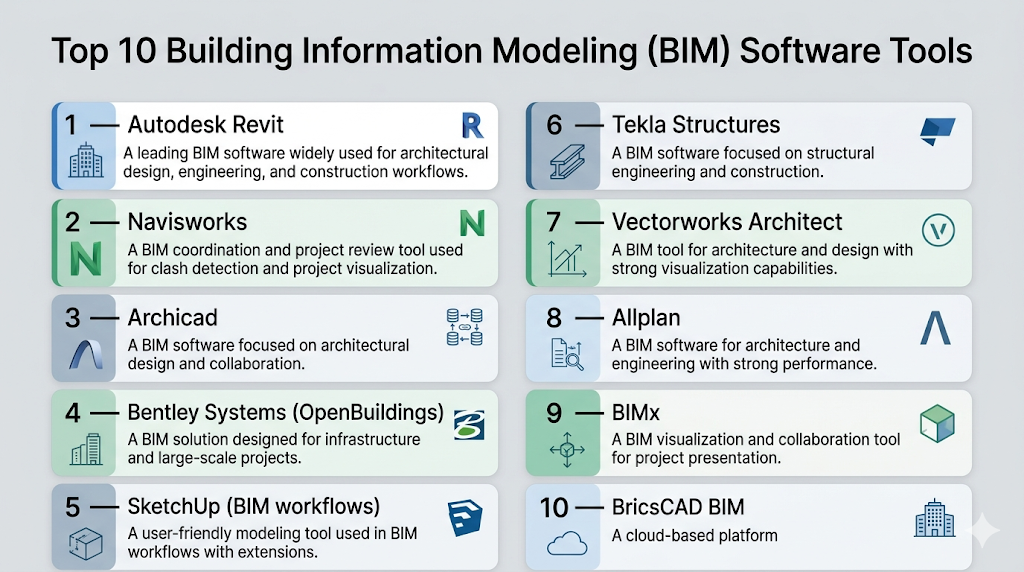
Top 10 Building Information Modeling (BIM) Software Tools
#1 — Autodesk Revit
Short description: A leading BIM software widely used for architectural design, engineering, and construction workflows.
Key Features
- Parametric modeling
- Multi-discipline support (architecture, structure, MEP)
- Collaboration tools
- Clash detection
- Documentation generation
Pros
- Industry standard
- Comprehensive feature set
Cons
- High cost
- Requires training
Platforms / Deployment
Windows
Security & Compliance
Not publicly stated
Integrations & Ecosystem
Strong ecosystem within design and construction workflows.
- Autodesk tools
- APIs
- Plugin ecosystem
Support & Community
Large professional community and training resources.
#2 — Navisworks
Short description: A BIM coordination and project review tool used for clash detection and project visualization.
Key Features
- Clash detection
- Model aggregation
- Project simulation
- Visualization tools
Pros
- Excellent coordination tool
- Supports large projects
Cons
- Not a full modeling tool
- Requires integration with other tools
Platforms / Deployment
Windows
Security & Compliance
Not publicly stated
Integrations & Ecosystem
Works well within BIM workflows.
- File compatibility
- Autodesk ecosystem
Support & Community
Strong professional usage.
#3 — Archicad
Short description: A BIM software focused on architectural design and collaboration.
Key Features
- Parametric modeling
- Visualization tools
- Collaboration features
- Open BIM support
Pros
- Strong architectural focus
- User-friendly
Cons
- Less suited for complex engineering
- Cost
Platforms / Deployment
Windows / macOS
Security & Compliance
Not publicly stated
Integrations & Ecosystem
Supports open BIM workflows.
- File compatibility
- Plugins
Support & Community
Active architecture-focused community.
#4 — Bentley Systems (OpenBuildings)
Short description: A BIM solution designed for infrastructure and large-scale projects.
Key Features
- Infrastructure modeling
- Digital twin integration
- Simulation tools
- Collaboration features
Pros
- Strong for infrastructure
- Scalable
Cons
- Complex interface
- Enterprise-focused
Platforms / Deployment
Windows
Security & Compliance
Not publicly stated
Integrations & Ecosystem
Enterprise-level integrations.
- Engineering tools
- APIs
Support & Community
Professional support and documentation.
#5 — SketchUp (BIM workflows)
Short description: A user-friendly modeling tool used in BIM workflows with extensions.
Key Features
- Easy modeling
- Plugin support
- Visualization tools
- Cloud sharing
Pros
- Easy to learn
- Fast workflow
Cons
- Requires plugins for full BIM
- Limited native BIM features
Platforms / Deployment
Web / Windows / macOS
Security & Compliance
Not publicly stated
Integrations & Ecosystem
Strong plugin ecosystem.
- Extensions
- File compatibility
Support & Community
Large community and tutorials.
#6 — Tekla Structures
Short description: A BIM software focused on structural engineering and construction.
Key Features
- Structural modeling
- Detailed drawings
- Fabrication workflows
- Collaboration tools
Pros
- High precision
- Strong for construction
Cons
- Complex
- Expensive
Platforms / Deployment
Windows
Security & Compliance
Not publicly stated
Integrations & Ecosystem
Strong construction integrations.
- APIs
- File compatibility
Support & Community
Professional user base.
#7 — Vectorworks Architect
Short description: A BIM tool for architecture and design with strong visualization capabilities.
Key Features
- BIM modeling
- Rendering tools
- Flexible workflows
- Documentation
Pros
- Good design flexibility
- Cross-platform
Cons
- Learning curve
- Performance issues on large projects
Platforms / Deployment
Windows / macOS
Security & Compliance
Not publicly stated
Integrations & Ecosystem
Supports design workflows.
- Plugins
- File compatibility
Support & Community
Active design community.
#8 — Allplan
Short description: A BIM software for architecture and engineering with strong performance.
Key Features
- BIM modeling
- Engineering tools
- Collaboration
- High performance
Pros
- Reliable
- Good for engineering
Cons
- Less popular globally
- Learning curve
Platforms / Deployment
Windows
Security & Compliance
Not publicly stated
Integrations & Ecosystem
Engineering-focused integrations.
- APIs
- File compatibility
Support & Community
Moderate community support.
#9 — BIMx
Short description: A BIM visualization and collaboration tool for project presentation.
Key Features
- Model visualization
- Mobile access
- Collaboration tools
- Presentation features
Pros
- Easy sharing
- Mobile-friendly
Cons
- Not a full BIM tool
- Limited editing
Platforms / Deployment
Mobile / Web
Security & Compliance
Not publicly stated
Integrations & Ecosystem
Works with BIM workflows.
- Integration with design tools
Support & Community
Focused on presentation use cases.
#10 — BricsCAD BIM
Short description: A BIM solution offering flexible modeling and interoperability.
Key Features
- BIM modeling
- AI-assisted workflows
- Interoperability
- CAD compatibility
Pros
- Flexible
- Cost-effective
Cons
- Smaller ecosystem
- Learning curve
Platforms / Deployment
Windows / macOS / Linux
Security & Compliance
Not publicly stated
Integrations & Ecosystem
Supports open workflows.
- APIs
- File compatibility
Support & Community
Growing community.
Comparison Table (Top 10)
| Tool Name | Best For | Platform(s) Supported | Deployment | Standout Feature | Public Rating |
|---|---|---|---|---|---|
| Revit | Professionals | Windows | Self-hosted | Industry standard | N/A |
| Navisworks | Coordination | Windows | Self-hosted | Clash detection | N/A |
| Archicad | Architects | Win/macOS | Self-hosted | Open BIM | N/A |
| OpenBuildings | Infrastructure | Windows | Self-hosted | Scalability | N/A |
| SketchUp | Beginners | Web/Win/macOS | Hybrid | Ease of use | N/A |
| Tekla | Engineers | Windows | Self-hosted | Structural detail | N/A |
| Vectorworks | Designers | Win/macOS | Self-hosted | Flexibility | N/A |
| Allplan | Engineers | Windows | Self-hosted | Performance | N/A |
| BIMx | Visualization | Mobile/Web | Cloud | Mobile access | N/A |
| BricsCAD BIM | Mixed users | Win/macOS/Linux | Self-hosted | Interoperability | N/A |
Evaluation & Scoring of Building Information Modeling (BIM) Software
| Tool Name | Core (25%) | Ease (15%) | Integrations (15%) | Security (10%) | Performance (10%) | Support (10%) | Value (15%) | Weighted Total |
|---|---|---|---|---|---|---|---|---|
| Revit | 10 | 7 | 9 | 6 | 9 | 9 | 6 | 8.5 |
| Navisworks | 8 | 7 | 9 | 6 | 9 | 8 | 7 | 8.1 |
| Archicad | 8 | 8 | 8 | 6 | 8 | 8 | 7 | 8.0 |
| OpenBuildings | 9 | 6 | 9 | 6 | 9 | 8 | 6 | 8.0 |
| SketchUp | 6 | 10 | 7 | 5 | 7 | 8 | 8 | 7.6 |
| Tekla | 9 | 6 | 8 | 6 | 9 | 8 | 6 | 7.9 |
| Vectorworks | 8 | 7 | 7 | 5 | 7 | 8 | 7 | 7.4 |
| Allplan | 8 | 7 | 7 | 5 | 8 | 7 | 7 | 7.5 |
| BIMx | 6 | 9 | 6 | 5 | 7 | 7 | 8 | 7.2 |
| BricsCAD BIM | 8 | 7 | 7 | 5 | 8 | 7 | 8 | 7.6 |
How to interpret scores:
- Scores are relative comparisons
- Higher totals indicate balanced performance
- Some tools excel in niche workflows
- Choose based on project requirements
Which BIM Software Is Right for You?
Solo / Freelancer
SketchUp and BricsCAD BIM are good starting points due to ease of use and flexibility.
SMB
Archicad and Vectorworks offer balanced features and usability.
Mid-Market
Tekla and Allplan provide strong engineering capabilities.
Enterprise
Revit and OpenBuildings are best for large-scale and complex projects.
Budget vs Premium
- Budget: SketchUp, BricsCAD BIM
- Premium: Revit, OpenBuildings
Feature Depth vs Ease of Use
- Feature depth: Revit, Tekla
- Ease of use: SketchUp, BIMx
Integrations & Scalability
- Strong: Revit, OpenBuildings
- Moderate: Archicad, Vectorworks
Security & Compliance Needs
Organizations should evaluate internal access control and data management policies.
Frequently Asked Questions (FAQs)
What is BIM software?
It is used to create and manage digital building models.
Is BIM required for construction?
Increasingly, yes for large projects.
Are there beginner-friendly BIM tools?
Yes, SketchUp and Archicad are easier to learn.
Can BIM tools integrate with other systems?
Yes, many support integration with project tools.
Is cloud BIM common?
Yes, especially for collaboration.
How long does it take to learn BIM?
It depends on complexity and tool.
What hardware is required?
High-performance systems for large projects.
Can I switch BIM tools later?
Yes, but interoperability can be a challenge.
What industries use BIM?
Architecture, construction, and engineering.
What are common mistakes?
Ignoring collaboration workflows and training needs.
Conclusion
Building Information Modeling software is essential for modern construction and design workflows. From beginner-friendly tools to enterprise-grade platforms, the options vary widely in complexity and capability.