Introduction
AR/VR (Augmented Reality and Virtual Reality) development platforms are software frameworks and engines that enable developers to build immersive, interactive 3D experiences. These platforms provide tools for rendering, simulation, device integration, and user interaction across headsets, mobile devices, and web environments.
With the rise of spatial computing, metaverse concepts, and immersive enterprise training, AR/VR platforms have become essential for building next-generation applications. From gaming and education to healthcare and industrial simulation, these tools power highly engaging digital experiences.
Common use cases include:
- VR games and immersive entertainment
- AR-based retail and marketing experiences
- Industrial training simulations
- Virtual collaboration and remote assistance
- Healthcare visualization and education
Key evaluation criteria:
- Cross-platform support (devices, OS, headsets)
- Rendering quality and performance
- Development flexibility (code vs visual scripting)
- Integration with AR/VR SDKs and hardware
- Ease of use and learning curve
- Asset ecosystem and community support
- Collaboration and deployment workflows
- Scalability and performance optimization
- Pricing and licensing model
Best for: Game developers, XR engineers, product designers, enterprise innovation teams, and startups building immersive applications.
Not ideal for: Teams with no 3D development experience or projects that do not require immersive interaction—traditional app development tools may be more efficient.
Key Trends in AR/VR Development Platforms
- AI-assisted content creation: Automated asset generation, scene optimization, and interaction scripting
- OpenXR standard adoption: Improved cross-device compatibility across XR ecosystems
- WebAR and browser-based XR: No-install immersive experiences growing in popularity
- Spatial computing ecosystems: Integration with head-mounted devices and mixed reality hardware
- Low-code/no-code AR tools: Faster prototyping for non-developers
- Real-time collaboration: Multi-user virtual environments for design and training
- Cloud rendering and streaming: Reducing device hardware dependency
- Digital twin integration: Linking AR/VR with real-world simulations
- Advanced physics and realism: Improved rendering pipelines and lighting systems
- Enterprise XR adoption: Growth in training, maintenance, and remote operations
How We Selected These Tools (Methodology)
- Evaluated industry adoption and developer preference
- Assessed graphics and rendering capabilities
- Reviewed AR/VR SDK and hardware support
- Analyzed performance and scalability
- Considered ease of use and onboarding experience
- Evaluated community, documentation, and ecosystem
- Reviewed integration with third-party tools and APIs
- Considered deployment flexibility (mobile, desktop, web, XR devices)
- Included both developer-focused and no-code platforms
- Ensured coverage across gaming, enterprise, and marketing use cases
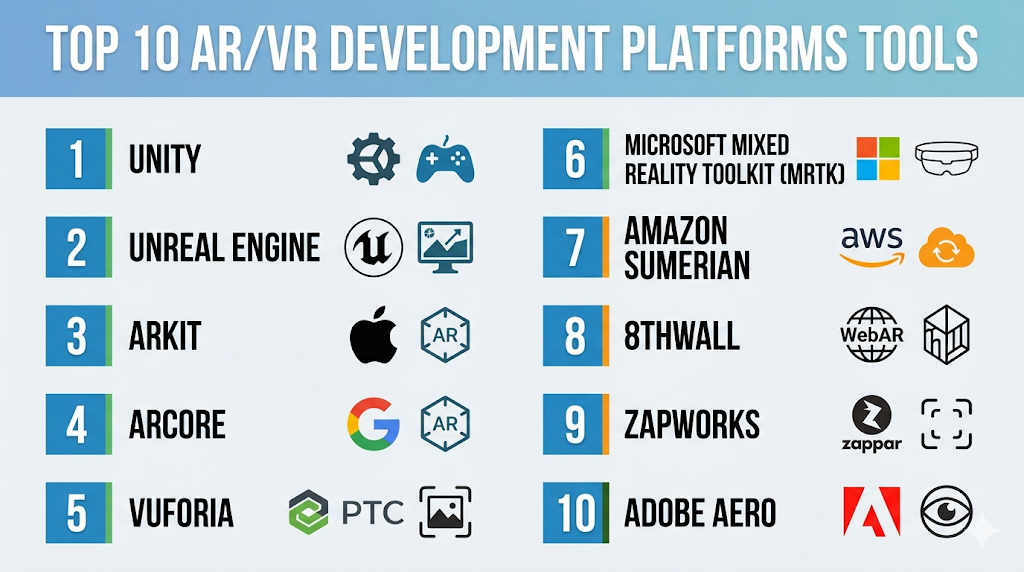
Top 10 AR/VR Development Platforms Tools
#1 — Unity
Short description: A widely used real-time 3D development platform for building AR, VR, and mixed reality applications across devices.
Key Features
- Cross-platform development for mobile, desktop, and XR devices
- Real-time 3D rendering engine
- AR Foundation for unified AR development
- Extensive Asset Store ecosystem
- XR Interaction Toolkit
- Strong scripting support (C#)
Pros
- Large community and resources
- Flexible for both AR and VR development
Cons
- Performance tuning can be complex
- Learning curve for advanced features
Platforms / Deployment
- Windows / macOS / Linux / iOS / Android / Web
- Cloud / Hybrid
Security & Compliance
- Not publicly stated
Integrations & Ecosystem
Highly extensible ecosystem with SDK support.
- ARKit, ARCore
- VR headset SDKs
- Asset Store
- APIs
Support & Community
Extremely strong global developer community and documentation.
#2 — Unreal Engine
Short description: A high-performance engine known for photorealistic rendering and immersive AR/VR experiences.
Key Features
- Advanced real-time rendering
- Blueprint visual scripting
- High-fidelity graphics
- Cross-platform deployment
- Physics and AI systems
Pros
- Best-in-class visual quality
- Visual scripting reduces coding effort
Cons
- Requires powerful hardware
- Steep learning curve
Platforms / Deployment
- Windows / macOS / Linux
- Cloud / Self-hosted
Security & Compliance
- Not publicly stated
Integrations & Ecosystem
Robust ecosystem for immersive development.
- VR SDKs
- Asset libraries
- APIs
Support & Community
Strong documentation and active community.
#3 — ARKit
Short description: Apple’s AR development framework for building immersive experiences on iOS devices.
Key Features
- Motion tracking
- Scene understanding
- LiDAR-based depth sensing
- Face tracking
- Native iOS integration
Pros
- High performance on Apple devices
- Seamless hardware integration
Cons
- Limited to Apple ecosystem
- Requires Swift/Objective-C knowledge
Platforms / Deployment
- iOS
- Self-hosted
Security & Compliance
- Not publicly stated
Integrations & Ecosystem
Tightly integrated with Apple ecosystem.
- iOS SDKs
- Unity integration
- APIs
Support & Community
Strong developer support within Apple ecosystem.
#4 — ARCore
Short description: Google’s AR platform for building augmented reality applications on Android devices.
Key Features
- Motion tracking
- Environmental understanding
- Light estimation
- Cloud anchors
- Cross-device compatibility
Pros
- Broad Android device support
- Strong Google ecosystem integration
Cons
- Fragmentation across devices
- Limited to AR (no VR)
Platforms / Deployment
- Android
- Self-hosted
Security & Compliance
- Not publicly stated
Integrations & Ecosystem
Works with Android ecosystem.
- Google services
- Unity integration
- APIs
Support & Community
Strong developer resources.
#5 — Vuforia
Short description: An enterprise-focused AR platform known for advanced object recognition and tracking.
Key Features
- Image and object recognition
- Model targets
- AR content management
- Industrial use cases
- Cross-platform support
Pros
- Strong enterprise AR capabilities
- Reliable tracking features
Cons
- Licensing costs
- Limited VR support
Platforms / Deployment
- Windows / Android / iOS
- Cloud / Self-hosted
Security & Compliance
- Not publicly stated
Integrations & Ecosystem
Enterprise-ready integrations.
- Unity
- IoT systems
- APIs
Support & Community
Strong enterprise support.
#6 — Microsoft Mixed Reality Toolkit (MRTK)
Short description: A toolkit for building mixed reality applications, especially for HoloLens devices.
Key Features
- Prebuilt components for MR apps
- Input and interaction systems
- Cross-platform support
- UI frameworks
- Spatial mapping
Pros
- Optimized for HoloLens
- Accelerates MR development
Cons
- Limited outside Microsoft ecosystem
- Requires Unity or Unreal
Platforms / Deployment
- Windows
- Cloud / Self-hosted
Security & Compliance
- Not publicly stated
Integrations & Ecosystem
Works with Microsoft ecosystem.
- Azure
- Unity
- APIs
Support & Community
Strong enterprise and developer support.
#7 — Amazon Sumerian
Short description: A cloud-based platform for building AR/VR applications with AWS integration.
Key Features
- Web-based AR/VR development
- Integration with AWS services
- Scene editor
- AI integration
- Scalable infrastructure
Pros
- Cloud-native
- Easy deployment
Cons
- AWS dependency
- Limited flexibility
Platforms / Deployment
- Web
- Cloud
Security & Compliance
- Not publicly stated
Integrations & Ecosystem
Part of AWS ecosystem.
- AWS services
- APIs
- AI tools
Support & Community
Moderate support and documentation.
#8 — 8thWall
Short description: A web-based AR platform for creating browser-based augmented reality experiences.
Key Features
- WebAR support
- No app installation required
- Real-time rendering
- Cross-device compatibility
- Cloud deployment
Pros
- Easy distribution via browser
- Great for marketing use cases
Cons
- Limited advanced features
- Subscription model
Platforms / Deployment
- Web
- Cloud
Security & Compliance
- Not publicly stated
Integrations & Ecosystem
Web-focused integrations.
- Web frameworks
- APIs
- Cloud services
Support & Community
Growing developer community.
#9 — ZapWorks
Short description: A platform for building interactive AR experiences, especially for marketing and education.
Key Features
- Visual scripting tools
- WebAR support
- Analytics tools
- Content management
- Cross-platform deployment
Pros
- Beginner-friendly
- Strong for marketing campaigns
Cons
- Limited for complex apps
- Subscription-based
Platforms / Deployment
- Web
- Cloud
Security & Compliance
- Not publicly stated
Integrations & Ecosystem
Supports web and creative workflows.
- APIs
- CMS tools
- Analytics
Support & Community
Good documentation and tutorials.
#10 — Adobe Aero
Short description: A no-code AR design tool for creating immersive experiences without programming.
Key Features
- Drag-and-drop AR creation
- Integration with Adobe Creative Cloud
- Real-time preview
- Cross-device support
- Visual workflows
Pros
- No coding required
- Ideal for designers
Cons
- Limited advanced features
- Not suitable for complex apps
Platforms / Deployment
- Windows / macOS / iOS
- Cloud
Security & Compliance
- Not publicly stated
Integrations & Ecosystem
Creative-focused ecosystem.
- Adobe tools
- Asset libraries
- APIs
Support & Community
Strong creative community.
Comparison Table (Top 10)
| Tool Name | Best For | Platform(s) Supported | Deployment | Standout Feature | Public Rating |
|---|---|---|---|---|---|
| Unity | General AR/VR | All major platforms | Hybrid | AR Foundation | N/A |
| Unreal Engine | High-end visuals | Cross-platform | Hybrid | Photorealistic rendering | N/A |
| ARKit | iOS AR | iOS | Self-hosted | LiDAR tracking | N/A |
| ARCore | Android AR | Android | Self-hosted | Cloud anchors | N/A |
| Vuforia | Enterprise AR | Cross-platform | Hybrid | Object tracking | N/A |
| MRTK | Mixed reality | Windows | Hybrid | HoloLens toolkit | N/A |
| Amazon Sumerian | Cloud XR | Web | Cloud | AWS integration | N/A |
| 8thWall | WebAR | Web | Cloud | Browser AR | N/A |
| ZapWorks | Marketing AR | Web | Cloud | Visual scripting | N/A |
| Adobe Aero | Designers | Desktop, Mobile | Cloud | No-code AR | N/A |
Evaluation & Scoring of AR/VR Development Platforms
| Tool Name | Core (25%) | Ease (15%) | Integrations (15%) | Security (10%) | Performance (10%) | Support (10%) | Value (15%) | Weighted Total (0–10) |
|---|---|---|---|---|---|---|---|---|
| Unity | 10 | 7 | 9 | 6 | 9 | 10 | 8 | 8.8 |
| Unreal | 10 | 6 | 9 | 6 | 10 | 9 | 8 | 8.7 |
| ARKit | 8 | 7 | 7 | 6 | 9 | 8 | 8 | 7.9 |
| ARCore | 8 | 7 | 7 | 6 | 8 | 8 | 8 | 7.8 |
| Vuforia | 8 | 6 | 8 | 6 | 8 | 7 | 7 | 7.6 |
| MRTK | 7 | 6 | 7 | 6 | 8 | 7 | 7 | 7.2 |
| Sumerian | 7 | 7 | 8 | 6 | 7 | 7 | 7 | 7.3 |
| 8thWall | 7 | 8 | 7 | 6 | 7 | 7 | 8 | 7.4 |
| ZapWorks | 6 | 8 | 7 | 6 | 7 | 7 | 8 | 7.2 |
| Adobe Aero | 6 | 9 | 6 | 6 | 6 | 7 | 8 | 7.1 |
How to interpret scores:
- Game engines dominate in performance and flexibility
- Native SDKs (ARKit, ARCore) excel in platform optimization
- WebAR tools prioritize ease of use and accessibility
- Enterprise tools focus on scalability and integration
- Choose based on use case, not just total score
Which AR/VR Development Platform Is Right for You?
Solo / Freelancer
- Best options: Unity, Adobe Aero, 8thWall
- Focus on ease of use and cost
SMB
- Best options: Unity, ZapWorks, ARCore
- Balance usability and capability
Mid-Market
- Best options: Unreal Engine, Vuforia
- Strong performance and scalability
Enterprise
- Best options: Unity, Unreal, MRTK
- Full-featured platforms with ecosystem support
Budget vs Premium
- Budget: Unity (free tier), ARCore, ARKit
- Premium: Vuforia, enterprise Unreal
Feature Depth vs Ease of Use
- Easy: Adobe Aero, ZapWorks
- Advanced: Unity, Unreal
Integrations & Scalability
- Strong: Unity, Unreal, AWS ecosystem
- Moderate: WebAR platforms
Security & Compliance Needs
- Enterprise platforms provide better governance
- Cloud platforms require data security evaluation
Frequently Asked Questions (FAQs)
What is an AR/VR development platform?
It is software used to create immersive augmented and virtual reality applications.
Which platform is best for beginners?
Unity and Adobe Aero are beginner-friendly options.
Do I need coding skills?
Most platforms require coding, but some offer visual scripting or no-code tools.
What devices are supported?
Platforms support mobile devices, desktops, and VR headsets.
Is Unity better than Unreal?
Unity is more flexible; Unreal excels in high-end graphics.
Can I build AR apps without coding?
Yes, tools like Adobe Aero and ZapWorks allow no-code development.
What is WebAR?
It allows AR experiences directly in browsers without installing apps.
Are these platforms free?
Some offer free tiers; enterprise tools require licensing.
What industries use AR/VR?
Gaming, healthcare, education, retail, and manufacturing.
How long does development take?
Depends on complexity—simple apps can take weeks, complex ones months.
Conclusion
AR/VR development platforms are enabling a new generation of immersive applications across industries. Whether you’re building a VR game, an industrial training system, or a marketing experience, there’s a platform tailored to your needs.