Introduction
3D rendering and ray tracing tools are used to generate realistic images and animations from 3D models. These tools simulate how light interacts with surfaces, materials, and environments to produce highly detailed and photorealistic visuals.
With increasing demand for high-quality visuals in industries such as gaming, film, architecture, and product design, rendering tools have become essential. Modern solutions now leverage GPU acceleration, real-time rendering, and AI-powered denoising to significantly reduce rendering times while improving output quality.
Common use cases include:
- Photorealistic product rendering
- Architectural visualization
- Film and visual effects production
- Game asset rendering
- Marketing and advertising visuals
Key evaluation criteria:
- Rendering quality and realism
- Speed and performance (CPU vs GPU rendering)
- Ease of use and workflow integration
- Material and lighting systems
- Compatibility with 3D modeling tools
- Real-time rendering capabilities
- AI denoising and optimization features
- Scalability for large scenes
- Pricing and licensing models
Best for: 3D artists, designers, architects, game developers, and studios requiring high-quality visual output.
Not ideal for: Users who only need basic visualization or simple previews.
Key Trends in 3D Rendering & Ray Tracing Tools
- Real-time ray tracing becoming more accessible
- AI-powered denoising reducing render times
- GPU acceleration replacing traditional CPU rendering
- Cloud rendering for scalability
- Integration with game engines and real-time workflows
- Physically based rendering (PBR) becoming standard
- Automation of lighting and scene setup
- Cross-platform compatibility improvements
- Subscription-based licensing models
How We Selected These Tools (Methodology)
- Evaluated industry adoption and popularity
- Assessed rendering quality and performance
- Considered compatibility with major 3D tools
- Reviewed GPU and CPU rendering capabilities
- Examined ease of use and workflow efficiency
- Included tools for beginners to professionals
- Analyzed ecosystem and plugin support
- Prioritized actively maintained tools
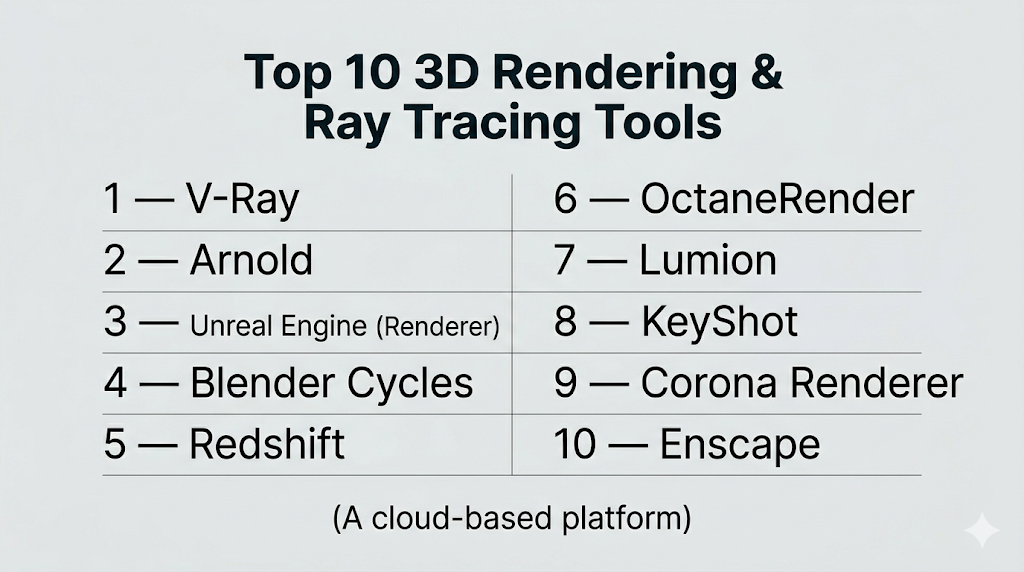
Top 10 3D Rendering & Ray Tracing Tools
#1 — V-Ray
Short description: A widely used rendering engine known for high-quality photorealistic output across industries.
Key Features
- Physically based rendering
- GPU and CPU rendering
- Advanced lighting system
- Material library
- Distributed rendering
Pros
- Industry-standard quality
- Flexible rendering options
Cons
- Requires learning
- Paid license
Platforms / Deployment
Windows / macOS / Linux
Security & Compliance
Not publicly stated
Integrations & Ecosystem
Strong integration with major 3D tools.
- Plugins for modeling software
- Rendering pipelines
- API support
Support & Community
Large professional community and documentation.
#2 — Arnold
Short description: A high-quality rendering engine used in film and animation production.
Key Features
- Physically accurate rendering
- Advanced shading
- Scalable rendering
- Motion blur and effects
Pros
- Film-quality output
- Reliable
Cons
- Slower than GPU-based engines
- Expensive
Platforms / Deployment
Windows / macOS / Linux
Security & Compliance
Not publicly stated
Integrations & Ecosystem
Used in professional pipelines.
- Integration with animation tools
- API support
Support & Community
Strong studio-level support.
#3 — Unreal Engine (Renderer)
Short description: A real-time rendering platform used for interactive and cinematic visuals.
Key Features
- Real-time ray tracing
- High-quality visuals
- VR/AR support
- Cinematic tools
Pros
- Real-time performance
- Free to use for many cases
Cons
- Complex setup
- Requires powerful hardware
Platforms / Deployment
Windows / macOS / Linux
Security & Compliance
Not publicly stated
Integrations & Ecosystem
Extensive ecosystem for real-time rendering.
- Asset marketplace
- APIs
- Plugin support
Support & Community
Large global community.
#4 — Blender Cycles
Short description: A physically based rendering engine integrated within Blender.
Key Features
- GPU and CPU rendering
- Path tracing
- Node-based materials
- Real-time preview
Pros
- Free
- Integrated with Blender
Cons
- Slower than some GPU engines
- Requires optimization
Platforms / Deployment
Windows / macOS / Linux
Security & Compliance
Not publicly stated
Integrations & Ecosystem
Works within Blender ecosystem.
- Add-ons
- File compatibility
Support & Community
Large open-source community.
#5 — Redshift
Short description: A GPU-accelerated rendering engine designed for speed and efficiency.
Key Features
- GPU rendering
- Out-of-core rendering
- Fast performance
- Advanced shading
Pros
- Very fast
- Efficient with large scenes
Cons
- Requires GPU
- Paid
Platforms / Deployment
Windows / macOS / Linux
Security & Compliance
Not publicly stated
Integrations & Ecosystem
Integrates with multiple 3D tools.
- Plugins
- APIs
Support & Community
Active professional user base.
#6 — OctaneRender
Short description: A real-time GPU rendering engine known for speed and photorealism.
Key Features
- GPU-based rendering
- Real-time preview
- Spectral rendering
- Material system
Pros
- Fast rendering
- High-quality visuals
Cons
- Requires strong GPU
- Licensing complexity
Platforms / Deployment
Windows / macOS / Linux
Security & Compliance
Not publicly stated
Integrations & Ecosystem
Wide integration support.
- Plugins
- APIs
Support & Community
Active user community.
#7 — Lumion
Short description: A rendering tool focused on architectural visualization.
Key Features
- Real-time rendering
- Pre-built assets
- Easy interface
- Landscape tools
Pros
- Very easy to use
- Fast results
Cons
- Limited flexibility
- Windows-only
Platforms / Deployment
Windows
Security & Compliance
Not publicly stated
Integrations & Ecosystem
Focused on architecture workflows.
- File imports
- Asset libraries
Support & Community
Strong in architecture community.
#8 — KeyShot
Short description: A rendering software focused on product visualization and ease of use.
Key Features
- Real-time rendering
- Drag-and-drop materials
- HDRI lighting
- Animation tools
Pros
- Easy to learn
- High-quality output
Cons
- Expensive
- Limited advanced control
Platforms / Deployment
Windows / macOS
Security & Compliance
Not publicly stated
Integrations & Ecosystem
Product design integrations.
- CAD compatibility
- Plugin support
Support & Community
Strong support and tutorials.
#9 — Corona Renderer
Short description: A user-friendly rendering engine focused on photorealism.
Key Features
- Physically based rendering
- Simple UI
- High-quality output
- Interactive rendering
Pros
- Easy to use
- Great quality
Cons
- Slower than GPU engines
- Limited platform support
Platforms / Deployment
Windows
Security & Compliance
Not publicly stated
Integrations & Ecosystem
Commonly used with design tools.
- Plugins
- File compatibility
Support & Community
Growing community.
#10 — Enscape
Short description: A real-time rendering plugin for architecture and design workflows.
Key Features
- Real-time rendering
- VR support
- Easy integration
- Fast performance
Pros
- Simple workflow
- Fast visualization
Cons
- Limited advanced features
- Plugin dependency
Platforms / Deployment
Windows / macOS
Security & Compliance
Not publicly stated
Integrations & Ecosystem
Designed for design tool integration.
- Plugins
- CAD integrations
Support & Community
Strong architecture-focused community.
Comparison Table (Top 10)
| Tool Name | Best For | Platform(s) Supported | Deployment | Standout Feature | Public Rating |
|---|---|---|---|---|---|
| V-Ray | Professionals | Win/macOS/Linux | Self-hosted | Photorealism | N/A |
| Arnold | Film studios | Win/macOS/Linux | Self-hosted | Accuracy | N/A |
| Unreal Engine | Real-time | Win/macOS/Linux | Hybrid | Real-time ray tracing | N/A |
| Blender Cycles | Creators | Win/macOS/Linux | Self-hosted | Free rendering | N/A |
| Redshift | GPU rendering | Win/macOS/Linux | Self-hosted | Speed | N/A |
| OctaneRender | GPU users | Win/macOS/Linux | Self-hosted | Real-time GPU | N/A |
| Lumion | Architects | Windows | Self-hosted | Ease of use | N/A |
| KeyShot | Product design | Win/macOS | Self-hosted | Simplicity | N/A |
| Corona | Designers | Windows | Self-hosted | Ease + realism | N/A |
| Enscape | Architecture | Win/macOS | Hybrid | Real-time plugin | N/A |
Evaluation & Scoring of 3D Rendering & Ray Tracing Tools
| Tool Name | Core (25%) | Ease (15%) | Integrations (15%) | Security (10%) | Performance (10%) | Support (10%) | Value (15%) | Weighted Total |
|---|---|---|---|---|---|---|---|---|
| V-Ray | 10 | 7 | 9 | 6 | 9 | 9 | 7 | 8.6 |
| Arnold | 10 | 6 | 9 | 6 | 8 | 9 | 6 | 8.2 |
| Unreal Engine | 9 | 7 | 9 | 6 | 10 | 9 | 9 | 8.9 |
| Blender Cycles | 9 | 7 | 8 | 5 | 8 | 9 | 10 | 8.6 |
| Redshift | 9 | 7 | 8 | 5 | 10 | 8 | 7 | 8.3 |
| OctaneRender | 9 | 7 | 8 | 5 | 10 | 8 | 7 | 8.3 |
| Lumion | 7 | 9 | 7 | 5 | 8 | 8 | 7 | 7.8 |
| KeyShot | 8 | 9 | 7 | 5 | 8 | 8 | 7 | 7.9 |
| Corona | 8 | 8 | 7 | 5 | 7 | 7 | 7 | 7.5 |
| Enscape | 7 | 9 | 7 | 5 | 8 | 8 | 7 | 7.8 |
How to interpret scores:
- Scores are relative comparisons across tools
- Higher scores indicate stronger overall capability
- Some tools excel in niche workflows
- Choose based on your specific needs
Which 3D Rendering & Ray Tracing Tool Is Right for You?
Solo / Freelancer
Blender Cycles and KeyShot offer strong capabilities with easier learning.
SMB
Lumion and Enscape provide fast and user-friendly workflows.
Mid-Market
Redshift and OctaneRender balance performance and flexibility.
Enterprise
V-Ray and Arnold are best for high-end production.
Budget vs Premium
- Budget: Blender Cycles
- Premium: V-Ray, Arnold
Feature Depth vs Ease of Use
- Feature depth: V-Ray, Arnold
- Ease of use: Lumion, KeyShot
Integrations & Scalability
- Strong: Unreal Engine, V-Ray
- Moderate: Blender Cycles, Lumion
Security & Compliance Needs
Organizations should evaluate internal policies and access controls.
Frequently Asked Questions (FAQs)
What is ray tracing?
It simulates how light interacts with objects for realistic visuals.
Are GPU renderers better than CPU?
GPU renderers are faster, but CPU can handle complex scenes.
Are there free rendering tools?
Yes, Blender Cycles is a popular free option.
How long does rendering take?
It depends on scene complexity and hardware.
Can I use these tools for animation?
Yes, many support animation rendering.
Do they support real-time rendering?
Some tools provide real-time capabilities.
What hardware is needed?
High-performance GPUs are recommended.
Can I integrate with modeling tools?
Most tools support integrations.
Is cloud rendering available?
Some tools support cloud-based rendering.
What are common mistakes?
Poor lighting setup and incorrect material settings.
Conclusion
3D rendering and ray tracing tools are essential for creating realistic visuals across industries. From real-time engines to high-end production renderers, the available tools offer a wide range of capabilities.