Introduction
In the current era of complex software delivery, the traditional methods of monitoring are often found to be insufficient. As distributed systems and microservices become the standard, the internal state of an application must be understood through its external outputs. This shift has led to the rise of Observability. Systems are no longer just watched; they are interrogated to find the “why” behind every failure.
The complexity of cloud-native environments is increasing daily. With hundreds of containers and ephemeral services running simultaneously, a deep level of insight is required. It is observed that performance bottlenecks often hide in the layers of infrastructure that are invisible to basic monitoring tools. Therefore, a transition toward a more robust engineering mindset is being made by top-tier organizations.
Understanding the Master in Observability Engineering (MOE)
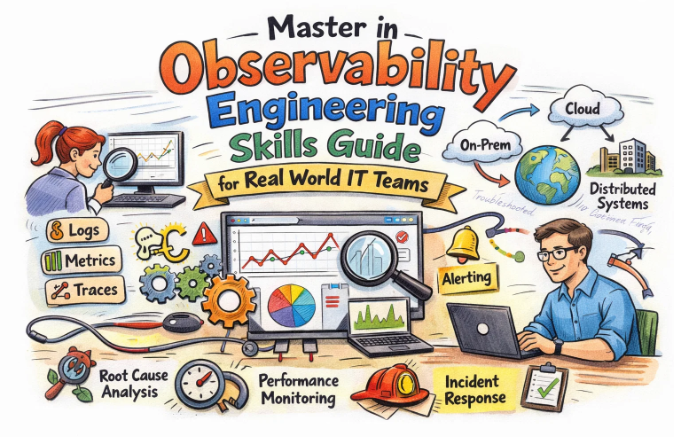
The Master in Observability Engineering (MOE) is a professional program designed to bridge the gap between simple health checks and deep system insights. It is structured to provide a comprehensive understanding of telemetry data, including traces, metrics, and logs. By following this curriculum, the ability to build “observable” systems is developed rather than just “monitored” ones.
Knowledge regarding the collection, processing, and visualization of data is imparted through this certification. It is not merely about using a specific tool; rather, the fundamental principles of system reliability are emphasized. The program ensures that high-cardinality data is handled efficiently and that meaningful alerts are generated to reduce “alert fatigue” in engineering teams.
Why Observability is Essential in the Modern Ecosystem
The demand for high availability is higher than ever before. It is recognized that downtime results in significant financial loss and damage to brand reputation. In an environment where deployments happen multiple times a day, traditional dashboards are often outdated by the time they are viewed. Observability allows for real-time debugging in production environments without the need for redeployments.
Furthermore, the integration of AI and machine learning into operations (AIOps) is heavily dependent on the quality of data provided by observability frameworks. If the data is flawed, the automated responses will also be flawed. By mastering this domain, engineers ensure that the automation layers of their organization are built on a solid foundation of accurate telemetry.
The Value of Certification for Professional Growth
Certifications are often viewed as a benchmark for technical competence. For engineers, a certification like the MOE provides a structured learning path that might otherwise be missed during on-the-job training. It is an objective way for skills to be validated in a competitive job market.
For engineering managers, certifications serve as a tool for team standardization. When every team member is trained under the same framework, communication is improved, and technical debt is reduced. It is believed that a certified workforce is more capable of handling large-scale outages with a calm, methodical approach.
Why Choose DevOpsSchool?
DevOpsSchool is recognized as a leader in the field of technical upskilling and professional certification. A curriculum is provided that is deeply rooted in real-world scenarios rather than just theoretical concepts. The instructors are chosen based on their extensive industry experience, ensuring that practical wisdom is shared with every learner.
The learning environment is designed to be interactive and supportive. Comprehensive study materials are offered, and a community of professionals is maintained to foster continuous growth. It is ensured that every student gains hands-on exposure to the latest tools and methodologies used by top tech companies globally.
Certification Deep-Dive: Master in Observability Engineering (MOE)
What is this certification?
The MOE certification is a professional designation that confirms an individual’s expertise in designing and implementing observability frameworks. It focuses on the three pillars of observability—metrics, logs, and traces—to ensure full system transparency.
Who should take this certification?
This program is ideally suited for Software Engineers, SREs, and DevOps professionals who are responsible for maintaining system uptime. It is also highly recommended for Architects and Engineering Managers who need to oversee the reliability of large-scale cloud infrastructures.
Certification Overview Table
| Track | Level | Who it’s for | Prerequisites | Skills Covered | Recommended Order |
| DevOps | Advanced | Senior Engineers | Basic Linux & Cloud | CI/CD Monitoring, ELK | 2nd |
| DevSecOps | Specialized | Security Analysts | Security Fundamentals | Security Tracing, SIEM | 3rd |
| SRE | Expert | SRE Professionals | MOE Foundation | SLIs/SLOs, Error Budgets | 1st |
| AIOps/MLOps | Futuristic | Data Scientists | Python/Basic ML | Model Monitoring, Drifts | 4th |
| DataOps | Technical | Data Engineers | SQL/Data Pipeline | Pipeline Observability | 5th |
| FinOps | Management | Financial Analysts | Cloud Billing Intro | Cost Visibility, Tagging | 6th |
Skills You Will Gain
- Telemetry Data Collection: The ability to collect data from diverse sources using OpenTelemetry is mastered.
- Distributed Tracing: Complex requests are tracked across multiple microservices to identify latency issues.
- Log Aggregation: Millions of log lines are centralized and indexed for rapid searching and analysis.
- Metric Analysis: Performance trends are identified through the study of time-series data.
- Dashboard Engineering: Meaningful visualizations are created to represent system health at a glance.
- Incident Response: Root cause analysis is performed more efficiently using correlated data.
- Alert Optimization: Actionable alerts are designed to minimize noise and focus on critical issues.
Real-World Projects Post-Certification
- End-to-End Tracing Implementation: A full tracing setup is built for a microservices-based e-commerce platform.
- Automated SLO Dashboard: A dashboard is developed that automatically tracks Service Level Objectives and Error Budgets.
- Centralized Logging Cluster: A high-availability Elastic Stack (ELK) or Grafana Loki cluster is deployed.
- Cloud-Native Monitoring: Prometheus and Grafana are integrated with a Kubernetes cluster for real-time scaling insights.
- Anomaly Detection System: A system is configured to detect unusual patterns in traffic using observability data.
Preparation Plan
7–14 Days Plan (The Sprint)
During this period, focus is placed entirely on the core concepts. The official documentation is read thoroughly, and the primary pillars of observability are studied. Practice exams are taken to identify weak areas, and basic configurations of Prometheus and Grafana are reviewed.
30 Days Plan (The Deep Dive)
In the first two weeks, time is spent on hands-on labs involving log management and distributed tracing. The third week is dedicated to understanding OpenTelemetry and its integration with various languages. The final week is used for mock tests and reviewing advanced troubleshooting scenarios.
60 Days Plan (The Mastery)
A comprehensive approach is taken where the first month is used to build a complete project from scratch. Different observability tools are compared, and their trade-offs are documented. The second month is focused on fine-tuning alerting rules and learning about AIOps integrations.
Common Mistakes to Avoid
- Focusing only on tools: It is often forgotten that observability is a culture and a set of practices, not just a software installation.
- Ignoring Data Costs: High-cardinality data can lead to massive cloud bills if not managed properly.
- Creating Too Many Alerts: If everything is an alert, then nothing is an alert. Only actionable events should be notified.
- Lack of Correlation: Logs, metrics, and traces are often kept in silos, making root cause analysis difficult.
Best Next Certification After This
- Same Track: Advanced Site Reliability Engineering (ASRE).
- Cross-Track: Certified DevSecOps Professional (CDP).
- Leadership / Management: Digital Transformation Lead or Engineering Strategy Certification.
Choose Your Learning Path
1. DevOps Path
This path is designed for those who want to automate the integration of observability into the CI/CD pipeline. The focus is placed on ensuring that every deployment is automatically instrumented.
2. DevSecOps Path
The visibility of security threats is prioritized here. It is learned how tracing can be used to detect unauthorized access patterns and how logs can be used for forensic audits.
3. Site Reliability Engineering (SRE) Path
This is the most popular path, where the relationship between observability and reliability is explored. Error budgets and incident management are the core focus areas.
4. AIOps / MLOps Path
Data is used to feed machine learning models that predict system failures. This path is best for those interested in the future of automated operations.
5. DataOps Path
The health of data pipelines is monitored. It is ensured that data flows correctly from source to destination without loss or corruption.
6. FinOps Path
Observability is applied to cloud spending. It is learned how to correlate performance metrics with cost data to optimize infrastructure investments.
Role → Recommended Certifications Mapping
| Role | Recommended Certification | Key Benefit |
| DevOps Engineer | MOE + Jenkins Expert | Full Pipeline Visibility |
| SRE | MOE + Chaos Engineering | System Resilience |
| Platform Engineer | MOE + Kubernetes Admin | Infrastructure Insights |
| Cloud Engineer | MOE + AWS/Azure Architect | Cloud Resource Optimization |
| Security Engineer | MOE + DevSecOps | Threat Hunting Capability |
| Data Engineer | MOE + Big Data | Pipeline Integrity |
| FinOps Practitioner | MOE + Cloud Economics | Cost Transparency |
| Engineering Manager | MOE + Leadership | Data-Driven Decision Making |
Next Certifications to Take
For the DevOps Learner
- Same-track: Certified GitOps Specialist.
- Cross-track: Kubernetes Security Specialist (CKS).
- Leadership-focused: Agile Leadership for Engineering.
For the SRE Learner
- Same-track: Chaos Engineering Professional.
- Cross-track: FinOps Certified Practitioner.
- Leadership-focused: Site Reliability Management.
For the Security Learner
- Same-track: Advanced Penetration Testing.
- Cross-track: MLOps Foundation.
- Leadership-focused: Chief Information Security Officer (CISO) Training.
Training & Certification Support Institutions
DevOpsSchool An extensive range of technical training programs is provided by this institution. It is highly regarded for its hands-on approach and industry-aligned curriculum. Support is offered throughout the certification journey to ensure student success.
Cotocus Expertise in specialized technical consulting and high-end training is offered here. The focus is placed on bridging the skills gap in modern engineering roles. Customized learning paths are developed for both individuals and corporate teams.
ScmGalaxy A community-driven platform where resources for SRE and DevOps are shared extensively. It is used by thousands of professionals to stay updated with the latest tools. Practical tutorials and expert blogs are regularly published to aid learning.
BestDevOps A practical lab-focused training environment is provided to help engineers master complex tools. The emphasis is placed on real-world application and problem-solving. It is recognized for its clear and concise instructional methods.
devsecopsschool.com This institution is dedicated to the integration of security into the DevOps lifecycle. Specialized courses on automated security testing and compliance are offered. It is a go-to resource for security-conscious engineers.
sreschool.com The core principles of reliability and system stability are taught here. Programs are designed to mirror the SRE practices used by major tech giants. Students are prepared to handle high-pressure incident management scenarios.
aiopsschool.com The intersection of Artificial Intelligence and Operations is explored at this school. Advanced training on predictive analytics for IT operations is provided. It is ideal for those looking to enter the next generation of automation.
dataopsschool.com Education regarding the management and observability of data pipelines is provided. The focus is placed on ensuring data quality and delivery speed. It is essential for modern data engineering teams.
finopsschool.com The financial management of cloud services is the primary focus of this institution. Practical strategies for cost optimization and cloud governance are taught. It helps organizations maximize the value of their cloud spend.
Frequently Asked Questions (General)
- What is the difficulty level of the MOE exam?
The exam is considered to be of intermediate to advanced difficulty, requiring both theoretical knowledge and practical experience. - How much time is required to complete the certification?
Approximately 30 to 60 days are usually required for a thorough preparation, depending on the prior experience level. - Are there any mandatory prerequisites for this program?
While not strictly mandatory, a basic understanding of Linux, cloud computing, and at least one programming language is highly recommended. - In what sequence should certifications be taken?
It is suggested that the MOE be taken after gaining a basic understanding of DevOps or SRE principles. - What is the career value of being a certified Observability Engineer?
Significant career growth is often seen, as organizations are actively looking for experts who can reduce Mean Time to Recovery (MTTR). - Which job roles benefit most from this certification?
Roles such as SRE, DevOps Engineer, Cloud Architect, and Systems Administrator find this certification most beneficial. - Is hands-on practice included in the training?
Yes, a major portion of the training is dedicated to practical labs and real-world project scenarios. - Does this certification help in getting a salary hike?
It is observed that certified professionals often command higher salaries due to their specialized skillset. - Are the concepts applicable to all cloud providers?
Yes, the principles of observability are cloud-agnostic and can be applied to AWS, Azure, Google Cloud, or on-premise systems. - Is recertification required after a few years?
Regular updates are recommended to stay current with the fast-evolving landscape of observability tools. - Can a beginner in IT take this course?
It is possible, but it is recommended that some foundational knowledge of software development be acquired first. - Is there community support available for students?
Extensive community support is provided through forums and study groups by the training institutions.
Specific FAQs for Master in Observability Engineering (MOE)
- Is OpenTelemetry a core part of the MOE curriculum?
Yes, OpenTelemetry is treated as a fundamental component for standardizing telemetry data collection. - How are “metrics” and “logs” differentiated in the course?
Metrics are explained as numerical data over time, while logs are described as detailed text records of specific events. - Are specific tools like Prometheus or New Relic taught?
The core concepts are taught using popular tools like Prometheus, Grafana, and ELK to ensure practical proficiency. - Does the MOE cover cost optimization for observability?
Yes, strategies for managing data volume and reducing storage costs are included in the syllabus. - Can the MOE certification be used to transition from QA to DevOps?
It is an excellent tool for such a transition, as it provides deep insights into system behavior. - Is tracing across different programming languages covered?
The techniques for instrumenting various languages like Java, Python, and Go are discussed. - How does this certification assist in incident management?
The ability to quickly correlate data during an outage is improved, leading to faster resolution. - Is a certificate provided immediately after the exam?
The certificate is typically issued after the successful completion of the exam and project requirements.
Testimonial
Aarav The clarity of the system’s internal state was greatly improved after the completion of this program. A much deeper understanding of how to handle distributed traces was gained. It is a highly recommended path for anyone struggling with complex microservices.
Elena The real-world application of the labs was very impressive. The knowledge was immediately used to solve a persistent latency issue in a production environment. The transition from monitoring to true observability was made seamless.
Liam A significant growth in confidence was felt when discussing system architecture with senior stakeholders. The structured approach to telemetry data helped in building more resilient platforms. It is worth the investment for any career-minded engineer.
Priya Skill improvement was noted particularly in the area of dashboard design and alerting. The noise in the monitoring system was reduced by 40% using the principles learned here. It has made the daily operations much smoother for the entire team.
Sam A clear career path was provided by this certification. The difference between simple health checks and deep diagnostics is now understood. It is believed that this is the most valuable certification currently available for SRE professionals.
Conclusion
The Master in Observability Engineering (MOE) certification is a vital milestone for any professional working in the modern cloud ecosystem. It is clear that as systems grow more complex, the ability to observe and understand them becomes a non-negotiable skill. By pursuing this program, engineers are empowered to build more reliable, scalable, and transparent applications.
Long-term career benefits include increased marketability, higher salary potential, and the ability to lead high-impact technical projects. Strategic learning and certification planning are encouraged for those who wish to remain at the forefront of the industry. The journey toward mastering observability is not just about passing an exam; it is about adopting a mindset that prioritizes deep system understanding and continuous improvement.