Introduction
Catalog Management Software are specialized tools that help businesses centralize, organize, enrich, and distribute product information across internal systems and external sales channels. These tools serve as a central hub for product content — including attributes, pricing, digital assets, taxonomy, and inventory metadata — to ensure consistency across e‑commerce sites, marketplaces, print catalogs, mobile apps, and partner systems.
In today’s digital commerce landscape, customers demand rich, accurate product experiences regardless of where they interact with a brand. Catalog management has become foundational for modern commerce operations, enabling businesses to reduce errors, accelerate time‑to‑market, improve search relevance, and support omnichannel strategies that unify buying experiences.
Real‑world use cases include consolidating disparate product data from suppliers, enriching product descriptions and media assets for international markets, feeding synchronized catalogs into marketplaces and retail partners, supporting personalization engines, and automating catalog updates in real time.
Evaluation criteria for buyers typically include:
- Centralized data modeling and schema flexibility
- Digital asset management and media enrichment
- Multi‑system publishing and syndication
- Workflow and governance controls
- Integration breadth (API, connectors, custom adapters)
- Scalability and performance
- Security and access controls
- Reporting and analytics
- Ease of onboarding and usability
- Total cost and return on productivity
Best for: E‑commerce directors, product data teams, merchants with large catalogs, marketplace sellers, brands with complex SKUs, and companies scaling across channels.
Not ideal for: Small sellers with simple product lists, businesses satisfied with spreadsheets and manual processes, or operations that do not need multi‑channel syndication.
Key Trends in Catalog Management Software
- AI‑assisted product enrichment and attribute suggestion
- Headless catalog architectures for composable commerce
- Real‑time synchronization across channels and marketplaces
- Support for complex product models (bundles, variants, kits)
- Expanded digital asset management with video and interactive media
- Centralized taxonomy and semantic search optimization
- Automated data quality monitoring and validation rules
- Cloud‑native scalability for high SKU volumes
- Low‑code/no‑code connectors and integration accelerators
- Governance workflows with roles, approvals, and audit trails
How We Selected These Tools (Methodology)
- Richness of core catalog management functionality
- Support for digital asset management within catalog workflows
- Integration depth with commerce, ERP, CRM, and marketplaces
- Performance, scalability, and enterprise readiness
- Security posture including access controls and audit capabilities
- User experience, onboarding, and admin efficiency
- Applicability across SMB, mid‑market, and enterprise segments
- Customer success signals based on feedback and case usage
- Flexibility for custom data models and taxonomy management
- Total cost of ownership including subscription and maintenance
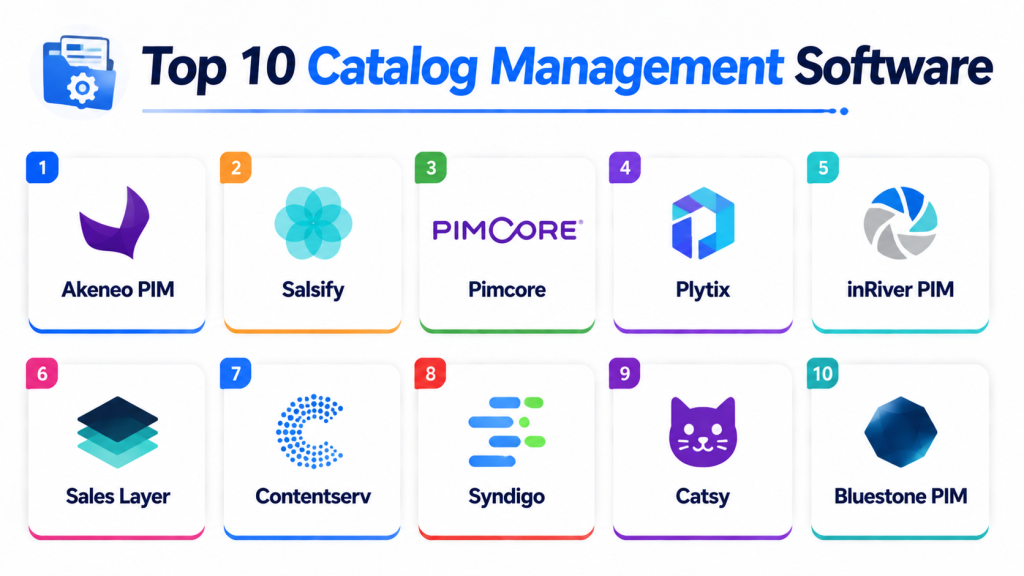
Top 10 Catalog Management Software Tools
#1 — Akeneo
Short description: Akeneo is a widely adopted enterprise catalog management platform focused on product information (PIM) centralization, enrichment, and syndication for omnichannel commerce.
Key Features
- Centralized product information hub
- Attribute and taxonomy modeling
- Digital asset management
- Workflow and localization support
- Multi‑channel publish and syndication
- API and connector ecosystem
Pros
- Strong for mid‑market to enterprise use
- Flexible data modeling
- Rich digital asset support
Cons
- Higher cost for full enterprise edition
- Implementation may require specialist expertise
Platforms / Deployment
- Web
- Cloud or self‑hosted
Security & Compliance
Not publicly stated
Integrations & Ecosystem
Akeneo has connectors and APIs for commerce platforms, marketplaces, ERP systems, and DAM systems.
- Commerce platforms
- ERP connectors
- DAM integrations
- Custom APIs
Support & Community
Documentation library, user forums, and professional services for onboarding
#2 — Salsify
Short description: Salsify is a product experience management platform that combines product catalog management with syndication to marketplaces, retailers, e‑commerce endpoints, and digital channels.
Key Features
- Product master data management
- Digital asset management
- Marketplace syndication
- Workflow and governance controls
- Analytics on product performance
- Channel optimization tools
Pros
- Excellent marketplace readiness
- Strong governance and workflow controls
- Combines PIM and syndication
Cons
- Cost may be high for smaller teams
- Complexity for basic catalog needs
Platforms / Deployment
- Web
- Cloud
Security & Compliance
Not publicly stated
Integrations & Ecosystem
Broad integrations for commerce platforms, marketplaces, and digital channels.
- Major marketplaces
- E‑commerce platforms
- ERP systems
- Marketing platforms
Support & Community
Dedicated onboarding support, success managers, and resource center
#3 — Informatica MDM – Product 360
Short description: Informatica MDM Product 360 provides master data management (MDM) with a strong foundation for catalog management, governance, and cross‑domain data harmonization.
Key Features
- Central master catalog
- Cross‑domain data integration
- Data quality and validation tools
- Hierarchy, relationships, and model governance
- Multi‑lifecycle workflows
- Enterprise scale and performance
Pros
- Robust enterprise governance
- Strong data stewardship and validation
- Cross‑domain data integration
Cons
- Implementation and licensing complexity
- Overhead for smaller catalogs
Platforms / Deployment
- Web
- Cloud or on‑premise
Security & Compliance
Not publicly stated
Integrations & Ecosystem
Enterprise connectors across ERP, CRM, BI, and commerce systems.
- ERP integrations
- CRM synchronizers
- Analytics connectors
- Data quality frameworks
Support & Community
Enterprise support services, documentation, and expert partners
#4 — Pimcore
Short description: Pimcore is an open platform enabling catalog management, digital asset management, and customer experience data for brands with flexible modeling needs.
Key Features
- Flexible product data modeling
- Digital asset and document management
- Multi‑channel distribution
- Workflow and business rules
- API‑first and extensibility
- Open platform for customization
Pros
- Highly flexible and extensible
- Strong open platform appeal
- Combines PIM and DAM
Cons
- Requires technical expertise to customize
- Self‑hosting adds operational overhead
Platforms / Deployment
- Web
- Cloud or self‑hosted
Security & Compliance
Not publicly stated
Integrations & Ecosystem
APIs and connectors serve commerce platforms, marketplace exports, and internal systems.
- Commerce connectors
- DAM pipelines
- ERP syncs
- Custom integrations
Support & Community
Strong developer community and professional services
#5 — Riversand MDM
Short description: Riversand MDM offers enterprise master data and catalog management with governance, workflow, and omnichannel syndication capabilities.
Key Features
- Master data governance
- Product catalog centralization
- Digital asset enrichment
- Workflow and stewardship tools
- Multi‑channel syndication
- Analytics and insights
Pros
- Enterprise feature depth
- Strong governance and workflows
- Scalable to high SKU volumes
Cons
- Enterprise pricing and onboarding complexity
- Less intuitive for smaller teams
Platforms / Deployment
- Web
- Cloud
Security & Compliance
Not publicly stated
Integrations & Ecosystem
Connectors for ERPs, commerce platforms, and digital publishers.
- ERP and CRM
- Commerce endpoints
- Syndication channels
- Analytics systems
Support & Community
Enterprise support portals, training, and consulting
#6 — Catsy PIM
Short description: Catsy PIM is a catalog management tool focused on mid‑market brands requiring structured product data, media assets, and marketplace readiness.
Key Features
- Product data centralization
- Digital asset management
- Marketplace export templates
- Workflow approvals
- Attribute and taxonomy modeling
Pros
- Easier onboarding
- Strong marketplace templates
- Mid‑market focus
Cons
- Fewer enterprise governance workflows
- Less extensible than big enterprise tools
Platforms / Deployment
- Web
- Cloud
Security & Compliance
Not publicly stated
Integrations & Ecosystem
Marketplaces, commerce channels, and ERP connectors.
- Marketplace feeds
- Commerce integrations
- Asset stores
- API access
Support & Community
Email support, onboarding docs, and training
#7 — Stibo Systems
Short description: Stibo Systems offers catalog and product master data management focused on enterprise governance, stakeholder collaboration, and data quality.
Key Features
- Enterprise data governance
- Product and supplier data synchronization
- Workflow approvals
- Digital asset support
- Hierarchy and relationship modeling
Pros
- Strong data governance
- Scales to global operations
- Rich feature set for enterprise
Cons
- Enterprise licensing and complexity
- Longer implementation cycles
Platforms / Deployment
- Web
- Cloud or hybrid
Security & Compliance
Not publicly stated
Integrations & Ecosystem
ERP systems, commerce suites, marketplaces, and analytics platforms.
- ERP connectors
- Commerce endpoints
- Syndication engines
- Analytics connectors
Support & Community
Enterprise support services and learning resources
#8 — Contentserv
Short description: Contentserv is a catalog and product experience platform with strong workflow tools, DAM integration, and channel syndication for global commerce.
Key Features
- Product data central hub
- Digital asset management
- Workflow and approval engines
- Localization and translation support
- Channel syndication
- Analytics and insights
Pros
- Good for complex catalogs
- Global readiness with localization
- Strong DAM support
Cons
- Premium pricing
- Steeper learning curve
Platforms / Deployment
- Web
- Cloud
Security & Compliance
Not publicly stated
Integrations & Ecosystem
Marketplaces, commerce platforms, translation engines, and ERP systems.
- Commerce connectors
- Marketplace exports
- Localization tools
- Analytics feeds
Support & Community
Professional services and documentation
#9 — Systore PIM
Short description: Systore PIM focuses on simplifying catalog management workflows with intuitive interfaces, marketplace templates, and real‑time data syndication.
Key Features
- Catalog centralization
- Marketplace templates
- Asset management
- Workflow approvals
- Real‑time data sync
Pros
- Easy to adopt
- Templates accelerate marketplace onboarding
- Real‑time data updates
Cons
- Fewer advanced governance workflows
- Limited custom modeling
Platforms / Deployment
- Web
- Cloud
Security & Compliance
Not publicly stated
Integrations & Ecosystem
Marketplace and commerce integrations with API support.
- Commerce channels
- Marketplaces
- Asset stores
- API pipelines
Support & Community
Onboarding support, docs, and tutorials
#10 — Plytix
Short description: Plytix is a catalog management platform targeting small to mid‑size businesses needing product data centralization, DAM, and channel exports.
Key Features
- Product data repository
- Digital asset manager
- Catalog exports
- Collaboration tools
- Workflow controls
Pros
- Affordable for SMB adoption
- Easy interface
- Good for channel exports
Cons
- Limited enterprise governance
- Fewer complex modeling options
Platforms / Deployment
- Web
- Cloud
Security & Compliance
Not publicly stated
Integrations & Ecosystem
E‑commerce platforms, marketplaces, and automation tools.
- Commerce endpoints
- Marketplace feeds
- Asset libraries
- API access
Support & Community
Documentation, community resources, and support
Comparison Table (Top 10)
| Tool Name | Best For | Platform(s) Supported | Deployment | Standout Feature | Public Rating |
|---|---|---|---|---|---|
| Akeneo | Mid‑market to enterprise | Web | Cloud / Self‑hosted | Strong data modeling | N/A |
| Salsify | Marketplace syndication | Web | Cloud | Channel optimization | N/A |
| Informatica MDM | Enterprise governance | Web | Cloud / On‑premise | Data stewardship | N/A |
| Pimcore | Flexible open platform | Web | Cloud / Self‑hosted | Extensible framework | N/A |
| Riversand | Enterprise scale | Web | Cloud | Governance workflows | N/A |
| Catsy PIM | Mid‑market catalogs | Web | Cloud | Marketplace templates | N/A |
| Stibo Systems | Enterprise operations | Web | Cloud / Hybrid | Global data governance | N/A |
| Contentserv | Complex catalogs | Web | Cloud | DAM + syndication | N/A |
| Systore PIM | Quick onboarding | Web | Cloud | Marketplace templates | N/A |
| Plytix | SMB catalog needs | Web | Cloud | Easy channel exports | N/A |
Evaluation & Scoring of Catalog Management Software
| Tool Name | Core (25%) | Ease (15%) | Integrations (15%) | Security (10%) | Performance (10%) | Support (10%) | Value (15%) | Weighted Total |
|---|---|---|---|---|---|---|---|---|
| Akeneo | 9 | 8 | 8 | 6 | 8 | 7 | 8 | 8.2 |
| Salsify | 8 | 7 | 9 | 6 | 8 | 7 | 7 | 8.0 |
| Informatica MDM | 9 | 6 | 8 | 7 | 8 | 7 | 7 | 7.9 |
| Pimcore | 8 | 7 | 7 | 6 | 7 | 7 | 8 | 7.7 |
| Riversand | 9 | 6 | 9 | 7 | 8 | 7 | 7 | 8.0 |
| Catsy PIM | 7 | 8 | 7 | 6 | 7 | 7 | 8 | 7.6 |
| Stibo Systems | 9 | 6 | 8 | 7 | 8 | 7 | 7 | 7.9 |
| Contentserv | 8 | 7 | 8 | 6 | 8 | 7 | 7 | 7.7 |
| Systore PIM | 7 | 8 | 7 | 6 | 7 | 7 | 8 | 7.6 |
| Plytix | 7 | 9 | 6 | 6 | 7 | 7 | 8 | 7.8 |
Scores are comparative; higher totals indicate stronger suitability across features, usability, integrations, and value. Choose tools based on organizational size, catalog complexity, and integration needs.
Which Catalog Management Software Is Right for You?
Solo / Freelancer
Plytix or Systore PIM provide affordable, easy catalog tools without heavy overhead.
SMB
Catsy PIM and Pimcore deliver structured catalog management and export readiness for medium growth.
Mid‑Market
Akeneo and Salsify offer rich catalog features, syndication, and governance for growing catalogs.
Enterprise
Riversand, Stibo Systems, and Informatica MDM support the scale, governance, and performance required for large global catalogs.
Budget vs Premium
SMBs may start with Plytix or Systore PIM for cost‑effective cataloging. Premium enterprise tools provide deep governance and syndication.
Feature Depth vs Ease of Use
Akeneo balances rich modeling with usability. Plytix excels in simplicity, while Riversand and Informatica deliver depth at scale.
Integrations & Scalability
Salsify and Riversand deliver broad integrations across marketplaces, commerce platforms, ERP systems, and digital channels.
Security & Compliance Needs
Verify platform compliance for data governance, role‑based access, and audit logs when handling regulated product data.
Frequently Asked Questions (FAQs)
1. What pricing models do catalog management tools use?
Pricing ranges from subscription tiers to enterprise licensing with varying limits on SKUs, users, and channels.
2. How long does implementation take?
Implementation can range from a few weeks for straightforward setups to several months for enterprise catalog migrations and governance rules.
3. Can these tools handle digital assets?
Yes, most tools manage product images, videos, and related media within catalog workflows.
4. What integrations should I check?
Look for connectors to e‑commerce platforms, marketplaces, ERP, CRM, DAM, and analytics systems.
5. Do these tools support multi‑channel syndication?
Many of the top tools provide syndication pipelines to e‑commerce sites, marketplaces, and partner feed endpoints.
6. Is data governance included?
Enterprise‑focused tools include workflows, approvals, and audit logs; simpler tools may offer basic controls.
7. How scalable are catalog tools?
Cloud‑native tools scale from hundreds to millions of SKUs with real‑time synchronization.
8. Can catalog data be localized?
Yes, platforms vary in support for localization and translation workflows; verify if multilingual needs are required.
9. Do tools support custom product models?
Flexible schema and attribute modeling are supported by most modern catalog management systems.
10. What reporting features exist?
Tools typically provide dashboards for data completeness, publishing errors, and performance metrics; advanced analytics may require add‑ons.
Conclusion
Catalog Management Software help organizations centralize, enrich, and syndicate product data across digital channels, marketplaces, and commerce endpoints. From SMB‑oriented tools like Plytix and Systore PIM to enterprise solutions such as Akeneo, Riversand, and Informatica MDM, options exist for every scale of catalog complexity. Choosing the right platform depends on the size of your catalog, integration needs, and governance requirements.