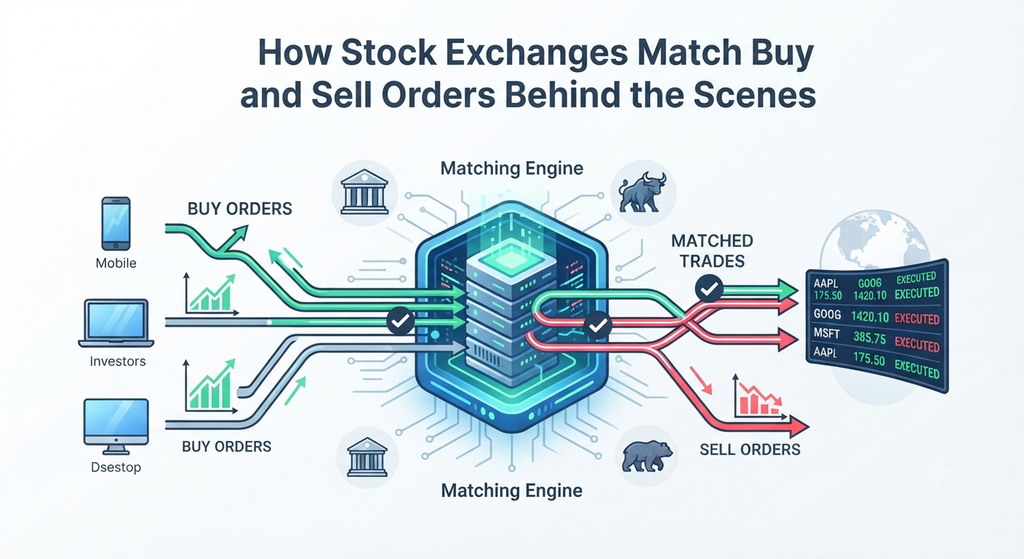
When you tap “Buy” on a brokerage app, a confirmation often appears before you can blink. To a retail investor, it feels as though you are purchasing shares directly from a digital storefront. In reality, your brokerage does not hold a warehouse of company stock waiting to be sold. Instead, your request travels through a high-speed electronic network to a stock exchange, where an automated system pairs your desire to buy with another participant’s willingness to sell.
Understanding this invisible marketplace takes the mystery out of why prices jump during breaking news, why certain orders fill instantly while others sit untouched for days, and how fair pricing is maintained across millions of simultaneous transactions.
The Central Limit Order Book: The Market’s Digital Ledger
At the heart of every modern stock exchange—whether it is the New York Stock Exchange (NYSE), Nasdaq, or the National Stock Exchange of India (NSE)—sits a continuous digital ledger known as the Central Limit Order Book (CLOB).
Think of the order book as a two-sided live auction board that updates thousands of times per second:
- The Bid Side (Buyers): Lists all active buy orders, showing the maximum prices buyers are willing to pay and how many shares they want at each price level.
- The Ask or Offer Side (Sellers): Lists all active sell orders, showing the minimum prices sellers are willing to accept and the quantity of shares available.
The gap between the highest bid price and the lowest ask price is called the bid-ask spread. A trade can only happen when a buyer and a seller agree on a price—either because a buyer raises their offer to meet the lowest ask, or a seller lowers their price to meet the highest bid.
Core Rules of the Matching Engine
The software responsible for pairing buyers and sellers is called the matching engine. Because thousands of orders can arrive at the exact same millisecond, exchanges rely on strict, deterministic algorithms so no participant receives unfair treatment. Almost all major equity exchanges use a Price-Time Priority (also known as First-In, First-Out, or FIFO) model.
1. Price Priority Comes First
Price is always the deciding factor. On the buy side, an order offering $150.05 per share automatically jumps ahead of an order offering $150.00. On the sell side, a trader willing to sell at $150.10 gets priority over someone demanding $150.15. The matching engine always pairs the most aggressive buyer with the most aggressive seller first.
2. Time Priority Breaks Ties
What happens when two traders place buy orders at the exact same price? The matching engine looks at the timestamp down to the nanosecond. Whoever submitted their order to the exchange first is placed ahead in the queue. Your order at $150.00 will not execute until every earlier order at $150.00 has been completely filled.
Step-by-Step: What Happens When You Place an Order?
To see how these rules work in practice, imagine Company X has the following order book at 10:15:00 AM:
| Bid Size (Shares) | Bid Price (Buyers) | Ask Price (Sellers) | Ask Size (Shares) |
| 300 | $49.98 | $50.00 | 100 |
| 500 | $49.95 | $50.02 | 250 |
| 1,200 | $49.90 | $50.05 | 400 |
Now, trace how two different incoming orders behave against this exact book.
Scenario A: You Place a Market Order for 200 Shares
A market order instructs the exchange to buy immediately at whatever prices are currently available.
- The matching engine looks at the lowest ask price first: 100 shares at $50.00. It fills your first 100 shares at $50.00, wiping out that price level.
- You still need 100 more shares. The engine moves to the next best ask price: $50.02, where 250 shares are waiting.
- It fills your remaining 100 shares at $50.02, leaving 150 shares sitting at $50.02 on the order book.
Your trade completes instantaneously, resulting in an average purchase price of $50.01 per share.
Scenario B: You Place a Limit Order for 200 Shares at $49.99
A limit order sets a strict ceiling on what you are willing to pay.
- The matching engine checks the lowest ask price ($50.00) and sees that it exceeds your $49.99 limit.
- No immediate match is possible. Instead of rejecting your order, the engine adds it to the bid side of the order book.
- Because $49.99 is higher than the previous best bid of $49.98, your order becomes the new top bid, narrowing the bid-ask spread to just one cent ($49.99 vs. $50.00). Your order will sit there until a seller accepts $49.99, you cancel it, or the trading session expires.
Who Supplies the Shares When Volume Is Low?
If every trade requires an opposing party, you might wonder why you can still buy shares of a mid-sized company during a quiet afternoon when few retail investors are active.
This is where Designated Market Makers (DMMs) and liquidity providers step in. Market makers are specialized financial firms registered with the exchange that continuously post both bid and ask quotes throughout the trading day. By standing ready to buy when others want to sell—and sell when others want to buy—they prevent artificial price gaps and keep markets running smoothly. In exchange for taking on the risk of holding inventory during volatile swings, market makers earn fractions of a cent from the bid-ask spread and often receive small fee rebates from the exchange.
Special Auction Mechanisms: Opening and Closing Bells
Continuous matching works well during normal market hours, but it can struggle at 9:30 AM when overnight news creates a flood of conflicting orders, or at 4:00 PM when institutional funds need to execute massive trades at an official daily closing price.
To handle these surges without causing wild price spikes, exchanges switch to a batch auction (often called a call auction) at the open and close:
- Order Accumulation: During a brief window before the bell, the exchange collects buy and sell orders without executing them immediately.
- Equilibrium Calculation: The matching engine calculates a single clearing price—the exact price point at which the maximum possible number of shares can be matched.
- Single-Price Execution: When the bell rings, all eligible orders execute simultaneously at that single equilibrium price, establishing the official opening or closing price for the day.
What Happens When Orders Do Not Match?
Not every order results in a completed trade. An order can remain unfilled or partially filled for several practical reasons:
- Price Movement Away from Your Limit: If you place a buy limit order at $49.99 and positive earnings news pushes the stock straight to $52.00, your order stays open on the book unexecuted.
- Partial Fills and Time-in-Force Instructions: If you place an Immediate-or-Cancel (IOC) order for 500 shares at $50.00 when only 200 shares are available at that price, the engine fills the 200 shares and immediately cancels the remaining 300. Similarly, a Fill-or-Kill (FOK) order cancels the entire request if all 500 shares cannot be matched instantly.
- Circuit Breakers and Trading Halts: If a stock moves up or down by a regulator-defined percentage within a short timeframe, exchanges trigger automatic volatility halts. During a halt, matching pauses completely to give participants time to digest information before continuous trading resumes.
Frequently Asked Questions
Does my broker match my order internally, or does it always go to a stock exchange?
Not every retail order reaches a public stock exchange. In markets like the United States, many brokers route retail market orders to wholesale market makers—a process known as internalization—who execute the trade off-exchange at prices equal to or better than the National Best Bid and Offer (NBBO). Large institutional orders and resting limit orders are far more likely to be routed directly to public exchange order books.
Why did my market order fill at a worse price than the quote I saw on my screen?
The price displayed on a standard quote screen reflects the last traded price or the top layer of the order book at that exact moment. If prices are moving fast or your order size is larger than the number of shares available at the best ask price, the matching engine fills the remainder of your order at the next available price levels—a phenomenon known as slippage.
Can large institutional investors hide their orders from the public order book?
Yes. If a pension fund tries to buy 500,000 shares openly on the order book, other traders will see the massive demand and drive the price up. To prevent this, exchanges allow iceberg orders, which display only a small fraction of the total order (for example, 500 shares at a time) while keeping the rest hidden until each visible slice fills. Institutions also use off-exchange venues called dark pools to match large blocks quietly.
How fast do stock exchange matching engines operate today?
Modern matching engines process orders in microseconds (millionths of a second) to nanoseconds (billionths of a second). Exchanges colocate their matching servers in specialized data centers so that incoming electronic messages travel over short, equal-length fiber-optic cables, ensuring network distance does not give one trader an unfair timing advantage over another.
Key Takeaway for Investors
Every stock price you see flickering on a screen is simply the result of the most recent match between a willing buyer and a willing seller. By understanding how the central limit order book prioritizes price first and arrival time second, you can make smarter decisions about when to use a market order for speed versus a limit order for price control—especially during volatile market openings or in thinly traded stocks.