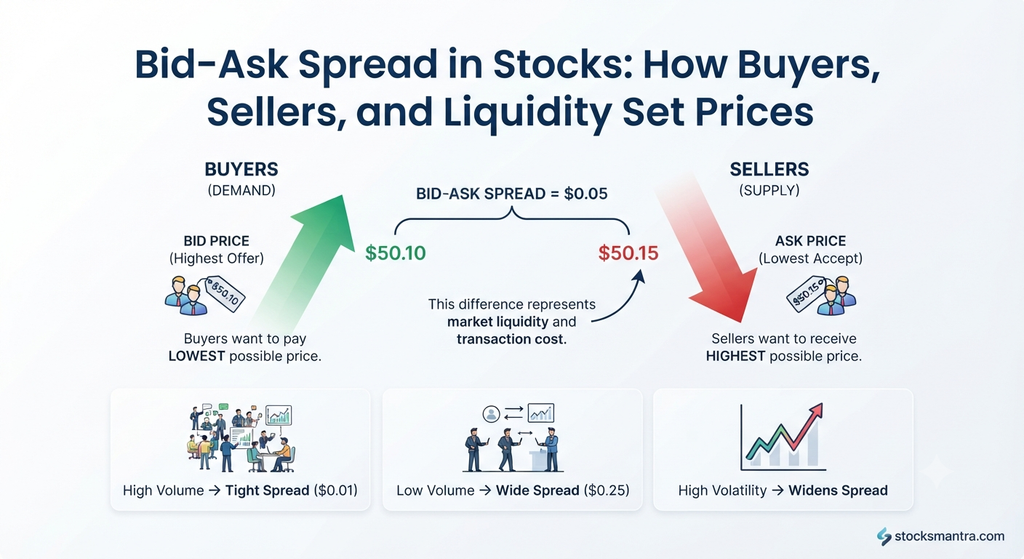
When you pull up a stock quote on a brokerage screen, you rarely see just one price. Alongside the last traded price, you will see two live numbers constantly flickering: the bid and the ask.
Many new investors overlook these two numbers and simply hit the “Buy” button using a market order, only to notice their fill price is slightly higher than the quote they saw a second earlier. That small gap isn’t a broker error or a random glitch—it is the bid-ask spread at work. Understanding how buyers and sellers quote prices in an open market helps you control your entry and exit prices, avoid hidden transaction costs, and read market liquidity before placing a trade.
How Buyers and Sellers Set Prices in the Market
Stock exchanges operate like continuous two-sided auctions. At any given second during market hours, thousands of participants—ranging from individual retail traders to institutional desks and automated market makers—are posting orders specifying the exact price they are willing to accept.
- The Bid Price: This is the highest price a buyer is currently willing to pay for a single share of a stock. If you want to sell shares immediately using a market order, your shares will sell at the current bid price.
- The Ask Price (or Offer Price): This is the lowest price a seller is currently willing to accept to part with a single share of that same stock. If you want to buy shares immediately using a market order, you will pay the current ask price.
Because buyers always want to pay as little as possible and sellers want to receive as much as possible, the ask price is always higher than the bid price. A trade only happens when a buyer agrees to step up to the seller’s ask price, or a seller agrees to drop down to the buyer’s bid price.
Calculating the Bid-Ask Spread
The bid-ask spread is simply the numerical difference between the lowest ask price and the highest bid price.
$$\text{Bid-Ask Spread} = \text{Ask Price} – \text{Bid Price}$$
Suppose Company A is currently quoted with a bid price of $49.95 and an ask price of $50.00.
- The dollar spread is $0.05 ($50.00 – $49.95).
- Traders also measure the spread as a percentage of the ask price to compare stocks of different price levels fairly:
$$\text{Spread Percentage} = \left( \frac{\text{Ask Price} – \text{Bid Price}}{\text{Ask Price}} \right) \times 100$$
For Company A, the spread percentage is $\left(\frac{0.05}{50.00}\right) \times 100 = 0.10\%$.
If you were to buy 100 shares at the $50.00 ask price ($5,000 total) and immediately sell them back at the $49.95 bid price ($4,995 total), you would lose $5.00 instantly—even though the stock’s underlying value never moved. Even when a brokerage charges zero commission, the bid-ask spread acts as an implicit transaction cost on every round-trip trade.
Bid vs. Ask: Side-by-Side Comparison
| Feature | Bid Price | Ask Price |
| Market Participant | Represents active buyers | Represents active sellers |
| Price Level | Always the lower of the two quotes | Always the higher of the two quotes |
| Impact on Your Trade | The price you receive when placing a market sell order | The price you pay when placing a market buy order |
| Order Book Side | Displayed on the buy side (demand) | Displayed on the sell side (supply) |
| Bid Size / Ask Size | Number of shares buyers want at that exact bid | Number of shares sellers are offering at that exact ask |
Why Spreads Widen or Narrow
Not every stock has a penny-wide spread. While heavily traded blue-chip stocks often trade with a $0.01 spread, smaller or less active stocks can have spreads of $0.25, $0.50, or even several dollars. Three primary factors drive these differences:
1. Trading Volume and Liquidity
Liquidity refers to how easily shares can be bought or sold without causing a major price swing. Stocks with millions of shares changing hands every hour have deep order books filled with competing buyers and sellers. That competition forces bids up and asks down, creating a tight spread. Thinly traded stocks—such as micro-cap companies or obscure exchange-traded funds (ETFs)—have fewer participants, leaving wider gaps between the highest buyer and lowest seller.
2. Market Volatility
During calm trading sessions, market makers feel confident quoting tight spreads because the stock price is predictable from second to second. However, right before an earnings announcement, a Federal Reserve interest rate decision, or unexpected breaking news, prices can swing sharply. Liquidity providers widen their spreads during volatile periods to protect themselves against the risk of buying shares just before a sudden drop or selling just before a spike.
3. Time of Day
Spreads rarely stay static throughout the trading day. They tend to be widest during the first 15 to 30 minutes after the market opens, as overnight news is digested and order books find their balance. Spreads typically tighten during the middle of the day and widen again during pre-market and after-hours sessions, when trading volume drops significantly.
Practical Ways to Manage the Bid-Ask Spread
You cannot eliminate the bid-ask spread, as it is a fundamental part of how exchanges match orders, but you can prevent it from eating unnecessarily into your returns:
- Use Limit Orders Instead of Market Orders: A market order prioritizes speed over price, forcing you to cross the spread and accept whatever ask or bid is currently available. A limit order lets you set the maximum price you will pay or the minimum price you will accept. If a stock is quoted at $20.10 bid / $20.30 ask, placing a buy limit order at $20.15 or $20.20 positions you inside the spread, potentially saving you money if a seller meets your price.
- Check Bid and Ask Sizes: Most brokerage platforms display “bid size” and “ask size” alongside the prices (often in lots of 100 shares). If you want to buy 1,000 shares of a stock with an ask price of $15.00, but the ask size is only 200 shares, a market order will buy those first 200 shares at $15.00 and then automatically move up the order book to fill the remaining 800 shares at higher ask prices—a phenomenon known as slippage.
- Avoid Market Orders in Extended Hours: Pre-market and after-hours trading sessions have far lower liquidity. Wide spreads during these hours can cause market orders to execute at unfavorable prices far away from the regular session’s closing price.
Frequently Asked Questions
Why is the last traded price sometimes different from both the bid and the ask? The “last” price simply records the most recent transaction that already occurred. Once that trade finishes, the order book updates immediately. If buyers or sellers cancel orders or submit new ones a fraction of a second later, the live bid and ask quotes can shift above or below that last historical trade.
Who keeps the money from the bid-ask spread? In modern electronic markets, the spread is captured by market makers and liquidity providers—specialized firms and automated trading systems that continuously post both buy and sell quotes. They take on the risk of holding inventory so other investors can trade immediately, earning the small spread difference across thousands of transactions as compensation.
Does a tight bid-ask spread mean a stock is a good investment? No. A tight spread only tells you that a stock is liquid and inexpensive to trade in and out of. It reflects trading activity and market efficiency, not the underlying financial health, valuation, or future growth potential of the company.
What happens when the bid price equals the ask price? When a buyer raises their bid to match the current ask—or a seller lowers their ask to match the current bid—an immediate trade is executed on the exchange. Once those shares are matched and cleared from the order book, the next highest bid and next lowest ask become the new active quotes.
Key Takeaway
Every stock quote tells a two-part story: what buyers are willing to offer and what sellers demand in return. Checking the gap between the bid and the ask before submitting an order takes only a second, yet it reveals how liquid a stock is and helps you choose between paying for instant execution with a market order or protecting your entry price with a limit order.