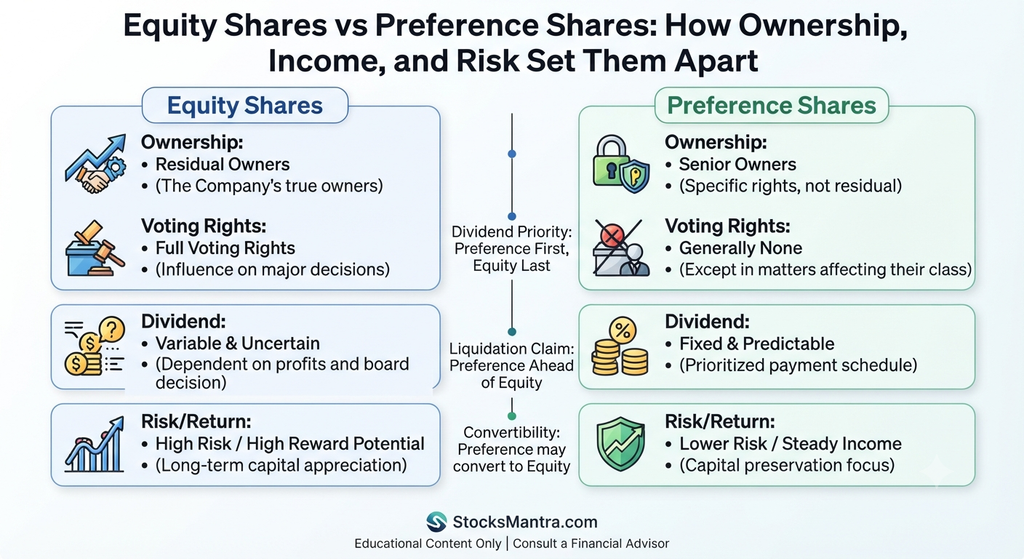
When a company raises capital by issuing stock, it does not always offer every investor the same deal. One investor might buy shares hoping for long-term price appreciation and a voice in how the business is run. Another might want predictable dividend payouts without riding the daily rollercoaster of market sentiment. Those two expectations correspond to the two primary classes of corporate stock: equity shares and preference shares.
Understanding the differences between equity shares vs preference shares matters whether you are analyzing a company’s balance sheet, evaluating an initial public offering, or deciding how to balance growth and income in your own portfolio. While both represent ownership stakes in a corporation, they sit at very different rungs on the capital ladder—affecting everything from voting power to who gets paid first if the business shuts down.
Two Ways to Own a Piece of a Company
At their core, both equity and preference shares allow a business to raise money from investors without taking on traditional debt. Unlike bondholders, shareholders are owners rather than lenders. However, corporate law separates those owners into distinct tiers with different rights and trade-offs.
Equity shares (often called common stock or ordinary shares) represent residual ownership in a company. Equity shareholders are the true risk-takers of the business. They benefit the most when profits surge and the share price climbs, because there is no ceiling on how much their stake can grow. In exchange for that unlimited upside, they sit at the back of the line when profits are distributed or assets are liquidated.
Preference shares (commonly known as preferred stock) blend characteristics of both stocks and bonds. Like equity, preference shares represent ownership rather than a loan. Like bonds, they typically pay a fixed dividend rate and grant holders priority over common shareholders when dividends are declared or assets are distributed. In return for that stability and priority, preference shareholders usually give up voting power and cap their potential capital appreciation.
Side-by-Side Comparison: Equity vs Preference Shares
Before examining each feature in detail, the table below outlines how these two share classes compare across the factors investors care about most.
| Feature | Equity Shares | Preference Shares |
| Dividend Rate | Variable; depends on company profits and board approval | Usually fixed as a percentage of face value or a set dollar/rupee amount |
| Dividend Priority | Paid after preference shareholders receive their share | Paid before any dividends go to equity shareholders |
| Voting Rights | Full voting rights on major corporate decisions and board elections | Generally no voting rights, except on matters directly affecting their class |
| Capital Appreciation | High potential; share price grows with company performance | Limited; price stays closer to par value and responds more to interest rates |
| Liquidation Payout | Last in line after creditors, bondholders, and preference holders | Paid before equity shareholders (though after debt holders) |
| Convertibility | Cannot be converted into preference shares | May be convertible into equity shares if issued with that clause |
| Redemption | Perpetual; bought back only through open-market buybacks or delisting | Often redeemable after a fixed maturity period |
| Risk Profile | Higher risk, higher long-term return potential | Moderate risk, focused on steady income |
7 Core Differences Every Investor Should Understand
1. Dividend Priority and Payout Structure
Dividends are the clearest dividing line between the two share classes. Preference shareholders hold a contractual priority: whenever a company’s board approves a dividend payout, preference holders must receive their stated dividend before a single cent reaches equity shareholders.
For equity holders, dividends are never guaranteed. Even if a company posts strong annual earnings, management can choose to reinvest every dollar back into expansion, research, or debt reduction. When equity dividends are paid, they fluctuate with company performance—rising during boom years and shrinking or disappearing during downturns.
2. Voting Rights and Corporate Influence
Owning equity shares gives you a formal say in corporate governance. Depending on the number of shares held, equity investors vote on:
- Electing or removing members of the board of directors
- Approving mergers, acquisitions, or major asset sales
- Authorizing new share issuances or stock splits
- Ratifying the appointment of external auditors
Preference shareholders typically sit outside day-to-day governance. Under standard corporate statutes (such as India’s Companies Act, 2013 and U.S. state corporate laws), preference shareholders do not carry general voting rights. They only gain the right to vote on resolutions that directly alter their specific rights—such as winding up the company, reducing share capital, or modifying dividend terms—or if their dividends remain unpaid for a legally specified period.
3. Capital Growth Potential vs. Price Stability
Equity shares are built for wealth creation over time. Because equity holders own the residual value of the business, every product launch, market share gain, or margin improvement directly increases the intrinsic value of their shares. Over multi-year horizons, this uncapped upside is what drives stock market compounding.
Preference shares behave quite differently on secondary markets. Because their dividend payout is fixed, their market price rarely skyrockets alongside booming earnings. Instead, preference share prices fluctuate primarily in response to prevailing interest rates and the issuing company’s creditworthiness—much like corporate bonds. When interest rates rise, existing fixed-rate preference shares tend to dip in price; when rates fall, they become more attractive.
4. Claims During Liquidation or Bankruptcy
If a company runs into severe financial distress and liquidates its assets, payouts follow a strict legal hierarchy:
- Secured creditors and banks
- Unsecured creditors and bondholders
- Preference shareholders
- Equity shareholders
Preference shareholders recover their invested capital (typically up to the share’s par or face value) before equity holders see anything. Equity shareholders absorb the first and hardest losses; in most bankruptcies, common stock ends up worth zero.
5. Arrears and Cumulative Dividend Protection
Not all preference shares handle missed payments the same way, which introduces an important nuance for income investors:
- Cumulative preference shares: If the company skips a dividend during a rough financial year, the unpaid amount accumulates as arrears. The company must pay all accumulated arrears in full before distributing any dividends to equity shareholders in future years.
- Non-cumulative preference shares: If a dividend is skipped in a given year, that payout is lost permanently.
Equity shares never carry cumulative dividend rights. If a company skips a common dividend for three consecutive years and resumes payouts in year four, equity holders only receive year four’s declared dividend.
6. Redemption and Lifespan of the Investment
Equity shares are permanent capital. A company has no obligation to buy back equity shares from investors on a set schedule. If an equity investor wants cash, they sell their shares to another buyer on a stock exchange.
Preference shares frequently come with a built-in exit timeline. Redeemable preference shares are issued with a predetermined maturity date—such as 5, 10, or 20 years—at which point the company buys the shares back from investors at an agreed price. (Note that in jurisdictions like India, companies are legally restricted from issuing irredeemable preference shares, meaning virtually all corporate preference shares carry a maximum tenure, typically up to 20 years for standard businesses.)
7. Convertibility and Bonus Perks
Convertible preference shares give holders the option—or automatic trigger—to exchange their preference shares for a predetermined number of equity shares after a specific date. This structure is especially common in venture capital and private equity deals, allowing early investors to enjoy downside protection initially while converting into equity if the company scales successfully.
Equity shares, by contrast, cannot be converted into preference shares. However, equity shareholders are eligible for corporate actions such as bonus share issues (free additional shares issued from company reserves) and rights issues (discounted shares offered to existing owners), which are generally not extended to preference shareholders.
A Practical Example: How Profits Get Divided
Suppose a manufacturing firm generates $1,000,000 in distributable profit for the year. Its capital structure includes:
- 50,000 preference shares with a face value of $100 each and a fixed 8% annual dividend.
- 500,000 equity shares held by public and institutional investors.
Before the board can declare any dividend for equity investors, it must satisfy the preference dividend obligation:
$$\text{Preference Dividend} = 50,000 \times \$100 \times 8\% = \$400,000$$
That leaves $600,000 in remaining profit. The board might retain $300,000 for factory upgrades and distribute the remaining $300,000 to equity holders—giving each equity share $0.60 ($300,000 ÷ 500,000).
Now imagine the following year is tough, and distributable profit drops to $420,000. Preference shareholders still receive their full $400,000. Only $20,000 remains, meaning equity shareholders might receive just $0.04 per share—or nothing at all if the board keeps that small buffer in reserve. Conversely, if profits surge to $3,000,000, preference shareholders still receive only their capped $400,000, while equity shareholders capture the massive upside.
Which Type of Share Fits Your Investing Goals?
Choosing between equity shares and preference shares comes down to what role you want an investment to play in your portfolio:
- Equity shares make sense when: You have a multi-year investment horizon, can tolerate short-term market swings, and want your capital to compound alongside business growth. For retail investors building long-term wealth, public stock exchanges offer far higher liquidity and selection in equity shares than in preference shares.
- Preference shares make sense when: Your priority is predictable income, lower price volatility than common stock, and stronger protection during downturns. They are widely used by income-focused investors, retirees, and institutional buyers who prefer steady cash flows over voting control.
Keep in mind that on most retail stock exchanges, equity shares dominate daily trading volume, whereas preference shares are often thinly traded or issued privately to institutional and high-net-worth investors. Always check trading liquidity, call provisions (whether the company can buy back the shares early), and tax treatment on dividends in your jurisdiction before investing.
Frequently Asked Questions
Can a company issue only preference shares without equity shares?
No. Every limited company must have equity share capital because equity shareholders are the foundational owners who hold voting rights and bear residual business risk. Preference shares are optional and can only be issued alongside existing equity shares.
Do preference shareholders ever get voting rights?
In normal operations, no. However, preference shareholders gain temporary or specific voting rights if a proposed resolution directly affects their share class—such as changing their dividend rate or winding up the company—or if their dividends go unpaid for a legally mandated duration (typically two years under Indian corporate law).
Are preference shares safer than equity shares?
Preference shares carry lower risk than equity shares because of their priority in dividend payouts and liquidation claims. However, they are not risk-free: if a company suffers severe losses, dividends can still be suspended, and in a bankruptcy, debt holders and banks are paid before preference shareholders.
Why are preference shares less common for retail stock market investors?
Most companies issue preference shares through private placements to banks, mutual funds, and institutional investors rather than listing them broadly for retail trading. Even when listed, preference shares usually have much lower daily trading volume than common equity shares.
How are dividends from equity and preference shares taxed?
In many jurisdictions, including India and the United States, dividend income from both equity and preference shares is taxed under similar rules—often at the investor’s applicable income tax slab rate or qualified dividend rate—while capital gains tax depends on the holding period and whether the shares are listed on a recognized exchange. Consulting a tax professional for local rules is always recommended.
Final Takeaway: Balancing Growth Potential Against Income Priority
Equity shares and preference shares represent two distinct philosophies of investing in the same business. Equity shares reward patience and risk tolerance with uncapped capital appreciation, variable dividends, and corporate voting power—making them the core engine for long-term wealth building. Preference shares trade that upside and governance voice for predictable dividend payouts and higher priority if a company ever liquidates.
Neither share class is universally better; each serves a different financial objective. By matching a share’s payout priority, risk profile, and liquidity to your own investment horizon, you can evaluate corporate capital structures with far greater clarity and build a portfolio aligned with what you actually expect your money to do.