When investors talk about the stock market, they rarely treat all public companies as a single group. A multinational corporation with decades of steady earnings behaves very differently on the stock exchange than a regional manufacturer still expanding into new markets. To organize this wide universe of public companies, analysts and exchanges group stocks by their size—specifically, their market capitalization.
Understanding the distinction between large-cap, mid-cap, and small-cap stocks helps clarify why certain shares swing wildly in price during a single trading session while others move gradually over years. Rather than describing what a company makes or sells, these three labels measure a company’s overall market value and signal where it likely stands in its business lifecycle.
How Market Capitalization Defines Stock Size
Market capitalization—commonly shortened to market cap—is the total dollar or rupee value of a company’s outstanding shares held by all shareholders. It is calculated using a straightforward formula:
$$\text{Market Capitalization} = \text{Current Share Price} \times \text{Total Number of Outstanding Shares}$$
For example, if a company has 50 million shares trading at $40 each, its market capitalization is $2 billion.
A common misconception among new investors is judging a company’s size by its individual share price alone. A stock trading at $500 per share is not automatically larger or more valuable than one trading at $50 per share. If the $500 stock only has 1 million shares in circulation, its market cap is $500 million. Meanwhile, if the $50 stock has 200 million shares, its market cap is $10 billion. Market capitalization looks at the entire pie rather than the price of a single slice.
Because stock prices fluctuate every trading day, market capitalization is dynamic. Over time, sustained business growth or prolonged downturns can push a company from one size category into another.
Understanding the Three Core Market Cap Categories
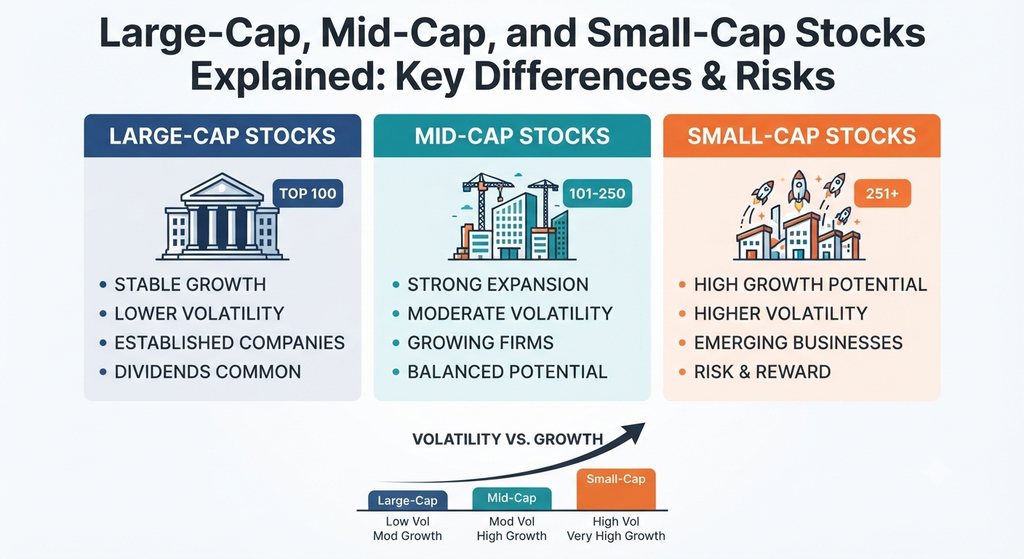
Different global stock markets and financial regulators use slightly different thresholds to separate companies by size. In the United States, financial institutions and index providers generally use fixed dollar ranges, whereas in markets like India, the Securities and Exchange Board of India (SEBI) defines these categories based on company rankings by full market capitalization (the top 100 companies as large-cap, the 101st to 250th as mid-cap, and the 251st onward as small-cap).
Despite regional variations in exact cutoff numbers, the business characteristics of each tier remain remarkably consistent worldwide.
Large-Cap Stocks: The Established Industry Leaders
Large-cap stocks represent the biggest publicly traded companies in the economy—typically valued at $10 billion or more in U.S. markets (or ranking within the top 100 listed companies in India). Many of these businesses are household names that dominate their respective industries, such as banking, energy, consumer staples, healthcare, and enterprise technology.
- Business Maturity: Most large-cap firms have operated for decades, survived multiple economic cycles, and established recognizable brands with loyal customer bases.
- Financial Stability: They generally maintain deeper cash reserves, diversified revenue streams across multiple regions, and easier access to credit during tight economic conditions.
- Return Profile: Because these companies have already captured substantial market share, their year-over-year revenue growth tends to be moderate. Instead of rapid price doubling, investors often look to large-cap stocks for capital preservation, steady compounding, and regular dividend payouts.
Mid-Cap Stocks: Businesses in Their Expansion Phase
Mid-cap stocks sit in the middle ground, generally carrying a market value between $2 billion and $10 billion in U.S. markets (or ranking 101st through 250th in Indian equity markets). These companies have typically moved past the survival struggles of early-stage businesses and established a profitable, proven business model.
- Growth Trajectory: Mid-cap companies are often actively scaling—opening new locations, launching complementary product lines, or expanding from regional dominance to national or international reach.
- Balance of Traits: They tend to carry less operational fragility than small companies while retaining more room for rapid earnings expansion than massive conglomerates.
- Acquisition Targets: Successful mid-cap firms frequently attract buyout offers from large-cap competitors looking to acquire innovation or market share quickly.
Small-Cap Stocks: Emerging and Niche Companies
Small-cap stocks represent smaller public enterprises, generally valued between $300 million and $2 billion in U.S. markets (or ranked from the 251st company onward in India). Note that companies valued below $300 million are frequently separated further into micro-cap or nano-cap tiers due to their heightened risk.
- Early-Stage Potential: Many small-cap firms serve specialized niche markets, develop emerging technologies, or operate within local economies. Because they start from a smaller revenue base, a single major contract or successful product launch can substantially alter their financial trajectory.
- Higher Vulnerability: Smaller balance sheets mean these companies have thinner financial cushions during recessions, supply chain disruptions, or periods of rising interest rates.
- Limited Analyst Coverage: Institutional research desks focus heavily on large corporations. As a result, small-cap stocks receive less media and analyst attention, which can create pricing inefficiencies alongside lower daily trading volumes.
Comparing Large-Cap, Mid-Cap, and Small-Cap Stocks
Evaluating these three categories side by side highlights the trade-offs between stability, liquidity, and upside potential.
| Feature | Large-Cap Stocks | Mid-Cap Stocks | Small-Cap Stocks |
| Typical U.S. Market Cap | $10 billion and above | $2 billion to $10 billion | $300 million to $2 billion |
| Company Stage | Mature, established industry leaders | Growing, scaling proven models | Emerging, niche, or early-stage |
| Price Volatility | Lower relative to broader market | Moderate | High; prone to sharp swings |
| Growth Potential | Steady, moderate compounding | Strong expansion potential | High upside if execution succeeds |
| Dividend Likelihood | Common and often consistent | Occasional; many reinvest profits | Rare; profits usually fund growth |
| Trading Liquidity | Very high; easy to buy or sell | Moderate to high | Lower; wider bid-ask spreads |
| Institutional Coverage | Extensive analyst and media tracking | Moderate coverage | Limited research coverage |
How Economic Cycles Affect Each Category
Market capitalization tiers rarely move in lockstep across different phases of the economy. Interest rates, inflation, and investor risk appetite influence each group differently.
During economic downturns or periods of uncertainty, investors often rotate money toward large-cap stocks. Large corporations usually have stronger pricing power to pass rising costs onto customers and sufficient cash flow to weather slower consumer spending. Their high trading liquidity also allows large funds to enter and exit positions without drastically moving the share price.
Conversely, during early economic recoveries, small-cap and mid-cap stocks frequently outperform. When interest rates stabilize or decline and credit becomes more accessible, smaller companies benefit disproportionately because they rely more heavily on borrowing to fund expansion. As consumer confidence returns, nimble businesses can scale revenue faster than massive corporations constrained by their sheer size.
Common Misconceptions About Market Cap Investing
When evaluating companies across size tiers, several assumptions often lead investors astray:
- Assuming Large-Cap Stocks Cannot Lose Value: While large-cap companies are less volatile than smaller peers, size does not make a business immune to disruption. Historic industry leaders have lost massive market value when they failed to adapt to technological shifts or carried excessive debt.
- Believing Small-Cap Always Means Higher Returns: Small-cap stocks offer higher potential returns to compensate investors for taking on greater risk, not guaranteed outperformance. Many small businesses struggle to scale, face fierce competition, or experience prolonged periods of underperformance.
- Ignoring Liquidity in Smaller Stocks: In thinly traded small-cap shares, the gap between the highest price a buyer will pay (the bid) and the lowest price a seller will accept (the ask) can be wide. Placing large market orders in low-volume stocks can result in unfavorable execution prices.
Frequently Asked Questions
Can a company change its market cap category over time?
Yes. Market cap categories are not permanent labels. If a small-cap company consistently grows its revenue and earnings, rising investor demand will push its share price upward, eventually graduating it into mid-cap and potentially large-cap territory. Similarly, a struggling large-cap company whose stock price drops sharply can fall back into the mid-cap tier.
Are large-cap stocks always safer than mid-cap or small-cap stocks?
Large-cap stocks generally carry lower business failure risk and smaller day-to-day price swings, making them more stable in a relative sense. However, all equity investments carry market risk, and individual large-cap stocks can still experience steep declines during broad market sell-offs or company-specific crises.
Why do small-cap stocks rarely pay dividends?
Growing a young or niche business requires substantial capital for equipment, hiring, marketing, and research. Small-cap management teams typically retain earnings to reinvest directly into business expansion rather than distributing cash to shareholders as dividends.
How do index funds use market cap categories?
Many benchmark stock indexes track specific market cap segments so investors can measure performance accurately. For instance, the S&P 500 focuses primarily on large-cap U.S. companies, the S&P MidCap 400 tracks mid-sized firms, and the Russell 2000 serves as a widely followed benchmark for small-cap stocks.
What is the difference between market cap and enterprise value?
Market capitalization measures only the total value of a company’s equity (outstanding shares). Enterprise value goes further by adding total debt to the market cap and subtracting cash and cash equivalents, giving analysts a fuller picture of what it would theoretically cost to acquire the entire business.
Practical Takeaway
Large-cap, mid-cap, and small-cap classifications serve as a practical starting point for understanding what to expect from a stock before examining its financial statements. Large-cap companies anchor portfolios with established operations and lower volatility, mid-cap firms offer a middle ground of proven profitability and room to scale, and small-cap stocks provide exposure to emerging businesses alongside sharper price swings. Recognizing how size shapes risk, liquidity, and growth dynamics allows investors to align their stock research with their own financial goals and tolerance for market fluctuations.