Introduction
Security Awareness Training Platforms help organizations educate employees about cybersecurity risks, safe behaviors, and compliance requirements. These tools deliver structured training programs, phishing simulations, and real-time assessments to reduce human-related security incidents—one of the most common causes of breaches.
As cyber threats become more sophisticated, attackers increasingly target employees through phishing, social engineering, and credential theft. Security awareness platforms address this by combining interactive training, behavioral analytics, and automated campaigns to build a security-first culture across the organization.
Common Use Cases
- Employee cybersecurity training programs
- Phishing simulation campaigns
- Compliance training (security policies, regulations)
- Risk scoring and user behavior tracking
- Ongoing security awareness initiatives
What Buyers Should Evaluate
- Training content quality and variety
- Phishing simulation capabilities
- Automation of campaigns and reporting
- User engagement and learning effectiveness
- Integration with HR and identity systems
- Analytics and risk scoring features
- Scalability for large organizations
- Compliance support and reporting
- Cost vs value
Best for: Enterprises, IT security teams, compliance officers, and organizations aiming to reduce human risk in cybersecurity.
Not ideal for: Very small teams with limited security training requirements.
Key Trends in Security Awareness Training Platforms
- AI-driven personalized training programs
- Advanced phishing simulation and attack scenarios
- Behavioral analytics and risk scoring
- Gamification for improved engagement
- Integration with identity and security tools
- Continuous training instead of one-time programs
- Cloud-based delivery and scalability
- Automated compliance reporting
- Focus on human risk management
- Localization and multi-language training support
How We Selected These Tools (Methodology)
- Strong market adoption and reputation
- Proven training effectiveness and phishing simulation capabilities
- Integration with security and HR systems
- Availability of automation and analytics features
- Support for compliance training requirements
- Suitability for SMB to enterprise organizations
- Strong content libraries and updates
- Balance between ease of use and advanced features
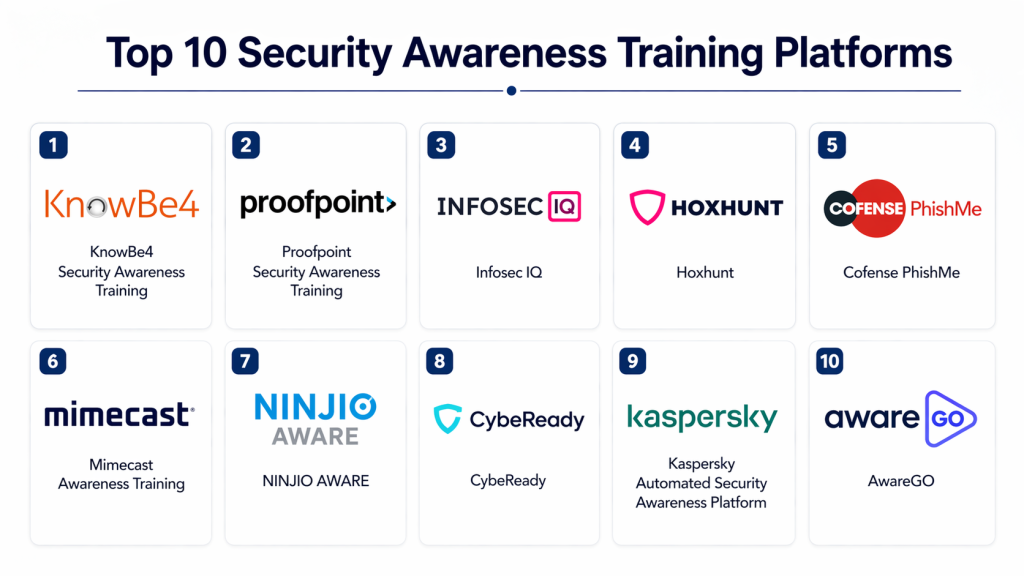
Top 10 Security Awareness Training Platforms
#1 — KnowBe4
Short description: A leading security awareness platform offering extensive training content and phishing simulations.
Key Features
- Security awareness training modules
- Phishing simulation campaigns
- Risk scoring and analytics
- Automated training workflows
- Compliance reporting
Pros
- Extensive content library
- Strong phishing simulation capabilities
Cons
- Premium pricing
- Requires configuration
Platforms / Deployment
- Cloud
Security & Compliance
- RBAC, reporting
- Compliance support varies
Integrations & Ecosystem
- HR systems
- Security tools
- APIs
Support & Community
Strong enterprise support.
#2 — Proofpoint Security Awareness
Short description: A platform focused on human risk management and advanced phishing simulations.
Key Features
- Phishing simulation
- Behavior analytics
- Training modules
- Risk scoring
- Reporting dashboards
Pros
- Strong analytics
- Enterprise-ready
Cons
- Complex setup
- Higher cost
Platforms / Deployment
- Cloud
Security & Compliance
- Not publicly stated
Integrations & Ecosystem
- Security platforms
- APIs
Support & Community
Enterprise support.
#3 — Cofense PhishMe
Short description: A phishing-focused training platform designed to improve employee response to threats.
Key Features
- Phishing simulations
- Incident response training
- Reporting tools
- Analytics
- Campaign automation
Pros
- Strong phishing focus
- Realistic simulations
Cons
- Limited broader training
- Requires integration
Platforms / Deployment
- Cloud
Security & Compliance
- Not publicly stated
Integrations & Ecosystem
- Security tools
- APIs
Support & Community
Good support.
#4 — Hoxhunt
Short description: A gamified security awareness platform focused on user engagement.
Key Features
- Gamified training
- Phishing simulations
- Behavior analytics
- Automated campaigns
- Reporting
Pros
- High engagement
- Personalized training
Cons
- Premium pricing
- Limited customization
Platforms / Deployment
- Cloud
Security & Compliance
- Not publicly stated
Integrations & Ecosystem
- APIs
- Security tools
Support & Community
Strong support.
#5 — SANS Security Awareness
Short description: A training platform backed by cybersecurity research and expertise.
Key Features
- Training modules
- Phishing simulations
- Compliance content
- Reporting
- Continuous updates
Pros
- High-quality content
- Trusted brand
Cons
- Limited automation
- Higher cost
Platforms / Deployment
- Cloud
Security & Compliance
- Not publicly stated
Integrations & Ecosystem
- APIs
- Security tools
Support & Community
Strong support.
#6 — Infosec IQ
Short description: A comprehensive training platform with phishing simulations and risk scoring.
Key Features
- Training modules
- Phishing simulations
- Risk analytics
- Reporting
- Automation
Pros
- Balanced features
- Easy to use
Cons
- Smaller ecosystem
- Limited advanced customization
Platforms / Deployment
- Cloud
Security & Compliance
- Not publicly stated
Integrations & Ecosystem
- APIs
- HR tools
Support & Community
Good support.
#7 — Terranova Security
Short description: A platform focused on compliance training and user awareness.
Key Features
- Security training
- Phishing simulations
- Compliance modules
- Reporting
- Risk assessment
Pros
- Strong compliance focus
- Good content
Cons
- Less advanced analytics
- Limited customization
Platforms / Deployment
- Cloud
Security & Compliance
- Not publicly stated
Integrations & Ecosystem
- APIs
- Security tools
Support & Community
Good support.
#8 — Webroot Security Awareness Training
Short description: A lightweight training platform designed for SMBs.
Key Features
- Training modules
- Phishing simulations
- Reporting
- Automation
- Risk tracking
Pros
- Easy to deploy
- Cost-effective
Cons
- Limited enterprise features
- Smaller content library
Platforms / Deployment
- Cloud
Security & Compliance
- Not publicly stated
Integrations & Ecosystem
- APIs
- Security tools
Support & Community
Good SMB support.
#9 — NINJIO
Short description: A security awareness platform focused on storytelling-based training.
Key Features
- Video-based training
- Phishing awareness
- Compliance modules
- Reporting
- Engagement tracking
Pros
- Engaging content
- Easy to use
Cons
- Limited advanced features
- Less customization
Platforms / Deployment
- Cloud
Security & Compliance
- Not publicly stated
Integrations & Ecosystem
- APIs
- SaaS tools
Support & Community
Good support.
#10 — CybSafe
Short description: A behavior-driven security awareness platform focusing on human risk management.
Key Features
- Behavior analytics
- Training modules
- Risk scoring
- Automation
- Reporting
Pros
- Strong analytics
- Modern approach
Cons
- Smaller ecosystem
- Requires setup
Platforms / Deployment
- Cloud
Security & Compliance
- Not publicly stated
Integrations & Ecosystem
- APIs
- Security tools
Support & Community
Good support.
Comparison Table (Top 10)
| Tool Name | Best For | Platform(s) Supported | Deployment | Standout Feature | Public Rating |
|---|---|---|---|---|---|
| KnowBe4 | Enterprise | Web | Cloud | Content library | N/A |
| Proofpoint | Enterprise | Web | Cloud | Human risk analytics | N/A |
| Cofense | Phishing | Web | Cloud | Simulation focus | N/A |
| Hoxhunt | Engagement | Web | Cloud | Gamification | N/A |
| SANS | Training | Web | Cloud | Content quality | N/A |
| Infosec IQ | SMB/Mid | Web | Cloud | Balanced features | N/A |
| Terranova | Compliance | Web | Cloud | Compliance focus | N/A |
| Webroot | SMB | Web | Cloud | Simplicity | N/A |
| NINJIO | Engagement | Web | Cloud | Story-based training | N/A |
| CybSafe | Analytics | Web | Cloud | Behavior analytics | N/A |
Evaluation & Scoring of Security Awareness Training Platforms
| Tool Name | Core (25%) | Ease (15%) | Integrations (15%) | Security (10%) | Performance (10%) | Support (10%) | Value (15%) | Weighted Total |
|---|---|---|---|---|---|---|---|---|
| KnowBe4 | 9 | 8 | 8 | 9 | 9 | 8 | 7 | 8.4 |
| Proofpoint | 9 | 7 | 9 | 9 | 9 | 8 | 7 | 8.5 |
| Cofense | 8 | 7 | 8 | 8 | 8 | 7 | 7 | 7.8 |
| Hoxhunt | 8 | 9 | 7 | 8 | 8 | 8 | 7 | 8.0 |
| SANS | 8 | 7 | 7 | 8 | 8 | 8 | 7 | 7.8 |
| Infosec IQ | 8 | 8 | 7 | 8 | 8 | 7 | 8 | 7.9 |
| Terranova | 7 | 8 | 7 | 7 | 7 | 7 | 8 | 7.6 |
| Webroot | 7 | 9 | 6 | 7 | 7 | 7 | 9 | 7.6 |
| NINJIO | 7 | 9 | 6 | 7 | 7 | 7 | 9 | 7.6 |
| CybSafe | 8 | 8 | 7 | 8 | 8 | 7 | 7 | 7.9 |
Which Security Awareness Training Platform Is Right for You?
Solo / Freelancer
Use Webroot or NINJIO for simplicity.
SMB
Use Infosec IQ or Webroot.
Mid-Market
Use Hoxhunt or CybSafe.
Enterprise
Use KnowBe4, Proofpoint, or SANS.
Budget vs Premium
- Budget: Webroot, NINJIO
- Premium: Proofpoint, KnowBe4
Feature Depth vs Ease of Use
- Deep features: Proofpoint
- Ease of use: Hoxhunt
Integrations & Scalability
Best: KnowBe4, Proofpoint
Security & Compliance Needs
Best: SANS, Terranova
Frequently Asked Questions (FAQs)
1. What are security awareness platforms?
They train employees on cybersecurity best practices.
2. Why are they important?
They reduce human-related security risks.
3. Do they include phishing simulations?
Yes, most platforms include simulations.
4. Are they cloud-based?
Most are cloud-native.
5. Who should use them?
Organizations of all sizes.
6. Are they expensive?
Pricing varies.
7. Do they integrate with HR systems?
Yes, integration is common.
8. Can they track employee performance?
Yes, via analytics.
9. Do they support compliance training?
Yes, compliance is a key feature.
10. What is the biggest benefit?
Improved security culture.
Conclusion
Security Awareness Training Platforms are essential for reducing human risk and strengthening an organization’s overall cybersecurity posture. By combining training, simulations, and behavioral analytics, these tools help employees recognize threats and respond effectively. As cyberattacks increasingly target users rather than systems, investing in awareness training is no longer optional—it is a critical layer of defense. While enterprise platforms provide advanced analytics and scalability, smaller organizations can benefit from simpler tools that focus on engagement and ease of use. The best approach is to assess your organization’s risk level, choose a platform that aligns with your training needs, and continuously measure its effectiveness through real-world simulations and reporting.