Introduction
Desktop publishing software (DTP) is used to design, layout, and produce visually rich documents such as magazines, brochures, books, catalogs, and marketing materials. Unlike standard word processors, these tools provide precise control over typography, page layout, images, and print-ready output.
In modern digital workflows, DTP tools are critical for both print and digital publishing. With the rise of omnichannel content, these platforms now support interactive PDFs, eBooks, and even web-ready layouts. Advanced features like AI-assisted layout, preflight checks, and cloud collaboration are transforming how teams create and distribute content.
Common use cases include:
- Magazine, newspaper, and book publishing
- Marketing materials (flyers, brochures, catalogs)
- Corporate reports and presentations
- eBook and digital publishing
- Packaging and print design
Key evaluation criteria buyers should consider:
- Typography and layout precision
- Multi-page document handling
- Print-ready output (CMYK, PDF, preflight checks)
- Asset management and linking
- Collaboration and cloud workflows
- Integration with creative tools
- Ease of use vs professional depth
- Performance with large documents
- Automation (templates, master pages)
Best for: Graphic designers, publishers, marketing teams, agencies, and enterprises producing structured visual documents.
Not ideal for: Users needing basic document editing—word processors or simple design tools are more efficient.
Key Trends in Desktop Publishing Software
- AI-assisted layout design: Smart grids, auto-alignment, and content-aware layouts
- Hybrid print + digital publishing: Support for eBooks, interactive PDFs, and web layouts
- Cloud collaboration: Real-time editing and shared assets
- Template-driven workflows: Faster content production at scale
- Integration-first ecosystems: Seamless workflows with design and asset tools
- Automation and scripting: Reducing manual layout work
- Advanced typography tools: Variable fonts and dynamic text styles
- Cross-platform publishing: Desktop + browser-based tools
- Performance optimization: Handling large multi-page documents efficiently
- Shift to subscription vs one-time pricing models
How We Selected These Tools (Methodology)
- Evaluated industry adoption across publishing and design teams
- Assessed layout precision and typography capabilities
- Reviewed performance with large multi-page documents
- Considered ease of use vs professional complexity
- Included tools for enterprise, SMB, and individual users
- Analyzed integration with creative and productivity ecosystems
- Evaluated print-ready output capabilities
- Reviewed community support and learning resources
- Balanced open-source, freemium, and premium tools
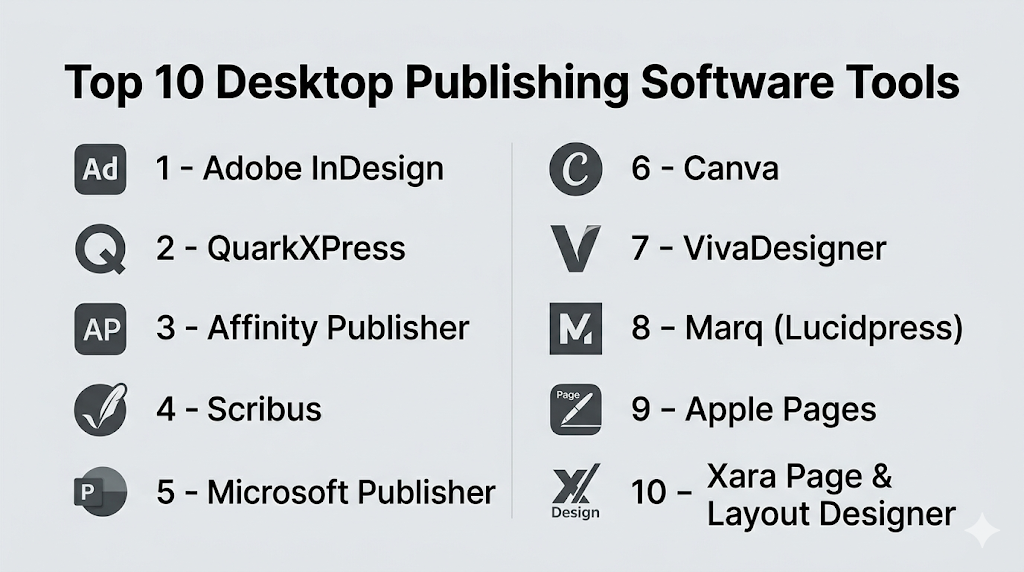
Top 10 Desktop Publishing Software Tools
#1 — Adobe InDesign
Short description: Industry-standard desktop publishing software used for professional print and digital layout design.
Key Features
- Advanced typography and layout tools
- Master pages and grid systems
- Preflight and print-ready export
- AI-assisted layout features
- Multi-page document management
- Integration with creative ecosystem
Pros
- Industry-leading precision
- Extensive feature set
Cons
- Subscription pricing
- Learning curve
Platforms / Deployment
Windows / macOS
Cloud / Local
Security & Compliance
Not publicly stated
Integrations & Ecosystem
Part of a large creative ecosystem.
- Design tools integration
- Asset libraries
- Plugins
Support & Community
Massive global community.
#2 — QuarkXPress
Short description: A long-standing professional DTP tool known for advanced layout control and publishing capabilities.
Key Features
- High-precision layout control
- Multi-format publishing (print, web, mobile)
- Built-in vector and image tools
- Advanced typography
- PDF and digital publishing
- AI-assisted layout
Pros
- Powerful professional features
- Strong print capabilities
Cons
- Expensive
- Less mainstream adoption
Platforms / Deployment
Windows / macOS
Local
Security & Compliance
Not publicly stated
Integrations & Ecosystem
Professional publishing workflows.
- File compatibility
- Export tools
Support & Community
Established professional base.
#3 — Affinity Publisher
Short description: A modern DTP tool offering professional features with a one-time purchase model.
Key Features
- StudioLink integration
- High-performance rendering
- Advanced typography
- Multi-page layouts
- Preflight checks
- Non-destructive editing
Pros
- No subscription
- Strong performance
Cons
- Smaller ecosystem
- Limited cloud collaboration
Platforms / Deployment
Windows / macOS / iPad
Local
Security & Compliance
Not publicly stated
Integrations & Ecosystem
Integrated with Affinity tools.
- Design workflows
- Export tools
Support & Community
Growing community.
#4 — Scribus
Short description: A free, open-source desktop publishing tool suitable for professional print layouts.
Key Features
- CMYK and ICC color management
- PDF creation tools
- Advanced layout capabilities
- Open-source flexibility
- Multi-platform support
- Pre-press features
Pros
- Free and powerful
- Strong print support
Cons
- Outdated UI
- Learning curve
Platforms / Deployment
Windows / macOS / Linux
Local
Security & Compliance
Not publicly stated
Integrations & Ecosystem
Open-source ecosystem.
- Plugins
- Export tools
Support & Community
Active open-source community.
#5 — Microsoft Publisher
Short description: A beginner-friendly DTP tool within the Microsoft ecosystem for simple layouts.
Key Features
- Template-based design
- Drag-and-drop interface
- Integration with Office tools
- Basic layout tools
- Print-ready output
Pros
- Easy to use
- Familiar interface
Cons
- Limited advanced features
- Windows-only
Platforms / Deployment
Windows
Local
Security & Compliance
Not publicly stated
Integrations & Ecosystem
Microsoft ecosystem.
- Office tools
- File compatibility
Support & Community
Strong user base.
#6 — Canva
Short description: A cloud-based design platform with DTP capabilities for quick and collaborative publishing.
Key Features
- Drag-and-drop editor
- Templates and assets
- Cloud collaboration
- AI design tools
- Multi-format export
Pros
- Very easy to use
- Strong collaboration
Cons
- Limited precision
- Not ideal for complex layouts
Platforms / Deployment
Web / Mobile
Cloud
Security & Compliance
Not publicly stated
Integrations & Ecosystem
Extensive integrations.
- Social media
- Cloud storage
Support & Community
Massive global adoption.
#7 — VivaDesigner
Short description: A professional DTP tool offering both desktop and browser-based publishing capabilities.
Key Features
- Cross-platform support
- Advanced layout tools
- XML-based publishing
- Cloud and desktop versions
- Multi-channel publishing
Pros
- Flexible deployment
- Strong for enterprise
Cons
- Less popular
- Learning curve
Platforms / Deployment
Web / Windows / macOS
Cloud / Local
Security & Compliance
Not publicly stated
Integrations & Ecosystem
Enterprise workflows.
- XML publishing
- Export tools
Support & Community
Moderate support.
#8 — Marq (Lucidpress)
Short description: A cloud-based publishing tool focused on brand consistency and team collaboration.
Key Features
- Brand templates
- Cloud-based editing
- Collaboration tools
- Asset management
- Easy publishing
Pros
- Great for teams
- Easy to use
Cons
- Limited advanced layout tools
- Subscription required
Platforms / Deployment
Web
Cloud
Security & Compliance
Not publicly stated
Integrations & Ecosystem
Marketing workflows.
- Brand assets
- Cloud integrations
Support & Community
Moderate support.
#9 — Apple Pages
Short description: A simple publishing and document design tool for Apple users.
Key Features
- Templates
- Basic layout tools
- iCloud sync
- Easy formatting
- Media integration
Pros
- Free for Apple users
- Easy to use
Cons
- Limited professional features
- Apple-only
Platforms / Deployment
macOS / iOS
Cloud / Local
Security & Compliance
Not publicly stated
Integrations & Ecosystem
Apple ecosystem.
- iCloud
- Devices
Support & Community
Strong user base.
#10 — Xara Page & Layout Designer
Short description: A user-friendly DTP tool focused on ease of use and quick layout creation.
Key Features
- Drag-and-drop design
- Templates
- Vector tools
- Print and web export
- Lightweight interface
Pros
- Easy for beginners
- Affordable
Cons
- Limited advanced features
- Smaller ecosystem
Platforms / Deployment
Windows
Local
Security & Compliance
Not publicly stated
Integrations & Ecosystem
Basic integrations.
- Export tools
Support & Community
Moderate support.
Comparison Table (Top 10)
| Tool Name | Best For | Platform(s) Supported | Deployment | Standout Feature | Public Rating |
|---|---|---|---|---|---|
| Adobe InDesign | Professionals | Win/macOS | Hybrid | Industry standard | N/A |
| QuarkXPress | Publishing houses | Win/macOS | Local | Precision layout | N/A |
| Affinity Publisher | Freelancers | Multi-platform | Local | One-time pricing | N/A |
| Scribus | Open-source users | Multi-platform | Local | Free DTP | N/A |
| Microsoft Publisher | Beginners | Windows | Local | Ease of use | N/A |
| Canva | Teams | Web/Mobile | Cloud | Collaboration | N/A |
| VivaDesigner | Enterprise | Multi-platform | Hybrid | XML workflows | N/A |
| Marq | Marketing teams | Web | Cloud | Brand templates | N/A |
| Apple Pages | Apple users | Apple | Hybrid | Simplicity | N/A |
| Xara Designer | Beginners | Windows | Local | Ease of use | N/A |
Evaluation & Scoring of Desktop Publishing Software
| Tool Name | Core (25%) | Ease (15%) | Integrations (15%) | Security (10%) | Performance (10%) | Support (10%) | Value (15%) | Weighted Total |
|---|---|---|---|---|---|---|---|---|
| InDesign | 10 | 6 | 10 | 5 | 9 | 10 | 7 | 8.8 |
| QuarkXPress | 9 | 6 | 8 | 5 | 9 | 8 | 7 | 8.0 |
| Affinity Publisher | 9 | 8 | 7 | 5 | 9 | 7 | 9 | 8.2 |
| Scribus | 8 | 6 | 6 | 5 | 7 | 8 | 10 | 7.8 |
| MS Publisher | 6 | 9 | 7 | 5 | 7 | 7 | 8 | 7.2 |
| Canva | 7 | 10 | 8 | 5 | 7 | 9 | 9 | 8.1 |
| VivaDesigner | 8 | 7 | 7 | 5 | 8 | 7 | 7 | 7.6 |
| Marq | 7 | 9 | 7 | 5 | 7 | 7 | 8 | 7.5 |
| Pages | 6 | 10 | 6 | 5 | 7 | 7 | 9 | 7.3 |
| Xara | 7 | 9 | 6 | 5 | 7 | 7 | 8 | 7.4 |
How to interpret the scores:
- Higher scores indicate stronger overall capabilities
- Professionals should prioritize core features and integrations
- Beginners should focus on ease of use
- Free tools often score high in value
- Choose based on publishing complexity
Which Desktop Publishing Software Tool Is Right for You?
Solo / Freelancer
- Best options: Affinity Publisher, Scribus
- Focus on cost and flexibility
SMB
- Best options: Canva, Affinity Publisher
- Balance ease and features
Mid-Market
- Best options: InDesign, QuarkXPress
- Advanced workflows required
Enterprise
- Best options: InDesign, VivaDesigner
- Need scalability and integration
Budget vs Premium
- Budget: Scribus, Canva
- Premium: InDesign, QuarkXPress
Feature Depth vs Ease of Use
- Advanced: InDesign, QuarkXPress
- Easy: Canva, Microsoft Publisher
Integrations & Scalability
- Strong: Adobe ecosystem
- Limited: standalone tools
Security & Compliance Needs
- Most tools: Not publicly stated
- Enterprises should validate internally
Frequently Asked Questions (FAQs)
What is desktop publishing software?
Software used to design and layout print and digital documents.
Which tool is best for professionals?
Adobe InDesign is widely considered the industry standard.
Are there free DTP tools?
Yes, Scribus is a powerful open-source option.
What is the difference between DTP and word processing?
DTP focuses on layout and design, while word processors focus on text.
Can I create eBooks with DTP tools?
Yes, many tools support digital publishing formats.
Do these tools support print-ready files?
Yes, most support PDF and CMYK output.
Is Canva a DTP tool?
It offers basic DTP features but lacks advanced precision.
Which tool is best for beginners?
Microsoft Publisher and Canva are beginner-friendly.
Do I need design skills?
Basic skills help, but templates simplify the process.
Can teams collaborate on DTP tools?
Yes, especially cloud-based platforms.
Conclusion
Desktop publishing software remains a cornerstone of professional content creation, enabling precise control over layout, typography, and visual storytelling. From enterprise-grade platforms to beginner-friendly tools, the market offers solutions for every need.