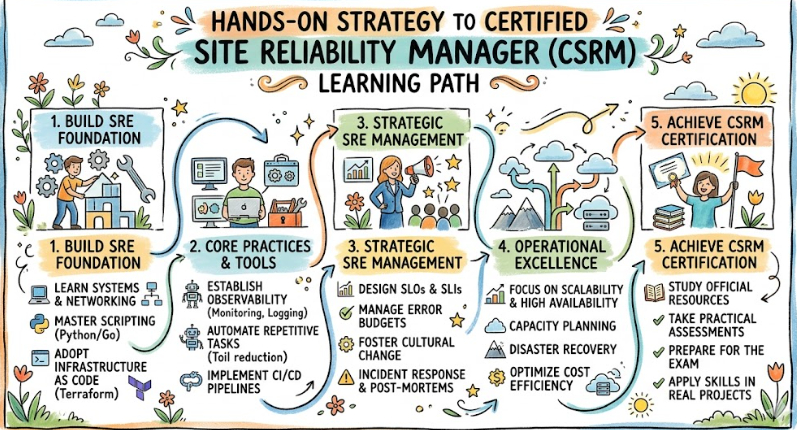
Introduction
Maintaining the balance between new features and system stability is a challenge that is faced by every modern tech organization. In this environment, the role of a Site Reliability Manager is seen as vital. Reliability is no longer just a technical requirement; it is treated as a core business value. This guide is prepared to help professionals understand the path to becoming a leader in this space through the Certified Site Reliability Manager program.
What is Certified Site Reliability Manager
The Certified Site Reliability Manager (CSRM) is a professional designation created for those who oversee the health and performance of large-scale systems. It is not just about fixing bugs or managing servers. Instead, focus is placed on leadership, strategic planning, and the implementation of SRE principles at a management level.
By this program, a deep understanding of Service Level Objectives (SLOs), error budgets, and incident response orchestration is provided. The gap between engineering teams and business stakeholders is bridged by the skills taught in this curriculum. It is recognized as a standard for those who wish to lead SRE teams effectively.
Why it matters today?
The cost of downtime is higher than ever before. When systems fail, revenue is lost, and brand reputation is damaged. Therefore, experts who can manage reliability are in high demand. Automation is prioritized over manual work in modern environments. A Certified Site Reliability Manager ensures that these automated systems are governed properly.
Decisions are driven by data rather than guesswork. With the rise of cloud-native technologies, complexity has increased. This complexity is managed by leaders who understand how to scale reliability across multiple teams. The CSRM framework is utilized to ensure that growth does not come at the expense of stability.
Why Certified Site Reliability Manager certifications are important
Trust is built through standardized certification. When a professional is certified, a specific level of knowledge is guaranteed to the employer. In the global job market, competitive advantages are gained by those who hold recognized credentials.
Career growth is accelerated because the certification covers both technical depth and leadership breadth. Complex problems are solved more efficiently when a structured framework is followed. Furthermore, a global community of practitioners is joined by those who complete this program. It is seen as a badge of expertise that validates years of hard work in the field.
Why choose SRESchool?
Excellence in reliability education is provided by SRESchool. A curriculum is designed by industry experts who have handled massive traffic and complex infrastructures. Practical knowledge is emphasized over theoretical concepts.
At SRESchool, learners are supported through a variety of resources, including real-world case studies and interactive sessions. The latest trends in the industry are reflected in the updated course materials. A focus is maintained on helping students achieve their career goals through high-quality training and recognized certifications.
Certification Deep-Dive: Certified Site Reliability Manager
What is this certification?
This is a leadership-focused program where the management of SRE teams and the implementation of reliability frameworks at scale are taught. Strategic decision-making and operational excellence are the primary focuses of this course.
Who should take this certification?
This certification is recommended for Engineering Managers, Senior SREs, DevOps Leads, and Platform Architects. It is also suitable for those who are transitioning from pure engineering roles into leadership positions.
Certification Overview Table
| Track | Level | Who it’s for | Prerequisites | Skills Covered | Recommended Order |
| DevOps | Advanced | DevOps Leads | Basic Linux & Cloud | CI/CD, Automation | 1 |
| DevSecOps | Expert | Security Leads | Security Fundamentals | Compliance, Security | 2 |
| SRE | Master | SRE Managers | System Administration | SLOs, Error Budgets | 1 |
| AIOps/MLOps | Specialist | Data Engineers | Machine Learning | AI for Operations | 3 |
| DataOps | Professional | Data Architects | Database Management | Data Pipelines | 2 |
| FinOps | Management | Finance & Tech Leads | Cloud Billing | Cost Optimization | 3 |
Skills you will gain
- Strategic management of reliability goals is mastered.
- Incident response frameworks are developed and implemented.
- Error budgets are calculated and managed to balance innovation.
- Team leadership and mentorship techniques are refined.
- Advanced automation strategies for large-scale systems are designed.
- Cross-team collaboration between Dev and Ops is facilitated.
- Post-mortem cultures are established to ensure continuous learning.
- Capacity planning and cost-efficiency are optimized.
Real-world projects you should be able to do after this certification
- A full SRE roadmap for a multi-cloud environment is designed.
- An automated incident management system is built.
- SLOs and SLIs for a high-traffic e-commerce platform are established.
- A blameless post-mortem process is implemented across an organization.
- Resource utilization is analyzed to reduce operational overhead.
Preparation plan
7–14 days plan
In this short period, the core exam objectives are reviewed. Focus is placed on understanding the terminology and the basic structure of the SRE framework. Practice questions are solved to identify weak areas.
30 days plan
The official study guide is read thoroughly. Each chapter is summarized in simple notes. Real-world scenarios are analyzed, and labs are completed. Time is spent daily on mastering the calculation of SLOs and error budgets.
60 days plan
A deep dive into advanced topics is conducted. Industry white papers are studied to understand different implementations of SRE. Multiple mock exams are taken to build confidence and speed. Mentorship from current managers is sought to understand the practical challenges of the role.
Common mistakes to avoid
- Practical application is often ignored in favor of theory.
- The cultural aspect of SRE is sometimes overlooked.
- Error budgets are misunderstood as rigid limits rather than tools for balance.
- Communication with non-technical stakeholders is often neglected.
- Automation is seen as a one-time task instead of a continuous process.
Best next certification after this
Same track
The Senior Site Reliability Leadership certification is recommended to further advance in management.
Cross-track
A certification in FinOps is suggested to understand the financial impact of reliability decisions.
Leadership / management
An Executive Leadership program for CTOs or VPs of Engineering is a logical next step.
Choose Your Learning Path
DevOps Path
This path is best for those who enjoy building pipelines and improving the developer experience. The journey starts with CI/CD mastery and ends with platform engineering.
DevSecOps Path
Security is integrated into every step of the lifecycle in this path. It is ideal for professionals who want to ensure that speed does not compromise safety.
Site Reliability Engineering (SRE) Path
The focus is placed on the stability and scalability of production systems. This path is perfect for those who like to solve complex infrastructure puzzles.
AIOps / MLOps Path
Data science is applied to operations in this track. It is suited for tech experts who want to use AI to predict and prevent system failures.
DataOps Path
The management of data flows and storage is the core of this path. It is designed for those who want to ensure data reliability across the organization.
FinOps Path
Cloud costs are balanced with performance in this track. It is best for leaders who are responsible for the financial health of technical projects.
Role → Recommended Certifications Mapping
| Role | Recommended Certification | Key Benefit |
| DevOps Engineer | Certified DevOps Expert | Advanced Automation Skills |
| Site Reliability Engineer | Certified Site Reliability Manager | Leadership and SLO Mastery |
| Platform Engineer | Certified Cloud Architect | Infrastructure as Code Expertise |
| Cloud Engineer | Certified Cloud Professional | Cloud Service Proficiency |
| Security Engineer | Certified DevSecOps Lead | Security Integration |
| Data Engineer | Certified DataOps Professional | Reliable Data Pipelines |
| FinOps Practitioner | Certified FinOps Manager | Cloud Cost Control |
| Engineering Manager | Certified SRE Manager | Team & Reliability Strategy |
Next Certifications to Take
Certified FinOps Manager (Same-track)
The financial side of cloud operations is explored in this course. It is essential for managers who need to justify infrastructure spending and optimize resources.
Certified AIOps Specialist (Cross-track)
Machine learning techniques are used to improve system monitoring. This certification is helpful for moving into the next generation of automated operations.
Executive Technical Leadership (Leadership-focused)
Skills for managing multiple departments are developed here. It prepares professionals for high-level roles like Director of Infrastructure or VP of Operations.
Training & Certification Support Institutions
DevOpsSchool
Complete training for various DevOps and SRE tracks is provided here. Practical labs and experienced mentors are made available to help students succeed in their certification exams.
Cotocus
A focus is placed on corporate training and specialized technical workshops. Solutions are tailored for teams that want to adopt modern engineering practices quickly.
ScmGalaxy
A vast library of resources and tutorials is maintained by this community. It is a great place for self-learners to find guidance and support for their technical journey.
BestDevOps
The latest tools and techniques in the automation space are covered by this institution. Quality education is delivered through structured courses and hands-on projects.
devsecopsschool.com
The intersection of security and operations is the specialty here. Professionals are trained to build secure software delivery chains using modern security tools.
sreschool.com
This institution is dedicated entirely to the field of Site Reliability Engineering. High-quality certifications and training programs are offered for all levels of expertise.
aiopsschool.com
The use of artificial intelligence in technical operations is taught at this school. Students are prepared for the future of automated system management.
dataopsschool.com
The principles of data management and operations are covered here. It is a key resource for engineers who work with large-scale data systems.
finopsschool.com
Education on cloud financial management is provided by this platform. It helps tech leads and finance teams work together to manage cloud costs effectively.
FAQs Section
- What is the difficulty level of the Certified Site Reliability Manager exam?
The exam is considered to be of a professional level. A deep understanding of management and technical concepts is required. - How much time is required to prepare?
Usually, 30 to 60 days are needed for thorough preparation depending on the candidate’s prior experience. - Are there any prerequisites for this certification?
A basic understanding of Linux, cloud computing, and DevOps principles is highly recommended. - In what sequence should these certifications be taken?
It is often recommended to start with DevOps and SRE fundamentals before moving to the Manager level. - What is the career value of this certification?
Significant salary growth and access to leadership roles are often reported by certified professionals. - Which job roles can be applied for after certification?
Roles such as SRE Manager, Engineering Manager, and Operations Lead are commonly sought. - Is the certification recognized globally?
Yes, it is respected by major tech companies across India and international markets. - Are retakes allowed if the exam is not passed?
Yes, retake policies are provided by the certification body, usually after a short waiting period. - How long is the certification valid?
Typically, the certification is valid for two to three years, after which renewal is required. - Is there a community for certified managers?
Yes, a global network of alumni is accessible for networking and knowledge sharing. - Are study materials provided by SRESchool?
Complete study guides and practice sets are included in the training program. - Does this certification help in moving to a remote role?
Many remote-friendly companies specifically look for certified leaders to manage their distributed systems.
Additional FAQs specifically focused on Certified Site Reliability Manager
- How is the Certified Site Reliability Manager different from a standard SRE role?
The focus of this role is placed on leadership and strategy rather than just performing technical tasks. - Can a project manager take this certification?
Yes, it is very beneficial for project managers who oversee technical infrastructure teams. - What is the passing score for the CSRM exam?
A score of 70% or higher is generally required to pass the examination. - Is hands-on coding required for the manager certification?
While deep coding is not the main focus, the ability to understand and review automation scripts is necessary. - How does this certification help in incident management?
Advanced frameworks for organizing teams during outages are taught in this program. - Are SLOs a big part of the exam?
Yes, the definition and management of SLOs are core topics in the curriculum. - Is cloud-specific knowledge required?
A general understanding of cloud platforms is needed, though the principles apply to any infrastructure. - What is the best way to maintain this certification?
Continuous learning and participation in industry events are recommended for recertification.
Testimonials
Amit
A clear path for career growth was found through this program. The concepts of error budgets are now used daily to lead my team more effectively. Confidence in making big technical decisions has truly improved.
Sneha
The way systems are viewed has completely changed. Real-world applications taught in the course allowed for immediate improvements in our production environment. It is a must-have for any aspiring leader.
Rohan
Strategic thinking was the biggest gain from this certification. The gap between business goals and technical reliability was finally bridged. It has been a game-changer for my professional journey.
Priya
The clarity provided on incident response was outstanding. A much more structured approach is now followed during system outages. The recognition from my peers after getting certified was very rewarding.
Vikram
Managing a large SRE team became much easier after learning these management frameworks. The focus on blameless culture has improved our team morale significantly. This course is highly recommended for all managers.
Conclusion
The Certified Site Reliability Manager certification is recognized as a powerful tool for any technical professional seeking to advance. The necessary skills are provided by this program to lead teams in a world that is increasingly dependent on stable and high-performing systems. Long-term career benefits, including higher salaries and better job opportunities, are secured by those who earn this credential. The ability to drive real change within an organization is developed when these expert principles are applied to daily operations. Strategic learning and the careful planning of certifications are encouraged for anyone who wants to stay ahead in the global tech industry. Success is achieved through a deep understanding of reliability, and a significant impact on business growth is made by certified managers. New opportunities are opened in various markets, and professional authority is established when this level of expertise is shown. A balance between stability and innovation is maintained, ensuring that long-term career goals are met with total confidence and professional growth is continued.