Introduction
The landscape of modern technology is being transformed by the rapid growth of data and the increasing complexity of infrastructure. In this environment, traditional methods of monitoring and managing IT systems are found to be insufficient. The manual handling of millions of alerts and metrics is no longer possible for human teams alone. Consequently, Artificial Intelligence for IT Operations, or AIOps, has emerged as a critical solution. By integrating machine learning and big data, intelligent systems are created to automate problem-solving and enhance system reliability. This guide is written to provide a comprehensive understanding of the AIOps Foundation Certification and its role in a successful technical career.
A shift toward proactive and predictive operations is being observed across the global market, including India. Organizations are seeking professionals who can implement AI-driven strategies to reduce downtime and improve efficiency. The knowledge of how to apply AI to operational data is considered a high-value skill. Through this certification, a solid foundation is built, allowing engineers and managers to stay ahead in a competitive industry. The future of IT operations is being shaped by these intelligent technologies, and being prepared for this change is essential for long-term growth.
What is AIOps Foundation Certification
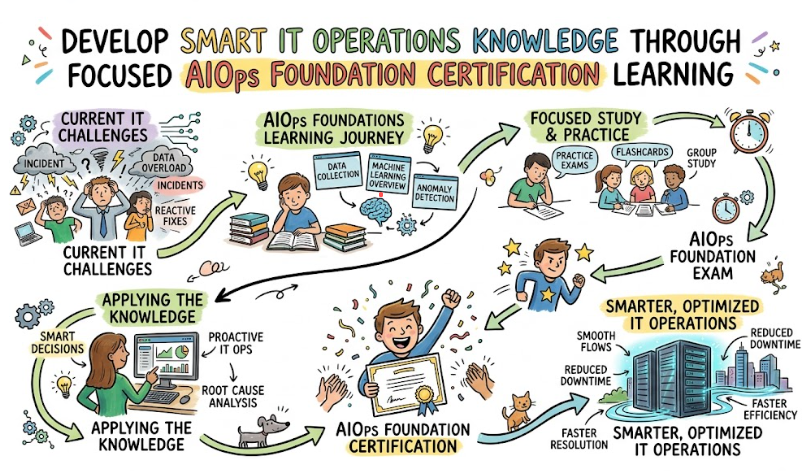
The AIOps Foundation Certification is an entry-level professional credential that is designed to introduce the core principles of AI-driven operations. It focuses on the fundamental concepts required to understand how machine learning models can be applied to IT data. A clear path is provided for learners to move from reactive troubleshooting to proactive system management. By obtaining this certification, a standardized understanding of AIOps terminology, lifecycles, and best practices is demonstrated.
Why it matters today?
In today’s digital world, the cost of system downtime is extremely high. When services are interrupted, business revenue and customer trust are negatively impacted. Traditional monitoring tools often create a situation known as “alert fatigue,” where critical issues are missed due to a high volume of minor notifications. AIOps is used to solve this problem by providing noise reduction and automated root cause analysis. Efficiency is increased when AI is used to identify patterns that are invisible to the human eye. As more businesses move to the cloud, the ability to manage these complex environments with intelligent automation is becoming a mandatory requirement for technical teams.
Why AIOps Foundation Certification certifications are important
Certifications are viewed as an important validation of a professional’s expertise. A structured way to learn complex topics is provided, ensuring that no critical gaps are left in the knowledge base. For employers, a certified professional is seen as a reliable asset who has met a specific industry standard. In a market where many claim to have AI skills, a formal certification serves as credible proof of proficiency. Furthermore, a shared language and framework are established within teams, which leads to better collaboration and faster project delivery.
Why choose AIOps School?
At AIOps School, a strong emphasis is placed on the practical application of AI in real-world scenarios. The training is delivered by experts who have deep experience in managing large-scale infrastructure. A wide range of resources is provided to ensure that students not only pass the exam but also gain the confidence to lead AI projects at their workplaces. Comprehensive support and a focus on hands-on learning are offered to help professionals master the complexities of AI-driven operations. By choosing this institution, a learner is given access to a community that is dedicated to the advancement of intelligent IT practices.
Certification Deep-Dive
What is this certification?
The AIOps Foundation Certification is an introductory program that covers the basics of using machine learning and data science in IT operations. The focus is placed on understanding the lifecycle of AIOps and how it integrates with existing DevOps practices.
Who should take this certification?
This program is highly recommended for software engineers, SREs, and DevOps professionals who wish to modernize their skills. It is also suitable for engineering managers who need to understand the strategic benefits of AI in their technical departments.
Certification Overview Table
| Track | Level | Who it’s for | Prerequisites | Skills Covered | Recommended Order |
| DevOps | Foundation | Software Engineers are included | Basic IT knowledge is required | Automation is covered | First step is recommended |
| DevSecOps | Foundation | Security Engineers are targeted | DevOps basics are required | Security AI is covered | Second step is recommended |
| SRE | Foundation | Operations Engineers are included | Systems knowledge is required | SLOs are covered | First step is recommended |
| AIOps/MLOps | Foundation | AI Specialists are targeted | Operations basics are required | Data patterns are covered | First step is recommended |
| DataOps | Foundation | Data Engineers are included | Data management is required | Data quality is covered | First step is recommended |
| FinOps | Foundation | Finance/Cloud Roles are included | Cloud basics are required | Cost AI is covered | First step is recommended |
Skills you will gain
- An understanding of data ingestion and processing for AI models is achieved.
- Knowledge of how to apply noise reduction to monitoring systems is acquired.
- The ability to identify patterns in complex system data is developed.
- Familiarity with automated incident response and remediation is gained.
- The skill to perform root cause analysis using AI tools is learned.
- An understanding of the five stages of the AIOps lifecycle is achieved.
Real-world projects you should be able to do after this certification
- An intelligent alert grouping system can be designed to reduce repetitive tickets.
- A monitoring dashboard for anomaly detection in cloud infrastructure can be built.
- An automated workflow for incident classification based on historical data can be created.
- A tool for filtering out non-actionable notifications in a production environment can be developed.
- A predictive analysis report for future infrastructure capacity needs can be generated.
Preparation plan
7–14 days plan: The first week is dedicated to learning the core terminology and definitions of AIOps. The official study materials and introductory videos are reviewed. In the second week, the focus is shifted to understanding the different types of machine learning models and how they are used in IT operations.
30 days plan: During the first two weeks, a deep dive into the AIOps lifecycle is taken. The middle part of the month is used for hands-on labs and exploring common AIOps tools. The final week is reserved for taking practice exams and reviewing the most difficult topics to ensure full preparation.
60 days plan: The first month is used to build a strong foundation in data science and monitoring principles. The second month is focused on practical implementation and building small AI-driven projects. This longer period allows for a much deeper mastery of the subject and better retention of knowledge.
Common mistakes to avoid
- The importance of data quality is often underestimated, which should be avoided.
- Focusing only on the theory without any practical practice is a common mistake.
- Skipping the basic principles of IT monitoring before learning AI is not recommended.
- Not spending enough time on practice questions can lead to difficulties during the exam.
- Trying to master advanced AI algorithms before understanding the foundation is avoided.
Best next certification after this
Same track: Certified AIOps Professional
Cross-track: SRE Foundation Certification
Leadership / management: Digital Transformation Officer Certification
Choose Your Learning Path
DevOps Path: This path is best for those who want to add intelligence to their CI/CD pipelines. AI is used to predict deployment risks and automate the feedback loop between developers and operations.
DevSecOps Path: This is chosen by professionals who focus on security. It involves using AI to identify security threats and vulnerabilities in real-time, providing a proactive layer of protection.
Site Reliability Engineering (SRE) Path: SREs use this path to reduce manual toil. The focus is placed on using intelligent automation to maintain system reliability and meet service level objectives.
AIOps / MLOps Path: This is the core path for those wanting to specialize in AI-driven operations. It covers the management of machine learning models in production environments.
DataOps Path: This path is designed for data engineers who want to ensure the quality and speed of data delivery. AI is used to monitor the health of data pipelines automatically.
FinOps Path: This is ideal for those managing cloud budgets. Predictive AI models are used to forecast cloud spending and suggest cost-saving measures.
Role → Recommended Certifications Mapping
| Role | Recommended Certifications | Primary Goal |
| DevOps Engineer | AIOps Foundation, Docker, Kubernetes | Intelligent automation is achieved |
| SRE | AIOps Foundation, SRE Practitioner | System reliability is improved |
| Platform Engineer | AIOps Foundation, Cloud Architect | Self-healing platforms are built |
| Cloud Engineer | AIOps Foundation, Cloud Security | Complex clouds are managed |
| Security Engineer | AIOps Foundation, DevSecOps Professional | Proactive threat hunting is enabled |
| Data Engineer | AIOps Foundation, Big Data Specialty | Data health is maintained |
| FinOps Practitioner | AIOps Foundation, FinOps Associate | Cloud spending is optimized |
| Engineering Manager | AIOps Foundation, Leadership in Tech | AI adoption is led |
Next Certifications to Take
One same-track certification: Certified AIOps Professional. This program is designed to provide advanced skills in implementing enterprise-grade AI solutions for IT operations.
One cross-track certification: SRE Foundation Certification. The principles of reliability and scalability are explored, which perfectly complement the automation skills learned in AIOps.
One leadership-focused certification: Digital Transformation Leader. This is aimed at professionals who need to lead their organizations through the cultural and technical changes of adopting AI.
Training & Certification Support Institutions
DevOpsSchool: Comprehensive training for DevOps and SRE roles is provided here. A strong emphasis is placed on hands-on projects and preparing students for the modern job market.
Cotocus: This institution is known for its specialized technical courses. Customized learning paths are offered to help professionals achieve their specific career milestones.
ScmGalaxy: A wide range of resources and community support for configuration management and DevOps is offered. It is a highly regarded institution for technical skill development.
BestDevOps: Focused training programs for modern engineering practices are delivered. The courses are designed to keep students updated with the latest trends in technology.
devsecopsschool.com: Training for integrating security into the DevOps workflow is provided. The focus is placed on building secure and resilient software from the beginning.
sreschool.com: The entire focus is placed on Site Reliability Engineering. The skills needed to manage complex systems at scale are taught through practical examples.
aiopsschool.com: Dedicated training for AIOps and AI-driven operations is delivered. The curriculum is designed to help professionals master the use of AI in IT environments.
dataopsschool.com: Education for data operations and data engineering is provided. The focus is on improving the quality and reliability of data pipelines.
finopsschool.com: Training on cloud financial management is offered. It helps professionals understand how to optimize and manage cloud costs using intelligent tools.
FAQs Section
1. Is the AIOps Foundation Certification difficult to pass?
The difficulty level is considered moderate as it focuses on foundational concepts and terminology.
2. How much time is needed for preparation?
A period of four to six weeks is usually sufficient for most candidates to feel fully prepared.
3. Are there any prerequisites for this exam?
No formal prerequisites are required, though basic knowledge of IT monitoring is recommended.
4. What is the recommended certification sequence?
The Foundation level is taken first, followed by Professional or specialized MLOps certifications.
5. What is the career value of this certification?
High career value is provided as companies are actively seeking professionals with AI-driven operations skills.
6. Which job roles benefit most from this certification?
DevOps Engineers, SREs, and Engineering Managers find this certification particularly useful for their growth.
7. Does this certification help in getting a salary hike?
Specialized skills in AIOps often lead to better negotiation power and access to higher-paying roles.
8. Is the exam conducted in an online format?
Yes, the exam can be taken online from any location at a convenient time for the candidate.
9. How long is the certification valid?
The certification is valid for a period of two years before renewal or higher-level testing is suggested.
10. Are practice tests included in the training programs?
Yes, mock exams and practice questions are provided by most training institutions to help students.
11. Is a background in coding necessary for the foundation level?
Extensive coding is not required, but an understanding of technical workflows is very helpful.
12. Is the training based on real-world IT scenarios?
Yes, the curriculum is designed to include practical examples from actual production environments.
AIOps Foundation Certification Specific FAQs
1. What are the key topics covered in this specific certification?
Topics such as alert correlation, noise reduction, and the AIOps lifecycle are covered in detail.
2. How does AIOps improve incident management?
Incident management is improved by using AI to identify the root cause of issues automatically.
3. Is data science knowledge required for the foundation level?
Only basic concepts of data science are introduced, so advanced knowledge is not necessary to start.
4. Does the certification cover multi-cloud AIOps strategies?
Yes, the principles taught can be applied to any cloud or on-premise infrastructure.
5. What is the concept of “Noise Reduction” in AIOps?
Noise reduction is the process of filtering out irrelevant alerts so that engineers can focus on real problems.
6. Can a beginner in IT take this certification?
While possible, it is much easier for someone who understands basic server and network monitoring.
7. Are hands-on labs part of the AIOps Foundation course?
Yes, hands-on labs are provided to show how AI models interact with real operational data.
8. Why is “Anomaly Detection” important for SREs?
It is important because it allows for the detection of unusual system behavior before it leads to a failure.
Testimonials
Anil
The way IT operations are viewed has been completely transformed. A clear path for implementing AI in the daily workflow was provided through this certification.
Sunita
Confidence in managing large-scale systems has grown. The ability to automate repetitive tasks has led to a significant reduction in manual toil at work.
Rohan
A much better understanding of how AI can be used for system reliability was achieved. The practical insights gained were immediately applicable to the company’s projects.
Kavita
The transition into a senior DevOps role was made smoother. The skills acquired have allowed for the management of more complex and intelligent infrastructure.
Manish
Strategic planning for the team’s future has become much easier. A solid foundation in AIOps has helped in making informed decisions about technology adoption.
Conclusion
The AIOps Foundation Certification is an essential step for any professional who wishes to stay relevant in the modern technical world. By mastering the basics of AI-driven operations, a person is prepared to handle the complexities of today’s systems. The long-term career benefits include access to specialized roles and the ability to lead high-impact automation projects. Strategic learning and careful certification planning are encouraged to ensure a successful and rewarding career in the field of AIOps and DevOps.