Introduction
Many people enter the stock market looking for a quick way to double their money. They read headlines about fast gains, buy trendy stocks, and hope for the best. Unfortunately, this approach usually ends in frustration and financial loss. The market is not a lottery; it is a platform for owning pieces of real businesses.
The gap between losing money and building lasting wealth rarely comes down to secret information. Instead, it comes down to habits. Just as physical health depends on daily exercise and proper nutrition, financial health relies on consistent, sensible money behaviors.
This article explores the core financial habits that separate successful, long-term investors from people who simply gamble with their savings.
What Is Stock Market Success?
In financial terms, stock market success means growing your purchasing power safely and consistently over a long period. It does not mean getting rich overnight.
Why Definitions Matter
Many beginners measure success by checking their portfolio every single day to see green numbers. Experienced investors measure success by whether their financial plan is on track, whether their asset allocation matches their goals, and whether they are sticking to their strategy during market storms.
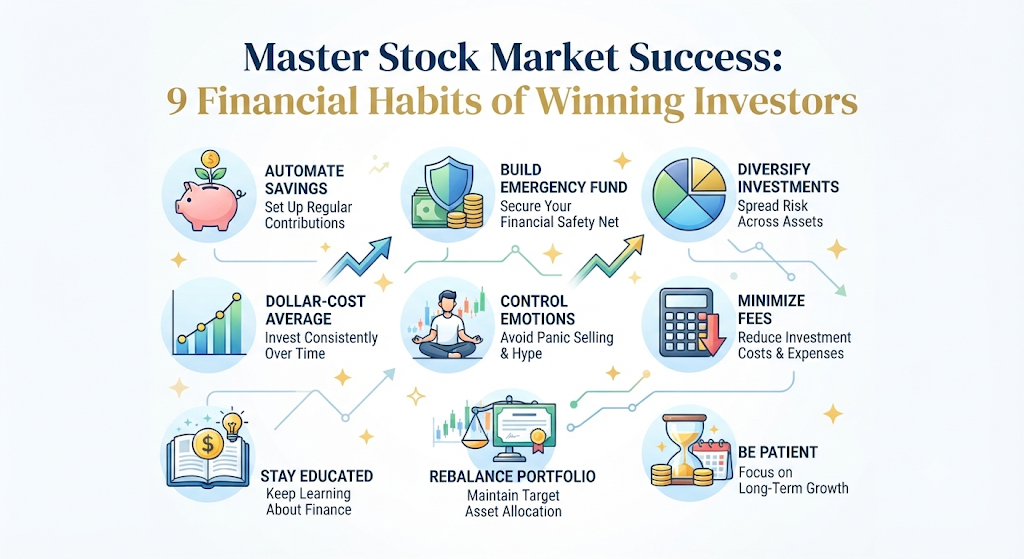
Habit 1: Pay Yourself First Through Automated Saving
The foundation of stock market success starts before you buy a single share. You must have capital to invest.
The Concept
“Paying yourself first” means setting aside a fixed portion of your income for savings and investments the moment you receive it, rather than investing whatever is left over at the end of the month.
Why It Matters
Human nature makes spending easy and saving difficult. If you rely on willpower to invest what remains after monthly expenses, you will often find that nothing remains. Automation removes emotion and temptation from the equation.
Practical Implementation
Set up an automatic transfer from your primary bank account to your brokerage account on the day you get paid. Treating your investment contribution like a non-negotiable monthly bill transforms saving from a chore into a habit.
Habit 2: Maintain a Separate Emergency Fund
Before putting money at risk in the stock market, successful investors secure a financial safety net.
What Is an Emergency Fund?
An emergency fund is a pool of cash—usually equal to three to six months of essential living expenses—stored in a safe, liquid account like a high-yield savings account.
Why It Matters
Life is unpredictable. Car repairs, medical bills, or sudden job loss can happen at any time. If you do not have cash reserves, a sudden emergency forces you to sell your stocks at the worst possible time—often right when the market is crashing. Having an emergency fund protects your investments so they can stay invested undisturbed.
Habit 3: Practice Strategic Asset Allocation and Diversification
Putting all your money into one stock is like putting all your savings on a single number at a roulette table. Winning investors spread their risk.
Understanding Diversification
Diversification means spreading your money across different companies, industries, and even asset classes (such as stocks, bonds, and cash).
The Role of Asset Allocation
Asset allocation is how you divide your portfolio among those different categories based on your age, risk tolerance, and goals.
- Why it matters: If one industry faces a downturn, strong performance in another sector can cushion the blow.
- Example: A portfolio holding only airline stocks will suffer heavily during global travel restrictions. A portfolio holding airlines, technology companies, healthcare providers, and consumer goods will absorb that shock much better.
Habit 4: Dollar-Cost Averaging (DCA) Over Market Timing
Trying to guess the exact bottom and top of the stock market is nearly impossible, even for professional traders. Successful investors do not try to time the market.
What Is Dollar-Cost Averaging?
Dollar-cost averaging is the practice of investing a fixed amount of money at regular intervals (such as weekly or monthly), regardless of whether the market is up or down.
How It Works in Practice
When prices are high, your fixed amount buys fewer shares. When prices drop during a market correction, that exact same amount buys more shares. Over time, this smooths out your average purchase cost and removes the stress of wondering if “today is the right day to buy.”
Habit 5: Maintain Emotional Discipline and Ignore the Noise
Financial markets are driven by human emotion: extreme optimism during bull markets and intense fear during bear markets.
The Danger of Emotional Investing
Panic selling during a market crash is one of the most destructive mistakes an investor can make. When stock prices fall, fear tells investors to sell everything to stop the bleeding. In reality, selling locks in temporary losses and misses the eventual market recovery.
How to Build Emotional Control
- Limit portfolio checking: Constantly looking at daily price swings creates unnecessary anxiety.
- Focus on the long term: Remind yourself that stock ownership represents multi-year or multi-decade goals.
- View market drops as sales: Just as shoppers love when clothes go on clearance, long-term investors should view market dips as an opportunity to buy quality assets at lower prices.
Habit 6: Keep Costs and Fees Low
Every dollar paid in management fees, unnecessary transaction charges, or high expense ratios is a dollar that cannot compound for your future.
Why Fees Destroy Wealth
Fees work against you quietly and steadily. Paying a 2% annual fee might sound small, but over thirty years, high fees can consume a massive chunk of your total investment returns due to the loss of compounding growth.
Practical Steps
- Choose low-cost index funds or exchange-traded funds (ETFs) when appropriate.
- Avoid excessive day-to-day trading, which racks up brokerage commissions and tax liabilities.
- Read the fee disclosures of any financial product before purchasing it.
Habit 7: Continuous Financial Education
The financial world changes constantly. Tax laws evolve, economic conditions shift, and new financial tools emerge.
What to Learn
Successful investors do not need to read complex academic papers every day, but they should understand:
- Basic economic indicators (inflation, interest rates, GDP growth).
- How to read a basic company balance sheet and income statement.
- The difference between speculation (gambling on short-term price movements) and investing (owning income-producing assets).
Why It Matters
Knowledge builds conviction. When you understand why you own a specific investment, you are far less likely to panic when its price fluctuates.
Habit 8: Regular Portfolio Rebalancing
Markets move constantly. Over time, some of your investments will grow faster than others, throwing your original asset allocation out of balance.
What Is Rebalancing?
Rebalancing is the process of realigning the weightings of your portfolio assets. For example, if your target was 70% stocks and 30% bonds, a strong stock market run might push your stock allocation to 85%. Rebalancing means selling a portion of your stocks to buy bonds, bringing your portfolio back to your intended risk level.
Why It Matters
Rebalancing forces you to follow a classic investing rule: sell high and buy low. It prevents your portfolio from becoming riskier than you originally intended.
Habit 9: Maintain Realistic Expectations and Patience
The media loves sensational stories of overnight stock market fortunes. In reality, sustainable wealth creation is slow, boring, and uneventful.
The Power of Compounding
Albert Einstein allegedly called compound interest the eighth wonder of the world. When your investments generate earnings, those earnings begin generating their own earnings.
However, compounding requires time. Expecting a 20% return every single year is unrealistic and usually leads to taking dangerous risks. A patient, steady approach over 10, 20, or 30 years yields far superior results than chasing speculative bubbles.
Common Mistakes to Avoid
Even with good habits, beginners often stumble into a few common traps:
- Chasing Hot Tips: Buying a stock simply because a friend, coworker, or internet influencer recommended it without doing your own research.
- Neglecting Taxes: Failing to understand capital gains taxes or missing out on tax-advantaged retirement accounts.
- Over-Concentration: Holding 90% of your portfolio in the stock of your employer or a single trending tech company.
- Trading on Margin: Borrowing money from your broker to buy stocks, which magnifies both gains and catastrophic losses.
Decision-Making Framework for Your Investments
Before making any investment move, run through this simple checklist:
- Is my emergency fund fully funded? (Do not invest cash you might need next month.)
- Does this investment fit my long-term strategy and risk tolerance?
- What are the total fees associated with this purchase?
- Am I buying this based on a solid business rationale or just emotional hype?
- Can I hold this investment comfortably through a 20% market drop?
Key Terms
- Asset Allocation: The process of dividing your investments among different asset classes like stocks, bonds, and cash.
- Compound Interest: Earning interest on both your initial principal and the accumulated interest from previous periods.
- Diversification: Spreading investments across various assets to reduce overall portfolio risk.
- Dollar-Cost Averaging: Investing a fixed sum of money at regular intervals regardless of market conditions.
- Expense Ratio: The annual fee that funds charge shareholders to manage their investments.
- Liquidity: How quickly and easily an asset can be converted into cash without losing significant value.
- Market Correction: A decline of 10% or more in the price of a security or market index from its recent peak.
- Rebalancing: Adjusting portfolio asset weights back to their original target percentages.
Frequently Asked Questions
How much money do I need to start investing in the stock market?
You can start with very small amounts today. Many modern brokerages allow fractional share purchases, meaning you can buy a piece of a company for just a few dollars. The habit of regular investing matters far more than the initial lump sum.
Is stock market investing the same as gambling?
No. Gambling relies entirely on chance, and the house always has a mathematical advantage. Investing in stocks means purchasing fractional ownership in real, revenue-generating businesses that produce goods and services people need. Over long periods, the broader market reflects the economic productivity of those businesses.
How often should I check my investment portfolio?
Checking your portfolio once a month or once a quarter is more than enough for most long-term investors. Checking daily often triggers emotional anxiety and leads to impulsive, costly trading decisions.
What is the biggest mistake new investors make?
The single biggest mistake is letting short-term emotions dictate long-term decisions—specifically, panic-selling during market downturns and buying out of FOMO (fear of missing out) during speculative bubbles.
Should I pay off debt before investing in the stock market?
Generally, high-interest consumer debt (such as credit card debt with 15–20% interest rates) should be paid off first, because guaranteed savings on interest payments beat uncertain stock market returns. Low-interest debt like a mortgage can often be managed alongside regular investing.
How do I know if my portfolio is too risky?
If a 15% market drop keeps you awake at night, causes panic, or makes you want to sell everything, your portfolio is likely too aggressive for your true risk tolerance. Adjust your asset allocation to include more stable assets like bonds or cash equivalents.
Conclusion
Succeeding in the stock market does not require an advanced degree in finance or a crystal ball. It requires discipline, patience, and the commitment to build healthy financial habits.
By automating your savings, diversifying your holdings, ignoring emotional market noise, and keeping your costs low, you put the power of long-term compounding to work for you. Treat investing as a steady marathon rather than a frantic sprint, and let time do the heavy lifting.