Introduction
Many people think investing is like gambling at a casino. They believe you need to watch stock charts all day, jump in and out of the market, and find the next big trend to make money. In reality, that approach usually leads to stress, high fees, and lost savings.
True financial security rarely comes from quick trades. Instead, it comes from a boring, reliable habit: long-term investing.
The main challenge for beginners is emotional discipline. When the stock market drops, it is easy to panic and sell everything. When the market rises rapidly, it is tempting to chase hype. This guide will show you how long-term investing actually works, why time is your greatest asset, and how you can build lasting wealth without losing your peace of mind.
What Is Long-Term Investing?
At its core, long-term investing is a strategy where you purchase financial assets with the goal of holding them for an extended period—often decades.
Understanding the Basics
- Professional Term → Simple Meaning: Asset Allocation means dividing your investment money among different types of investments, like stocks and bonds.
- Why It Matters: Spreading your money protects you. If one industry struggles, another might do well, lowering your overall risk.
- Example: Instead of putting all your savings into a single technology company, you divide your money across hundreds of different companies in different sectors.
Long-term investors do not care if a stock price drops this week or next month. They care about where the business or the economy will be in ten or twenty years.
How Long-Term Investing Works: The Magic of Compounding
The secret engine behind long-term investing is compound interest.
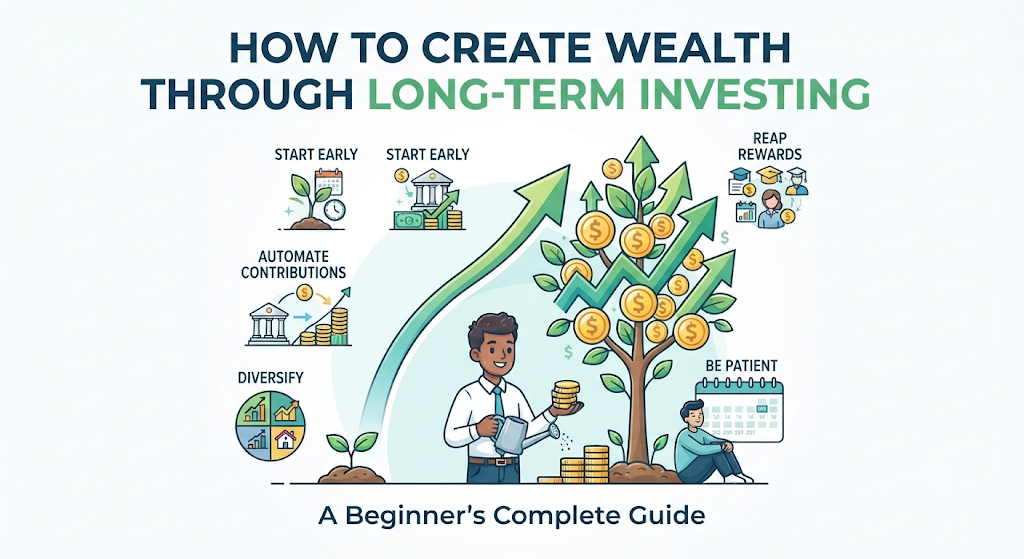
Compound interest is the process where the money you earn starts generating its own earnings. Over time, this creates a snowball effect.
A Simple Example
Imagine you invest $1,000 and earn an average return of 8% in the first year. You make $80. In the second year, you earn 8% not just on your original $1,000, but on $1,080. Your earnings generate more earnings.
Over five or ten years, this growth is slow. But over twenty, thirty, or forty years, the curve bends upward sharply. Time is far more important than the exact moment you start or the amount of money you begin with.
Why Long-Term Investing Matters
Short-term trading is unpredictable. Market prices fluctuate daily based on news, emotions, and rumors. However, over long periods, the global economy tends to grow, and strong businesses generate genuine profits.
| Short-Term Trading | Long-Term Investing |
|---|---|
| Focuses on days, weeks, or months | Focuses on years or decades |
| Relies heavily on market luck and timing | Relies on business growth and patience |
| Involves high trading fees and taxes | Minimizes transaction costs and taxes |
| High emotional stress | Low daily maintenance |
Long-term investing lets you ignore daily noise. You let time work for you instead of fighting against market volatility.
Important Factors to Understand Before You Start
Before putting your hard-earned money into any investment, you must understand a few fundamental rules of the financial world.
1. Risk and Return Go Hand in Hand
There is no safe investment that guarantees high returns. If someone promises you 20% a year with zero risk, it is almost certainly a scam. To earn higher returns over the long run, you must accept that your portfolio value will go up and down along the way.
2. Inflation Eats Cash
If you keep all your money in a traditional bank savings account, its purchasing power decreases every year due to inflation—the gradual increase in the prices of everyday goods and services. Long-term investing helps your money grow faster than inflation so you can afford things in the future.
3. Costs Matter
Fees eat into your returns. If a fund charges a high yearly management fee, it quietly steals thousands of dollars of your potential compound growth over decades. Choosing low-cost index funds is one of the easiest ways to keep more of your profits.
Practical Examples: Two Different Investors
To see how this works in real life, let us look at two fictional investors.
Investor A: The Market Timer
- Strategy: Tries to buy stocks right before they go up and sell before they drop.
- Result: Frequently gets stressed, pays high trading commissions, sells during market panics at a loss, and misses the best recovery days.
Investor B: The Long-Term Index Investor
- Strategy: Automatically invests a fixed amount of money every month into a broad-market index fund, regardless of what the news says.
- Result: Spends very little time managing the account, pays minimal fees, captures the long-term growth of the entire economy, and builds steady wealth over fifteen years.
Investor B almost always wins in the end.
Common Mistakes Beginners Should Make Sure to Avoid
Even with good intentions, beginners often fall into predictable traps.
1. Checking the Portfolio Every Day
- What people do: Open their investment app multiple times a day to check prices.
- Why it causes problems: Daily price swings trigger emotional reactions, making you want to panic-sell.
- What you should do instead: Set up automatic contributions and check your portfolio only once or twice a year.
2. Chasing Trendy Investments
- What people do: Buy an asset just because everyone on social media is talking about it.
- Why it causes problems: By the time a trend is popular, prices are usually inflated, and you are buying near the peak.
- What you should do instead: Stick to boring, diversified, proven long-term assets like broad index funds.
3. Stopping Investments During a Market Crash
- What people do: Stop investing or sell everything when the market drops.
- Why it causes problems: You lock in your losses and miss out on buying great assets at a discount.
- What you should do instead: View market drops as a clearance sale where your regular monthly contribution buys more shares for less money.
Risks and Limitations
Even long-term investing carries risks that you must acknowledge.
- Market Risk: Entire markets can drop significantly during economic recessions or global crises.
- Sequence of Returns Risk: If you retire and need to withdraw money right during a severe market crash, it can damage your long-term plan.
- Behavioral Risk: Your own panic is often a bigger threat to your wealth than the actual stock market.
To reduce these risks, keep an emergency fund of 3 to 6 months of living expenses in cash so you never have to sell your long-term investments during an emergency.
Simple Decision-Making Framework
If you are ready to start your long-term investing journey, follow this simple framework:
- Build a Safety Net: Save 3 to 6 months of living expenses in a secure bank account before investing.
- Define Your Timeline: Confirm that you will not need this investment money for at least 5 to 10 years.
- Choose Low-Cost Vehicles: Look for broad-market index funds or exchange-traded funds (ETFs) that track major indexes.
- Automate Your Deposits: Set up an automatic transfer from your paycheck into your investment account every month.
- Stay Consistent: Ignore market news, avoid checking prices daily, and let time compound your wealth.
Checklist for Long-Term Investors
Use this checklist to verify your setup before you begin:
- Do I have an emergency fund separate from my investments?
- Am I investing money I won’t need for at least 5–10 years?
- Have I chosen low-fee, diversified funds rather than single speculative stocks?
- Have I automated my monthly contributions?
- Have I prepared myself mentally to ignore short-term market crashes?
Key Terms
- Index Fund: A type of mutual fund or ETF designed to match the performance of a specific financial market index, like the S&P 500.
- Diversification: Spreading investments across different companies, industries, and asset classes to reduce risk.
- Volatility: The rate at which the price of an investment increases or decreases for a set of returns; a measure of market turbulence.
- Compound Interest: Earning interest on both your initial principal and the accumulated interest from previous periods.
- ETF (Exchange-Traded Fund): A collection of securities—such as stocks—that tracks an underlying index and trades on an exchange just like a regular stock.
- Bull Market: A market condition where stock prices are generally rising over a sustained period.
- Bear Market: A market condition where stock prices fall significantly, typically by 20% or more from recent highs.
- Liquidity: How quickly and easily an asset can be converted into cash without affecting its market price.
Frequently Asked Questions
How much money do I need to start long-term investing?
You do not need thousands of dollars. Many modern brokerages and mutual funds let you start with very small amounts, sometimes as little as $10 or $50. The most important habit is starting early and contributing regularly, even if the amounts are small.
Is long-term investing safe?
No investment is 100% safe. However, long-term investing in diversified, broad-market funds historically carries much lower risk than day trading or buying single speculative stocks. Over periods of 10 to 20 years, diversified markets have historically trended upward despite temporary crashes.
What is dollar-cost averaging?
Dollar-cost averaging is the practice of investing a fixed amount of money at regular intervals (such as every month), regardless of whether the market is up or down. This automatically buys you more shares when prices are low and fewer shares when prices are high, removing the stress of trying to time the market.
Should I pay off debt before I start investing?
Generally, yes. High-interest debt—like credit card debt—charges interest rates that are usually much higher than what you can reliably earn in the stock market. It is wiser to pay off high-interest debt first before building a long-term investment portfolio.
Can I lose all my money in long-term investing?
If you invest all your money into a single company that goes bankrupt, you can lose everything. However, if you invest in a broad index fund that holds hundreds of different companies across various industries, you will only lose all your money if the entire global economy collapses permanently.
How often should I check my investment portfolio?
Checking your portfolio once every few months or even once a year is more than enough. Checking it every day increases anxiety and tempts you to make emotional, impulsive decisions that harm your long-term returns.
What is the difference between a stock and a bond?
A stock represents a small ownership share in a single company. A bond is essentially a loan you give to a corporation or government in exchange for regular interest payments. Stocks generally offer higher growth with higher risk, while bonds offer lower growth with more stability.
Do I need to hire a financial advisor?
If your financial situation is straightforward—such as investing a monthly amount into broad index funds for retirement—you can easily manage it yourself. If you have complex tax situations, large inheritances, or complicated business assets, a fee-only professional advisor can be valuable.
Conclusion
Creating wealth through long-term investing does not require complex math, insider information, or constant stress. It requires patience, discipline, and a focus on time rather than timing. By automating your contributions, keeping your costs low, and staying calm when markets drop, you set yourself up for long-term financial security. Start small, stay consistent, and let time do the heavy lifting.