Introduction
Pricing Intelligence Tools help businesses monitor competitor prices, track market movements, analyze product-level pricing changes, and make better pricing decisions across online stores, marketplaces, retail channels, and regional markets. These tools are used by eCommerce brands, retailers, manufacturers, distributors, marketplaces, and revenue teams that need accurate pricing visibility before adjusting promotions, margins, and positioning.
Pricing has become a continuous decision rather than a fixed catalog update. Competitors change prices frequently, marketplaces update offers quickly, and customers compare products across multiple channels before buying. Pricing Intelligence Tools help teams understand where they are overpriced, underpriced, out of sync with competitors, or losing margin because of poor visibility.
Common real-world use cases include:
- Monitoring competitor prices across marketplaces and websites
- Tracking product availability and stock changes
- Supporting dynamic pricing and repricing workflows
- Identifying margin risks and pricing gaps
- Improving promotional planning and campaign timing
Buyers evaluating Pricing Intelligence Tools should consider:
- Competitor price monitoring accuracy
- Product matching quality
- Repricing and rule automation
- Marketplace and retailer coverage
- Reporting and analytics depth
- API and integration flexibility
- Scalability for large SKU catalogs
- Alerting and workflow automation
- Security and access controls
- Pricing model and total operating cost
Best for: eCommerce retailers, marketplaces, consumer brands, pricing teams, revenue managers, category managers, distributors, and enterprises managing competitive product catalogs across multiple channels.
Not ideal for: very small businesses with few products, companies operating in markets with limited price competition, or teams that only need basic manual price checking.
Key Trends in Pricing Intelligence Tools
- AI-powered price recommendations are helping teams move from manual monitoring to automated pricing decisions.
- Product matching accuracy is becoming more important as catalog names, bundles, pack sizes, and variants differ across competitors.
- Dynamic repricing workflows are expanding across marketplaces, retail media, and direct-to-consumer stores.
- Real-time alerts are helping pricing teams respond faster to competitor price drops, stock changes, and promotional events.
- Omnichannel price monitoring is becoming essential for brands selling across marketplaces, retailers, and owned stores.
- MAP and price compliance monitoring is growing for manufacturers and brands protecting channel consistency.
- API-first pricing platforms are supporting custom pricing engines, ERP workflows, and headless commerce systems.
- Margin-aware pricing is becoming more important as businesses balance competitiveness with profitability.
- Visual dashboards are increasingly used by category managers, revenue teams, and merchandising teams.
- Enterprise buyers are prioritizing governance features such as RBAC, audit logs, approvals, and centralized access controls.
How We Selected These Tools
The tools included in this list were selected based on market relevance, pricing workflow coverage, scalability, and practical usability across different business sizes.
Evaluation factors included:
- Competitive price monitoring capabilities
- Product matching and data quality workflows
- Repricing and dynamic pricing support
- Marketplace and retailer coverage
- Reporting and dashboard usability
- Integration ecosystem maturity
- Security and governance capabilities
- Scalability for large product catalogs
- Suitability for SMB, mid-market, and enterprise teams
- Overall pricing operations value
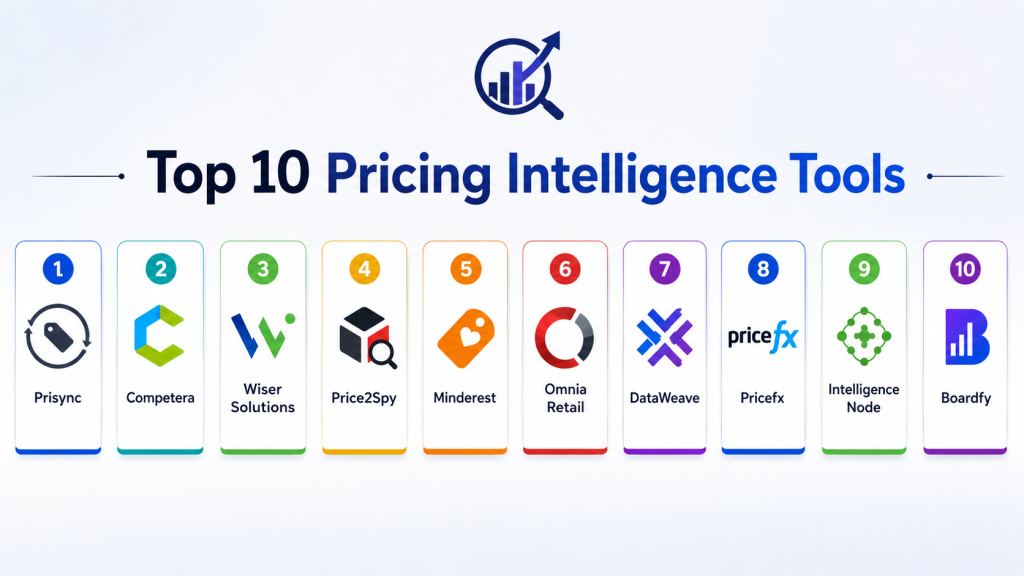
Top 10 Pricing Intelligence Tools
#1 — Prisync
Short description: Prisync is a competitive price monitoring and dynamic pricing platform built for eCommerce businesses and retailers. It helps teams track competitor prices, monitor stock availability, receive alerts, and automate pricing decisions using rule-based workflows. It is especially useful for SMB and mid-market online retailers that want fast visibility into competitor pricing.
Key Features
- Competitor price tracking
- Stock availability monitoring
- Dynamic pricing rules
- Price change alerts
- Historical pricing reports
- Product-level competitor matching
- Export and API options
Pros
- Easy to use for eCommerce teams
- Strong competitor monitoring features
- Good fit for growing online retailers
Cons
- Advanced enterprise customization may be limited
- Product matching quality depends on setup
- Large catalogs may require higher-tier plans
Platforms / Deployment
- Web
- Cloud
Security & Compliance
- GDPR support
- Role-based access features
- Additional certifications not publicly stated
Integrations & Ecosystem
Prisync integrates with common eCommerce and pricing workflows. It is mainly focused on online retailers that need fast competitor monitoring and repricing support.
- Shopify
- Magento
- WooCommerce
- Google Shopping workflows
- APIs
- CSV and spreadsheet workflows
Support & Community
Prisync provides practical onboarding resources, documentation, and customer support for retailers and eCommerce teams. Community visibility is strong among SMB pricing and marketplace sellers.
#2 — Price2Spy
Short description: Price2Spy is a price monitoring, repricing, and competitor tracking platform used by retailers, brands, and agencies. It helps teams monitor competitor prices, track changes, receive alerts, and compare product-level pricing across websites and marketplaces. It is known for flexible monitoring options and broad use cases.
Key Features
- Competitor price monitoring
- Availability and stock tracking
- Repricing automation
- Price change alerts
- Historical price charts
- Product matching workflows
- MAP monitoring support
Pros
- Flexible monitoring setup
- Good alerting and history tracking
- Useful for both retailers and brands
Cons
- Setup quality affects monitoring accuracy
- Interface can feel complex for beginners
- Advanced workflows may require configuration effort
Platforms / Deployment
- Web
- Cloud
Security & Compliance
- GDPR support
- Access control capabilities
- Additional certifications not publicly stated
Integrations & Ecosystem
Price2Spy supports multiple integration methods for pricing data import, export, and automation. It works well for teams that need competitor monitoring across many sources.
- Shopify
- Magento
- WooCommerce
- APIs
- FTP data workflows
- Spreadsheet imports and exports
Support & Community
Price2Spy offers documentation, onboarding support, and implementation assistance. It has strong visibility among competitive pricing and monitoring teams.
#3 — Competera
Short description: Competera is an AI-driven pricing platform designed for retailers that want automated price recommendations and advanced pricing decision support. It focuses on demand-based pricing, competitive intelligence, and machine learning-driven price optimization. It is best suited for mid-market and enterprise retailers with mature pricing operations.
Key Features
- AI-powered price recommendations
- Competitive price monitoring
- Demand-based pricing models
- Product elasticity analysis
- Rule-based pricing workflows
- Scenario simulation
- Advanced pricing analytics
Pros
- Strong AI pricing optimization
- Good fit for sophisticated retail teams
- Supports margin and demand-aware decisions
Cons
- Requires quality data inputs
- May be complex for smaller teams
- Implementation can take planning
Platforms / Deployment
- Web
- Cloud
Security & Compliance
- RBAC capabilities
- GDPR support
- Enterprise security controls
- Additional certifications not publicly stated
Integrations & Ecosystem
Competera is designed for integration with retail and commerce data systems. It works best when connected to structured product, sales, and competitor data.
- ERP systems
- eCommerce platforms
- Data warehouses
- Pricing engines
- APIs
- Business intelligence tools
Support & Community
Competera provides enterprise onboarding, pricing strategy support, and customer success guidance. Its community is strongest among advanced retail pricing teams.
#4 — Intelligence Node
Short description: Intelligence Node is a retail intelligence and pricing platform focused on competitive pricing, product matching, assortment analytics, and digital shelf visibility. It is designed for brands and retailers that need large-scale market visibility across products, categories, and competitors. It is suitable for enterprise and mid-market teams managing complex catalogs.
Key Features
- Competitive pricing intelligence
- Product matching and catalog comparison
- Assortment analytics
- Digital shelf monitoring
- Price benchmarking
- Marketplace tracking
- AI-driven retail analytics
Pros
- Strong retail intelligence capabilities
- Good for large catalog monitoring
- Useful for pricing and merchandising teams
Cons
- Enterprise setup may require support
- May be more than small sellers need
- Pricing workflows depend on data quality
Platforms / Deployment
- Web
- Cloud
Security & Compliance
- GDPR support
- Access control capabilities
- Additional certifications not publicly stated
Integrations & Ecosystem
Intelligence Node supports retail analytics workflows across digital commerce and marketplace environments. It is useful for category management and competitive benchmarking.
- Retail marketplaces
- eCommerce platforms
- Analytics systems
- APIs
- Data export workflows
- Business intelligence tools
Support & Community
Support is typically oriented toward business users, pricing teams, and retail analysts. Documentation and onboarding assistance are available for enterprise use cases.
#5 — Minderest
Short description: Minderest is a pricing intelligence and competitor monitoring platform built for retailers and brands. It supports competitor price tracking, recommended price monitoring, assortment comparison, and dynamic pricing use cases. It is useful for companies operating across multiple countries, currencies, and retail channels.
Key Features
- Competitor price monitoring
- Dynamic pricing support
- Recommended price tracking
- Product availability monitoring
- Assortment comparison
- International market monitoring
- Price analytics dashboards
Pros
- Strong international monitoring capabilities
- Useful for both retailers and brands
- Good category-level pricing visibility
Cons
- Advanced setup may require onboarding support
- Smaller businesses may not need full functionality
- Custom workflows can add complexity
Platforms / Deployment
- Web
- Cloud
Security & Compliance
- GDPR support
- Access control capabilities
- Additional certifications not publicly stated
Integrations & Ecosystem
Minderest supports pricing workflows across retail, brand, and marketplace environments. It is especially useful for teams operating across regions and multiple competitor sets.
- Retail websites
- Marketplaces
- ERP workflows
- APIs
- Business intelligence systems
- Data export workflows
Support & Community
Minderest offers expert-led onboarding and support resources for pricing and retail teams. Community visibility is stronger in retail and brand monitoring use cases.
#6 — Wiser Solutions
Short description: Wiser Solutions provides retail pricing intelligence, market analytics, and in-store data solutions for brands and retailers. It supports competitor price monitoring, digital shelf insights, product availability tracking, and retail execution analytics. It is suitable for organizations that need pricing visibility across online and offline retail contexts.
Key Features
- Competitive price monitoring
- Digital shelf analytics
- Retail execution insights
- Product availability tracking
- Automated price alerts
- Marketplace monitoring
- Reporting dashboards
Pros
- Strong retail data intelligence
- Useful for brands and retailers
- Supports broader market visibility beyond pricing
Cons
- May be complex for small teams
- Pricing intelligence is part of a broader retail data suite
- Advanced customization may require support
Platforms / Deployment
- Web
- Cloud
Security & Compliance
- GDPR support
- Role-based access capabilities
- Additional certifications not publicly stated
Integrations & Ecosystem
Wiser Solutions connects pricing intelligence with broader retail execution and analytics workflows. It is useful for teams that need more than basic competitor price tracking.
- Retailer monitoring workflows
- eCommerce platforms
- Marketplace data sources
- APIs
- Analytics dashboards
- Data exports
Support & Community
Wiser Solutions provides onboarding assistance and customer success support for retail and brand teams. Its ecosystem is strongest among organizations managing digital shelf and retail intelligence programs.
#7 — Omnia Retail
Short description: Omnia Retail is a dynamic pricing and pricing automation platform designed for retailers that need transparent pricing workflows. It helps teams automate pricing decisions while keeping control over business rules, margins, and competitive positioning. It is especially useful for retail pricing teams that want a balance between automation and explainability.
Key Features
- Dynamic pricing automation
- Competitor price monitoring
- Pricing rule management
- Margin-aware pricing
- Product segmentation
- Dashboard reporting
- Pricing workflow controls
Pros
- Strong transparent pricing automation
- Good fit for retail pricing teams
- Supports margin-focused decisions
Cons
- Requires pricing strategy maturity
- Not ideal for basic monitoring only
- Setup may require operational planning
Platforms / Deployment
- Web
- Cloud
Security & Compliance
- GDPR support
- Access control capabilities
- Additional certifications not publicly stated
Integrations & Ecosystem
Omnia Retail integrates with retail and commerce systems to automate pricing decisions and connect pricing logic with operational data.
- eCommerce platforms
- ERP systems
- Product data systems
- APIs
- Analytics tools
- Retail data workflows
Support & Community
Omnia Retail provides onboarding and pricing workflow guidance. It is most useful for retail teams that want structured pricing automation with human oversight.
#8 — Pricefx
Short description: Pricefx is an enterprise pricing platform focused on price optimization, price management, quoting, and commercial pricing operations. It is used by enterprises in retail, manufacturing, distribution, and B2B sectors. While broader than pricing intelligence, it is highly relevant for teams that need advanced pricing strategy and execution.
Key Features
- Price optimization
- Price management workflows
- Quoting and deal pricing
- Analytics dashboards
- Pricing governance
- Scenario modeling
- Enterprise integrations
Pros
- Strong enterprise pricing depth
- Suitable for complex B2B and retail pricing
- Broad pricing lifecycle coverage
Cons
- More complex than pure monitoring tools
- Requires structured pricing data
- Implementation may involve enterprise planning
Platforms / Deployment
- Web
- Cloud
Security & Compliance
- SSO/SAML support
- RBAC controls
- Audit logging
- GDPR support
- Additional certifications not publicly stated
Integrations & Ecosystem
Pricefx integrates with enterprise systems and pricing workflows. It is best suited for organizations that need structured price governance and optimization across departments.
- ERP systems
- CRM systems
- CPQ systems
- Data warehouses
- APIs
- Business intelligence tools
Support & Community
Pricefx provides enterprise onboarding, implementation support, and pricing operations guidance. It has strong relevance for mature pricing organizations.
#9 — Skuuudle
Short description: Skuuudle is a competitive price intelligence platform focused on helping retailers and brands monitor competitor prices and market positioning. It supports product matching, pricing analytics, and market visibility for teams that need reliable competitive benchmarking. It is useful for category managers and pricing analysts.
Key Features
- Competitor price tracking
- Product matching workflows
- Market position analysis
- Price benchmarking
- Availability monitoring
- Reporting dashboards
- Data quality review support
Pros
- Strong retail benchmarking features
- Useful for category and pricing teams
- Good market visibility capabilities
Cons
- Smaller ecosystem compared with larger platforms
- Advanced automation may be limited
- Setup quality affects insight accuracy
Platforms / Deployment
- Web
- Cloud
Security & Compliance
- GDPR support
- Access control capabilities
- Additional certifications not publicly stated
Integrations & Ecosystem
Skuuudle supports retail pricing intelligence workflows through monitoring, reporting, and data export capabilities.
- Retail websites
- Marketplaces
- APIs
- Data export workflows
- Business intelligence systems
- Product catalog workflows
Support & Community
Skuuudle provides onboarding support and pricing intelligence guidance. It is strongest for teams focused on competitor benchmarking and retail category monitoring.
#10 — DataWeave
Short description: DataWeave is a digital commerce analytics and pricing intelligence platform used by brands and retailers for competitive intelligence, digital shelf analytics, assortment tracking, and pricing insights. It is well suited for organizations that need broad market visibility and large-scale data intelligence.
Key Features
- Competitive pricing intelligence
- Digital shelf analytics
- Assortment monitoring
- Product matching
- Brand visibility tracking
- Marketplace intelligence
- Analytics dashboards
Pros
- Strong digital commerce analytics
- Good for brands and enterprise retailers
- Useful for pricing and assortment decisions
Cons
- More advanced than basic price monitoring tools
- May require onboarding and data alignment
- Pricing intelligence is part of a broader analytics suite
Platforms / Deployment
- Web
- Cloud
Security & Compliance
- GDPR support
- Enterprise access controls
- Additional certifications not publicly stated
Integrations & Ecosystem
DataWeave supports large-scale digital commerce analytics and market intelligence workflows. It is valuable for organizations that need pricing visibility connected with digital shelf and assortment intelligence.
- Retail websites
- Marketplaces
- eCommerce analytics systems
- APIs
- Data export workflows
- Business intelligence tools
Support & Community
DataWeave provides enterprise-oriented onboarding and customer success support. It is best suited for teams with structured pricing, category, and analytics workflows.
Comparison Table
| Tool Name | Best For | Platform(s) Supported | Deployment | Standout Feature | Public Rating |
|---|---|---|---|---|---|
| Prisync | SMB eCommerce retailers | Web | Cloud | Easy competitor price monitoring | N/A |
| Price2Spy | Flexible price tracking | Web | Cloud | Price and availability alerts | N/A |
| Competera | AI pricing optimization | Web | Cloud | Demand-aware price recommendations | N/A |
| Intelligence Node | Retail intelligence teams | Web | Cloud | Large-scale product matching | N/A |
| Minderest | International retailers and brands | Web | Cloud | Multi-country price monitoring | N/A |
| Wiser Solutions | Retail and brand analytics | Web | Cloud | Digital shelf and pricing visibility | N/A |
| Omnia Retail | Dynamic pricing teams | Web | Cloud | Transparent pricing automation | N/A |
| Pricefx | Enterprise pricing operations | Web | Cloud | Full pricing lifecycle management | N/A |
| Skuuudle | Competitive benchmarking | Web | Cloud | Retail price benchmarking | N/A |
| DataWeave | Enterprise digital commerce analytics | Web | Cloud | Pricing plus digital shelf intelligence | N/A |
Evaluation & Scoring of Pricing Intelligence Tools
| Tool Name | Core 25% | Ease 15% | Integrations 15% | Security 10% | Performance 10% | Support 10% | Value 15% | Weighted Total |
|---|---|---|---|---|---|---|---|---|
| Prisync | 8.5 | 9.0 | 8.1 | 7.6 | 8.4 | 8.3 | 8.8 | 8.4 |
| Price2Spy | 8.6 | 8.3 | 8.2 | 7.7 | 8.5 | 8.2 | 8.5 | 8.4 |
| Competera | 9.3 | 7.5 | 8.8 | 8.4 | 9.0 | 8.5 | 7.7 | 8.6 |
| Intelligence Node | 9.0 | 7.8 | 8.7 | 8.1 | 8.8 | 8.3 | 7.8 | 8.5 |
| Minderest | 8.8 | 8.0 | 8.5 | 8.0 | 8.7 | 8.2 | 8.0 | 8.4 |
| Wiser Solutions | 8.7 | 7.9 | 8.6 | 8.1 | 8.7 | 8.4 | 7.8 | 8.4 |
| Omnia Retail | 8.9 | 8.1 | 8.5 | 8.0 | 8.8 | 8.2 | 8.0 | 8.5 |
| Pricefx | 9.4 | 7.2 | 9.1 | 8.9 | 9.0 | 8.8 | 7.3 | 8.6 |
| Skuuudle | 8.3 | 8.0 | 8.0 | 7.7 | 8.2 | 8.1 | 8.1 | 8.1 |
| DataWeave | 8.9 | 7.6 | 8.7 | 8.3 | 8.8 | 8.4 | 7.6 | 8.4 |
These scores are comparative rather than absolute. Enterprise pricing platforms tend to score higher in optimization depth, governance, and integrations, while SMB-focused tools often score better in usability and value. A higher score does not always mean a better fit for every business. Teams should prioritize the criteria most closely aligned with catalog size, pricing maturity, competitor density, and integration requirements.
Which Pricing Intelligence Tools Tool Is Right for You?
Solo / Freelancer
Solo sellers and small online merchants usually need simple competitor tracking, fast setup, and clear alerts. Prisync and Price2Spy are good options because they provide straightforward price monitoring without requiring complex pricing operations. These tools work well when the goal is to understand competitor movement and make practical pricing updates quickly.
SMB
SMBs need better automation, competitor visibility, and price change alerts across multiple channels. Prisync, Price2Spy, and Minderest are practical options for growing retailers that want to track competitors, monitor stock availability, and respond faster to market changes. These platforms provide a balance of usability and pricing intelligence depth.
Mid-Market
Mid-market businesses usually need stronger analytics, larger catalog support, and better pricing workflow control. Competera, Intelligence Node, Omnia Retail, and Wiser Solutions are strong choices for teams that need more structured pricing intelligence, product matching, and market visibility. These tools are useful when pricing decisions involve category managers, revenue teams, and merchandising teams.
Enterprise
Enterprises should prioritize platforms with advanced governance, scalability, integrations, and pricing optimization capabilities. Pricefx, Competera, DataWeave, Intelligence Node, and Wiser Solutions are better suited for complex environments with multiple markets, large SKU catalogs, and mature pricing teams. These platforms support broader pricing strategy beyond basic competitor tracking.
Budget vs Premium
Budget-focused businesses should start with tools like Prisync or Price2Spy because they offer strong core monitoring without heavy implementation demands. Premium buyers should consider Pricefx, Competera, DataWeave, or Intelligence Node when they need AI recommendations, enterprise integrations, advanced analytics, and governance features.
Feature Depth vs Ease of Use
Prisync and Price2Spy are easier for teams that want quick competitor tracking and alerts. Pricefx, Competera, and DataWeave offer deeper pricing intelligence and optimization capabilities but usually require stronger data readiness and operational planning.
Integrations & Scalability
Businesses with ERP, CRM, PIM, marketplace, and data warehouse requirements should prioritize Pricefx, Competera, Omnia Retail, or DataWeave. These platforms are better suited for complex integration environments and scalable pricing workflows.
Security & Compliance Needs
Organizations with stricter governance needs should look for SSO, RBAC, audit logs, approval workflows, and centralized administrative controls. Enterprise-focused platforms are generally stronger in security governance than lightweight monitoring tools.
Frequently Asked Questions
1. What is a Pricing Intelligence Tool?
A Pricing Intelligence Tool helps businesses monitor competitor prices, track product availability, analyze market trends, and make better pricing decisions. It provides visibility into how products are priced across competitors, marketplaces, regions, and channels.
2. Why are Pricing Intelligence Tools important?
Pricing changes quickly across digital channels, and manual monitoring is slow and unreliable. These tools help teams react faster to competitor movements, protect margins, improve promotions, and stay competitive in crowded markets.
3. Do Pricing Intelligence Tools support dynamic pricing?
Many Pricing Intelligence Tools support dynamic pricing or integrate with pricing engines. Some platforms provide rule-based repricing, while advanced tools use AI, elasticity models, and demand signals to recommend pricing changes.
4. How do these tools track competitor prices?
Most tools collect pricing data from websites, marketplaces, product feeds, retailer pages, and structured integrations. They then match products, monitor price changes, and present insights through dashboards, alerts, reports, or APIs.
5. What is product matching in pricing intelligence?
Product matching means identifying the same or equivalent product across different competitors, marketplaces, or retailers. Accurate matching is critical because wrong matches can lead to poor pricing decisions and misleading reports.
6. Are Pricing Intelligence Tools useful for brands?
Yes, brands use these tools to monitor retailer pricing, detect pricing inconsistencies, track MAP compliance, understand assortment gaps, and compare market positioning. They are especially useful for brands selling through multiple partners.
7. How difficult is implementation?
Implementation depends on catalog size, number of competitors, data quality, and integration needs. SMB tools can be deployed quickly, while enterprise pricing platforms may require structured onboarding, data mapping, and integration planning.
8. Can these tools help protect profit margins?
Yes, pricing intelligence can help teams avoid unnecessary discounting, detect margin pressure, and understand when competitors are changing prices. Advanced tools can also support margin-aware pricing rules and profitability analysis.
9. What are common mistakes when choosing a platform?
Common mistakes include focusing only on price, ignoring product matching quality, underestimating integration needs, choosing a tool without scalability, and failing to define clear pricing workflows before implementation.
10. What are alternatives to Pricing Intelligence Tools?
Alternatives include manual competitor checks, spreadsheet-based monitoring, marketplace-native repricing tools, ERP pricing modules, and custom web data pipelines. These alternatives may work for simple needs but often become difficult to scale.
Conclusion
Pricing Intelligence Tools help businesses turn market pricing data into faster, smarter, and more profitable decisions. The right platform depends on catalog size, competitor density, sales channels, pricing maturity, integration needs, and team capability. Small retailers may prefer easy-to-use tools like Prisync or Price2Spy, while mid-market teams may benefit from Minderest, Omnia Retail, Intelligence Node, or Wiser Solutions for broader pricing visibility. Enterprises with complex pricing strategies should evaluate Competera, Pricefx, or DataWeave for advanced analytics, governance, and optimization workflows. The best next step is to shortlist two or three tools, test product matching accuracy, validate integrations, review security needs, and run a pilot using real pricing scenarios before making a long-term decision.