Introduction
Starting your investment journey can feel overwhelming. Financial news talks constantly about crashing markets, skyrocketing stocks, and complex trading strategies. For a beginner, trying to choose which individual company to invest in feels like throwing a dart blindfolded.
Many new investors make the mistake of buying high-risk stocks hoping for quick riches, only to lose money and quit. Others keep all their savings in a traditional bank savings account where inflation slowly eats away at their purchasing power.
There is a calmer, smarter middle ground: index funds. This guide explains what index funds are, why they matter, how they work, and how they help new investors build a secure financial future without needing a degree in finance.
What Are Index Funds?
To understand an index fund, you first need to understand what a market “index” is.
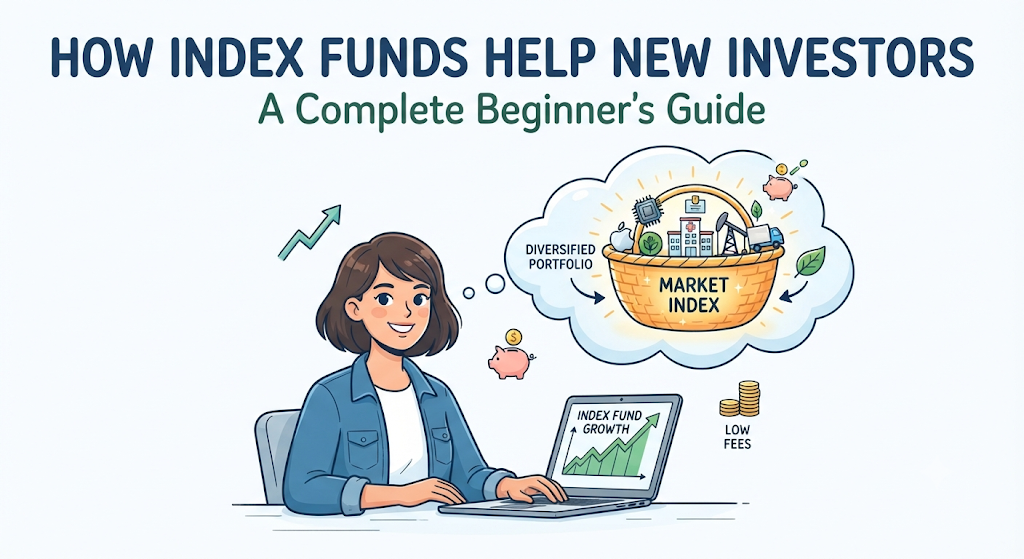
An index is simply a basket of stocks grouped together to track the health of a specific market. For example, the S&P 500 index tracks 500 of the largest publicly traded companies in the United States, including giants like Apple, Microsoft, and Amazon.
- Professional term: Market Index
- Simple meaning: A curated list of companies used to measure how a specific stock market is performing.
- Why it matters: It gives investors a benchmark to see if the market is going up or down as a whole, rather than looking at single stocks.
- Example: If you want to know how the US stock market is doing today, you check the S&P 500.
An index fund is an investment fund that copies that index. If you buy a fund that tracks the S&P 500, your money is automatically invested in all 500 companies within that index simultaneously.
How Index Funds Work
Traditional mutual funds are managed by professional stock pickers. These managers research companies, buy and sell stocks daily, and try to beat the stock market. Because they do a lot of work, they charge high management fees.
Index funds take a different approach. They are passively managed.
- Professional term: Passive Management
- Simple meaning: An investment strategy where a fund simply copies an existing market index without trying to beat it.
- Why it matters: Because humans are not spending hours researching and trading stocks every day, the operational costs drop dramatically.
- Example: A computer program automatically buys shares of the 500 companies in the S&P 500 in exact proportion to their market size. If a company leaves the index, the fund sells it and buys the new one.
Why Index Funds Matter for New Investors
New investors face three major hurdles: lack of time, lack of capital, and lack of knowledge. Index funds solve all three problems at once.
1. Instant Diversification
Buying shares in 500 different top-tier companies individually would require thousands of dollars and hours of work. An index fund bundles them together. If one company in the fund struggles or goes bankrupt, your portfolio barely notices because the other 499 companies cushion the blow.
- Professional term: Diversification
- Simple meaning: Spreading your money across many different investments to lower your risk.
- Why it matters: It protects you from losing everything if a single company performs poorly.
- Example: Putting all your savings into one restaurant stock is risky if that restaurant closes. Putting small amounts of money into 500 different businesses through an index fund protects you if a few restaurants fail.
2. Extremely Low Costs
When investing, fees destroy returns over time. Actively managed funds often charge high expense ratios (fees taken from your investment annually). Index funds have very low expense ratios—often under 0.10%—because they require minimal human management. Lower fees mean more of your hard-earned money stays invested and compounding.
3. Removal of Emotional Decision-Making
New investors often panic when markets drop, selling at a loss, or chase hype bubbles, buying at the peak. Index funds encourage a “buy and hold” mindset. You are investing in the entire market’s long-term growth rather than trying to time daily market swings.
Detailed Explanation: The Power of Compounding
When you invest in a broad market index fund, you benefit from economic growth over decades. Historically, major stock indexes have trended upward over long periods, despite short-term crashes and recessions.
As your investments grow, they generate earnings. Those earnings then generate their own earnings—a process known as compound growth.
- Professional term: Compound Interest / Compounding
- Simple meaning: Earning returns on top of your previous returns, like a snowball rolling down a hill and getting bigger.
- Why it matters: Time is your greatest asset as a young or new investor. Starting early lets compounding do the heavy lifting.
- Example: Investing $200 every month into an index fund with an average historical return of 8% turns into a substantial nest egg over 25 to 30 years simply due to reinvested gains.
Practical Examples: Two Investors
Investor A: The Stock Picker
Rohan tries to find the next big tech startup. He spends hours reading forums, buying individual stocks, and selling whenever news breaks. He pays high trading commissions, loses sleep over daily price drops, and ultimately underperforms the overall market because of emotional trades and high fees.
Investor B: The Index Fund Investor
Priya sets up an automatic monthly transfer into a low-cost S&P 500 index fund. She closes her investment app and focuses on her career. Over ten years, she spends zero time stressing over daily stock movements, pays nearly zero in fees, and captures the steady upward march of the broader economy.
Real-World Considerations
While index funds are powerful, new investors must understand operational realities before jumping in.
- Market Volatility: Index funds do not protect you from market crashes. If the entire economy drops 20%, your index fund will also drop 20%. You must be mentally prepared to hold through market downturns without panicking.
- Account Types: Where you hold your index fund matters. Utilizing tax-advantaged accounts (such as a 401(k), IRA, or local equivalents depending on your country) shields your investment gains from immediate taxes.
- Dividends: Many companies inside index funds pay out a portion of their profits to shareholders (dividends). Most brokerage platforms let you automatically reinvest these dividends to buy more shares of the fund.
Common Mistakes Beginners Should Avoid
- Mistake: Trying to time the market by waiting for the “perfect low price.”
- Why people do it: Fear of buying right before a market drop.
- Why it causes problems: Studies show that “time in the market beats timing the market.” Waiting on the sidelines often means missing the best recovery days.
- What you should do instead: Use dollar-cost averaging—investing a fixed amount of money on a regular schedule (like every month) regardless of whether the market is up or down.
- Mistake: Checking your account balance every single day.
- Why people do it: Excitement or anxiety about seeing money fluctuate.
- Why it causes problems: Daily price swings trigger emotional impulses to buy or sell unnecessarily.
- What you should do instead: Treat your long-term index fund like a planted tree; let it grow quietly in the background without digging it up every week to check the roots.
- Mistake: Chasing past performance of niche thematic indexes.
- Why people do it: Buying a trendy sector index fund just because it had a great year last year.
- Why it causes problems: Chasing trends often leads to buying at the top when prices are inflated.
- What you should do instead: Stick to broad-market index funds that cover hundreds or thousands of companies across diverse sectors.
Risks and Limitations
- Systemic Market Risk: If the entire global or national economy enters a severe depression, broad index funds will lose value alongside it.
- Lack of Outperformance: Because index funds aim to match the market average, you will never experience the lottery-like overnight gains of a single rogue stock that skyrockets 500% in a month. You trade massive risk for steady, reliable average growth.
- Tracking Error: While rare with large reputable funds, a slight difference can sometimes exist between the fund’s performance and the actual index performance due to management costs and cash drag.
Comparison: Active Mutual Funds vs. Index Funds
| Feature | Active Mutual Funds | Index Funds |
|---|---|---|
| Management | Managed by professional stock pickers | Automated / Passive matching |
| Fees (Expense Ratio) | High (often 0.5% to 2.0%+ annually) | Very low (often 0.03% to 0.10%) |
| Goal | To beat the market average | To match the market average |
| Long-Term Success | Most fail to beat the index over 10+ years | Consistently outperforms most active funds over time |
| Best For | High-risk speculators or niche investors | New and long-term wealth builders |
Decision-Making Framework for New Investors
- Check Your Emergency Fund: Ensure you have 3 to 6 months of living expenses saved in a safe, accessible bank account before putting money into the stock market.
- Determine Your Timeline: Money needed in the next 1 to 3 years (like for a house down payment) should not go into stock index funds. Index investing is designed for timelines of 5 to 10+ years.
- Choose a Reputable Brokerage: Open an account with a trusted, low-cost investment platform or brokerage.
- Select a Broad Index Fund: Look for funds that track major broad indexes (like the S&P 500 or Total Stock Market Index) with low expense ratios.
- Automate Your Contributions: Set up automatic investments so your wealth grows consistently without requiring willpower each month.
Key Terms
- Asset Allocation: How you divide your investments among different categories like stocks, bonds, and cash.
- Bear Market: A market condition where stock prices fall significantly (usually 20% or more from recent highs).
- Bull Market: A market condition where stock prices are rising or expected to rise.
- Compound Interest: Earning returns on both your initial principal and the accumulated interest/gains from previous periods.
- Expense Ratio: The annual fee that a fund charges its shareholders to manage the investment.
- Liquidity: How quickly and easily an asset can be converted into cash without affecting its market price.
- Mutual Fund: A pool of money collected from many investors to purchase a basket of securities.
- Portfolio: A collection of financial investments like stocks, bonds, and cash held by an investor.
- Stock: A share representing fractional ownership in a corporation.
- Volatility: The degree of variation in trading prices over time; how wildly a price bounces up and down.
FAQs
1. Do I need thousands of dollars to start investing in index funds?
No. Many modern brokerage platforms allow you to buy “fractional shares,” meaning you can start investing in index funds with as little as $5 or $10.
2. Can I lose all my money in an index fund?
You would only lose all your money if every single major corporation in the index (such as all 500 companies in the S&P 500, including Microsoft, Apple, healthcare firms, and banks) simultaneously went completely bankrupt. While market drops happen, total systemic collapse of every major company at once is extremely unlikely.
3. How often should I check my index fund portfolio?
Ideally, very rarely. Checking it once every few months or once a year is plenty. Index investing is a long-term strategy designed to ignore daily market noise.
4. Are index funds good for retirement planning?
Yes. Because of their low costs, broad diversification, and strong long-term historical performance, broad-market index funds are the core holdings of most retirement portfolios worldwide.
5. What is the difference between a mutual fund index fund and an ETF index fund?
Both can track the exact same index. Mutual funds trade once per day after the market closes, whereas Exchange-Traded Funds (ETFs) trade throughout the day like individual stocks. Both work exceptionally well for long-term investors.
6. Do index funds pay dividends?
Yes. If the companies held within the index fund pay dividends to their shareholders, those dividends flow through to you as an index fund investor, where you can cash them out or automatically reinvest them.
7. What happens if the brokerage firm holding my index fund goes out of business?
Your shares represent actual legal ownership in the underlying companies. If a brokerage fails, your assets are protected and transferred to another financial institution under strict regulatory oversight.
8. Can index funds beat professional stock pickers?
Statistically, yes. Over 10- and 20-year periods, the vast majority of actively managed mutual funds fail to beat simple low-cost broad market index funds after accounting for high management fees.
Conclusion
Building wealth does not require complex trading strategies, insider knowledge, or watching financial charts all day. For new investors, index funds provide a streamlined, low-cost, and powerful path forward.
By capturing the collective growth of hundreds of top businesses at once, you eliminate the stress of picking individual winners. Start small, keep your fees low, focus on the long term, and let time and compounding do the work for you.