Published: November 2026
Category: GST Updates | Business Compliance | Taxation
Applicable Country: India
Introduction: What Are Next-Gen GST Process Reforms?
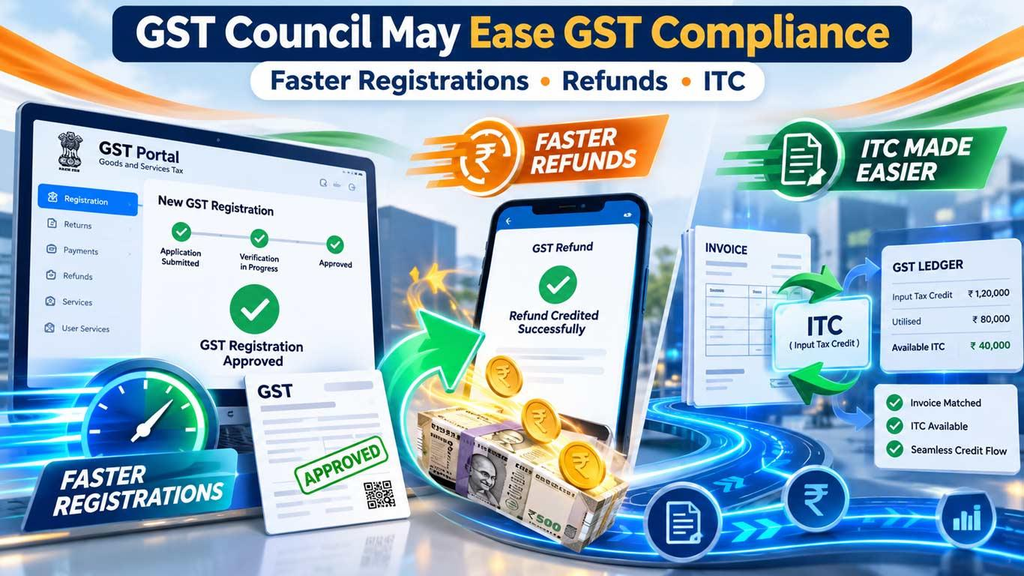
The Government of India is working towards making the Goods and Services Tax (GST) system simpler, faster and more convenient for businesses.
GST has been an important part of India’s taxation system since its introduction on 1 July 2017. Over the years, businesses have become familiar with GST registration, invoice generation, return filing, tax payments, Input Tax Credit (ITC) and refund applications.
However, businesses have also faced several practical difficulties, such as:
- Delays in GST registration.
- Complicated return-filing procedures.
- Differences between sales records and GST returns.
- Delays in receiving GST refunds.
- Difficulties in claiming Input Tax Credit.
- Unnecessary notices and penalties.
- Time-consuming GST compliance procedures.
To address these challenges, the GST Council recommended several Next-Gen GST Process Reforms at its 57th meeting held in October 2026.
The main objective is to reduce unnecessary compliance work, improve transparency, make refunds faster and provide a more predictable GST system.
In this guide, we will understand all six major areas of reform in simple language, along with practical examples.
Table of Contents
- Understanding GST: The Basics
- GST Registration Reforms
- Ease of Living and Doing Business
- GST Refund Reforms
- GST Return-Filing Reforms
- Input Tax Credit (ITC) Reforms
- GST Litigation and Penalty Reforms
- Other Important GST Changes
- Practical Examples for Businesses
- Monthly GST Compliance Checklist
- Important GST Forms
- Implementation Dates and Important Notes
- Official GST Resources
- Frequently Asked Questions
PART 1: Understanding GST – The Basics
Before understanding the new reforms, let’s first understand what GST actually means.
1.1 What is GST?
GST stands for Goods and Services Tax.
It is an indirect tax charged on the supply of goods and services in India.
For example, suppose a company provides an online training service for ₹25,000 and the applicable GST rate is 18%.
The invoice calculation would be:
| Particulars | Amount |
|---|---|
| Training fee | ₹25,000 |
| GST @ 18% | ₹4,500 |
| Total invoice value | ₹29,500 |
The company collects ₹29,500 from its customer. The GST portion is tax collected for payment to the government, subject to applicable GST rules.
1.2 What are the different types of GST?
There are three main types of GST that businesses should understand.
| GST Type | Full Form | When It Applies |
|---|---|---|
| CGST | Central Goods and Services Tax | Generally applies to intra-state supplies along with SGST |
| SGST | State Goods and Services Tax | Generally applies to intra-state supplies along with CGST |
| IGST | Integrated Goods and Services Tax | Generally applies to inter-state supplies |
Example:
If a company registered in Jharkhand provides services to a customer in Jharkhand, CGST and SGST will generally apply.
If the same company provides services to a customer in Karnataka, IGST will generally apply.
The actual tax treatment depends on the place-of-supply rules.
1.3 What is Input Tax Credit (ITC)?
Input Tax Credit is one of the most important concepts in GST.
ITC allows eligible registered businesses to claim credit for GST paid on qualifying purchases of goods and services.
Let’s understand this with an example.
A company purchases eligible business services worth ₹10,000 and pays ₹1,800 GST.
Later, the company sells services and collects ₹4,500 GST.
| Particulars | Amount |
|---|---|
| Output GST collected | ₹4,500 |
| Eligible ITC available | ₹1,800 |
| Net GST payable | ₹2,700 |
The business can use the eligible ITC to reduce its GST payment.
However, ITC is not available on every purchase. The business must satisfy the applicable conditions under GST law.
1.4 Important GST Forms
Here are some common GST forms that business owners and accountants should know.
| GST Form | Purpose |
|---|---|
| GST REG-01 | Application for GST registration |
| GST REG-06 | GST registration certificate |
| GSTR-1 | Reporting outward supplies or sales |
| GSTR-1A | Adding or amending certain outward supply details |
| GSTR-3B | Summary return for tax liability and ITC |
| GSTR-2B | Auto-drafted ITC statement |
| GSTR-9 | Annual GST return, where applicable |
| RFD-01 | GST refund application |
| DRC-03 | Voluntary payment of specified GST dues |
| REG-16 | Application for cancellation of GST registration |
Understanding these forms will make it easier to follow the reforms discussed below.
PART 2: GST Registration Reforms
Making GST Registration Simpler, Faster and More Predictable
GST registration is one of the first steps for businesses that are required to register under GST.
Earlier, businesses sometimes experienced difficulties because of incomplete documentation, unclear application requirements and repeated queries during the registration process.
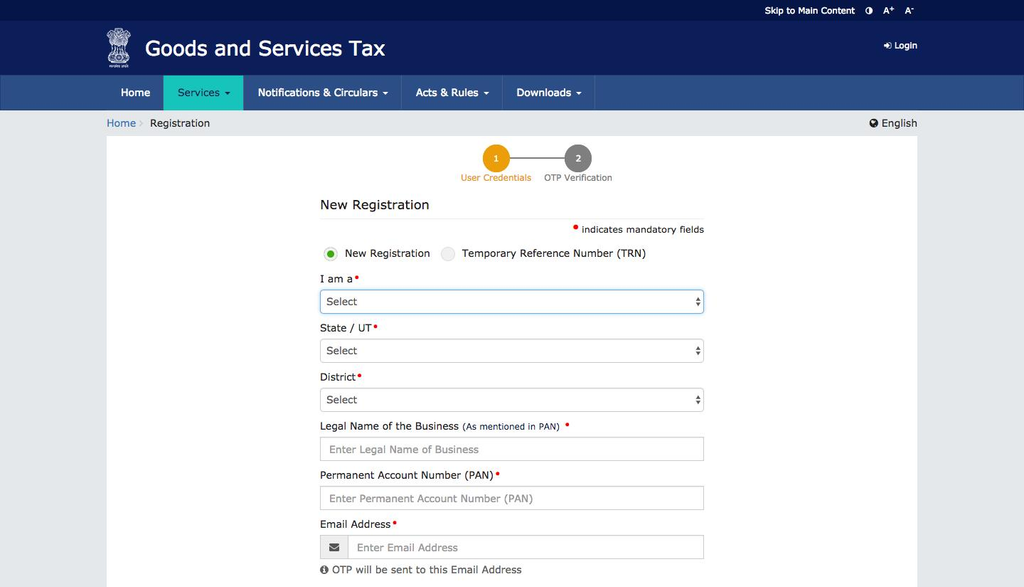
The new reforms aim to make the registration process more user-friendly.
2.1 What are the proposed changes?
The GST Council recommended the following improvements:
1. Clearer documentation requirements
The government intends to provide detailed documentation guidelines and FAQs so that applicants understand exactly what documents are required.
2. Improved GST registration application
The registration application is proposed to become easier to complete, with clearer instructions for taxpayers and tax officers.
3. Better GST portal interface
The GST portal is expected to provide:
- Clear navigation.
- Better dropdown options.
- Helpful tooltips.
- Contextual instructions.
- Improved application guidance.
The purpose is to reduce mistakes and unnecessary registration queries.
4. Automatic acceptance of certain amendments
The Council recommended automatic acceptance of amendments to registration particulars, except changes relating to the Principal Place of Business under the general proposed route.
For taxpayers registered through the automatic route, amendments including Principal Place of Business changes are proposed to receive automatic acceptance.
2.2 Simplified registration for small e-commerce sellers
Another important recommendation concerns small sellers operating through e-commerce platforms.
Eligible small sellers who pass on ITC not exceeding ₹2.5 lakh per month, excluding stock transfers, may be able to use a simplified PAN-based registration mechanism in states or union territories other than their home state.
The e-commerce operator’s warehouse may also be declared as the Principal Place of Business in an eligible state where the seller has no physical presence.
This can help small online sellers expand their business into other states.
2.3 Simplified GST cancellation
The Council also recommended making GST registration cancellation easier.
Under the proposed phased approach:
- Eligible cancellation applications may be accepted automatically after pending returns are filed.
- All outstanding dues must be paid.
- The applicable ITC conditions must be satisfied.
- The cancellation application form may be simplified.
2.4 What documents should a business maintain?
A business applying for GST registration should generally prepare:
- PAN card.
- Aadhaar details, where applicable.
- Business address proof.
- Electricity bill or other accepted address evidence.
- Rent agreement or ownership documents, where applicable.
- Bank account details.
- Business constitution documents.
- Authorised signatory details.
Practical Example:
Suppose a small company wants to register under GST.
Earlier, the applicant might have faced repeated questions because the address proof or business details were incomplete.
With clearer documentation instructions and a better application interface, the process should become easier and more predictable.
Business Benefit: Less confusion, fewer application errors and potentially faster registration processing.
PART 3: Ease of Living and Doing Business
Reducing Unnecessary Compliance and Procedural Difficulties

This reform focuses on reducing the compliance burden for taxpayers, especially small businesses.
3.1 Changes relating to arrest and prosecution
The GST Council recommended changes to certain arrest and prosecution provisions.
The major recommendations include:
- Withdrawal of specified arrest powers under GST.
- Increasing the prosecution threshold from ₹1 crore to ₹5 crore.
- Removing certain specified offences from the prosecution framework.
- Rationalising provisions relating to fraudulent ITC claims.
This does not mean that tax evasion, fake invoices or GST fraud become legal.
Serious offences can still attract action under the applicable law.
3.2 Late-fee relief for small taxpayers
The Council recommended a late-fee waiver for certain taxpayers whose aggregate turnover was up to ₹5 crore in the preceding financial year.
The proposed relief applies where the delayed return is filed by the end of the month in which it was originally due.
Example:
Suppose a qualifying business has a GST return due on 20 November.
The business files the return on 25 November.
If the business satisfies all the prescribed conditions for the proposed waiver, it may qualify for late-fee relief.
The waiver is not automatic for every delayed return. Eligibility and the effective legal provision must be checked.
3.3 Simplified annual return and quarterly payment concept
The GST Council introduced a concept note for an optional Annual Return Quarterly Payment (ARQP) scheme.
It is intended for qualifying taxpayers with aggregate turnover of ₹5 crore or less in the preceding financial year who exclusively make supplies to unregistered persons (B2C supplies).
The objective is to simplify GST compliance for eligible small consumer-facing businesses.
This was introduced as a concept for further discussion, not as a scheme that every taxpayer can immediately use.
3.4 Improved e-way bill procedures
The Council also recommended changes to the inspection and interception of vehicles carrying goods.
The aim is to reduce unnecessary interruptions during transportation.
The recommendations include:
- Interception based on specific intelligence and authorisation by an officer of the prescribed seniority.
- Restrictions on inspections in transit states.
- Exceptions where required e-way bills or transport documents are missing.
- Protection against certain confiscation actions involving goods in transit.
Business Benefit: Better predictability for transportation and fewer unnecessary compliance interruptions.
PART 4: GST Refund Reforms
Faster Refund Processing and Better Cash Flow for Businesses
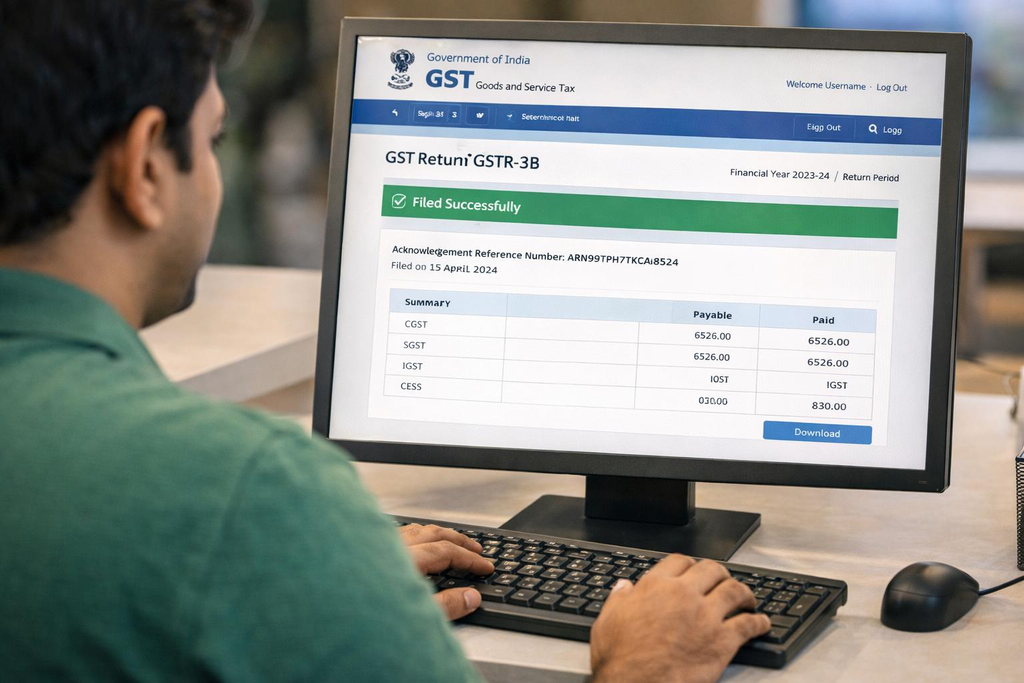
GST refunds are important because they directly affect a company’s working capital.
Sometimes a business pays more tax than required or accumulates eligible ITC.
Under applicable conditions, the business may be entitled to claim a refund.
4.1 What is a GST refund?
A GST refund is an amount that an eligible taxpayer can claim back from the government under the provisions of GST law.
Common refund situations include:
- Excess balance in the Electronic Cash Ledger.
- Export of goods or services.
- Supplies to eligible SEZ units or developers.
- Accumulated ITC under the Inverted Duty Structure.
4.2 Automatic refund of excess cash ledger balance
Suppose a business deposits ₹50,000 into its GST Electronic Cash Ledger.
However, its actual tax payment requirement is ₹35,000.
| Particulars | Amount |
|---|---|
| Amount deposited | ₹50,000 |
| Amount utilised | ₹35,000 |
| Remaining balance | ₹15,000 |
The proposed reform provides for automatic refund processing of eligible excess cash ledger balances.
This can help businesses receive their unused funds faster.
4.3 Reduction in refund acknowledgement time
Earlier, the acknowledgement period for refund applications was 15 days.
The Council recommended reducing it to 10 days.
The proposed system also provides for deemed acknowledgement where no response is issued within the prescribed period.
4.4 Automatic provisional refund of 90%
This is one of the most important refund-related recommendations.
The Council recommended a provisional refund of 90% of the claimed amount for eligible refund claims involving:
- Zero-rated supplies.
- Inverted Duty Structure.
The refund would be subject to system-based risk assessment and eligibility conditions.
Example:
Suppose a business submits an eligible refund claim of ₹1,00,000.
| Particulars | Amount |
|---|---|
| Total refund claim | ₹1,00,000 |
| Potential provisional refund at 90% | ₹90,000 |
| Remaining amount | ₹10,000 |
This is an illustration, not a guarantee that every refund application will receive 90%.
4.5 What is zero-rated supply?
Zero-rated supplies mainly include:
- Export of goods.
- Export of services.
- Supplies to eligible SEZ developers or SEZ units.
Eligible exporters may claim refunds under the applicable GST refund mechanism.
4.6 What is Inverted Duty Structure?
An Inverted Duty Structure occurs when the GST rate on eligible inputs is higher than the GST rate on the outward supplies.
Example:
A business pays 18% GST on certain eligible inputs but charges 5% GST on its final product.
This may result in accumulated ITC.
The business may qualify for a refund under the applicable inverted duty structure provisions.
4.7 Important refund-related documents
Businesses should maintain:
| Document | Purpose |
|---|---|
| Purchase invoices | Evidence of purchases and ITC |
| Sales invoices | Evidence of outward supplies |
| GSTR-1 | Sales reporting |
| GSTR-3B | Tax liability and ITC reporting |
| GSTR-2B | ITC reconciliation |
| Bank statements | Payment evidence |
| LUT documents | Export without payment of IGST, where applicable |
| Export documents | Supporting export transactions |
| RFD-01 | Refund application |
Business Benefit: Faster processing, improved transparency and better working capital management.
PART 5: GST Return-Filing Reforms
Improving Accuracy and Reducing Return Mismatches
GST return filing is one of the most important monthly or quarterly responsibilities of a registered business.
A small mismatch between sales records, purchase records and GST returns can create unnecessary complications.
The new reforms aim to improve the reconciliation process.
5.1 Understanding the three important GST returns
| GST Return | Purpose |
|---|---|
| GSTR-1 | Reports sales and outward supplies |
| GSTR-3B | Reports summary tax liability and ITC |
| GSTR-2B | Shows the auto-drafted ITC statement |
5.2 Improvements in GSTR-1, GSTR-1A and IFF
The Council recommended improvements in these facilities to enable better reconciliation with GSTR-3B.
This should help businesses identify differences before filing their returns.
5.3 Better Reverse Charge Mechanism reporting
Reverse Charge Mechanism (RCM) means that the recipient of specified goods or services is responsible for paying GST instead of the supplier.
A new electronic statement is proposed to help taxpayers track:
- GST paid under RCM.
- ITC claimed against eligible RCM payments.
This should make RCM reporting easier.
5.4 Invoice Management System (IMS)
The Invoice Management System is a useful facility for businesses receiving purchase invoices.
It allows recipients to take appropriate action on eligible supplier-reported documents.
The available actions include:
- Accept.
- Reject.
- Keep pending.
Example:
Suppose your company receives an invoice from a supplier for ₹10,000 plus GST.
The invoice appears in the relevant system.
Your accountant can verify:
- Whether the supplier details are correct.
- Whether the invoice belongs to your company.
- Whether the invoice amount is correct.
- Whether the GST amount is correct.
- Whether the purchase is eligible for ITC.
The appropriate action can then be taken.
5.5 Electronic Credit Reversal and Reclaim Statement
Sometimes a business reverses ITC and becomes eligible to claim it again later.
The Council recommended an Electronic Credit Reversal and Reclaim Statement to improve tracking of such transactions.
This should help businesses maintain more accurate ITC records.
5.6 Correction of tax liability and ITC
A mechanism is proposed to enable correction of certain differences between GSTR-1, GSTR-1A/IFF and GSTR-3B.
The alternate mechanism for correcting liability and ITC is proposed to apply from the April 2027 return period.
5.7 Monthly GST reconciliation example
| Activity | What to check |
|---|---|
| Sales reconciliation | Sales register vs GSTR-1 |
| Tax reconciliation | GSTR-1 vs GSTR-3B |
| Purchase reconciliation | Purchase register vs GSTR-2B |
| ITC reconciliation | Eligible ITC vs ITC claimed |
| RCM reconciliation | RCM liability and payment |
| Bank reconciliation | Customer receipts vs invoices |
| Tax payment | Cash ledger and credit ledger |
Business Benefit: Fewer mistakes, improved reconciliation and better control over GST reporting.
PART 6: Input Tax Credit (ITC) Reforms
Improving ITC Availability and Refund Opportunities
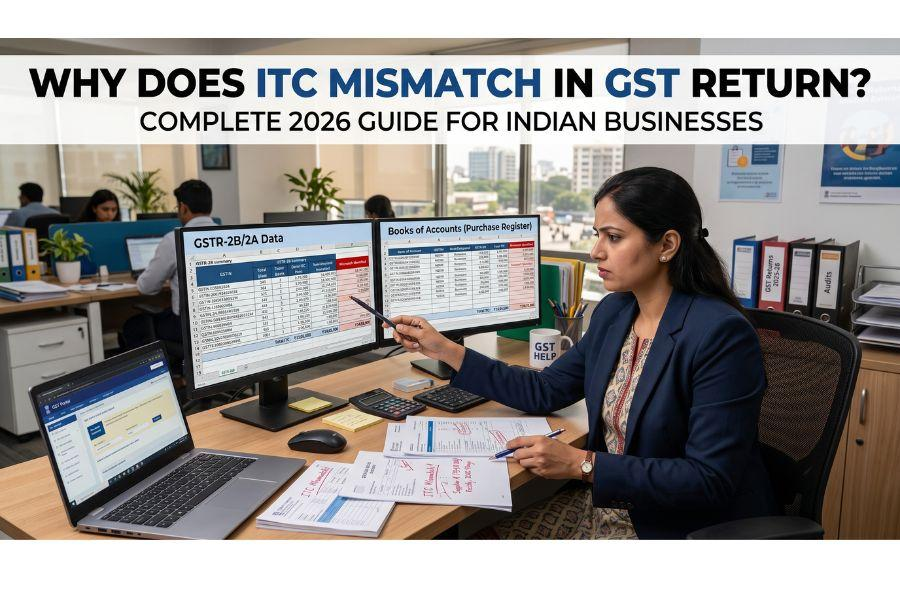
Input Tax Credit is an important part of GST because it prevents unnecessary tax-on-tax situations.
The GST Council recommended several changes to widen ITC eligibility and improve refund opportunities.
6.1 What is blocked ITC?
Under GST law, certain purchases are restricted from ITC claims.
These restrictions are mainly covered under Section 17(5) of the CGST Act.
The Council recommended removing specified restrictions for certain categories.
These include:
- Outdoor catering.
- Health insurance.
- Life insurance.
- Telecommunication towers.
- Pipelines outside factory premises.
- Free samples.
- Goods destroyed or written off after their shelf life expires, as required by law.
The purpose is to reduce the cascading effect of taxes and improve ITC availability.
However, the relevant amendments and conditions must be checked before claiming ITC.
6.2 ITC on health and life insurance
Businesses sometimes purchase insurance services for employees or other eligible business purposes.
The Council recommended removing certain ITC restrictions relating to health and life insurance services.
The final eligibility will depend on the amended provisions and applicable conditions.
6.3 ITC on outdoor catering
Businesses may arrange catering for eligible business events.
The Council recommended removing specified restrictions relating to outdoor catering services.
Businesses should check the final law before claiming the credit.
6.4 ITC on free samples
Some companies distribute free samples to customers as part of their marketing activities.
The Council recommended removing specified ITC restrictions relating to free samples.
This may help eligible businesses reduce their tax costs.
6.5 ITC on expired or destroyed goods
Suppose a business has goods that expire and must be destroyed under applicable legal requirements.
The Council recommended changes to restrictions on ITC for certain goods destroyed or written off after their shelf life expires.
Businesses should maintain proper supporting evidence, including stock records and destruction documentation.
6.6 Refund of accumulated ITC on input services
The Council recommended allowing refunds of accumulated ITC on input services in specified inverted duty structure cases.
Recommended applicability: ITC availed on or after 1 November 2026.
6.7 Refund of accumulated ITC on capital goods
The Council also recommended extending refunds to accumulated ITC on capital goods in specified zero-rated supply and inverted duty structure cases.
Recommended applicability: ITC availed on or after 1 April 2027.
Refunds relating to ITC on capital goods are proposed to be spread over 60 months.
6.8 Difference between ITC claim and ITC refund
Many business owners confuse these two terms.
| ITC Claim | ITC Refund |
|---|---|
| Used to reduce output GST liability | Refund of eligible accumulated ITC |
| Adjusted through the GST credit ledger | Applied for through the prescribed refund process |
| Subject to ITC eligibility | Subject to refund eligibility and restrictions |
Important: Not every unused ITC balance can be refunded.
Business Benefit: Better ITC management, potential refunds and reduced blockage of working capital.
PART 7: GST Litigation and Penalty Reforms
Reducing Unnecessary GST Notices and Disputes
GST notices can create difficulties for businesses, especially when the issue involves differences in returns, ITC claims or tax payments.
The Council recommended several changes to simplify dispute resolution.
7.1 Minimum threshold for show-cause notices
The Council recommended that show-cause notices should not be issued where the tax amount involved is below ₹10,000.
The recommendation also addresses pending notices and appeals below this threshold.
This is not a general exemption from paying tax.
7.2 Reduction in general penalty
The maximum general penalty under Section 125 is recommended to be reduced from ₹25,000 to ₹10,000.
7.3 Reduced penalty in specified cases
The Council recommended a reduced penalty of 5% in certain cases where tax and interest are paid within the prescribed period after an adjudication order.
The recommended periods are:
- Within 30 days under Section 73.
- Within 60 days under Section 74A.
The applicable conditions and statutory provisions must be checked.
7.4 Penalty treated as a charge
The Council recommended that in specified situations, where the taxpayer voluntarily pays the full tax, interest and applicable penalty within the prescribed time, the penalty may be termed as a charge.
7.5 Better guidelines for GST officers
The Council also recommended comprehensive guidelines for:
- Issuing demand notices.
- Passing adjudication orders.
- Handling appeal orders.
- Improving dispute resolution procedures.
7.6 What should a business do after receiving a GST notice?
Follow these steps:
Step 1: Read the notice carefully.
Check the financial year, tax period, amount involved and legal section mentioned.
Step 2: Understand the issue.
Find out whether the notice relates to sales differences, ITC mismatch, tax payment or another issue.
Step 3: Collect supporting documents.
Prepare invoices, purchase registers, bank statements, GST returns and reconciliation reports.
Step 4: Prepare a written reply.
Explain the facts clearly and attach the necessary supporting evidence.
Step 5: Consult a GST professional.
For significant amounts, fraud allegations or legal disputes, take professional advice.
Step 6: Save the acknowledgement.
Keep proof of submission and all related communication.
Business Benefit: Better dispute management, reduced litigation burden and more predictable compliance.
PART 8: Other Important GST Changes
Apart from the six major areas, the Council recommended additional measures.
8.1 Export of services
The Council recommended removing the condition that the supplier and recipient must not be establishments of the same person for a service to qualify as an export of services.
This could benefit Indian service providers working through foreign offices or branches.
8.2 Export payments
A clarification is proposed regarding the receipt of export payments in foreign exchange or Indian rupees, where permitted under applicable rules.
8.3 Place of supply
Changes have been recommended for certain services where the recipient makes goods physically available to the supplier.
This may improve access to export-related benefits for eligible service providers.
8.4 Opportunity to object before ITC blocking
The Council recommended allowing taxpayers to submit objections and attend a personal hearing before a decision is taken on certain amounts blocked in the Electronic Credit Ledger under Rule 86A.
This aims to improve taxpayer protection.
8.5 E-invoicing changes
The Council recommended extending e-invoicing requirements to specified domestic supplies received from unregistered persons under reverse charge and imports of services.
The proposal applies to taxpayers with aggregate annual turnover of ₹5 crore or more, subject to the final rules and implementation.
PART 9: Practical GST Examples for Businesses
Let’s understand how a company can use these concepts in its daily accounting activities.
Example 1: GST calculation on a service invoice
Suppose a company sells a training service for ₹25,000.
| Particulars | Amount |
|---|---|
| Service value | ₹25,000 |
| GST @ 18% | ₹4,500 |
| Total invoice | ₹29,500 |
The company records the taxable value and GST separately in its accounting system.
Example 2: ITC calculation
Suppose the company has:
| Particulars | Amount |
|---|---|
| Output GST | ₹50,000 |
| Eligible ITC | ₹20,000 |
| Net GST payable | ₹30,000 |
The company can use eligible ITC to reduce its output GST liability, subject to the applicable utilisation rules.
Example 3: Purchase invoice verification
Suppose the company receives a software subscription invoice.
| Particulars | Amount |
|---|---|
| Software subscription | ₹10,000 |
| GST @ 18% | ₹1,800 |
| Total | ₹11,800 |
The accountant should verify:
- Whether the invoice is valid.
- Whether the supplier GSTIN is correct.
- Whether the invoice appears in GSTR-2B, as applicable.
- Whether the service is used for business.
- Whether the ITC is legally available.
Only after the applicable conditions are satisfied should the business claim ITC.
Example 4: Export of services
Suppose an Indian company provides eligible training services to a foreign customer.
The transaction may qualify as an export of services if all the statutory conditions are satisfied.
The company should maintain:
- Customer agreement.
- Invoice.
- Proof of service delivery.
- Payment evidence.
- Foreign customer details.
- LUT, where applicable.
- Relevant export documentation.
Eligible exports can qualify for zero-rated treatment under GST.
PART 10: Monthly GST Compliance Checklist
Every registered business should maintain a proper monthly GST compliance process.
The following checklist can be used by an accountant or business owner.
| No. | Compliance Activity | Status |
|---|---|---|
| 1 | Update the sales register | Pending / Completed |
| 2 | Update the purchase register | Pending / Completed |
| 3 | Verify sales invoices | Pending / Completed |
| 4 | Verify purchase invoices | Pending / Completed |
| 5 | Reconcile sales with GSTR-1 | Pending / Completed |
| 6 | Reconcile GSTR-1 with GSTR-3B | Pending / Completed |
| 7 | Reconcile purchase records with GSTR-2B | Pending / Completed |
| 8 | Verify eligible ITC | Pending / Completed |
| 9 | Check RCM liability | Pending / Completed |
| 10 | Verify GST payment | Pending / Completed |
| 11 | Check Electronic Cash Ledger | Pending / Completed |
| 12 | Check Electronic Credit Ledger | Pending / Completed |
| 13 | Review outstanding GST notices | Pending / Completed |
| 14 | Save GST return acknowledgements | Pending / Completed |
| 15 | Maintain monthly GST working papers | Pending / Completed |
Following this checklist can help businesses avoid unnecessary last-minute GST work.
PART 11: Important GST Documents Every Business Should Maintain
A business should maintain proper documentation for GST compliance.
Suggested folder structure:
GST Compliance – Financial Year 2026–27
- GST Registration
- GST registration certificate.
- PAN and business details.
- Registration amendments.
- Sales Invoices
- Customer invoices.
- Credit notes.
- Debit notes.
- Sales register.
- Purchase Invoices
- Vendor invoices.
- Expense bills.
- Purchase register.
- GST Returns
- GSTR-1.
- GSTR-3B.
- GSTR-2B.
- GSTR-9, where applicable.
- ITC Reconciliation
- Purchase reconciliation.
- GSTR-2B reconciliation.
- ITC working papers.
- Reversal and reclaim records.
- GST Payments
- GST challans.
- Payment receipts.
- Cash ledger.
- Credit ledger.
- GST Refunds
- Refund applications.
- Supporting documents.
- Refund acknowledgements.
- Refund orders.
- GST Notices
- Department notices.
- Replies.
- Supporting evidence.
- Submission acknowledgements.
A well-organised documentation system makes GST audits, reconciliations and departmental enquiries easier to handle.
PART 12: GST Reform Implementation Dates
One important point must be understood: a GST Council recommendation does not automatically become an enforceable legal provision.
The relevant amendments, notifications, rules and effective dates must be checked before applying a reform.
Based on the official government backgrounder available in November 2026, the following dates and recommendations are important.
| Reform | Recommended applicability or status |
|---|---|
| Simplified Rule 14A registration | Operationalised from 1 November 2025 |
| ITC refund on eligible input services under IDS | ITC availed on or after 1 November 2026 |
| Alternate return correction mechanism | Proposed from April 2027 return period |
| ITC refund on eligible capital goods | ITC availed on or after 1 April 2027 |
| Capital goods refund | Proposed to be spread over 60 months |
| Refund acknowledgement | Proposed reduction from 15 days to 10 days |
| Provisional refund | 90% for eligible claims, subject to risk assessment |
| GST prosecution threshold | Recommended increase from ₹1 crore to ₹5 crore |
| General penalty | Recommended reduction from ₹25,000 to ₹10,000 |
Important Note: These dates and figures describe the government’s announced recommendations and implementation framework. Always verify the latest applicable notification before changing your GST returns or accounting practices.
PART 13: Official GST Websites and Resources
Businesses should use official government websites for GST registration, return filing, payments, refunds and legal updates.
1. GST Portal
Website: https://www.gst.gov.in/
Used for:
- GST registration.
- GST return filing.
- GST payments.
- Refund applications.
- Checking GST ledgers.
- Tracking applications.
2. Central Board of Indirect Taxes and Customs (CBIC)
Website: https://www.cbic.gov.in/
Used for:
- GST laws.
- Notifications.
- Circulars.
- Rules.
- Government tax clarifications.
3. GST Council
Website: https://gstcouncil.gov.in/
Used for:
- GST Council meeting recommendations.
- Policy decisions.
- GST reform announcements.
4. Press Information Bureau (PIB)
Website: https://pib.gov.in/
Used for:
- Official government announcements.
- GST reform explanations.
- Government press releases.
- Frequently asked questions.
5. Official Next-Gen GST Process Reforms Backgrounder
https://www.pib.gov.in/PressNoteDetails.aspx?ModuleId=3&NoteId=160401
This is an important reference for understanding the recommendations covered in this guide.
PART 14: Frequently Asked Questions (FAQs)
Q1. What are Next-Gen GST Process Reforms?
Next-Gen GST Process Reforms are a set of recommended improvements intended to simplify GST registration, returns, refunds, ITC claims and dispute resolution in India.
Q2. Who will benefit from these reforms?
Small businesses, medium-sized companies, exporters, e-commerce sellers, service providers and other eligible GST-registered taxpayers may benefit.
Q3. Will GST registration become easier?
The recommendations include clearer documentation, improved portal navigation, simpler applications and automatic acceptance of certain amendments.
Q4. What is the 90% GST refund reform?
It is a recommendation for provisional refunds of 90% of eligible claims involving zero-rated supplies and inverted duty structure, based on system risk assessment.
Q5. What is the new GST refund acknowledgement period?
The Council recommended reducing the acknowledgement period from 15 days to 10 days.
Q6. What is the new general penalty recommendation?
The maximum general penalty under Section 125 is recommended to be reduced from ₹25,000 to ₹10,000.
Q7. Is ITC now available on all business expenses?
No. ITC remains subject to statutory conditions, eligibility requirements and applicable restrictions.
Q8. Can every business claim a GST refund?
No. Refunds are available only in specified situations and subject to applicable GST provisions.
Q9. Will GST return filing become easier?
The recommendations include improved reconciliation, better invoice management and mechanisms to correct specified differences between returns.
Q10. Do GST Council recommendations automatically become law?
No. The relevant statutory amendments, notifications, rules and implementation instructions must be checked.
Q11. What should businesses do to prepare for the reforms?
Businesses should maintain proper invoices, sales registers, purchase registers, ITC records, GST returns, payment evidence and reconciliation reports.
Q12. Where can businesses check the latest GST updates?
Businesses should refer to the official GST Portal, CBIC, GST Council and Press Information Bureau websites.
Conclusion: What Do These GST Reforms Mean for Indian Businesses?
The Next-Gen GST Process Reforms represent an important step towards making India’s GST system simpler, more transparent and business-friendly.
The main objective is to reduce unnecessary paperwork, improve registration procedures, speed up eligible refunds, simplify return filing, improve ITC availability and reduce avoidable litigation.
For businesses, the message is straightforward:
Maintain proper records, reconcile GST regularly, understand your ITC eligibility and stay updated with official notifications.
You do not need to wait until the end of the financial year to organise your GST compliance. A proper monthly accounting process can prevent many common mistakes.
Whether you are running a small business, managing a company, working in accounts or handling GST compliance, understanding these reforms can help you make better financial and compliance decisions.
Remember: A better understanding of GST is not just about filing returns. It is about managing your business finances correctly and staying compliant with the law.
Disclaimer
This tutorial is intended for general educational and informational purposes. It is based on the Government of India’s published information regarding the Next-Gen GST Process Reforms and the 57th GST Council meeting recommendations available in November 2026.
GST laws, rules, notifications and implementation dates may change. The examples used in this guide are illustrative and do not constitute tax or legal advice.
Businesses should consult a qualified Chartered Accountant or GST professional before making changes to their GST returns, ITC claims, refund applications or tax payments.
Official Source: Ministry of Finance, Government of India – Press Information Bureau.
Reference: Next-Gen GST Process Reforms, published 9 October 2026.