Introduction
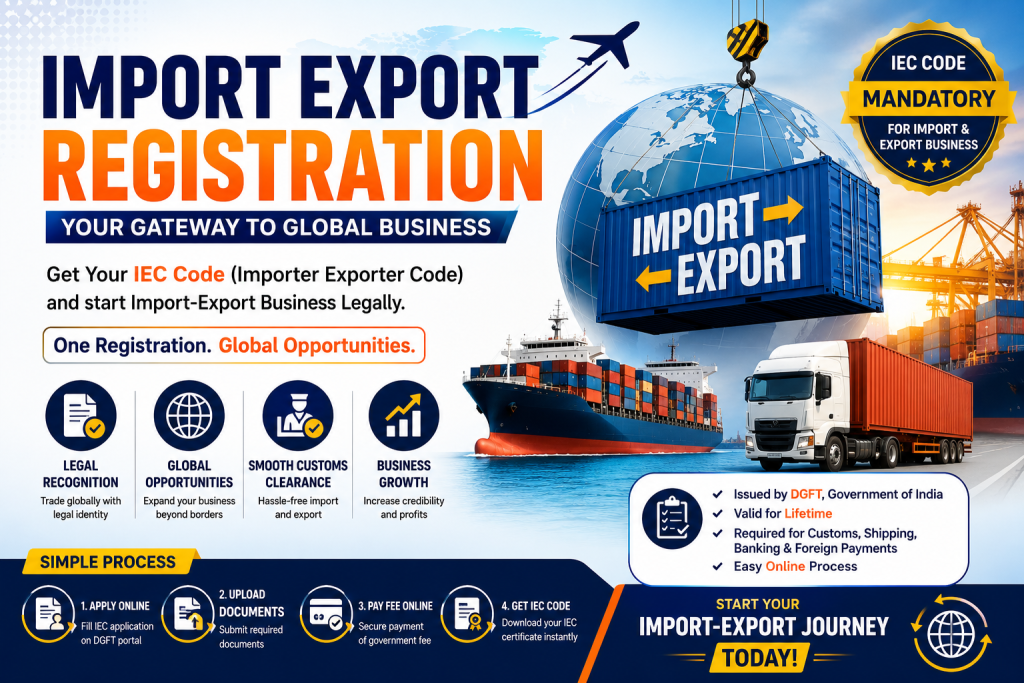
Import Export Registration is an important requirement for businesses that want to start importing goods into India or exporting goods from India. Whether you are a manufacturer, trader, startup, e-commerce seller, merchant exporter, service provider, or small business owner, you may need Import Export Registration before starting international trade.
In India, Import Export Registration is commonly known as IEC Registration. IEC stands for Importer Exporter Code. It is issued by the Directorate General of Foreign Trade, also known as DGFT. IEC acts as a business identification number for import and export activities.
Without IEC, most businesses cannot legally import or export goods. It is also required for customs clearance, shipment processing, international payment, bank documentation, and export-related benefits.
This blog explains Import Export Registration in a simple and practical way. It covers meaning, importance, eligibility, documents, fees, process, benefits, common mistakes, and FAQs.
What Is Import Export Registration?
Import Export Registration means obtaining an Importer Exporter Code from DGFT. This code is required by businesses or individuals who want to import or export goods and services from India.
IEC is a unique identification number linked with the PAN of the applicant. It helps government departments, customs authorities, banks, and trade bodies identify the importer or exporter.
In simple words, Import Export Registration gives your business permission and identity to start international trade.
What Is IEC Code?
IEC Code means Importer Exporter Code. It is a mandatory registration number for most import and export activities in India.
IEC is required for:
- Importing goods into India
- Exporting goods from India
- Customs clearance
- International shipping
- Receiving export payments
- Sending import payments
- Applying for export benefits
- Registering with export promotion councils
- Building an international trade profile
IEC is generally issued in electronic form and can be downloaded from the DGFT portal after approval.
Why Import Export Registration Is Important
Import Export Registration is important because it gives legal recognition to a business for international trade. Without IEC, customs and banks may not allow import-export transactions.
Key Benefits of Import Export Registration
- Allows import and export business
- Helps in customs clearance
- Required for international trade payments
- Improves business credibility
- Helps expand business globally
- Supports export benefit applications
- Useful for e-commerce exports
- Required by banks for foreign remittance
- Helps build importer/exporter profile
- Supports business growth in foreign markets
Import Export Registration is useful for both new and existing businesses that want to enter the global market.
Who Needs Import Export Registration?
Any person or business planning to import or export goods generally needs IEC Registration.
Suitable For
- Proprietorship firms
- Partnership firms
- LLPs
- Private Limited Companies
- Public Limited Companies
- Manufacturers
- Traders
- Merchant exporters
- E-commerce exporters
- Importers
- Export houses
- Service exporters, where applicable
- Startups
- MSMEs
- Trusts, societies, and HUFs, where applicable
If your business wants to deal with foreign buyers, foreign sellers, overseas suppliers, international marketplaces, or global shipments, IEC Registration may be required.
Is IEC Required for Service Export?
IEC may not be required for every service export. However, if the service exporter wants to claim benefits under Foreign Trade Policy or needs IEC for bank, export incentive, or compliance purposes, IEC may be required.
For example, IT service providers, consultants, freelancers, agencies, and software companies may apply for IEC if they receive foreign payments, claim benefits, or need proper export documentation.
It is better to check the business requirement before deciding.
Who Can Apply for Import Export Registration?
Import Export Registration can be applied by different types of applicants.
Eligible Applicants
| Applicant Type | Example |
|---|---|
| Individual | Freelancer or individual importer/exporter |
| Proprietorship Firm | Small business or shop owner |
| Partnership Firm | Business operated by partners |
| LLP | Limited Liability Partnership |
| Private Limited Company | Startup or company |
| Public Limited Company | Large company |
| Trust | Registered trust |
| Society | Registered society |
| HUF | Hindu Undivided Family |
The applicant must have PAN, bank account, and valid address details.
Documents Required for Import Export Registration
Proper documents are required for IEC Registration. The documents depend on applicant type, but some documents are commonly needed.
Basic Documents Required
- PAN card of applicant or business entity
- Aadhaar card, voter ID, passport, or driving licence of authorized person
- Business address proof
- Bank account details
- Cancelled cheque or bank certificate
- Mobile number
- Email ID
- Digital Signature Certificate, where required
- Business registration proof, if applicable
Documents for Proprietorship Firm
For a proprietorship business, the following documents may be required:
- PAN card of proprietor
- Aadhaar card or identity proof of proprietor
- Address proof of business place
- Cancelled cheque with printed name
- Bank certificate, if required
- Mobile number and email ID
- Passport-size photograph, where required
Documents for Partnership Firm
For a partnership firm, the following documents may be required:
- PAN card of partnership firm
- Partnership deed
- Identity proof of managing partner
- Address proof of business place
- Cancelled cheque with firm name
- Bank certificate, if required
- Mobile number and email ID
- DSC of authorized partner, where required
Documents for LLP
For an LLP, the following documents may be required:
- LLP PAN card
- Certificate of incorporation
- LLP agreement, if required
- Details of designated partner
- Identity proof of authorized signatory
- Address proof of registered office
- Cancelled cheque with LLP name
- Bank certificate, if required
- DSC of authorized signatory
Documents for Private Limited Company
For a Private Limited Company, the following documents may be required:
- Company PAN card
- Certificate of incorporation
- Details of directors
- Identity proof of authorized director
- Address proof of registered office
- Cancelled cheque with company name
- Bank certificate, if required
- Digital Signature Certificate of authorized director
- Board authorization, if required
Government Fee for Import Export Registration
The government fee for new IEC Registration is generally ₹500.
If an IEC needs modification, the modification fee is generally ₹200.
Professional service charges, documentation charges, DSC charges, correction charges, or consultation fees may be separate.
Simple Fee Table
| Service | Government Fee |
|---|---|
| New IEC Registration | ₹500 |
| IEC Modification | ₹200 |
| Professional Assistance | Separate service charge |
| DSC, if required | Separate cost |
The government fee should be paid through the official payment option available during the application process.
Step-by-Step Import Export Registration Process
Import Export Registration is completed online through the DGFT portal. The process should be done carefully to avoid rejection or delay.
Step 1: Check Business Requirement
First, check whether your business needs IEC. If you are planning to import or export goods, IEC is generally required.
Step 2: Collect Documents
Prepare all required documents before starting the application. Make sure PAN, bank details, address proof, and business documents are correct.
Step 3: Register on DGFT Portal
Create a user account on the DGFT portal as an importer/exporter. Use a valid mobile number and email ID because OTP verification may be required.
Step 4: Login to Dashboard
After registration, login to the DGFT dashboard using your user ID and password.
Step 5: Select Apply for IEC
Go to the IEC section and select the option to apply for a new IEC.
Step 6: Fill Applicant Details
Enter applicant details carefully. These may include:
- Applicant name
- PAN details
- Business name
- Business type
- Address details
- Mobile number
- Email ID
- Bank details
- Branch details, if any
Step 7: Add Proprietor, Partner, or Director Details
Add details of proprietor, partners, designated partners, directors, trustees, or authorized persons as applicable.
Step 8: Upload Documents
Upload required documents in the correct format. The documents should be clear, readable, and valid.
Step 9: Review Application
Review all details before submission. Check spelling, PAN, address, bank account, entity name, and contact information.
Step 10: Pay Government Fee
Pay the applicable government fee for IEC Registration.
Step 11: Digitally Sign and Submit
Digitally sign the application using DSC or e-sign option, wherever applicable. Then submit the application.
Step 12: Download IEC Certificate
After successful approval, download the IEC certificate from the portal. The certificate contains the IEC number, firm name, address, PAN, and issue details.
Details Required in IEC Application
The IEC application may require several business details. Keep the following information ready:
- Name of applicant
- PAN number
- Business name
- Constitution of business
- Date of incorporation or establishment
- Registered office address
- Branch office details, if any
- Bank account number
- IFSC code
- Mobile number
- Email ID
- Details of proprietor, partners, directors, trustees, or Karta
- Identity details of authorized signatory
- Digital signature or e-sign details
Every detail should match official documents.
Digital Signature Requirement for IEC
Digital Signature Certificate may be required for business entities such as companies, LLPs, and partnership firms. It helps verify the authorized signatory and complete online submission securely.
For proprietorship firms, Aadhaar-based e-sign may be available in some cases. However, for companies and LLPs, DSC is generally preferred for secure authentication.
Before applying, make sure the DSC is valid, active, and installed properly on the system.
IEC Certificate Download
After IEC approval, the applicant can download the certificate online from the DGFT portal.
The IEC certificate usually includes:
- IEC number
- Name of firm
- Address
- PAN number
- Date of issue
- Branch details, if any
- QR code or verification details, where available
The certificate should be saved safely because it may be required for customs, banks, logistics, shipping partners, and export documentation.
IEC Validity
IEC does not usually require fresh registration again and again. Once issued, the same IEC can continue to be used unless surrendered, cancelled, suspended, or deactivated.
However, IEC holders should update or confirm IEC details every year as required by DGFT. If annual updation is not completed, the IEC may be deactivated.
This annual update helps keep business details active and correct in the DGFT system.
Annual IEC Update
IEC holders should update or confirm their IEC profile every year. Even if there is no change in details, confirmation may still be required.
Annual IEC update may include checking:
- Firm name
- Address
- Email ID
- Mobile number
- Bank details
- Branch details
- Director or partner details
- Authorized signatory details
If there is no change, the business may only need to confirm existing details. If there are changes, proper modification should be done.
Difference Between IEC Registration and IEC Modification
IEC Registration and IEC Modification are different.
IEC Registration is done when a business applies for IEC for the first time.
IEC Modification is done when an existing IEC holder wants to update details such as address, bank details, partner details, director details, branch details, email ID, or mobile number.
Simple Difference
| Point | IEC Registration | IEC Modification |
|---|---|---|
| Purpose | New IEC application | Update existing IEC |
| Applicant | New importer/exporter | Existing IEC holder |
| Fee | ₹500 | ₹200 |
| Result | New IEC issued | Existing IEC updated |
| Required When | Before import/export | When details change |
Import Export Registration for E-Commerce Sellers
E-commerce sellers who want to export products through international marketplaces may need IEC Registration. This is useful for sellers dealing with foreign buyers and international shipments.
IEC may be required for:
- Exporting products through online marketplaces
- Receiving foreign payments
- Courier exports
- Customs clearance
- Shipping documentation
- Export invoice processing
- Bank realization documents
Small sellers, MSMEs, handmade product sellers, D2C brands, and online store owners can use IEC to expand into global markets.
Import Export Registration for Startups
Startups planning to sell products or services outside India may need IEC Registration. It helps them build an international business profile and deal with foreign customers, vendors, and platforms.
IEC can be useful for startups involved in:
- Product exports
- SaaS and IT services
- Consulting services
- E-commerce exports
- Manufacturing exports
- Importing raw materials
- Importing machinery
- Exporting digital products, where applicable
Startups should also check whether they need GST, LUT, RCMC, AD Code, or other export-related compliance depending on their business activity.
Other Registrations That May Be Needed After IEC
IEC is a basic registration for import-export activity. Depending on the business, other registrations may also be required.
Possible Additional Requirements
- GST registration
- LUT for export without payment of IGST
- AD Code registration with customs
- RCMC from Export Promotion Council
- FSSAI registration for food export/import
- APEDA registration for agricultural products
- Drug licence for medicines
- BIS registration for certain products
- WPC approval for wireless products
- Import licence for restricted goods
- Export licence for restricted goods
IEC alone may not be enough for every product. Some goods require special permission or product-specific compliance.
Benefits of Import Export Registration
Import Export Registration gives many benefits to businesses planning international trade.
1. Legal Permission for Import and Export
IEC allows a business to start import and export activities legally, subject to applicable laws.
2. Customs Clearance
IEC is required during customs clearance for most import and export shipments.
3. International Payment Support
Banks may ask for IEC during foreign trade payment transactions.
4. Business Expansion
IEC helps businesses sell products or services in international markets.
5. Export Benefits
IEC may be required to apply for export incentives, schemes, and benefits.
6. Global Business Identity
IEC gives the business a recognized import-export identity.
7. Useful for E-Commerce Exports
Online sellers can use IEC to export products through international platforms.
8. Supports Manufacturer and Trader Growth
Manufacturers and traders can reach foreign customers and suppliers with IEC.
Common Mistakes to Avoid
Many IEC applications face delay because of simple mistakes. Avoid the following errors:
- Using wrong PAN details
- Entering incorrect business name
- Giving mismatched bank details
- Uploading unclear documents
- Using personal bank account instead of firm account
- Giving wrong address
- Not matching details with PAN records
- Not using valid mobile number and email ID
- Not arranging DSC where required
- Not updating IEC annually
- Ignoring DGFT profile updates
- Not checking product-specific restrictions
- Assuming IEC is enough for every export/import
A properly prepared application reduces the chance of rejection or delay.
Import Export Registration Service Includes
Professional assistance for Import Export Registration may include:
- Basic consultation
- Eligibility checking
- Document checklist
- DGFT portal registration support
- IEC application preparation
- PAN and bank detail checking
- Document upload guidance
- Government fee payment guidance
- DSC support, where required
- Application submission assistance
- IEC certificate download support
- IEC modification guidance, if required
Professional support helps beginners avoid mistakes and complete the process smoothly.
Important Points Before Applying
Before applying for IEC, keep these points in mind:
- PAN is mandatory.
- Bank account should be in the applicant or firm name.
- Valid business address is required.
- Email ID and mobile number should be active.
- DSC may be required for certain entities.
- IEC application fee is generally ₹500.
- IEC modification fee is generally ₹200.
- IEC should be updated or confirmed every year.
- IEC does not replace product-specific licences.
- Restricted products may need separate permission.
FAQs
1. What is Import Export Registration?
Import Export Registration means obtaining IEC Code from DGFT to start import or export activities from India.
2. What is IEC Code?
IEC Code stands for Importer Exporter Code. It is a business identification number used for import and export transactions.
3. Is IEC mandatory for import and export?
Yes, IEC is mandatory for most import and export activities unless the applicant falls under an exempted category.
4. Who issues IEC Code?
IEC Code is issued by the Directorate General of Foreign Trade.
5. What is the government fee for IEC Registration?
The government fee for new IEC Registration is generally ₹500.
6. What is the IEC modification fee?
The government fee for IEC modification is generally ₹200.
7. What documents are required for IEC Registration?
Basic documents include PAN, bank details, address proof, identity proof, mobile number, email ID, and business registration documents, if applicable.
8. Can a proprietor apply for IEC?
Yes, a proprietor can apply for IEC using proprietor details, PAN, address proof, and bank details.
9. Can a company apply for IEC?
Yes, a Private Limited Company, Public Limited Company, LLP, partnership firm, trust, society, and other eligible entities can apply.
10. Is DSC required for IEC?
DSC may be required for companies, LLPs, partnership firms, and other entities. Proprietors may use e-sign where available.
11. Does IEC expire?
IEC does not usually expire like a short-term licence, but it must be updated or confirmed every year to keep it active.
12. Is IEC enough for all imports and exports?
No. IEC is the basic registration. Some products may need additional licences, approvals, or product-specific compliance.
Conclusion
Import Export Registration is the first important step for any business that wants to start international trade from India. It gives the business an Importer Exporter Code, which is required for most import and export activities, customs clearance, bank transactions, and export documentation.
The process is online and can be completed through the DGFT portal. To apply successfully, the applicant should keep PAN, bank details, valid address proof, business documents, mobile number, email ID, and DSC ready where required.
IEC Registration helps manufacturers, traders, startups, MSMEs, e-commerce sellers, and service providers expand their business beyond India. However, businesses should also remember that IEC is only the basic registration. Depending on the product or service, additional approvals such as GST, RCMC, AD Code, FSSAI, APEDA, BIS, or import-export licence may be required.
With correct documents, proper details, and careful submission, Import Export Registration can be completed smoothly and can help your business enter the global market with confidence.