Introduction
Master Data Management (MDM) Tools are platforms that centralize, standardize, and govern critical business data across an organization. They ensure a single source of truth for key entities such as customers, products, suppliers, and employees, enabling consistent and reliable data across applications, analytics, and operations.
In large organizations, data is often fragmented across multiple systems, leading to inconsistencies, duplication, and errors. MDM tools address these issues by providing a unified data hub, enforcing governance rules, and integrating with operational and analytical systems.
Common use cases include:
- Customer 360 and unified profiles
- Product data management
- Supplier and vendor master management
- Regulatory compliance and reporting
- Data governance and stewardship
- Integration with ERP, CRM, and analytics platforms
Key evaluation criteria include data model flexibility, integration capabilities, governance workflows, scalability, automation, security, ease of deployment, and support for cloud and on-premise environments.
Best for data governance teams, enterprise IT, analytics teams, and organizations handling large-scale, multi-domain data. Not ideal for small organizations with minimal master data requirements.
Key Trends in MDM Tools
- Multi-domain MDM adoption (customer, product, supplier, etc.)
- Cloud-native MDM platforms gaining traction
- AI-assisted data matching and deduplication
- Strong integration with data catalogs and analytics platforms
- Data governance and stewardship automation
- Real-time master data synchronization
- Enhanced compliance and regulatory tracking
- Open standards and API-first architecture
- Self-service capabilities for business users
- Increased focus on customer 360 and personalized experiences
How We Selected These Tools (Methodology)
- Market adoption and enterprise usage
- Multi-domain MDM support
- Integration with ERP, CRM, and analytics platforms
- Automation and AI-powered data matching
- Scalability and performance
- Governance and compliance features
- Ease of deployment and user adoption
- Real-time and batch processing capabilities
- Vendor support and ecosystem maturity
- Security and access control mechanisms
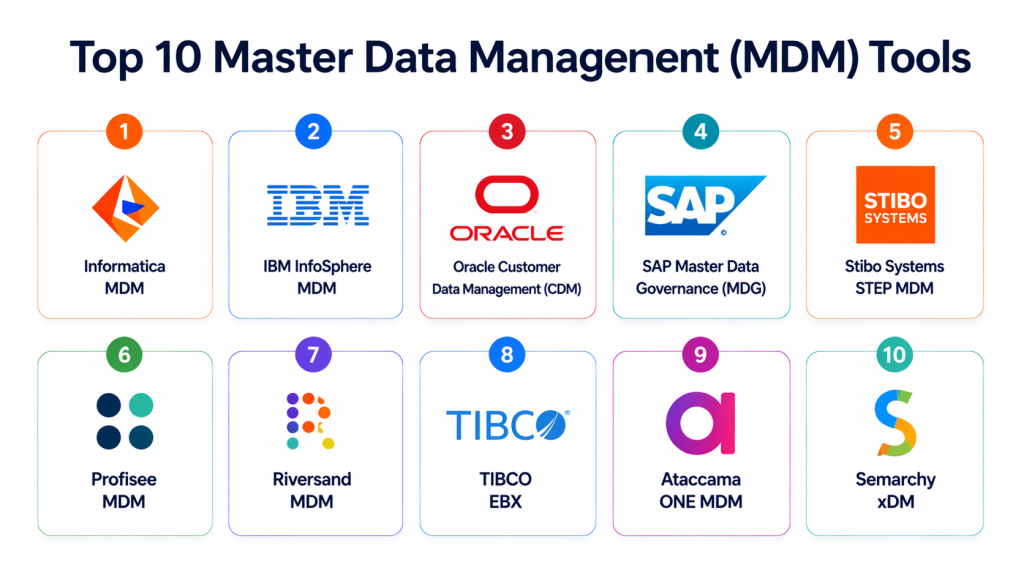
Top 10 Master Data Management (MDM) Tools
1 — Informatica MDM
Informatica MDM provides enterprise-grade master data management for multi-domain scenarios.
Key Features
- Multi-domain support (customer, product, supplier)
- Data matching and deduplication
- Workflow automation
- Data stewardship tools
- Integration with ERP/CRM
- Real-time synchronization
- Metadata management
Pros
- Highly scalable
- Strong governance features
- Reliable enterprise adoption
Cons
- High cost
- Complex setup
Platforms / Deployment
Cloud / On-premise / Hybrid
Security & Compliance
RBAC, encryption, enterprise compliance support
Integrations & Ecosystem
ERP, CRM, analytics platforms, ETL systems
Support & Community
Strong enterprise support
2 — IBM InfoSphere MDM
IBM InfoSphere MDM delivers multi-domain master data management with AI-driven capabilities.
Key Features
- Customer and product MDM
- Advanced matching algorithms
- Data governance workflows
- Real-time updates
- Data quality management
- Metadata and lineage support
- Role-based stewardship
Pros
- Strong enterprise reliability
- AI-enhanced data matching
- Scalable architecture
Cons
- Complex deployment
- Licensing cost
Platforms / Deployment
Cloud / On-premise / Hybrid
Security & Compliance
Enterprise-grade security, encryption, RBAC
Integrations & Ecosystem
ERP, CRM, BI tools, ETL systems
Support & Community
Strong IBM enterprise support
3 — Oracle Customer Data Management (CDM)
Oracle CDM centralizes customer master data for unified profiles.
Key Features
- Customer 360 view
- Data cleansing and standardization
- Duplicate detection
- Data governance workflows
- Integration with Oracle ERP/CRM
- Real-time updates
- Reporting and analytics
Pros
- Tight Oracle ecosystem integration
- Reliable customer data management
- Scalable for enterprise use
Cons
- Limited non-Oracle integrations
- Complex setup
Platforms / Deployment
Cloud / On-premise / Hybrid
Security & Compliance
Encryption, RBAC, compliance support
Integrations & Ecosystem
Oracle CRM, ERP, BI tools
Support & Community
Strong Oracle enterprise support
4 — SAP Master Data Governance (MDG)
SAP MDG provides centralized master data governance within SAP environments.
Key Features
- Centralized data hub
- Governance workflows
- Multi-domain master data
- Real-time replication
- Workflow approvals
- Data quality validation
- Integration with SAP ERP
Pros
- Seamless SAP integration
- Strong governance capabilities
- Reliable enterprise performance
Cons
- SAP ecosystem dependency
- High implementation effort
Platforms / Deployment
Cloud / On-premise
Security & Compliance
Enterprise security, RBAC, compliance features
Integrations & Ecosystem
SAP ERP, analytics, BI tools
Support & Community
Strong SAP support
5 — Stibo Systems STEP MDM
Stibo STEP is a multi-domain MDM platform designed for global enterprises.
Key Features
- Multi-domain master data
- Workflow automation
- Data validation and enrichment
- Real-time synchronization
- Data quality monitoring
- API-based integration
- Reporting and analytics
Pros
- Scalable and flexible
- Strong governance and workflow tools
- Enterprise-grade performance
Cons
- Complex setup
- Licensing cost
Platforms / Deployment
Cloud / On-premise / Hybrid
Security & Compliance
RBAC, encryption, enterprise compliance support
Integrations & Ecosystem
ERP, CRM, BI platforms, cloud services
Support & Community
Strong enterprise support
6 — Profisee MDM
Profisee provides an easy-to-use multi-domain MDM platform.
Key Features
- Multi-domain support
- Real-time data validation
- Workflow automation
- Data quality tools
- Integration with ERP/CRM
- Cloud-native architecture
- Role-based stewardship
Pros
- User-friendly
- Cost-effective
- Scalable
Cons
- Limited advanced AI features
- Smaller enterprise footprint
Platforms / Deployment
Cloud / On-premise / Hybrid
Security & Compliance
Encryption, RBAC, compliance support
Integrations & Ecosystem
ERP, CRM, BI tools
Support & Community
Growing enterprise support
7 — Riversand MDM
Riversand provides a multi-domain, cloud-native MDM solution.
Key Features
- Customer, product, supplier MDM
- AI-powered data matching
- Workflow and governance tools
- Data enrichment
- Analytics integration
- Real-time synchronization
- Metadata management
Pros
- Strong cloud-native architecture
- AI-enabled features
- Scalable for large enterprises
Cons
- Complex setup
- Costly at scale
Platforms / Deployment
Cloud / Hybrid
Security & Compliance
Encryption, RBAC, enterprise compliance
Integrations & Ecosystem
ERP, CRM, analytics platforms
Support & Community
Strong enterprise support
8 — TIBCO EBX
TIBCO EBX is a multi-domain MDM platform for centralized data management.
Key Features
- Multi-domain master data
- Data governance workflows
- Data modeling
- Real-time updates
- Workflow automation
- Data quality management
- Integration APIs
Pros
- Highly flexible
- Strong governance tools
- Scalable architecture
Cons
- Complex deployment
- High cost
Platforms / Deployment
Cloud / On-premise / Hybrid
Security & Compliance
Enterprise security, RBAC, encryption
Integrations & Ecosystem
ERP, CRM, BI tools, ETL pipelines
Support & Community
Strong enterprise support
9 — Ataccama ONE MDM
Ataccama ONE provides MDM with AI-assisted data quality and governance.
Key Features
- Multi-domain support
- AI-powered matching and deduplication
- Workflow automation
- Metadata management
- Data quality monitoring
- Real-time updates
- Self-service for business users
Pros
- AI-enhanced MDM
- Strong governance features
- Cloud-native and scalable
Cons
- Premium pricing
- Complex implementation
Platforms / Deployment
Cloud / Hybrid
Security & Compliance
Enterprise RBAC, encryption, compliance support
Integrations & Ecosystem
ERP, CRM, analytics, BI platforms
Support & Community
Strong enterprise support
10 — Semarchy xDM
Semarchy xDM is a multi-domain MDM platform with no-code configuration options.
Key Features
- Multi-domain master data
- No-code configuration
- Workflow automation
- Data quality management
- Real-time synchronization
- Integration APIs
- Reporting and analytics
Pros
- Easy to configure
- Scalable architecture
- Flexible workflow design
Cons
- Smaller enterprise footprint
- Limited AI features
Platforms / Deployment
Cloud / On-premise / Hybrid
Security & Compliance
RBAC, encryption, enterprise compliance
Integrations & Ecosystem
ERP, CRM, BI tools, ETL pipelines
Support & Community
Growing enterprise support
Comparison Table (Top 10)
| Tool | Best For | Platform | Deployment | Standout Feature | Public Rating |
|---|---|---|---|---|---|
| Informatica | Multi-domain MDM | Cross-platform | Hybrid | AI matching | N/A |
| IBM InfoSphere | Enterprise MDM | Cross-platform | Hybrid | AI-enhanced governance | N/A |
| Oracle CDM | Customer 360 | Oracle | Hybrid | Unified customer profiles | N/A |
| SAP MDG | SAP ecosystems | SAP | Hybrid | Governance workflows | N/A |
| Stibo Systems | Global MDM | Cross-platform | Hybrid | Multi-domain flexibility | N/A |
| Profisee | SMB to mid-market | Cross-platform | Hybrid | Easy to use | N/A |
| Riversand | Cloud-native MDM | Cross-platform | Cloud | AI-powered matching | N/A |
| TIBCO EBX | Multi-domain | Cross-platform | Hybrid | Flexible workflows | N/A |
| Ataccama ONE | AI-enabled MDM | Cloud / Hybrid | Cloud / Hybrid | AI deduplication | N/A |
| Semarchy xDM | No-code MDM | Cloud / Hybrid | Cloud / Hybrid | No-code configuration | N/A |
Evaluation & Scoring
| Tool | Core (25%) | Ease (15%) | Integrations (15%) | Security (10%) | Performance (10%) | Support (10%) | Value (15%) | Total |
|---|---|---|---|---|---|---|---|---|
| Informatica | 9 | 7 | 9 | 9 | 9 | 9 | 7 | 8.4 |
| IBM InfoSphere | 9 | 7 | 9 | 9 | 9 | 9 | 7 | 8.4 |
| Oracle CDM | 9 | 7 | 8 | 9 | 9 | 9 | 7 | 8.1 |
| SAP MDG | 9 | 7 | 8 | 9 | 9 | 9 | 7 | 8.1 |
| Stibo Systems | 8 | 8 | 8 | 8 | 8 | 8 | 8 | 8.0 |
| Profisee | 8 | 9 | 8 | 8 | 8 | 8 | 8 | 8.1 |
| Riversand | 9 | 7 | 8 | 9 | 9 | 9 | 7 | 8.3 |
| TIBCO EBX | 8 | 7 | 8 | 8 | 8 | 8 | 8 | 8.0 |
| Ataccama ONE | 9 | 7 | 8 | 9 | 9 | 9 | 7 | 8.3 |
| Semarchy xDM | 8 | 8 | 8 | 8 | 8 | 8 | 8 | 8.0 |
Which MDM Tool Should You Choose?
Solo or small teams can use Profisee or Semarchy xDM for easier configuration and multi-domain support. SMBs often benefit from Stibo Systems or Riversand for cloud-native flexibility and AI features. Mid-market companies can rely on Oracle CDM or SAP MDG for enterprise-grade governance and customer 360 capabilities. Large enterprises typically choose Informatica, IBM InfoSphere, or Ataccama ONE for advanced multi-domain MDM, AI-enhanced deduplication, and strong compliance support. The right tool depends on organizational size, data complexity, and integration requirements.
Frequently Asked Questions
What is Master Data Management (MDM)?
It is the process of centralizing and governing critical business data.
Why is MDM important?
It ensures a single source of truth across systems and applications.
Which domains can MDM cover?
Customer, product, supplier, employee, and other key domains.
Can MDM integrate with ERP and CRM?
Yes, all leading MDM tools integrate with ERP, CRM, and BI platforms.
Are there cloud MDM solutions?
Yes, many MDM platforms are cloud-native or hybrid.
What is multi-domain MDM?
Managing multiple master data entities within one platform.
Which tool is easiest to start with?
Profisee and Semarchy xDM are user-friendly for SMBs.
Can MDM improve data quality?
Yes, most MDM tools include data cleansing and validation features.
Do MDM tools support AI?
Many enterprise MDM tools use AI for matching and deduplication.
Is implementation complex?
Enterprise-grade MDM deployment requires planning and governance policies.
Conclusion
Master Data Management (MDM) Tools are crucial for organizations seeking a single source of truth across critical data domains. They enable accurate, consistent, and reliable data for analytics, operations, and compliance purposes. These tools reduce duplication, streamline governance, and improve collaboration between teams. Multi-domain MDM platforms provide flexibility for customer, product, and supplier data management. AI-powered features enhance matching, deduplication, and automated workflows. Cloud-native solutions offer scalability and real-time synchronization. Choosing the right MDM solution depends on organizational size, data complexity, and integration needs. A pilot deployment helps validate the tool’s fit and scalability before enterprise-wide adoption. Effective MDM drives data trust, operational efficiency, and better decision-making across the organization.