Introduction
Reverse ETL Tools are platforms that move data from a data warehouse back into operational systems such as CRM, marketing platforms, customer support tools, and sales applications. Unlike traditional ETL pipelines that bring data into a warehouse, Reverse ETL focuses on activating warehouse data so business teams can use it in daily operations.
In modern data stacks, companies store clean and enriched data in warehouses like Snowflake, BigQuery, and Redshift. However, this data often remains unused in business tools. Reverse ETL solves this problem by syncing warehouse data into applications where decisions and actions happen.
Common use cases include customer segmentation, personalized marketing campaigns, sales lead scoring, customer success insights, product personalization, and revenue operations automation.
Key evaluation factors include sync reliability, real-time capability, integration coverage, data transformation flexibility, scalability, monitoring, security, and ease of use.
Best for data teams, growth teams, RevOps, marketing teams, and SaaS companies. Not ideal for organizations without a mature data warehouse.
Key Trends in Reverse ETL Tools
- Shift toward real-time data activation
- Strong adoption of warehouse-native architectures
- Growth of customer 360 data platforms
- Increased automation in marketing and sales workflows
- Expansion of no-code and low-code tools
- Strong API-first integration ecosystems
- Rising importance of data governance and lineage
- AI-driven segmentation and personalization
- Multi-source and multi-destination syncing
- Growing use in revenue operations (RevOps)
How We Selected These Tools (Methodology)
- Market adoption across SaaS and enterprise companies
- Integration support with major data warehouses
- Reliability and sync performance
- Real-time and batch processing capabilities
- Ease of setup and usability
- Security and compliance readiness
- Scalability for large datasets
- Error handling and monitoring features
- Ecosystem maturity and vendor support
- Real-world production usage
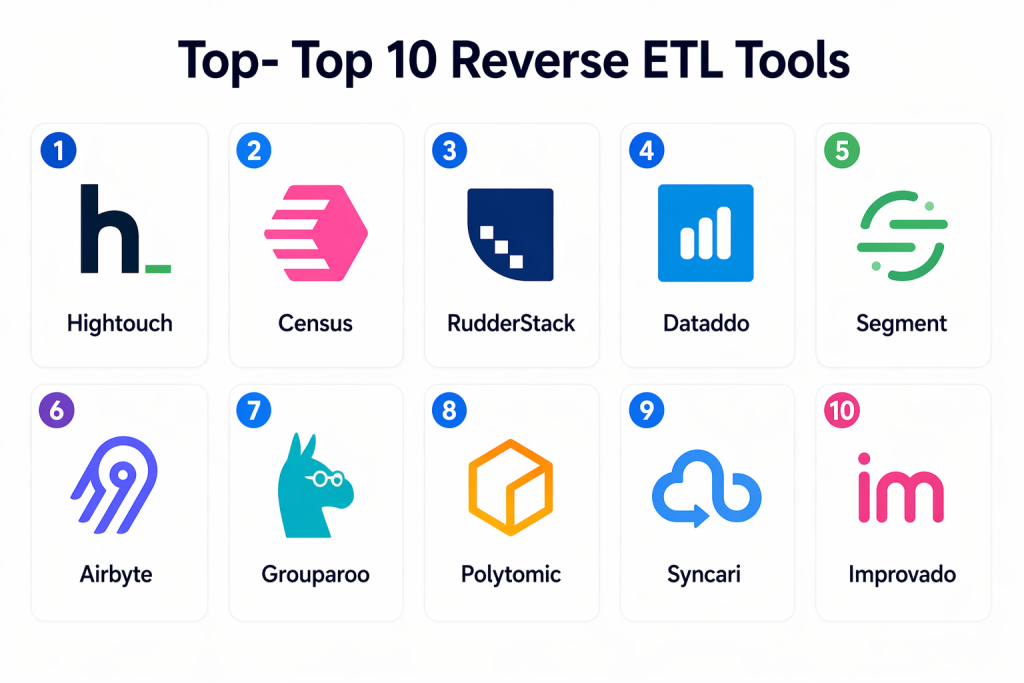
Top 10 Reverse ETL Tools
1 — Hightouch
Hightouch is one of the most widely used Reverse ETL platforms designed for warehouse-native data activation.
Key Features
- Warehouse-native architecture
- Real-time data syncing
- No-code audience builder
- Strong CRM integrations
- Flexible data transformations
- Sync monitoring and alerts
- Automated workflows
Pros
- Very easy to use
- Strong integration ecosystem
- Real-time activation
Cons
- Can be expensive at scale
- Requires mature warehouse setup
Platforms / Deployment
Cloud
Security & Compliance
RBAC, encryption, enterprise compliance support
Integrations & Ecosystem
Salesforce, HubSpot, marketing tools, BI platforms, data warehouses
Support & Community
Strong enterprise adoption
2 — Census
Census is a powerful Reverse ETL tool focused on SQL-based data activation from warehouses.
Key Features
- SQL-based audience creation
- Real-time and batch syncing
- Wide destination support
- Data modeling tools
- Automated sync scheduling
- Schema mapping
- Monitoring dashboards
Pros
- Strong SQL workflow support
- Reliable syncing
- Easy integration setup
Cons
- Requires data warehouse maturity
- Advanced features are paid
Platforms / Deployment
Cloud
Security & Compliance
Encryption, RBAC, enterprise security
Integrations & Ecosystem
CRM tools, marketing platforms, data warehouses, analytics systems
Support & Community
Strong SaaS adoption
3 — RudderStack
RudderStack is a warehouse-native customer data platform with Reverse ETL capabilities.
Key Features
- API-first architecture
- Warehouse-native CDP model
- Real-time data pipelines
- Identity resolution
- Multi-destination syncing
- Data transformation support
- Event tracking
Pros
- Highly flexible
- Developer-friendly
- Strong CDP + Reverse ETL combo
Cons
- Requires technical setup
- Steeper learning curve
Platforms / Deployment
Cloud / Self-hosted / Hybrid
Security & Compliance
Encryption, RBAC, enterprise-grade security
Integrations & Ecosystem
Analytics tools, CRM systems, marketing platforms, warehouses
Support & Community
Strong developer ecosystem
4 — Dataddo
Dataddo is a no-code Reverse ETL and data integration platform designed for simplicity.
Key Features
- No-code pipeline builder
- Wide SaaS connectors
- Automated syncing
- Real-time data movement
- Cloud-based architecture
- Flexible mapping tools
- Monitoring dashboard
Pros
- Very easy to use
- Fast setup
- Good for SMBs
Cons
- Limited advanced transformations
- Less control for engineers
Platforms / Deployment
Cloud
Security & Compliance
Encryption, RBAC, compliance support
Integrations & Ecosystem
CRM systems, marketing tools, BI platforms, warehouses
Support & Community
SMB-focused support
5 — Segment (Twilio Segment)
Segment is a customer data platform that also supports Reverse ETL functionality.
Key Features
- Customer data unification
- Warehouse syncing
- Identity resolution
- Event tracking
- Audience segmentation
- Real-time pipelines
- API-first design
Pros
- Strong enterprise adoption
- Robust data pipelines
- Unified customer view
Cons
- Expensive
- Complex implementation
Platforms / Deployment
Cloud
Security & Compliance
Enterprise security, encryption, RBAC
Integrations & Ecosystem
Marketing tools, CRM systems, analytics platforms, warehouses
Support & Community
Strong enterprise support
6 — Airbyte
Airbyte is an open-source data integration platform that also supports Reverse ETL workflows.
Key Features
- Open-source architecture
- Large connector ecosystem
- Batch syncing
- API-first design
- Self-hosted or cloud options
- Data pipeline customization
- ELT + Reverse ETL support
Pros
- Open-source flexibility
- Highly customizable
- Strong community support
Cons
- Requires engineering effort
- Not fully plug-and-play
Platforms / Deployment
Cloud / Self-hosted / Hybrid
Security & Compliance
Encryption, RBAC, enterprise features
Integrations & Ecosystem
Warehouses, APIs, SaaS tools, analytics platforms
Support & Community
Strong open-source ecosystem
7 — Grouparoo
Grouparoo is an open-source Reverse ETL tool focused on syncing warehouse data into business applications.
Key Features
- SQL-based audience creation
- Real-time syncing
- Plugin-based architecture
- Data modeling tools
- Automation workflows
- Flexible destinations
- Open-source design
Pros
- Cost-effective
- Highly customizable
- Open-source flexibility
Cons
- Requires technical expertise
- Smaller ecosystem
Platforms / Deployment
Self-hosted / Cloud
Security & Compliance
Encryption, RBAC support
Integrations & Ecosystem
CRM tools, marketing platforms, warehouses
Support & Community
Community-driven support
8 — Polytomic
Polytomic is a modern Reverse ETL tool focused on data syncing and operational automation.
Key Features
- SQL-based syncing
- Real-time activation
- CRM integrations
- Automated workflows
- Data transformation support
- Monitoring dashboards
- Secure data handling
Pros
- Easy to use
- Reliable syncing
- Good performance
Cons
- Smaller ecosystem
- Limited advanced features
Platforms / Deployment
Cloud
Security & Compliance
Encryption, RBAC, enterprise compliance
Integrations & Ecosystem
Salesforce, HubSpot, warehouses, BI tools
Support & Community
Growing enterprise adoption
9 — Syncari
Syncari is a data automation platform that includes Reverse ETL capabilities for syncing and governance.
Key Features
- Multi-system data sync
- Data automation workflows
- Unified data management
- No-code interface
- Data governance tools
- Real-time synchronization
- Data quality management
Pros
- Strong automation features
- Good enterprise governance
- Unified data control
Cons
- Complex for beginners
- Enterprise pricing
Platforms / Deployment
Cloud
Security & Compliance
RBAC, encryption, governance controls
Integrations & Ecosystem
CRM systems, SaaS platforms, warehouses
Support & Community
Strong enterprise support
10 — Improvado
Improvado is a marketing-focused Reverse ETL and data integration platform.
Key Features
- Marketing data integration
- Automated data pipelines
- Multi-source data aggregation
- Reporting automation
- Real-time data syncing
- ETL + Reverse ETL support
- Marketing analytics focus
Pros
- Strong marketing use cases
- Easy reporting automation
- Good data consolidation
Cons
- Marketing-focused only
- Limited general-purpose use
Platforms / Deployment
Cloud
Security & Compliance
Encryption, RBAC, compliance support
Integrations & Ecosystem
Marketing platforms, CRM systems, analytics tools, warehouses
Support & Community
Strong marketing enterprise support
Comparison Table (Top 10)
| Tool | Best For | Platform | Deployment | Standout Feature | Public Rating |
|---|---|---|---|---|---|
| Hightouch | Real-time activation | Cloud | Cloud | Warehouse-native sync | N/A |
| Census | SQL workflows | Cloud | Cloud | Audience builder | N/A |
| RudderStack | Developer CDP | Cross-platform | Hybrid | API-first architecture | N/A |
| Dataddo | SMB automation | Cloud | Cloud | No-code pipelines | N/A |
| Segment | Enterprise CDP | Cloud | Cloud | Identity resolution | N/A |
| Airbyte | Open-source ETL | Cross-platform | Hybrid | Connector ecosystem | N/A |
| Grouparoo | Open-source activation | Cross-platform | Self-hosted | SQL audience sync | N/A |
| Polytomic | Data syncing | Cloud | Cloud | Simple workflows | N/A |
| Syncari | Data automation | Cloud | Cloud | Unified data control | N/A |
| Improvado | Marketing analytics | Cloud | Cloud | Marketing ETL focus | N/A |
Evaluation & Scoring
| Tool | Core (25%) | Ease (15%) | Integrations (15%) | Security (10%) | Performance (10%) | Support (10%) | Value (15%) | Total |
|---|---|---|---|---|---|---|---|---|
| Hightouch | 9 | 9 | 9 | 9 | 9 | 9 | 8 | 8.9 |
| Census | 9 | 8 | 9 | 9 | 9 | 9 | 8 | 8.7 |
| RudderStack | 9 | 8 | 9 | 8 | 9 | 8 | 9 | 8.6 |
| Dataddo | 7 | 10 | 8 | 8 | 8 | 8 | 9 | 8.1 |
| Segment | 9 | 7 | 9 | 9 | 9 | 9 | 7 | 8.4 |
| Airbyte | 9 | 7 | 9 | 8 | 9 | 8 | 9 | 8.5 |
| Grouparoo | 8 | 7 | 8 | 8 | 8 | 7 | 9 | 8.0 |
| Polytomic | 8 | 8 | 8 | 8 | 9 | 8 | 8 | 8.3 |
| Syncari | 9 | 7 | 8 | 9 | 9 | 9 | 8 | 8.5 |
| Improvado | 8 | 8 | 8 | 8 | 8 | 8 | 7 | 8.0 |
Which Reverse ETL Tool Should You Choose?
Solo teams and startups can start with Dataddo or Airbyte for simple and flexible pipelines. SMBs often prefer Hightouch or Census for strong warehouse activation. Mid-market companies benefit from RudderStack or Polytomic for scalable workflows. Enterprises typically choose Segment or Syncari for advanced governance and customer data activation. Marketing-focused teams benefit most from Improvado. The right tool depends on data maturity, integration needs, and real-time activation requirements.
Frequently Asked Questions
What is Reverse ETL?
It is the process of moving data from a warehouse into business applications.
Why is Reverse ETL important?
It helps activate warehouse data for operational use cases.
What is Hightouch used for?
It is used to sync warehouse data into CRM and marketing tools.
Is Reverse ETL real-time?
Many tools support real-time or near real-time syncing.
Do I need a data warehouse for Reverse ETL?
Yes, it is typically required.
Which tools are best for Reverse ETL?
Hightouch, Census, and RudderStack are widely used.
Can Reverse ETL replace CDPs?
Warehouse-native CDPs can replace traditional CDPs in some cases.
Is Reverse ETL expensive?
Pricing depends on data volume and tool selection.
What industries use Reverse ETL?
SaaS, fintech, e-commerce, and marketing-driven companies.
Is coding required?
Some tools are no-code, while others require SQL or engineering skills.
Conclusion
Reverse ETL Tools are essential for modern data-driven organizations that want to activate warehouse data in operational systems. They bridge the gap between analytics and execution by syncing clean, structured data into CRM, marketing, and sales tools. Each platform offers different strengths in automation, scalability, and integration depth. The right choice depends on organizational maturity and real-time data needs. A pilot implementation is recommended before scaling across the business.