Introduction
DNS Management Tools are platforms that help organizations manage, configure, monitor, and optimize Domain Name System (DNS) records and infrastructure. DNS acts as the backbone of the internet by translating domain names into IP addresses, ensuring users can access applications and services reliably.
In modern IT environments where businesses rely on cloud services, global applications, and high-availability architectures, DNS is critical for performance, uptime, and security. Misconfigured DNS can lead to outages, slow response times, or even security risks. DNS management tools provide automation, traffic routing, failover mechanisms, and real-time monitoring to ensure resilient and efficient DNS operations.
Real-World Use Cases
- Managing domain and DNS records
- Implementing failover and high availability
- Routing traffic across regions or servers
- Monitoring DNS performance and uptime
- Enhancing DNS security and protection
What Buyers Should Evaluate
- DNS record management and automation
- Global traffic routing and load balancing
- DNS failover and redundancy
- Security features (DDoS protection, DNSSEC)
- Integration with cloud platforms
- Performance and latency optimization
- Ease of use and API support
- Pricing and scalability
Best for: DevOps teams, IT operations teams, cloud architects, and organizations running web applications or distributed systems.
Not ideal for: Individuals with simple domain needs or basic hosting setups.
Key Trends in DNS Management Tools
- AI-driven traffic routing and optimization
- Integration with cloud-native infrastructure
- Adoption of Anycast DNS networks
- Increased focus on DNS security (DNSSEC, DDoS protection)
- Automation via APIs and Infrastructure as Code
- Real-time performance monitoring
- Multi-cloud and hybrid DNS strategies
- Integration with CDNs and edge computing
- Zero-trust and secure DNS frameworks
- Developer-friendly platforms with API-first design
How We Selected These Tools (Methodology)
- Strong global adoption and reliability
- Advanced DNS management and routing capabilities
- Integration with cloud and DevOps ecosystems
- Performance and uptime guarantees
- Security and compliance considerations
- Ease of use and automation features
- Scalability for global applications
- Balance between enterprise and developer-friendly tools
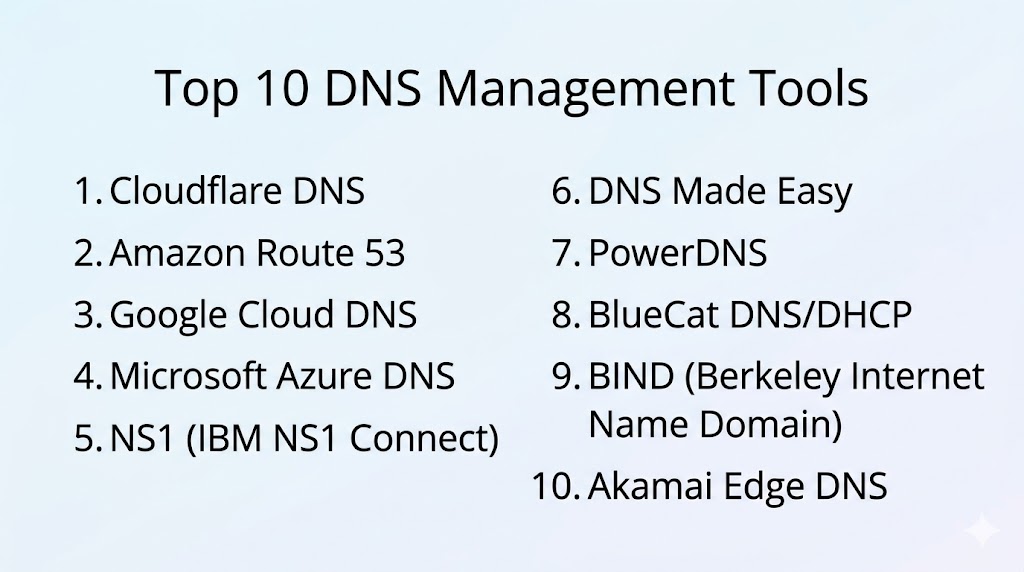
Top 10 DNS Management Tools
#1 — Cloudflare DNS
Short description: A widely used DNS platform offering fast performance, security, and global reach.
Key Features
- Anycast DNS network
- DDoS protection
- DNSSEC support
- Traffic routing
- Analytics
Pros
- Fast and reliable
- Strong security features
Cons
- Advanced features require paid plans
- Vendor ecosystem dependency
Platforms / Deployment
Web
Cloud
Security & Compliance
DNSSEC, DDoS protection
Not publicly stated
Integrations & Ecosystem
- CDN
- Security tools
- DevOps tools
Support & Community
Large global community
#2 — Amazon Route 53
Short description: A scalable DNS service integrated with AWS cloud infrastructure.
Key Features
- Traffic routing policies
- Health checks
- Failover support
- Integration with AWS
- Global DNS network
Pros
- Highly scalable
- Deep AWS integration
Cons
- Complex pricing
- AWS dependency
Platforms / Deployment
Web
Cloud
Security & Compliance
RBAC, encryption
Not publicly stated
Integrations & Ecosystem
- AWS services
- DevOps tools
Support & Community
Strong support
#3 — Google Cloud DNS
Short description: A managed DNS service for high-performance and scalable applications.
Key Features
- Global DNS infrastructure
- High availability
- API support
- Integration with GCP
- Automation
Pros
- Reliable
- Easy integration with GCP
Cons
- Limited advanced features
- Cloud dependency
Platforms / Deployment
Web
Cloud
Security & Compliance
Not publicly stated
Integrations & Ecosystem
- Google Cloud
- DevOps tools
Support & Community
Vendor support
#4 — Microsoft Azure DNS
Short description: A cloud-based DNS hosting service integrated with Azure.
Key Features
- DNS record management
- Global availability
- Integration with Azure
- Automation
- High reliability
Pros
- Strong Azure integration
- Scalable
Cons
- Limited outside Azure ecosystem
- Pricing
Platforms / Deployment
Web
Cloud
Security & Compliance
Not publicly stated
Integrations & Ecosystem
- Azure services
- DevOps tools
Support & Community
Enterprise support
#5 — NS1 (IBM NS1 Connect)
Short description: An advanced DNS platform focused on performance and traffic management.
Key Features
- Intelligent traffic routing
- API-first design
- Real-time monitoring
- Automation
- Analytics
Pros
- Advanced routing capabilities
- Developer-friendly
Cons
- Pricing
- Complex setup
Platforms / Deployment
Web
Cloud
Security & Compliance
Not publicly stated
Integrations & Ecosystem
- DevOps tools
- Cloud platforms
Support & Community
Enterprise support
#6 — Akamai Edge DNS
Short description: A high-performance DNS solution integrated with Akamai’s CDN.
Key Features
- Global Anycast network
- DDoS protection
- Traffic routing
- Analytics
- Integration with CDN
Pros
- High performance
- Enterprise-grade
Cons
- Expensive
- Complex setup
Platforms / Deployment
Web
Cloud
Security & Compliance
DDoS protection
Not publicly stated
Integrations & Ecosystem
- CDN
- Security tools
Support & Community
Enterprise support
#7 — Dyn (Oracle Dyn DNS)
Short description: A managed DNS service focused on performance and reliability.
Key Features
- Traffic management
- Failover
- Monitoring
- Analytics
- API support
Pros
- Reliable
- Good performance
Cons
- Limited availability updates
- Pricing
Platforms / Deployment
Web
Cloud
Security & Compliance
Not publicly stated
Integrations & Ecosystem
- Cloud tools
- DevOps tools
Support & Community
Vendor support
#8 — PowerDNS
Short description: An open-source DNS server with flexible management capabilities.
Key Features
- DNS server software
- API support
- Scalability
- Automation
- Security features
Pros
- Open-source
- Flexible
Cons
- Requires setup
- Limited UI
Platforms / Deployment
Linux
Self-hosted
Security & Compliance
Not publicly stated
Integrations & Ecosystem
- DevOps tools
- APIs
Support & Community
Active community
#9 — GoDaddy DNS
Short description: A simple DNS management solution integrated with domain services.
Key Features
- DNS record management
- Domain integration
- Basic routing
- Security features
- Easy setup
Pros
- Easy to use
- Beginner-friendly
Cons
- Limited advanced features
- Not enterprise-ready
Platforms / Deployment
Web
Cloud
Security & Compliance
Not publicly stated
Integrations & Ecosystem
- Domain services
Support & Community
Vendor support
#10 — DNS Made Easy
Short description: A high-performance managed DNS service for businesses.
Key Features
- Global DNS network
- Failover support
- Monitoring
- Analytics
- API access
Pros
- Reliable
- Good performance
Cons
- Pricing
- Limited ecosystem
Platforms / Deployment
Web
Cloud
Security & Compliance
Not publicly stated
Integrations & Ecosystem
- DevOps tools
- APIs
Support & Community
Vendor support
Comparison Table (Top 10)
| Tool Name | Best For | Platform(s) Supported | Deployment | Standout Feature | Public Rating |
|---|---|---|---|---|---|
| Cloudflare | Global apps | Web | Cloud | Security | N/A |
| Route 53 | AWS users | Web | Cloud | Scalability | N/A |
| Google DNS | GCP users | Web | Cloud | Reliability | N/A |
| Azure DNS | Azure users | Web | Cloud | Integration | N/A |
| NS1 | Advanced routing | Web | Cloud | API-first | N/A |
| Akamai | Enterprise | Web | Cloud | Performance | N/A |
| Dyn | Reliability | Web | Cloud | Traffic mgmt | N/A |
| PowerDNS | Open-source | Linux | Self-hosted | Flexibility | N/A |
| GoDaddy | Beginners | Web | Cloud | Simplicity | N/A |
| DNS Made Easy | SMB | Web | Cloud | Performance | N/A |
Evaluation & Scoring of DNS Management Tools
| Tool Name | Core | Ease | Integrations | Security | Performance | Support | Value | Weighted Total |
|---|---|---|---|---|---|---|---|---|
| Cloudflare | 10 | 9 | 9 | 10 | 10 | 9 | 9 | 9.5 |
| Route 53 | 10 | 8 | 10 | 9 | 10 | 9 | 8 | 9.2 |
| Google DNS | 9 | 9 | 9 | 8 | 9 | 8 | 9 | 8.9 |
| Azure DNS | 9 | 8 | 9 | 8 | 9 | 9 | 8 | 8.8 |
| NS1 | 9 | 7 | 9 | 9 | 9 | 9 | 7 | 8.6 |
| Akamai | 10 | 7 | 8 | 10 | 10 | 9 | 6 | 8.8 |
| Dyn | 9 | 8 | 8 | 8 | 9 | 8 | 7 | 8.3 |
| PowerDNS | 8 | 7 | 8 | 7 | 8 | 7 | 10 | 8.1 |
| GoDaddy | 7 | 10 | 6 | 7 | 8 | 7 | 9 | 7.9 |
| DNS Made Easy | 8 | 8 | 7 | 7 | 9 | 7 | 8 | 8.0 |
How to interpret scores:
These scores compare tools based on performance, usability, and value. Enterprise platforms excel in scalability and security, while simpler tools offer ease of use and affordability.
Which DNS Management Tool Is Right for You?
Solo / Freelancer
GoDaddy DNS or Cloudflare for simplicity.
SMB
DNS Made Easy or Google Cloud DNS for balance.
Mid-Market
Route 53 and Azure DNS for scalability.
Enterprise
Cloudflare, Akamai, or NS1 for advanced capabilities.
Budget vs Premium
- Budget: PowerDNS
- Premium: Akamai, Cloudflare
Feature Depth vs Ease of Use
- Feature-rich: NS1
- Easy-to-use: GoDaddy
Integrations & Scalability
- Best integrations: Route 53
- Scalable: Cloudflare
Security & Compliance Needs
- Strong security: Cloudflare, Akamai
- Moderate: Google DNS
Frequently Asked Questions (FAQs)
What is DNS management?
It involves managing domain name records and routing.
Why is DNS important?
It enables users to access websites and services.
Do DNS tools improve performance?
Yes, through optimized routing and caching.
Are these tools cloud-based?
Most modern tools are cloud-based.
Do they support automation?
Yes, many tools provide APIs.
Can small teams use them?
Yes, many tools support SMB use cases.
What is DNSSEC?
A security extension for DNS.
Do they support failover?
Yes, most tools include failover capabilities.
Are they secure?
Security features vary by tool.
What is the best tool overall?
Depends on your infrastructure.
Conclusion
DNS Management Tools are essential for ensuring reliable, fast, and secure access to applications and services. By providing advanced routing, automation, and monitoring capabilities, these tools help organizations maintain high availability and optimize performance. Whether you choose enterprise-grade solutions like Cloudflare and Akamai or flexible options like PowerDNS and Route 53, the right tool depends on your scale, infrastructure, and security needs. Start by evaluating your requirements, testing a few tools, and selecting the one that best aligns with your operational goals.