Introduction
The landscape of software development is undergoing a massive shift. In the past, writing code and managing servers were two completely different jobs. Today, those worlds have merged. The DevOps Certified Professional (DCP) is a credential that shows you understand this merger. It is not just about learning a few tools; it is about understanding a new way of working where speed and stability go hand in hand.
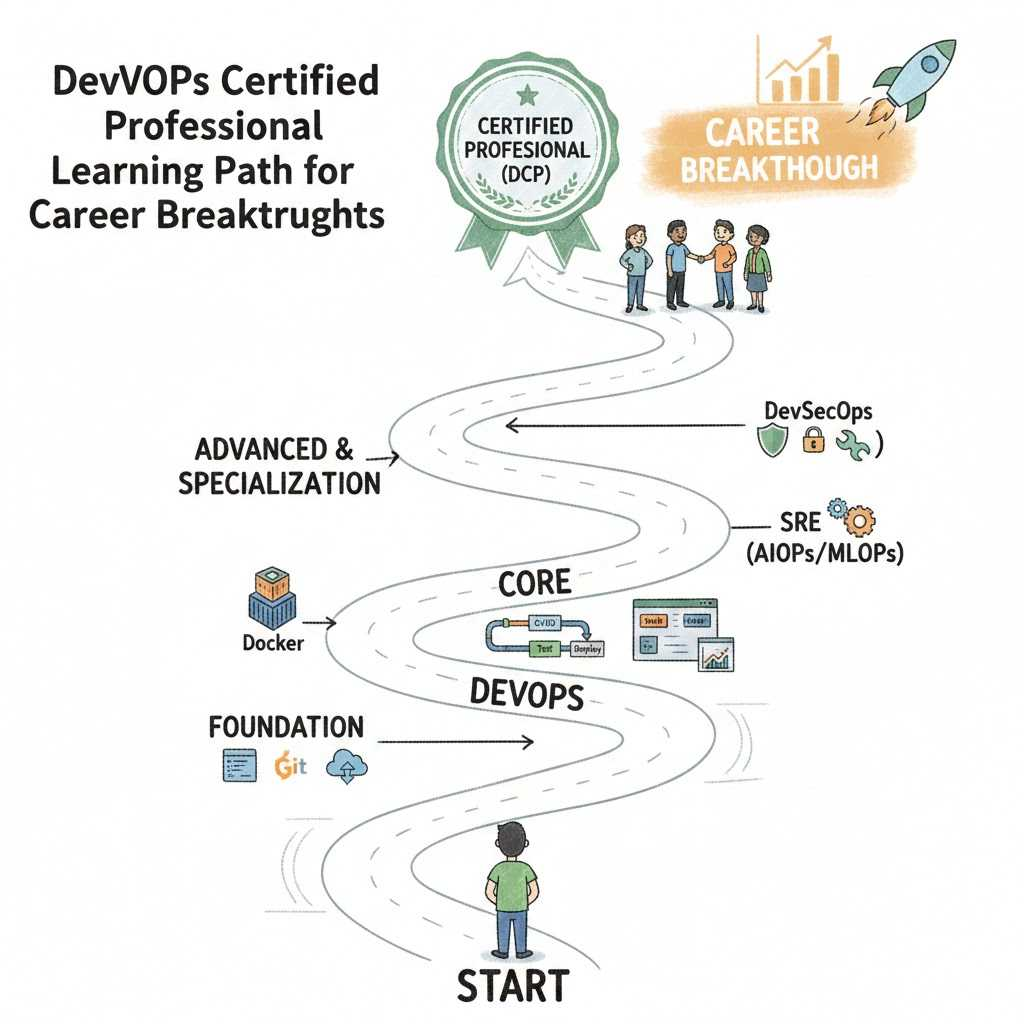
For engineers and managers, certifications act as a bridge. They take the messy, vast world of “Cloud and Automation” and turn it into a step-by-step learning journey. When a professional holds a DCP, it signals to the industry that they possess a standardized set of skills that are ready to be applied to high-stakes, real-world projects.
Summary of Certification Details
| Category | Difficulty | Target Group | Requirements | Core Knowledge | Suggested Sequence |
| DevOps | Pro | Tech Workers & Leads | IT Basics | CI/CD, Containers, Git | Start Here |
Why should you pick DevOpsSchool for your journey?
Choosing the right place to learn is just as important as the subject itself. DevOpsSchool stands out because the focus is entirely on the practical side of technology. Instead of just reading slides, students are pushed to work on actual systems. The mentors here are not just teachers; they are veterans who have managed massive server infrastructures for years. This ensures that the knowledge you receive is not just theoretical but something you can actually use in your daily job to solve problems and automate boring tasks.
Detailed Breakdown: DevOps Certified Professional (DCP)
What exactly is this program?
The DevOps Certified Professional (DCP) is a specialized training path created to teach the full cycle of modern software delivery. It focuses on how to make the journey from “writing a line of code” to “having that code run for millions of users” as smooth and automated as possible. It covers everything from version control to automated testing and deployment.
Who is this training meant for?
This is designed for anyone currently working in the IT space. Whether you are a developer who is tired of waiting for servers to be ready, or a system admin who wants to start writing code to manage infrastructure, this path is for you. It is also highly valuable for project leads who need to understand how their teams are actually deploying software in the modern age.
Knowledge you will acquire
- Mastering Version Control: You will learn how to manage code changes efficiently using Git.
- Automation Pipelines: Understanding how to build a CI/CD flow that tests and deploys code automatically.
- Container Management: Learning how to package applications inside Docker so they run perfectly on any machine.
- Infrastructure Basics: Gaining the ability to treat servers and networks like code that can be easily duplicated.
- System Health Monitoring: Learning how to keep an eye on your applications and get alerts before things break.
Practical tasks you will master
- Building a system that automatically checks for errors every time a developer saves their work.
- Creating a “portable” version of a website using containers that can be moved from a laptop to the cloud instantly.
- Setting up dashboards that show exactly how much memory and CPU your apps are using in real-time.
Study Timelines
- The 2-Week Sprint: In this short window, you should focus entirely on the “big picture.” Learn the terminology and get comfortable with basic Git commands and what a Dockerfile looks like.
- The 30-Day Path: Spend this month setting up your first Jenkins or GitLab pipeline. Move beyond theory and try to get a simple “Hello World” app to deploy automatically to a test server.
- The 60-Day Deep Dive: This is where you master the “hard stuff.” Practice handling failures in your pipeline, learn how to secure your containers, and try deploying more complex apps that require databases and cache layers.
Frequent Pitfalls to Bypass
- Tool Overload: Many people try to learn 50 tools at once. It is much better to master the concepts of automation using just two or three core tools first.
- Ignoring the “Ops” in DevOps: Don’t forget that at the end of the day, someone has to keep the server running. Don’t ignore basic Linux and networking skills.
- Skipping Documentation: Always write down how you built your system. If you can’t explain it, you haven’t mastered it.
Where to go from here?
- In the same field: Master of DevOps.
- Expanding your horizon: Site Reliability Engineering (SRE).
- Moving into leadership: Certified DevOps Manager.
Selecting Your Career Direction
1. The Automation Specialist (DevOps)
This is the most common path. It is for people who love to build the “pipes” that carry code from the developer to the customer. It is all about speed and removing manual work.
2. The Security-First Path (DevSecOps)
If you enjoy finding bugs and keeping hackers out, this is for you. You will learn how to put “security gates” inside the automation pipeline so that unsafe code never reaches the public.
3. The Reliability Path (SRE)
This path is for those who are obsessed with stability. SREs make sure that even if a server dies, the website stays up. It involves a lot of smart engineering to handle disasters.
4. The Intelligent Ops Path (AIOps / MLOps)
As AI becomes more common, we need people who can manage AI models. This path teaches you how to treat an AI model just like a piece of software and automate its lifecycle.
5. The Data Flow Path (DataOps)
Data is the new gold, but it’s hard to manage. This path focuses on making sure data moves quickly and accurately from one system to another without getting corrupted.
6. The Financial Efficiency Path (FinOps)
Cloud bills can get very expensive. This path is for people who want to bridge the gap between the finance department and the tech department to keep costs low.
Job Role to Training Alignment
- DevOps Engineer: Focus on DevOps Certified Professional (DCP) and Jenkins.
- Site Reliability Engineer: Focus on SRE Foundation and Kubernetes.
- Platform Engineer: Look into Terraform and Cloud-specific training.
- Cloud Engineer: Target Professional Cloud Architect tracks.
- Security Engineer: Choose the DevSecOps Professional path.
- Data Engineer: Prioritize DataOps certifications.
- FinOps Specialist: Focus on Cloud Financial Management.
- Technical Manager: Focus on DevOps Leadership and Strategy.
Growth Recommendations
- Keep Moving Forward: Advanced Pipeline Automation.
- Broaden Your Skills: Cloud Security Architect.
- Lead the Way: Strategic IT Operations Management.
Where to Find Support and Training
DevOpsSchool
This institution is known for its wide range of courses and deep technical support. It is a one-stop shop for anyone looking to get certified in any DevOps-related field.
Cotocus
A highly professional group that focuses on high-end consulting and technical training. They help individuals and companies master the cloud with ease.
ScmGalaxy
A massive community resource. If you are looking for guides, troubleshooting tips, or news about configuration management, this is the place to be.
BestDevOps
This platform makes learning DevOps very simple. They break down hard topics into easy-to-digest lessons that any beginner can follow.
devsecopsschool.com
This is the primary place to go if you want to learn how to keep your automated systems safe from digital threats.
sreschool.com
A dedicated site for learning how to build systems that never go down. They focus heavily on the Google-born SRE principles.
aiopsschool.com
The future of IT is AI. This school teaches you how to use machine learning to make your IT operations smarter and faster.
dataopsschool.com
If you deal with massive amounts of data, this school provides the framework to manage it effectively using DevOps ideas.
finopsschool.com
Learn the art of cloud cost optimization here. It is the best place to understand how to save money while staying in the cloud.
Frequently Asked Questions
General Information
- How hard is the DCP exam?
It is designed to be fair. If you have done the labs and understand the flow, you will pass. - How long should I study?
Most people find that 6 to 8 weeks of steady study is the “sweet spot.” - Do I need to be a coder?
You don’t need to be a software developer, but being comfortable with simple scripts is a huge help. - Which certification should I do first?
The DCP is the perfect foundation before you try more specialized tracks. - Will this help my salary?
Generally, certified professionals see a significant bump in their market value and job offers. - Is it okay for managers?
Absolutely. Managers need to know what their engineers are doing to lead effectively. - Can I take the test from home?
Yes, the exam process is fully digital and can be done remotely. - How long does the certificate last?
It is standard for these to be refreshed every couple of years to keep your skills current. - Is it tied to AWS or Azure?
No, it teaches the core tools that work on any cloud or even on your own private servers. - Do I need a lab environment?
Yes, practicing in a lab is the most important part of the learning process. - I’m a beginner, is this for me? If you have a year or two in IT, you are ready. Total beginners might need a few weeks of “IT basics” first.
- Is this recognized in other countries?
Yes, the skills taught are universal and used by tech companies globally.
DCP Specifics
13. Do we learn about Docker?
Yes, learning how to “containerize” apps is a major part of the course.
14. Is Jenkins covered?
Yes, Jenkins is one of the primary tools used to teach CI/CD in this program.
15. Will I learn about monitoring?
Yes, you will learn how to use tools to see if your website is healthy or lagging.
16. Is Linux knowledge a must?
You should know your way around a terminal, but the course will help you improve.
17. Are there real projects?
Yes, the training is built around finishing actual tasks that mimic a real job.
18. Can I do this while working full-time?
Yes, many students spend an hour or two each evening on their studies.
19. Does the course cover Git? Yes, you will start with Git because it is the foundation of all DevOps work.
20. Is there a community to help me? Yes, you will usually have access to a group of peers and mentors for questions.
Feedback from the Community
Aarav
“The way the lessons were structured made it very easy to follow. I finally understand how to automate the stuff I used to do by hand every single day.”
Ishani
“I was worried about the technical depth, but the mentors made it simple. My confidence in managing cloud servers has grown so much since I finished.”
Rohan
“This was exactly what I needed to move from a basic admin role into a high-level engineer position. The practical labs were the best part.”
Ananya
“Even with years of experience, I found the structured approach very helpful. It filled in a lot of small gaps I didn’t even know I had.”
Vikram
“As a lead, I needed to understand the ‘why’ behind DevOps. This program gave me the clarity to guide my team toward better automation.”
Final Thoughts
The DevOps Certified Professional (DCP) is a milestone in any modern tech career. It provides a clear, documented proof of your ability to handle the complexities of today’s software world. By investing the time to learn these skills now, you are securing your place in the future of the industry. It is a journey of continuous improvement that pays off in both career stability and professional satisfaction.