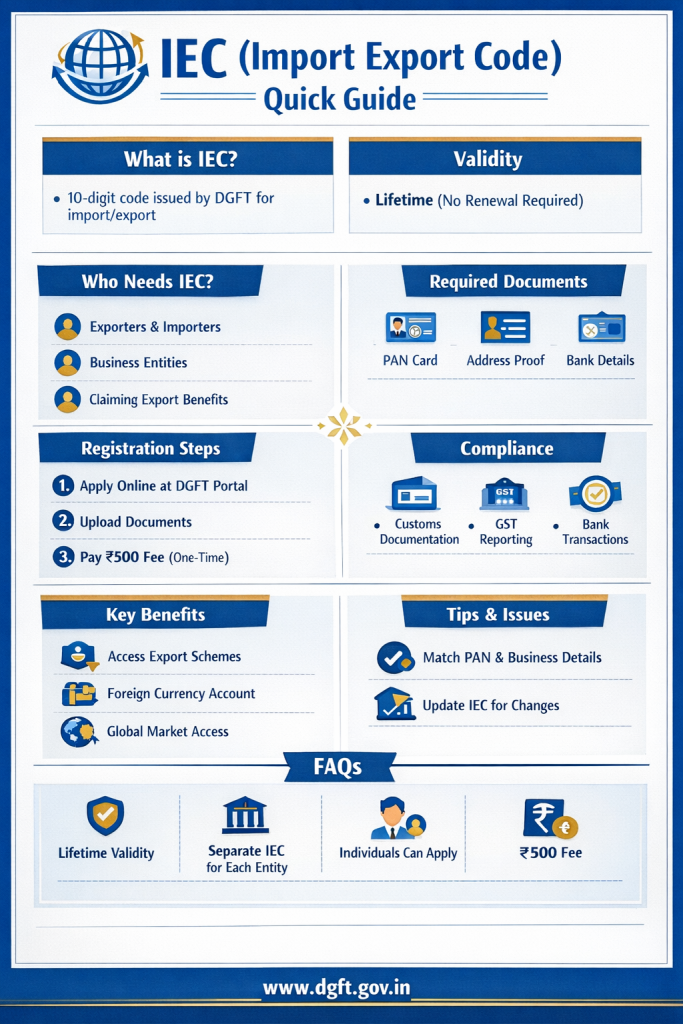
If you are planning to import or export goods and services from India, the Import Export Code (IEC is the essential starting point. The IEC is a 10-digit unique code issued by the Directorate General of Foreign Trade (DGFT) to identify your business for international trade. It is mandatory for anyone wishing to engage in cross-border trade, claim export benefits, or open foreign currency accounts.
This guide will walk you through what IEC is, who needs it, how to register, compliance requirements, benefits, and tips for smooth international trading. By the end, you’ll have a comprehensive understanding of IEC and its role in global business.
Why this matters: Without an IEC, you cannot legally conduct import-export activities in India, and you may miss out on government incentives for exporters.
What is IEC (Import Export Code)?
The Import Export Code (IEC) is a unique 10-digit number that identifies your business as a legal importer or exporter in India.
- Format: 10 digits – the first two digits represent the state code, while the remaining eight are unique numbers assigned to your entity.
- Validity: Lifetime, with no renewal required.
- Purpose: Ensures legal recognition of importers and exporters, streamlines customs procedures, and allows businesses to access export promotion schemes.
Why this matters: IEC is the first step toward international trade compliance, ensuring smooth business operations and eligibility for government benefits.
Who Needs an IEC?
The following entities require an IEC:
- Businesses exporting goods or services from India
- Businesses importing goods or services into India
- Companies aiming to claim benefits under export promotion schemes
- Businesses opening foreign currency accounts to facilitate international transactions
Exceptions: Individuals importing for personal, non-commercial purposes do not require IEC.
Why this matters: IEC provides legal recognition, allowing your business to trade internationally without regulatory hurdles.
How to Register for IEC
Step 1: Gather Required Documents
- PAN card of the business/entity
- Proof of business address (electricity bill, bank statement, GST registration certificate)
- Bank account details (current account in the business name)
- Digital signature (if applying online)
Step 2: Apply Online
- Visit the DGFT portal
- Fill out the ANF2A application form
- Upload the necessary documents
- Pay the application fee (₹500 approximately)
Step 3: Verification & Issuance
- DGFT verifies your application
- IEC is issued digitally, typically within 1–3 working days
Tips for a Smooth Registration:
- Ensure PAN and business name match exactly with bank records
- Keep digital copies of documents ready to avoid delays
- Use correct business type (proprietorship, LLP, company) to avoid rejection
Why this matters: Proper registration ensures your business can legally operate in international markets and access government benefits.
IEC Return Filing & Compliance
- Regular IEC holders do not have to file annual returns with DGFT, except those under specific export promotion schemes like EPCG or MEIS.
- Compliance requirements include:
- Customs documentation for imports and exports
- GST reporting for international transactions
- Bank reporting for foreign currency transactions
Why this matters: Compliance prevents penalties and ensures smooth customs clearance and banking operations.
Benefits of Having an IEC
- Legal trading permission – ensures your business operates within government regulations
- Access to export promotion schemes – claim incentives and benefits under DGFT programs
- Open foreign currency accounts – essential for international trade payments
- Facilitates customs clearance – speeds up import/export procedures
- Business credibility – adds legitimacy for banks, clients, and international partners
Why this matters: IEC is more than a legal requirement; it unlocks business opportunities, financial benefits, and smoother international operations.
Common Issues and Tips for IEC Holders
- Document mismatch: Ensure PAN and business details match DGFT records exactly
- Entity-specific: Partnerships, LLPs, and proprietorships require separate IECs
- Address or entity changes: Update DGFT records to avoid delays
- Keep IEC details handy: Required for customs, banks, and export documentation
- Check the fee: ₹500 one-time application fee
Why this matters: Handling IEC correctly prevents shipment delays, banking issues, and legal complications.
Real-World Insights
- Many exporters face customs delays due to mismatched IEC details, which can be avoided by careful documentation.
- Businesses that maintain updated IEC information and bank records have faster transaction approvals and access to export benefits.
- A single IEC can handle all import/export operations for one business entity, but separate IECs are needed for multiple entities.
IEC Quick Reference Table
| Section | Details |
|---|---|
| What is IEC? | 10-digit code issued by DGFT to identify importers/exporters. |
| Validity | Lifetime; no renewal required. |
| Format | First 2 digits = state code; next 8 = unique number. |
| Who Needs IEC? | Individuals, proprietorships, partnerships, LLPs, companies exporting or importing goods/services, claiming export benefits, or opening foreign currency accounts. |
| Exceptions | Personal/non-commercial imports do not require IEC. |
| Required Documents | PAN card, business address proof, bank account details, digital signature. |
| Registration Process | Apply online via DGFT, upload documents, pay ₹500, verification, IEC issued digitally in 1–3 days. |
| Compliance / Return Filing | Follow customs, GST, and banking reporting; annual returns only if under export schemes. |
| Benefits | Legal trading, access to export schemes, foreign currency accounts, customs clearance. |
| Common Issues / Tips | Document accuracy, entity-specific IEC, update DGFT records, keep IEC handy. |
| Fee | ₹500 (one-time) |
| FAQs Highlights | Lifetime validity, separate IEC per entity, individuals can apply, updates allowed online. |
FAQs – People Also Ask
- How long does IEC registration take?
1–3 working days after verification. - Is IEC required for service exports?
Yes, service exports also require IEC. - Does IEC expire?
No, IEC is valid for a lifetime. - Can small businesses get IEC?
Yes, all registered businesses intending to trade internationally can apply. - Is PAN mandatory for IEC?
Yes, PAN of the business/entity is required. - Do I need to file annual returns?
Only for businesses enrolled in specific export promotion schemes. - Can individuals apply for IEC?
Yes, proprietors and individuals can apply. - What is the cost for IEC?
₹500 one-time application fee. - Can multiple branches use the same IEC?
No, each entity/branch requires its own IEC. - Can I update my business address in IEC?
Yes, updates can be done online on the DGFT portal.
Conclusion
The Import Export Code (IEC) is a key legal requirement for anyone looking to trade internationally from India. It not only ensures compliance with government regulations but also provides access to financial benefits, export schemes, and smoother customs operations. By understanding the registration process, compliance requirements, and practical tips, businesses can confidently expand into global markets.
Next Steps: Apply for your IEC online via the DGFT portal, maintain updated documentation, and leverage government incentives to grow your import-export business. With proper IEC management, your business can access global opportunities and operate efficiently across borders.