Introduction
Identity Resolution Platforms help businesses connect customer data from multiple sources into accurate, unified customer profiles. These platforms match identifiers such as emails, phone numbers, device IDs, cookies, customer IDs, loyalty IDs, transaction records, and behavioral signals to understand when different data points belong to the same person, household, account, or business entity.
Identity resolution is important because customer data is often fragmented across websites, apps, CRMs, ecommerce systems, ad platforms, call centers, and offline transactions. Without a reliable identity layer, businesses struggle with duplicate profiles, poor personalization, weak attribution, inaccurate reporting, and inconsistent customer experiences.
Common real-world use cases include:
- Creating unified customer profiles
- Improving personalization and segmentation
- Supporting marketing attribution and audience activation
- Reducing duplicate customer records
- Connecting online and offline customer journeys
Buyers evaluating Identity Resolution Platforms should consider:
- Deterministic and probabilistic matching capabilities
- First-party data support
- CRM, CDP, and warehouse integrations
- Privacy and consent management
- Data governance controls
- Match accuracy and transparency
- Real-time profile updates
- Scalability for large datasets
- Audience activation support
- Security and compliance readiness
Best for: enterprises, ecommerce brands, retailers, publishers, financial services companies, healthcare organizations, SaaS companies, media networks, marketing teams, analytics teams, and customer data platform teams managing fragmented customer data.
Not ideal for: very small businesses with limited customer data, organizations without clean first-party data, or teams that only need basic contact deduplication inside a CRM.
Key Trends in Identity Resolution Platforms
- First-party identity resolution is becoming more important as third-party tracking becomes less dependable.
- Clean room and privacy-safe collaboration workflows are increasing demand for stronger identity graphs.
- Real-time identity stitching is helping brands deliver more consistent customer experiences.
- Consent-aware identity resolution is becoming a core requirement for regulated industries.
- Household, account, and business-level identity matching are becoming more important for B2B and retail use cases.
- AI-assisted entity matching is improving duplicate detection and profile unification.
- Warehouse-native identity resolution is gaining adoption among data teams.
- Retail media networks are using identity resolution to improve audience activation and measurement.
- Cross-device matching remains valuable but requires careful privacy governance.
- Identity resolution is increasingly connected with CDPs, data clean rooms, attribution, and personalization engines.
How We Selected These Tools
The tools included in this list were selected based on identity matching capabilities, data integration depth, privacy controls, scalability, and practical business value.
Evaluation factors included:
- Deterministic and probabilistic matching support
- First-party customer data unification
- Identity graph and profile management capabilities
- CRM, CDP, and data warehouse integrations
- Privacy, consent, and governance controls
- Real-time identity resolution support
- Audience activation and measurement workflows
- Enterprise scalability
- Ease of implementation and usability
- Overall value for marketing, analytics, and customer experience teams
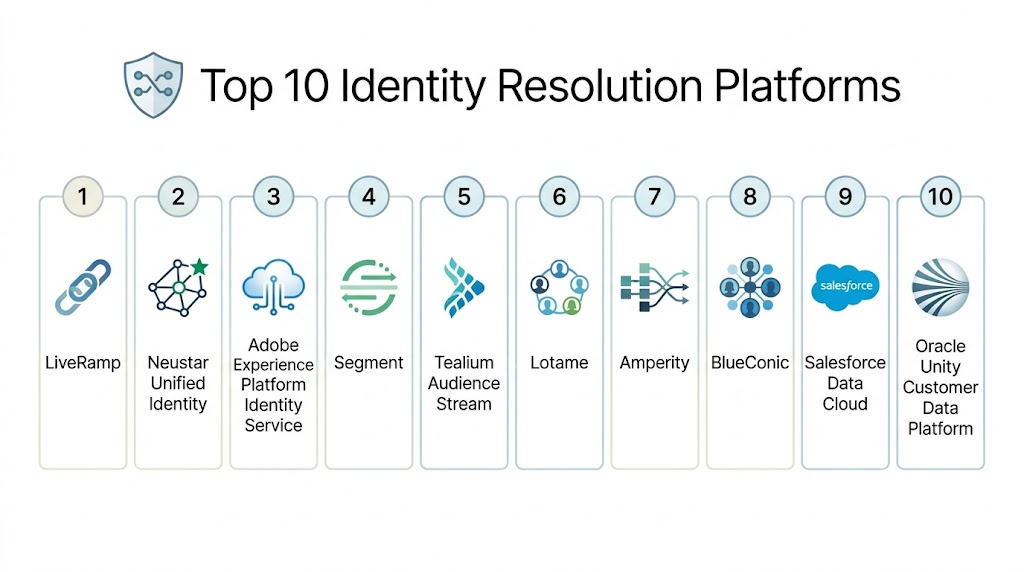
Top 10 Identity Resolution Platforms
#1 — LiveRamp
Short description: LiveRamp is a leading identity resolution and data collaboration platform used by advertisers, retailers, publishers, and enterprises. It helps organizations connect customer data across channels, activate audiences, and support privacy-safe measurement workflows. It is especially strong for advertising, retail media, and enterprise data partnerships.
Key Features
- Identity graph management
- First-party data onboarding
- Audience activation
- Data collaboration workflows
- Clean room support
- Measurement and attribution support
- Privacy-focused identity controls
Pros
- Strong enterprise identity ecosystem
- Excellent advertising and media activation support
- Useful privacy-safe collaboration capabilities
Cons
- Enterprise-oriented pricing
- Implementation may require technical planning
- Smaller businesses may not need full platform depth
Platforms / Deployment
- Web
- Cloud
Security & Compliance
- Access controls
- Governance workflows
- Privacy controls
- GDPR support
- Additional certifications not publicly stated
Integrations & Ecosystem
LiveRamp integrates with advertising platforms, data clean rooms, CDPs, and enterprise analytics systems for customer identity activation and measurement.
- Data clean rooms
- CDPs
- Advertising platforms
- CRM systems
- Data warehouses
- Analytics platforms
Support & Community
Strong enterprise onboarding and customer success support for media, retail, and data collaboration teams.
#2 — TransUnion TruAudience
Short description: TransUnion TruAudience provides identity resolution, audience targeting, and marketing measurement capabilities using consumer identity and data assets. It supports marketers, publishers, and agencies that need people-based identity, audience enrichment, and campaign measurement workflows.
Key Features
- People-based identity resolution
- Audience enrichment
- Household identity matching
- Marketing measurement
- Data onboarding
- Audience activation
- Cross-channel identity workflows
Pros
- Strong consumer identity assets
- Useful household-level matching
- Good marketing measurement support
Cons
- Enterprise-focused offering
- Best suited for mature data teams
- Privacy governance requires careful planning
Platforms / Deployment
- Web
- Cloud
Security & Compliance
- Access controls
- Governance workflows
- Privacy management controls
- Additional certifications not publicly stated
Integrations & Ecosystem
TransUnion TruAudience supports identity, media, and audience workflows across marketing and advertising ecosystems.
- Advertising platforms
- CRM systems
- CDPs
- Data collaboration tools
- Analytics workflows
- Data export systems
Support & Community
Enterprise support and implementation guidance are available for marketing, media, and analytics teams.
#3 — Experian Marketing Services
Short description: Experian Marketing Services provides identity resolution, audience insights, data enrichment, and marketing activation capabilities. It is widely used by brands and agencies that need customer identity matching, audience segmentation, and campaign measurement support across digital and offline channels.
Key Features
- Identity resolution
- Customer data enrichment
- Audience segmentation
- Offline-to-online matching
- Marketing activation
- Data hygiene workflows
- Measurement support
Pros
- Strong data enrichment capabilities
- Useful offline and online matching
- Good enterprise marketing support
Cons
- Enterprise pricing may be high
- Implementation can require support
- Best value depends on data maturity
Platforms / Deployment
- Web
- Cloud
Security & Compliance
- Access controls
- Privacy governance workflows
- GDPR support
- Additional certifications not publicly stated
Integrations & Ecosystem
Experian integrates with marketing platforms, CRM systems, data warehouses, and audience activation environments.
- CRM systems
- CDPs
- Advertising platforms
- Data warehouses
- Analytics tools
- Marketing automation systems
Support & Community
Strong enterprise onboarding and professional services support for marketing and customer data teams.
#4 — Neustar Fabrick
Short description: Neustar Fabrick is an identity and data collaboration platform focused on identity resolution, audience creation, and marketing measurement. It helps businesses connect customer identifiers across channels and improve media activation and attribution workflows.
Key Features
- Identity resolution
- Customer graph creation
- Audience activation
- Data collaboration
- Measurement workflows
- Cross-channel matching
- Privacy-safe analytics support
Pros
- Strong identity graph capabilities
- Useful for media and advertising workflows
- Good enterprise measurement support
Cons
- Enterprise implementation complexity
- Requires data governance maturity
- Smaller businesses may not need full capabilities
Platforms / Deployment
- Web
- Cloud
Security & Compliance
- Privacy controls
- Access governance
- GDPR support
- Additional certifications not publicly stated
Integrations & Ecosystem
Neustar Fabrick integrates with advertising, marketing, and analytics systems for identity resolution and activation.
- Advertising platforms
- CRM systems
- CDPs
- Data clean rooms
- Analytics systems
- APIs
Support & Community
Enterprise implementation support is available for advertising, analytics, and customer data teams.
#5 — Epsilon CORE ID
Short description: Epsilon CORE ID is an identity resolution solution designed to help brands connect customer data across online and offline environments. It supports personalized marketing, audience activation, measurement, and customer profile enrichment for enterprise marketers.
Key Features
- Identity graph capabilities
- Online and offline matching
- Audience segmentation
- Customer profile enrichment
- Marketing activation
- Measurement workflows
- Personalization support
Pros
- Strong enterprise marketing identity layer
- Good offline data matching support
- Useful personalization workflows
Cons
- Enterprise-focused pricing
- Best suited for large customer datasets
- Implementation may require services support
Platforms / Deployment
- Web
- Cloud
Security & Compliance
- Access controls
- Privacy governance workflows
- Additional certifications not publicly stated
Integrations & Ecosystem
Epsilon supports identity-driven marketing, activation, and analytics workflows for large brands.
- CRM systems
- Advertising platforms
- CDPs
- Marketing automation systems
- Analytics tools
- Data collaboration workflows
Support & Community
Strong professional services and enterprise customer success support for marketing organizations.
#6 — Salesforce Data Cloud
Short description: Salesforce Data Cloud helps organizations unify customer data across Salesforce and external systems using identity resolution and real-time profile capabilities. It is especially useful for teams already invested in Salesforce CRM, marketing, service, and commerce ecosystems.
Key Features
- Customer profile unification
- Identity resolution rules
- Real-time data ingestion
- Segmentation workflows
- Salesforce ecosystem integration
- Customer journey activation
- Data governance controls
Pros
- Strong Salesforce ecosystem fit
- Good real-time customer profile support
- Useful for marketing, sales, and service alignment
Cons
- Best value for Salesforce users
- Implementation can be complex
- Requires clean data model planning
Platforms / Deployment
- Web
- Cloud
Security & Compliance
- SSO support
- RBAC controls
- Audit logging
- Data governance workflows
- GDPR support
Integrations & Ecosystem
Salesforce Data Cloud integrates deeply with Salesforce and enterprise customer data systems.
- Salesforce CRM
- Marketing Cloud
- Service Cloud
- Commerce Cloud
- Data warehouses
- APIs
Support & Community
Large Salesforce ecosystem with enterprise support, implementation partners, certifications, and documentation.
#7 — Adobe Real-Time CDP
Short description: Adobe Real-Time CDP includes identity resolution capabilities for creating unified customer profiles across digital and offline data sources. It is designed for enterprises using Adobe Experience Cloud and needing real-time segmentation, activation, and personalization.
Key Features
- Real-time customer profiles
- Identity stitching
- Audience segmentation
- Cross-channel activation
- Consent-aware workflows
- Data governance controls
- Adobe ecosystem integration
Pros
- Strong real-time profile capabilities
- Excellent Adobe ecosystem integration
- Useful enterprise personalization support
Cons
- Enterprise implementation complexity
- Premium pricing structure
- Best suited for Adobe-centric organizations
Platforms / Deployment
- Web
- Cloud
Security & Compliance
- SSO/SAML support
- RBAC controls
- Governance workflows
- GDPR support
- Consent management support
Integrations & Ecosystem
Adobe Real-Time CDP integrates with Adobe and enterprise marketing systems for identity-based customer activation.
- Adobe Experience Platform
- Adobe Analytics
- Adobe Campaign
- Adobe Target
- Data warehouses
- APIs
Support & Community
Strong enterprise onboarding, partner ecosystem, documentation, and Adobe customer success support.
#8 — Twilio Segment
Short description: Twilio Segment is a customer data platform that supports identity resolution, profile unification, event tracking, and customer data routing. It helps businesses collect first-party customer data and unify user activity across apps, websites, and backend systems.
Key Features
- Customer identity stitching
- Event data collection
- Profile unification
- Reverse ETL support
- Audience segmentation
- Data routing
- Warehouse integration
Pros
- Strong developer-friendly data infrastructure
- Good first-party data collection
- Flexible integration ecosystem
Cons
- Advanced identity workflows require setup
- Costs can increase with scale
- Requires data operations maturity
Platforms / Deployment
- Web
- Cloud
Security & Compliance
- Access controls
- Governance workflows
- Privacy controls
- GDPR support
- Additional certifications not publicly stated
Integrations & Ecosystem
Twilio Segment integrates with hundreds of marketing, analytics, warehouse, and product systems.
- Data warehouses
- Analytics platforms
- Marketing automation tools
- CRM systems
- Product analytics tools
- APIs
Support & Community
Strong developer documentation, active community, and enterprise support options.
#9 — Tealium AudienceStream
Short description: Tealium AudienceStream is a customer data platform with identity resolution, real-time segmentation, and data governance capabilities. It helps organizations unify customer profiles, activate audiences, and manage customer data across marketing and analytics ecosystems.
Key Features
- Identity resolution
- Real-time customer profiles
- Audience segmentation
- Data governance
- Consent management workflows
- Event data management
- Activation connectors
Pros
- Strong real-time data activation
- Good governance and consent controls
- Useful enterprise CDP workflows
Cons
- Setup can be complex
- Requires strong data strategy
- Enterprise pricing may be high
Platforms / Deployment
- Web
- Cloud
Security & Compliance
- RBAC controls
- Consent management support
- Governance workflows
- GDPR support
- Additional certifications not publicly stated
Integrations & Ecosystem
Tealium integrates with advertising, analytics, CRM, and data infrastructure systems.
- CRM systems
- Advertising platforms
- Analytics tools
- Data warehouses
- Marketing automation platforms
- APIs
Support & Community
Enterprise onboarding, implementation support, and customer success resources are available.
#10 — Treasure Data CDP
Short description: Treasure Data CDP provides enterprise customer data management, identity resolution, segmentation, and activation capabilities. It is used by large organizations that need scalable customer profile unification and data-driven marketing workflows across multiple channels.
Key Features
- Customer profile unification
- Identity resolution
- Data ingestion workflows
- Segmentation
- Audience activation
- Analytics support
- Enterprise governance
Pros
- Strong enterprise scalability
- Good customer data unification
- Useful for complex data environments
Cons
- Enterprise implementation complexity
- Requires data engineering support
- Smaller businesses may not need full platform depth
Platforms / Deployment
- Web
- Cloud
Security & Compliance
- Access controls
- Governance workflows
- Privacy controls
- GDPR support
- Additional certifications not publicly stated
Integrations & Ecosystem
Treasure Data integrates with marketing, CRM, analytics, and data warehouse ecosystems.
- CRM systems
- Advertising platforms
- Data warehouses
- Marketing automation tools
- Analytics systems
- APIs
Support & Community
Strong enterprise support and implementation guidance for customer data and marketing teams.
Comparison Table
| Tool Name | Best For | Platform(s) Supported | Deployment | Standout Feature | Public Rating |
|---|---|---|---|---|---|
| LiveRamp | Advertising and data collaboration | Web | Cloud | Enterprise identity graph | N/A |
| TransUnion TruAudience | Consumer identity and audience enrichment | Web | Cloud | People-based identity matching | N/A |
| Experian Marketing Services | Data enrichment and audience activation | Web | Cloud | Offline-to-online matching | N/A |
| Neustar Fabrick | Media and measurement workflows | Web | Cloud | Customer graph creation | N/A |
| Epsilon CORE ID | Enterprise personalization | Web | Cloud | Online and offline identity layer | N/A |
| Salesforce Data Cloud | Salesforce customer profile unification | Web | Cloud | Real-time Salesforce identity resolution | N/A |
| Adobe Real-Time CDP | Adobe ecosystem personalization | Web | Cloud | Real-time profile stitching | N/A |
| Twilio Segment | First-party data infrastructure | Web | Cloud | Developer-friendly identity stitching | N/A |
| Tealium AudienceStream | Real-time CDP activation | Web | Cloud | Consent-aware identity workflows | N/A |
| Treasure Data CDP | Enterprise customer data unification | Web | Cloud | Scalable profile management | N/A |
Evaluation & Scoring of Identity Resolution Platforms
| Tool Name | Core 25% | Ease 15% | Integrations 15% | Security 10% | Performance 10% | Support 10% | Value 15% | Weighted Total |
|---|---|---|---|---|---|---|---|---|
| LiveRamp | 9.5 | 7.6 | 9.2 | 9.0 | 9.1 | 8.8 | 7.8 | 8.8 |
| TransUnion TruAudience | 9.1 | 7.5 | 8.6 | 8.8 | 8.8 | 8.6 | 7.7 | 8.4 |
| Experian Marketing Services | 9.0 | 7.6 | 8.7 | 8.7 | 8.8 | 8.6 | 7.8 | 8.4 |
| Neustar Fabrick | 8.9 | 7.5 | 8.8 | 8.7 | 8.7 | 8.5 | 7.7 | 8.4 |
| Epsilon CORE ID | 8.9 | 7.4 | 8.5 | 8.6 | 8.7 | 8.5 | 7.6 | 8.3 |
| Salesforce Data Cloud | 9.0 | 7.8 | 9.1 | 8.8 | 9.0 | 8.8 | 7.9 | 8.7 |
| Adobe Real-Time CDP | 9.1 | 7.6 | 9.0 | 8.9 | 9.0 | 8.7 | 7.7 | 8.6 |
| Twilio Segment | 8.8 | 8.2 | 9.3 | 8.4 | 8.8 | 8.6 | 8.1 | 8.7 |
| Tealium AudienceStream | 8.9 | 7.7 | 9.0 | 8.8 | 8.8 | 8.6 | 7.8 | 8.5 |
| Treasure Data CDP | 8.8 | 7.5 | 8.8 | 8.6 | 8.9 | 8.5 | 7.7 | 8.4 |
These scores are comparative rather than absolute. Enterprise identity graph providers generally score higher in audience enrichment and advertising activation, while CDP-based platforms perform better for first-party customer profile management. Developer-focused platforms offer strong integration flexibility, while enterprise suites provide deeper governance and support. Buyers should prioritize the criteria that match their data maturity, privacy requirements, and activation goals.
Which Identity Resolution Platform Is Right for You?
Solo / Freelancer
Solo users and freelancers usually do not need enterprise identity resolution platforms. Basic CRM deduplication, email matching, and analytics tools are often enough unless they manage large-scale customer data for clients.
SMB
SMBs should start with customer data platforms or CRM-native identity features before adopting enterprise identity graphs. Twilio Segment, HubSpot-native workflows, or lightweight CDP tools may be more practical than complex enterprise identity solutions.
Mid-Market
Mid-market companies often need better customer profile unification, event data management, and audience activation. Twilio Segment, Tealium AudienceStream, Salesforce Data Cloud, and Treasure Data CDP can support growing data operations and personalization programs.
Enterprise
Large enterprises should evaluate LiveRamp, Salesforce Data Cloud, Adobe Real-Time CDP, TransUnion TruAudience, Experian Marketing Services, or Epsilon CORE ID depending on whether their priority is advertising activation, profile unification, enrichment, or cross-channel personalization.
Budget vs Premium
Budget-conscious organizations should first improve first-party data hygiene and CRM identity rules. Premium platforms are better suited for organizations that need large-scale identity graphs, audience activation, privacy-safe collaboration, and enterprise governance.
Feature Depth vs Ease of Use
Salesforce Data Cloud and Adobe Real-Time CDP provide deep enterprise capabilities but require structured implementation. Twilio Segment offers strong developer flexibility, while LiveRamp and Experian provide stronger external identity and enrichment capabilities.
Integrations & Scalability
Organizations with CRM, CDP, data warehouse, advertising, and analytics ecosystems should prioritize platforms with strong integration coverage. Twilio Segment, Salesforce Data Cloud, Adobe Real-Time CDP, LiveRamp, and Tealium are strong options for scalable identity workflows.
Security & Compliance Needs
Organizations handling sensitive customer data should prioritize consent management, encryption, RBAC, audit logs, privacy workflows, and data governance. Regulated industries should validate compliance needs before implementing identity matching at scale.
Frequently Asked Questions
1. What is an Identity Resolution Platform?
An Identity Resolution Platform connects customer identifiers from different systems to build accurate customer profiles. It helps businesses understand when multiple records, devices, emails, or behaviors belong to the same person, household, account, or organization.
2. Why is identity resolution important?
Identity resolution helps businesses reduce duplicate records, improve personalization, measure customer journeys, support attribution, and create more accurate audience segments across channels and systems.
3. What is deterministic matching?
Deterministic matching uses exact identifiers such as email addresses, phone numbers, login IDs, or customer IDs to connect records. It is usually more reliable when strong first-party identifiers are available.
4. What is probabilistic matching?
Probabilistic matching uses signals such as device type, behavior, location patterns, and statistical models to estimate whether records belong to the same person or entity. It can increase reach but requires careful privacy governance.
5. Are Identity Resolution Platforms useful for B2B companies?
Yes. B2B companies use identity resolution to connect leads, contacts, accounts, website behavior, CRM activity, and sales interactions across buying committees and account journeys.
6. Are Identity Resolution Platforms useful for ecommerce?
Yes. Ecommerce brands use identity resolution to connect browsing behavior, purchases, loyalty data, email engagement, ad interactions, and customer service records into unified customer profiles.
7. How difficult is implementation?
Implementation complexity depends on data quality, systems involved, privacy requirements, and matching rules. Enterprise deployments usually require data mapping, governance planning, and integration work.
8. What are common mistakes when choosing a platform?
Common mistakes include ignoring consent requirements, overestimating match accuracy, failing to clean first-party data, selecting a platform without integration fit, and not defining activation goals clearly.
9. Are Identity Resolution Platforms secure?
Enterprise platforms usually include access controls, encryption, governance workflows, privacy controls, and audit capabilities. Buyers should validate security and compliance requirements before deployment.
10. What are alternatives to Identity Resolution Platforms?
Alternatives include CRM deduplication tools, CDP-native identity stitching, manual data cleaning, data warehouse matching rules, and custom identity graphs. These may work for simpler needs but can become difficult to scale.
Conclusion
Identity Resolution Platforms help organizations unify fragmented customer data into more accurate, privacy-aware, and actionable customer profiles. The right platform depends on data maturity, business model, privacy requirements, activation goals, and existing technology stack. Enterprises focused on advertising and data collaboration may prefer LiveRamp, TransUnion TruAudience, Experian, Neustar, or Epsilon, while organizations focused on first-party customer profiles may choose Salesforce Data Cloud, Adobe Real-Time CDP, Twilio Segment, Tealium, or Treasure Data. The best next step is to audit current customer identifiers, clean first-party data, define matching goals, review consent and governance requirements, and test two or three platforms with real datasets before making a long-term decision.