Introduction
Merchandise storefront platforms help creators, influencers, musicians, artists, brands, streamers, and online businesses sell physical and digital merchandise directly to their audience. These platforms simplify storefront creation, product management, order fulfillment, payments, shipping, print-on-demand workflows, and audience monetization through branded merchandise sales.
As the creator economy and direct-to-consumer commerce continue expanding, merchandise storefront platforms have evolved beyond simple online shops. Modern platforms now support print-on-demand services, creator branding, inventory management, social commerce, AI-powered product recommendations, subscription merchandise, analytics dashboards, and integrations with creator ecosystems like YouTube, TikTok, Twitch, and Instagram. Creators increasingly use merchandise sales as a major revenue stream alongside memberships, sponsorships, and subscriptions.
Real-world use cases include:
- Creator merchandise stores
- Influencer apparel brands
- Music and artist merch sales
- Gaming and streaming storefronts
- Print-on-demand creator businesses
Evaluation Criteria for Buyers
- Storefront customization flexibility
- Print-on-demand and fulfillment support
- Product catalog management
- Payment and checkout workflows
- Creator branding capabilities
- Analytics and reporting quality
- Social commerce integrations
- Ease of setup and usability
- Scalability for larger stores
- Pricing and transaction fee structure
Best for: creators, influencers, musicians, streamers, artists, podcasters, online communities, ecommerce startups, and brands selling merchandise directly to audiences.
Not ideal for: businesses requiring large-scale enterprise retail ERP systems or organizations that do not need direct-to-consumer merchandise workflows.
Key Trends in Merchandise Storefront Platforms
- Print-on-demand workflows continue reducing inventory risk for creators.
- Social commerce integrations are becoming essential for creator-driven sales.
- AI-assisted product recommendations are improving store conversion rates.
- Mobile-first storefront management is becoming standard.
- Subscription merchandise boxes and membership-based commerce are growing.
- Livestream shopping integrations are expanding across creator ecosystems.
- More platforms now combine digital and physical product sales together.
- Creator-focused storefront branding tools are becoming more advanced.
- Multi-channel selling across marketplaces and social apps is increasing.
- Audience analytics and customer retention tools are improving rapidly.
How We Selected These Tools Methodology
The platforms in this list were selected based on practical creator commerce and merchandise management requirements.
Selection factors included:
- Market popularity and creator adoption
- Storefront customization capabilities
- Print-on-demand and fulfillment support
- Ease of onboarding and usability
- Social commerce integrations
- Payment and checkout flexibility
- Analytics and reporting quality
- Scalability for growing stores
- Product and inventory management depth
- Overall creator commerce ecosystem maturity
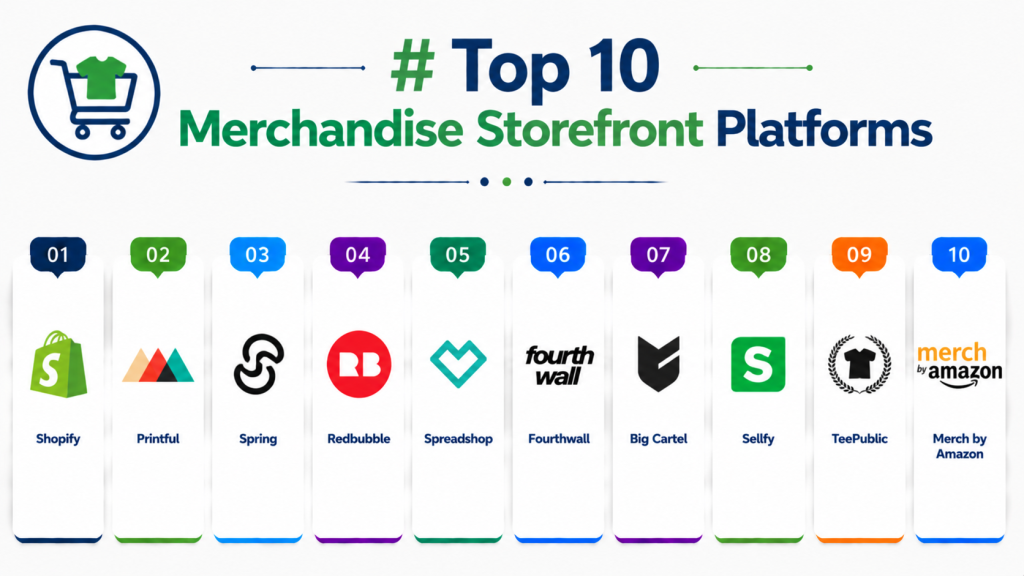
Top 10 Merchandise Storefront Platforms
#1 — Shopify
Short description: Shopify is one of the most widely used ecommerce and merchandise storefront platforms for creators, brands, and online businesses. It provides customizable storefronts, inventory management, payment processing, and integrations with print-on-demand providers. The platform works well for creators building scalable merchandise businesses with strong branding control.
Key Features
- Custom online storefronts
- Product and inventory management
- Multi-channel social selling
- Print-on-demand integrations
- Payment and checkout support
- Analytics dashboards
- Mobile commerce management
Pros
- Highly scalable ecommerce ecosystem
- Strong integration marketplace
- Flexible branding customization
Cons
- Monthly costs can increase with scale
- Advanced customization may require technical setup
- App ecosystem costs can add up
Platforms / Deployment
- Web
- iOS
- Android
- Cloud
Security & Compliance
- MFA support
- Payment security protections
- User access controls
- Additional certifications not publicly stated
Integrations & Ecosystem
Shopify supports one of the largest ecommerce integration ecosystems available.
- Printful
- Printify
- TikTok Shop
- Instagram Shopping
- YouTube Shopping
- Payment gateways
Support & Community
Shopify has a massive ecommerce community, extensive documentation, and strong onboarding support for creators and businesses.
#2 — Spring
Short description: Spring is a creator-focused merchandise platform that helps creators design, sell, and fulfill merchandise without handling inventory directly. It supports apparel, accessories, digital products, and creator storefront branding while integrating with creator ecosystems such as YouTube and social media platforms.
Key Features
- Print-on-demand merchandise
- Creator storefront customization
- Social commerce integrations
- Product design tools
- Order fulfillment workflows
- Revenue tracking dashboards
- Creator branding support
Pros
- Easy creator onboarding
- No inventory management required
- Strong creator-focused workflows
Cons
- Customization flexibility is limited
- Product margins may vary
- Less advanced ecommerce functionality than Shopify
Platforms / Deployment
- Web
- Cloud
Security & Compliance
- User authentication controls
- Payment security protections
- Additional certifications not publicly stated
Integrations & Ecosystem
Spring supports creator-driven merchandise and social selling workflows.
- YouTube
- Twitch
- TikTok
- Creator storefront tools
Support & Community
Spring is widely used by creators and influencers seeking simple merchandise workflows with minimal operational overhead.
#3 — Fourthwall
Short description: Fourthwall is a creator commerce platform combining merchandise stores, memberships, digital products, and audience monetization in one ecosystem. It allows creators to launch branded storefronts while handling fulfillment, payments, and ecommerce operations behind the scenes.
Key Features
- Creator storefront builder
- Merchandise and digital product sales
- Membership monetization
- Print-on-demand support
- Audience analytics
- Payment workflows
- Custom branding tools
Pros
- Strong all-in-one creator commerce approach
- Easy storefront setup
- Supports physical and digital products together
Cons
- Smaller ecosystem than Shopify
- Advanced enterprise ecommerce tools are limited
- Some integrations are still expanding
Platforms / Deployment
- Web
- Cloud
Security & Compliance
- Payment security protections
- User authentication controls
- Additional certifications not publicly stated
Integrations & Ecosystem
Fourthwall integrates creator monetization, storefront, and community workflows together.
- YouTube
- Twitch
- Discord
- Payment systems
- Creator engagement tools
Support & Community
Fourthwall is growing rapidly among creators and provides creator-focused onboarding resources and support.
#4 — Printful
Short description: Printful is a print-on-demand and fulfillment platform that allows creators and brands to sell customized merchandise without managing inventory. It integrates with ecommerce storefronts and marketplaces while handling production, shipping, and fulfillment operations.
Key Features
- Print-on-demand fulfillment
- Product customization tools
- Inventory-free merchandise workflows
- Ecommerce integrations
- Branding and packaging support
- Global shipping workflows
- Order tracking dashboards
Pros
- Strong fulfillment network
- High-quality print-on-demand workflows
- Broad ecommerce integrations
Cons
- Product costs can reduce margins
- Custom storefront functionality is limited
- Shipping times may vary by region
Platforms / Deployment
- Web
- Cloud
Security & Compliance
- User access controls
- Payment security protections
- Additional certifications not publicly stated
Integrations & Ecosystem
Printful supports integrations with major ecommerce and creator commerce platforms.
- Shopify
- Etsy
- WooCommerce
- Amazon
- TikTok Shop
- Ecommerce marketplaces
Support & Community
Printful has strong onboarding resources and is widely trusted within the creator merchandise ecosystem.
#5 — Printify
Short description: Printify is a print-on-demand merchandise platform that connects creators and businesses with fulfillment providers globally. It supports custom merchandise creation, storefront integrations, and scalable product catalogs for creator-driven ecommerce operations.
Key Features
- Print-on-demand product creation
- Multiple fulfillment providers
- Ecommerce platform integrations
- Product mockup generation
- Inventory-free workflows
- Global fulfillment support
- Revenue dashboards
Pros
- Flexible fulfillment provider network
- Large product catalog
- Good ecommerce integrations
Cons
- Print quality can vary by provider
- Fulfillment consistency may differ
- Storefront functionality is lighter than full ecommerce platforms
Platforms / Deployment
- Web
- Cloud
Security & Compliance
- User authentication controls
- Payment protections
- Additional certifications not publicly stated
Integrations & Ecosystem
Printify supports broad ecommerce and creator commerce integrations.
- Shopify
- Etsy
- WooCommerce
- eBay
- TikTok Shop
- Ecommerce marketplaces
Support & Community
Printify has a large creator and ecommerce seller community with useful setup documentation.
#6 — Big Cartel
Short description: Big Cartel is a lightweight ecommerce platform designed for artists, creators, musicians, and small independent brands selling merchandise online. It focuses on simplicity, clean storefronts, and easier store management for smaller creators.
Key Features
- Simple storefront builder
- Product listing management
- Inventory tracking
- Creator branding support
- Payment integrations
- Order management
- Mobile store management
Pros
- Easy for beginners
- Simple pricing structure
- Good for independent artists
Cons
- Limited scalability for large stores
- Fewer advanced ecommerce features
- Smaller integration ecosystem
Platforms / Deployment
- Web
- iOS
- Cloud
Security & Compliance
- User authentication protections
- Payment security controls
- Additional certifications not publicly stated
Integrations & Ecosystem
Big Cartel supports creator-focused ecommerce workflows.
- Stripe
- PayPal
- Social selling tools
- Ecommerce workflows
Support & Community
Big Cartel is especially popular among independent artists and small creative businesses seeking simple storefront management.
#7 — Teespring Creator Solutions
Short description: Teespring Creator Solutions focuses on merchandise creation, social commerce, and creator monetization workflows for influencers, streamers, and digital creators. It supports apparel, accessories, and creator-branded merchandise with integrated fulfillment operations.
Key Features
- Merchandise creation tools
- Print-on-demand fulfillment
- Social commerce support
- Creator storefront management
- Revenue tracking dashboards
- Product branding tools
- Mobile commerce workflows
Pros
- Strong creator-focused workflows
- No inventory management required
- Social media selling support
Cons
- Storefront customization is limited
- Product margins may vary
- Enterprise ecommerce functionality is lighter
Platforms / Deployment
- Web
- Cloud
Security & Compliance
- Payment protections
- User authentication controls
- Additional certifications not publicly stated
Integrations & Ecosystem
Teespring supports creator commerce and social monetization workflows.
- YouTube
- Twitch
- TikTok
- Social commerce tools
Support & Community
The platform is widely used by creators seeking simple merchandise monetization without operational complexity.
#8 — WooCommerce
Short description: WooCommerce is an open-source ecommerce platform built on WordPress that allows creators and businesses to build fully customizable merchandise storefronts. It supports product management, subscriptions, print-on-demand integrations, and extensive ecommerce flexibility.
Key Features
- Open-source storefront management
- Product catalog control
- WordPress integration
- Payment gateway support
- Plugin marketplace
- Inventory management
- Subscription commerce support
Pros
- Highly customizable ecosystem
- Strong WordPress flexibility
- Large plugin marketplace
Cons
- Requires more technical management
- Hosting and maintenance responsibilities
- Setup complexity is higher for beginners
Platforms / Deployment
- Web
- Cloud / Self-hosted
Security & Compliance
- User access controls
- Plugin-based security workflows
- Additional certifications not publicly stated
Integrations & Ecosystem
WooCommerce supports one of the largest ecommerce plugin ecosystems available.
- WordPress
- Printful
- Stripe
- PayPal
- Marketing tools
- Ecommerce plugins
Support & Community
WooCommerce has a massive open-source and ecommerce community with extensive tutorials and developer resources.
#9 — Sellfy
Short description: Sellfy is a creator commerce platform supporting merchandise, digital products, subscriptions, and print-on-demand sales. It is designed for creators and small businesses seeking simple storefront creation with integrated ecommerce functionality.
Key Features
- Merchandise storefront builder
- Print-on-demand support
- Digital product sales
- Subscription workflows
- Product analytics
- Payment management
- Creator branding tools
Pros
- Easy setup process
- Supports physical and digital products
- Beginner-friendly workflows
Cons
- Limited advanced ecommerce customization
- Smaller ecosystem than Shopify
- Enterprise scalability is lighter
Platforms / Deployment
- Web
- Cloud
Security & Compliance
- User authentication protections
- Payment security controls
- Additional certifications not publicly stated
Integrations & Ecosystem
Sellfy supports creator storefront and ecommerce workflows.
- Stripe
- PayPal
- Social platforms
- Creator websites
Support & Community
Sellfy is popular among independent creators and small ecommerce businesses seeking simpler storefront operations.
#10 — Etsy
Short description: Etsy is a marketplace-focused commerce platform widely used by creators, artists, and independent brands selling handmade, custom, and creative merchandise products. It combines storefront management with marketplace discovery and customer traffic.
Key Features
- Marketplace storefronts
- Product listing management
- Order and payment workflows
- Customer messaging tools
- Print-on-demand integrations
- Mobile seller tools
- Analytics dashboards
Pros
- Built-in customer marketplace
- Strong discovery ecosystem
- Good for handmade and creator products
Cons
- Marketplace competition is high
- Platform fees can add up
- Branding customization is limited
Platforms / Deployment
- Web
- iOS
- Android
- Cloud
Security & Compliance
- Payment protections
- User authentication controls
- Seller account protections
- Additional certifications not publicly stated
Integrations & Ecosystem
Etsy integrates with creator commerce and fulfillment workflows.
- Printful
- Printify
- Payment systems
- Shipping workflows
- Ecommerce tools
Support & Community
Etsy has a massive seller community and strong marketplace ecosystem for independent creators and small brands.
Comparison Table
| Tool Name | Best For | Platform Supported | Deployment | Standout Feature | Public Rating |
|---|---|---|---|---|---|
| Shopify | Scalable creator stores | Web, Mobile | Cloud | Advanced ecommerce ecosystem | N/A |
| Spring | Creator merchandise | Web | Cloud | Creator-focused merch workflows | N/A |
| Fourthwall | Creator commerce | Web | Cloud | All-in-one creator monetization | N/A |
| Printful | Print-on-demand fulfillment | Web | Cloud | Global fulfillment network | N/A |
| Printify | Flexible print-on-demand | Web | Cloud | Multiple fulfillment providers | N/A |
| Big Cartel | Independent artists | Web, Mobile | Cloud | Simple storefront management | N/A |
| Teespring Creator Solutions | Social creator merch | Web | Cloud | Social commerce support | N/A |
| WooCommerce | Custom ecommerce stores | Web | Cloud / Self-hosted | Open-source flexibility | N/A |
| Sellfy | Beginner creator stores | Web | Cloud | Simple creator storefronts | N/A |
| Etsy | Handmade creator products | Web, Mobile | Cloud | Marketplace discovery | N/A |
Evaluation & Scoring of Merchandise Storefront Platforms
| Tool Name | Core 25% | Ease 15% | Integrations 15% | Security 10% | Performance 10% | Support 10% | Value 15% | Weighted Total |
|---|---|---|---|---|---|---|---|---|
| Shopify | 9.5 | 8.0 | 9.5 | 8.0 | 9.0 | 8.5 | 7.5 | 8.63 |
| Spring | 8.0 | 8.5 | 7.5 | 7.0 | 8.0 | 7.5 | 8.0 | 7.88 |
| Fourthwall | 8.5 | 8.5 | 8.0 | 7.5 | 8.0 | 8.0 | 8.5 | 8.23 |
| Printful | 8.5 | 8.0 | 9.0 | 7.5 | 8.5 | 8.0 | 7.5 | 8.20 |
| Printify | 8.0 | 8.0 | 8.5 | 7.0 | 8.0 | 7.5 | 8.0 | 7.93 |
| Big Cartel | 7.5 | 9.0 | 6.5 | 7.0 | 7.5 | 7.5 | 8.5 | 7.75 |
| Teespring Creator Solutions | 8.0 | 8.0 | 7.5 | 7.0 | 8.0 | 7.5 | 8.0 | 7.83 |
| WooCommerce | 9.0 | 6.5 | 9.5 | 7.5 | 8.5 | 8.0 | 8.5 | 8.38 |
| Sellfy | 7.5 | 8.5 | 7.0 | 7.0 | 7.5 | 7.5 | 8.0 | 7.58 |
| Etsy | 8.0 | 8.5 | 7.5 | 7.5 | 8.0 | 8.0 | 8.0 | 7.98 |
These scores are comparative rather than absolute. Higher scores generally indicate stronger storefront flexibility, integrations, scalability, and creator commerce capabilities. Smaller creators may prioritize simplicity and affordability, while larger merchandise businesses often focus more on branding control, fulfillment reliability, analytics, and long-term scalability.
Which Merchandise Storefront Platform Is Right for You?
Solo / Freelancer
Solo creators and artists usually prioritize simple setup, lightweight store management, and affordable operations. Big Cartel, Sellfy, Spring, and Etsy are strong options for smaller merchandise businesses.
SMB
Small creator brands and growing ecommerce stores need stronger storefront customization, fulfillment support, analytics, and social commerce integrations. Shopify, Fourthwall, and Printful provide balanced scalability and operational flexibility.
Mid-Market
Mid-sized creator businesses should prioritize integrations, inventory workflows, branding control, analytics, and customer retention capabilities. Shopify and WooCommerce are especially strong for expanding merchandise operations.
Enterprise
Large creator brands and ecommerce businesses need deep customization, multi-channel commerce support, integrations, and scalable operational workflows. Shopify and WooCommerce provide the strongest flexibility for larger-scale commerce environments.
Budget vs Premium
Budget-focused creators may prefer Etsy, Big Cartel, or Sellfy because they require less operational setup. Premium platforms provide stronger branding, analytics, integrations, and advanced ecommerce workflows.
Feature Depth vs Ease of Use
Simpler platforms help creators launch merchandise stores quickly, while advanced ecommerce ecosystems provide greater customization, inventory control, and scaling capabilities.
Integrations & Scalability
Businesses with growing catalogs and larger audiences should prioritize platforms with strong integrations for fulfillment, analytics, payments, social commerce, and marketing automation.
Security & Compliance Needs
Merchandise storefronts handle payments, customer data, and transaction workflows. Businesses should prioritize secure payment systems, user permissions, and operational account protections.
Frequently Asked Questions FAQs
1. What is a merchandise storefront platform?
A merchandise storefront platform helps creators and businesses sell physical or digital merchandise online through customizable storefronts, payment systems, and fulfillment workflows.
2. Which platform is best for creator merchandise?
Shopify, Fourthwall, Spring, and Printful are among the strongest platforms for creator-focused merchandise businesses.
3. What is print-on-demand merchandise?
Print-on-demand allows creators to sell products without holding inventory. Items are produced and shipped only after customers place orders.
4. Which platform is best for beginners?
Big Cartel, Sellfy, and Spring are beginner-friendly options with easier onboarding and simpler store management workflows.
5. Can creators sell digital products and merchandise together?
Yes. Platforms like Fourthwall, Sellfy, Shopify, and Kajabi support both physical and digital product monetization.
6. Are these platforms secure for payments?
Most modern storefront platforms include payment security protections, account controls, and secure checkout workflows. Businesses should still review platform security settings carefully.
7. Which platform is best for custom branding?
Shopify and WooCommerce provide the strongest storefront customization and branding flexibility for creators and ecommerce businesses.
8. Can creators integrate social media selling?
Yes. Many platforms support integrations with Instagram, TikTok, YouTube, and other creator ecosystems for social commerce workflows.
9. What are common mistakes when launching a merchandise store?
Common mistakes include poor branding, weak product quality control, ignoring shipping workflows, underestimating customer support needs, and choosing platforms that cannot scale with growth.
10. What should creators test before selecting a platform?
Creators should test storefront setup, checkout workflows, payment handling, fulfillment speed, analytics quality, integrations, and mobile usability before committing long term.
Conclusion
Merchandise storefront platforms have become essential infrastructure for creators, influencers, artists, and online brands building direct-to-audience commerce businesses. The best platform depends on product strategy, audience size, fulfillment needs, branding requirements, and long-term scalability goals. Smaller creators may prioritize simplicity and low operational overhead through platforms like Big Cartel, Sellfy, or Spring, while growing creator businesses may benefit from Shopify, Fourthwall, or WooCommerce for stronger customization and scalability. Print-on-demand focused creators may prefer Printful or Printify, while marketplace-driven sellers may benefit from Etsy’s built-in customer discovery. Instead of choosing only based on popularity, creators should evaluate fulfillment quality, storefront flexibility, integrations, payment workflows, analytics, and audience growth potential before building a long-term merchandise business.