Introduction
Nonprofit CRM Systems are software platforms designed to help nonprofit organizations manage donors, volunteers, fundraising campaigns, grants, memberships, events, communications, and supporter relationships from a centralized system. In simple terms, these platforms help nonprofits organize supporter data, improve fundraising efforts, and strengthen long-term engagement with donors and communities.
Nonprofits today face increasing pressure to improve fundraising efficiency, donor retention, volunteer coordination, transparency, and reporting while operating with limited resources. Manual spreadsheets and disconnected systems make it difficult to track donor interactions, campaign performance, and organizational impact. Modern nonprofit CRM platforms combine donor management, automation, reporting, fundraising, and communication tools to help organizations scale operations more effectively.
Real-world use cases
- Managing donor databases and fundraising campaigns
- Tracking grants, pledges, and recurring donations
- Organizing volunteer and event management workflows
- Automating donor communication and engagement
- Measuring fundraising impact and reporting outcomes
What buyers should evaluate
- Donor and supporter management capabilities
- Fundraising and campaign automation tools
- Reporting and analytics dashboards
- Volunteer and event management support
- Email marketing and communication workflows
- Payment and donation processing integrations
- Ease of use for nonprofit staff and volunteers
- Scalability for growing donor databases
- Security, permissions, and data governance
- Integration with accounting, marketing, and productivity tools
Best for:
Nonprofit CRM Systems are best for charities, NGOs, educational nonprofits, healthcare foundations, religious organizations, advocacy groups, humanitarian programs, and community-driven organizations managing fundraising and supporter engagement.
Not ideal for:
These platforms may not be ideal for very small volunteer groups or one-time fundraising campaigns that only require simple spreadsheets or lightweight donation collection tools.
Key Trends in Nonprofit CRM Systems
- AI-assisted donor engagement is helping nonprofits personalize outreach and improve donor retention.
- Recurring giving automation is becoming central for sustainable fundraising strategies.
- Integrated fundraising and CRM workflows are replacing disconnected donor databases and campaign tools.
- Cloud-based nonprofit platforms are becoming standard because of easier deployment and remote collaboration.
- Volunteer and event management integration is becoming more common in modern nonprofit CRM suites.
- Mobile-first donor engagement is growing as nonprofits increase digital outreach campaigns.
- Impact reporting and analytics are becoming more important for grants and stakeholder transparency.
- API-first integration support is helping nonprofits connect CRMs with finance, marketing, and communication tools.
- Low-code and no-code customization is improving flexibility for nonprofit operations teams.
- Data privacy and donor security are becoming more critical due to increased digital fundraising activity.
How We Selected These Tools
- Evaluated nonprofit CRM platforms with strong adoption across charities and mission-driven organizations
- Prioritized tools with donor management and fundraising depth
- Considered usability for nonprofit teams with limited technical resources
- Included both enterprise-grade and SMB-friendly nonprofit CRM platforms
- Reviewed reporting, analytics, automation, and communication features
- Considered scalability for growing donor and volunteer databases
- Evaluated integrations with payments, accounting, marketing, and event systems
- Assessed support quality, onboarding resources, and ecosystem maturity
- Included platforms specialized for nonprofit fundraising and engagement
- Avoided generic CRMs without meaningful nonprofit-specific functionality
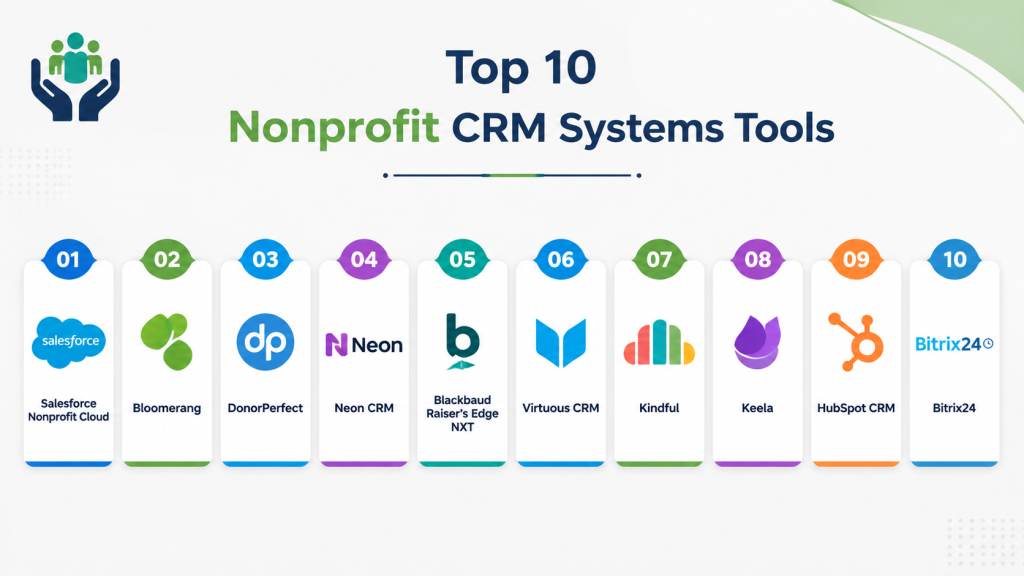
Top 10 Nonprofit CRM Systems Tools
#1 — Salesforce Nonprofit Cloud
Short description:
Salesforce Nonprofit Cloud is one of the most widely recognized nonprofit CRM platforms designed for fundraising, donor management, volunteer coordination, and program management. It provides a highly customizable ecosystem that supports organizations of different sizes. The platform is especially powerful for nonprofits needing scalability, automation, and integration flexibility. It is best suited for mid-sized to enterprise nonprofits with complex operations.
Key Features
- Donor and supporter management
- Fundraising campaign tracking
- Volunteer management workflows
- AI-powered reporting and analytics
- Marketing automation support
- Program and grant management
- Workflow automation and customization
Pros
- Highly scalable and customizable
- Strong nonprofit ecosystem and integrations
- Advanced analytics and automation capabilities
Cons
- Implementation can be complex
- Requires training and ongoing administration
- Higher total cost for advanced customization
Platforms / Deployment
Web / iOS / Android / Cloud
Security & Compliance
Supports encryption, RBAC, SSO, MFA, and enterprise-grade access controls. Additional compliance capabilities vary by deployment.
Integrations & Ecosystem
Salesforce has one of the largest nonprofit ecosystems with extensive integration capabilities.
- Payment gateways
- Marketing automation platforms
- Volunteer management systems
- Accounting software
- Communication platforms
- App marketplace ecosystem
Support & Community
Extensive documentation, nonprofit community resources, partner ecosystem, and enterprise support are available.
#2 — Bloomerang
Short description:
Bloomerang is a nonprofit CRM focused on donor retention, fundraising management, and supporter engagement. The platform is known for its user-friendly interface and donor communication tools. It helps nonprofits track donor interactions, manage campaigns, and improve recurring giving. It is best suited for small to mid-sized nonprofits prioritizing donor relationships.
Key Features
- Donor database management
- Fundraising campaign tracking
- Donor retention analytics
- Online giving forms
- Email marketing support
- Reporting and dashboards
- Volunteer and engagement tracking
Pros
- Easy to use for nonprofit teams
- Strong donor retention focus
- Good fundraising reporting tools
Cons
- Enterprise customization is limited
- Advanced workflows may require integrations
- Large organizations may outgrow some features
Platforms / Deployment
Web / Cloud
Security & Compliance
Secure login, permissions, and encrypted data workflows are supported. Specific certifications are not publicly stated.
Integrations & Ecosystem
Bloomerang integrates with fundraising, accounting, and engagement platforms.
- Donation platforms
- Email marketing tools
- Accounting systems
- Event management software
- Volunteer management tools
Support & Community
Good onboarding resources, customer support, webinars, and nonprofit-focused training materials are available.
#3 — DonorPerfect
Short description:
DonorPerfect is a nonprofit fundraising CRM designed to help organizations manage donor relationships, donations, fundraising campaigns, and reporting workflows. It is widely used by nonprofits looking for practical donor tracking and fundraising management capabilities. The platform balances usability with operational flexibility. It is best suited for growing nonprofits and fundraising-focused teams.
Key Features
- Donor and pledge tracking
- Recurring donation management
- Fundraising campaign tools
- Reporting and donor analytics
- Online donation forms
- Event management support
- Automated donor communication
Pros
- Strong fundraising workflow support
- Good donor tracking capabilities
- Practical reporting and segmentation tools
Cons
- Interface may feel dated to some users
- Advanced customization can require support
- Some integrations require additional setup
Platforms / Deployment
Web / Cloud
Security & Compliance
Role-based access and secure donor data management are supported. Specific certifications are not publicly stated.
Integrations & Ecosystem
DonorPerfect integrates with payment systems, email tools, and fundraising workflows.
- Payment gateways
- Email marketing tools
- Accounting systems
- Event fundraising tools
- Reporting workflows
Support & Community
Customer support, onboarding services, and nonprofit training resources are available.
#4 — Neon CRM
Short description:
Neon CRM is a nonprofit-focused CRM platform designed for donor management, memberships, fundraising, events, and communication workflows. It helps organizations centralize supporter engagement and operational management. The platform is known for balancing affordability with nonprofit-focused features. It is best suited for small and mid-sized nonprofits.
Key Features
- Donor and membership management
- Fundraising campaign support
- Event registration workflows
- Volunteer management
- Email marketing capabilities
- Reporting and analytics dashboards
- Online donation processing
Pros
- Good nonprofit-specific feature coverage
- Suitable for growing nonprofits
- Strong membership management workflows
Cons
- Advanced enterprise customization is limited
- Reporting complexity varies by setup
- Some workflows may require additional configuration
Platforms / Deployment
Web / Cloud
Security & Compliance
Secure user permissions and donor data workflows are supported. Specific certifications are not publicly stated.
Integrations & Ecosystem
Neon CRM supports integrations with nonprofit fundraising and operational systems.
- Payment processors
- Accounting platforms
- Email marketing systems
- Event registration tools
- Volunteer management workflows
Support & Community
Documentation, onboarding, customer support, and nonprofit education resources are available.
#5 — Blackbaud Raiser’s Edge NXT
Short description:
Blackbaud Raiser’s Edge NXT is a fundraising and donor management platform designed for nonprofits focused on donor engagement, major gifts, and fundraising operations. It is widely recognized in the nonprofit sector and supports campaign management, donor tracking, analytics, and reporting. The platform is especially strong for larger fundraising organizations. It is best suited for established nonprofits with advanced fundraising needs.
Key Features
- Donor and fundraising management
- Major gift tracking
- Campaign and event management
- Prospect research support
- Reporting and analytics tools
- Online fundraising workflows
- Donor segmentation capabilities
Pros
- Strong fundraising and donor management depth
- Good fit for larger nonprofits
- Advanced donor engagement tracking
Cons
- Higher pricing for smaller organizations
- Implementation can be resource-intensive
- Interface learning curve for some users
Platforms / Deployment
Web / Cloud
Security & Compliance
Supports role-based permissions, secure access, and audit-friendly workflows. Specific certifications are not publicly stated.
Integrations & Ecosystem
Blackbaud integrates with fundraising, finance, and nonprofit engagement tools.
- Fundraising systems
- Payment processors
- Marketing platforms
- Reporting workflows
- Volunteer management systems
Support & Community
Enterprise-style support, implementation guidance, and nonprofit training are available.
#6 — Virtuous CRM
Short description:
Virtuous CRM is a nonprofit CRM focused on donor engagement automation, fundraising workflows, and responsive fundraising strategies. It helps nonprofits personalize donor communication and improve recurring giving. The platform combines CRM, marketing automation, and online giving features. It is best suited for nonprofits focused on donor relationship growth and automation.
Key Features
- Donor management workflows
- Marketing automation support
- Online donation management
- Donor segmentation and analytics
- Fundraising campaign tools
- Volunteer engagement workflows
- AI-assisted donor insights
Pros
- Strong donor engagement automation
- Good fundraising communication workflows
- Useful recurring giving features
Cons
- Advanced setup may require onboarding help
- Pricing can increase with scaling
- Some enterprise workflows may need integrations
Platforms / Deployment
Web / Cloud
Security & Compliance
Secure access controls and encrypted donor data workflows are supported. Specific certifications are not publicly stated.
Integrations & Ecosystem
Virtuous CRM integrates with donation systems, marketing platforms, and nonprofit operations tools.
- Payment processors
- Marketing automation tools
- Email communication systems
- Volunteer engagement workflows
- Analytics integrations
Support & Community
Training, onboarding support, webinars, and nonprofit-focused customer resources are available.
#7 — Kindful
Short description:
Kindful is a nonprofit CRM platform focused on donor management, fundraising, and reporting. It helps nonprofits organize donor relationships and fundraising activities from one platform. The system is designed for ease of use and streamlined donor communication. It is best suited for nonprofits seeking straightforward donor management workflows.
Key Features
- Donor relationship management
- Fundraising campaign tracking
- Donation processing support
- Reporting and analytics
- Email communication tools
- Contact segmentation
- Online giving workflows
Pros
- Easy to learn and use
- Good donor communication support
- Useful reporting capabilities
Cons
- Enterprise customization is limited
- Complex automation may require additional tools
- Large-scale reporting may need integrations
Platforms / Deployment
Web / Cloud
Security & Compliance
Secure donor data handling and access permissions are supported. Specific certifications are not publicly stated.
Integrations & Ecosystem
Kindful supports integrations for fundraising, communication, and nonprofit operations.
- Payment gateways
- Email marketing tools
- Event fundraising platforms
- Accounting systems
- Reporting workflows
Support & Community
Customer support, onboarding, and nonprofit-focused resources are available.
#8 — Keela
Short description:
Keela is a nonprofit CRM and fundraising platform focused on donor engagement, communication automation, and impact tracking. It combines donor management with email campaigns, analytics, and fundraising workflows. The platform is designed for nonprofits seeking an all-in-one engagement solution. It is best suited for small and mid-sized nonprofits.
Key Features
- Donor and contact management
- Fundraising campaign support
- Email marketing automation
- Donation and pledge tracking
- Reporting and analytics
- Volunteer engagement tools
- Impact tracking workflows
Pros
- Strong communication automation
- Good usability for nonprofit teams
- Useful fundraising workflow coverage
Cons
- Enterprise-level customization is limited
- Reporting complexity varies by use case
- Large organizations may need broader ecosystems
Platforms / Deployment
Web / Cloud
Security & Compliance
Secure user permissions and donor data protection are supported. Specific certifications are not publicly stated.
Integrations & Ecosystem
Keela integrates with fundraising, communication, and nonprofit engagement tools.
- Payment processors
- Email marketing systems
- Event management platforms
- Volunteer workflows
- Reporting exports
Support & Community
Training materials, onboarding assistance, and customer support are available.
#9 — HubSpot CRM for Nonprofits
Short description:
HubSpot CRM is a general CRM platform that can be adapted for nonprofit fundraising, communication, donor engagement, and marketing workflows. It offers strong automation, communication, and reporting capabilities. The platform is useful for nonprofits prioritizing marketing and outreach. It is best suited for nonprofits needing a flexible CRM with strong communication workflows.
Key Features
- Contact and donor management
- Marketing automation
- Email communication tools
- Workflow automation
- Reporting and dashboards
- Campaign management support
- CRM pipeline tracking
Pros
- Strong communication and marketing tools
- Modern user experience
- Flexible integration ecosystem
Cons
- Not purpose-built for nonprofits
- Advanced nonprofit workflows require customization
- Costs can increase with scaling and modules
Platforms / Deployment
Web / iOS / Android / Cloud
Security & Compliance
Supports SSO, MFA, access controls, and encrypted workflows. Additional compliance capabilities vary by plan.
Integrations & Ecosystem
HubSpot integrates with fundraising, marketing, productivity, and nonprofit engagement systems.
- Email marketing tools
- Payment platforms
- Event systems
- Productivity suites
- Reporting and analytics tools
Support & Community
Strong documentation, training academy, community ecosystem, and support resources are available.
#10 — Bitrix24
Short description:
Bitrix24 is a collaboration and CRM platform that includes nonprofit-friendly CRM, communication, task management, and fundraising workflows. It offers cloud and self-hosted deployment options and is popular among organizations seeking budget-friendly CRM flexibility. The platform combines CRM with project and communication tools. It is best suited for nonprofits needing collaboration and CRM together.
Key Features
- CRM and contact management
- Task and project management
- Communication and collaboration tools
- Fundraising workflow support
- Document sharing and storage
- Automation and reporting tools
- Cloud and self-hosted deployment options
Pros
- Broad collaboration and CRM feature set
- Flexible deployment options
- Good value for budget-conscious organizations
Cons
- Interface can feel crowded
- Nonprofit-specific workflows require configuration
- Advanced fundraising features may need customization
Platforms / Deployment
Web / Windows / macOS / iOS / Android / Cloud / Self-hosted
Security & Compliance
Supports permissions, encrypted workflows, and access controls. Specific certifications are not publicly stated.
Integrations & Ecosystem
Bitrix24 integrates with communication, productivity, and fundraising workflows.
- Email systems
- Payment integrations
- Collaboration tools
- Productivity suites
- Automation workflows
Support & Community
Documentation, forums, onboarding resources, and customer support are available.
Comparison Table
| Tool Name | Best For | Platform Supported | Deployment | Standout Feature | Public Rating |
|---|---|---|---|---|---|
| Salesforce Nonprofit Cloud | Enterprise nonprofits | Web, iOS, Android | Cloud | Highly customizable nonprofit ecosystem | N/A |
| Bloomerang | Donor retention and fundraising | Web | Cloud | Donor retention analytics | N/A |
| DonorPerfect | Fundraising-focused nonprofits | Web | Cloud | Practical fundraising workflows | N/A |
| Neon CRM | Membership and donor management | Web | Cloud | Nonprofit-focused all-in-one CRM | N/A |
| Blackbaud Raiser’s Edge NXT | Major gift fundraising | Web | Cloud | Advanced donor engagement tracking | N/A |
| Virtuous CRM | Automated donor engagement | Web | Cloud | Responsive fundraising automation | N/A |
| Kindful | Simple donor management | Web | Cloud | Easy donor communication workflows | N/A |
| Keela | Small and mid-sized nonprofits | Web | Cloud | Fundraising plus engagement automation | N/A |
| HubSpot CRM | Communication-heavy nonprofits | Web, Mobile | Cloud | Marketing automation capabilities | N/A |
| Bitrix24 | Budget-friendly nonprofit operations | Web, Desktop, Mobile | Cloud, Self-hosted | Collaboration plus CRM workflows | N/A |
Evaluation & Scoring of Nonprofit CRM Systems
| Tool Name | Core 25% | Ease 15% | Integrations 15% | Security 10% | Performance 10% | Support 10% | Value 15% | Weighted Total |
|---|---|---|---|---|---|---|---|---|
| Salesforce Nonprofit Cloud | 10 | 7 | 10 | 9 | 9 | 9 | 7 | 8.8 |
| Bloomerang | 8 | 9 | 8 | 8 | 8 | 8 | 9 | 8.3 |
| DonorPerfect | 8 | 8 | 8 | 8 | 8 | 8 | 8 | 8.0 |
| Neon CRM | 8 | 8 | 7 | 8 | 8 | 8 | 8 | 7.9 |
| Blackbaud Raiser’s Edge NXT | 9 | 7 | 8 | 9 | 8 | 9 | 7 | 8.2 |
| Virtuous CRM | 8 | 8 | 8 | 8 | 8 | 8 | 8 | 8.0 |
| Kindful | 7 | 9 | 7 | 8 | 8 | 8 | 8 | 7.8 |
| Keela | 8 | 8 | 7 | 8 | 8 | 8 | 8 | 7.9 |
| HubSpot CRM | 8 | 9 | 9 | 8 | 8 | 8 | 7 | 8.2 |
| Bitrix24 | 8 | 7 | 8 | 8 | 8 | 7 | 9 | 7.9 |
These scores are comparative and should be interpreted according to organization size, donor complexity, fundraising needs, and technical maturity. Enterprise platforms usually score higher for scalability and integrations, while nonprofit-focused SMB platforms often score higher for usability and value. A lower score does not mean a weak platform; it may simply fit a narrower use case. Organizations should evaluate donor workflows, fundraising operations, reporting needs, and onboarding effort before making a final selection.
Which Nonprofit CRM Systems Tool Is Right for You?
Solo / Freelancer
Very small nonprofits, volunteer-led initiatives, and independent fundraisers usually need affordable and easy-to-use tools. Bloomerang, Kindful, Keela, and Bitrix24 can provide sufficient donor management and communication workflows without enterprise-level complexity.
SMB
Small and mid-sized nonprofits should prioritize donor management, fundraising automation, communication workflows, and affordability. Neon CRM, Bloomerang, DonorPerfect, Keela, and Virtuous CRM are strong options for organizations scaling donor engagement and recurring giving programs.
Mid-Market
Mid-sized nonprofits often need stronger analytics, automation, integrations, volunteer management, and campaign tracking. Virtuous CRM, Blackbaud Raiser’s Edge NXT, Salesforce Nonprofit Cloud, and HubSpot CRM can support more complex engagement and fundraising operations.
Enterprise
Large nonprofits, foundations, universities, and global organizations should prioritize scalability, governance, integrations, analytics, and multi-department coordination. Salesforce Nonprofit Cloud and Blackbaud Raiser’s Edge NXT are strong enterprise-focused choices due to ecosystem maturity and customization flexibility.
Budget vs Premium
Budget-focused nonprofits may prefer Bitrix24, Bloomerang, or Keela because of lower operational overhead and easier onboarding. Premium platforms such as Salesforce and Blackbaud provide deeper customization, integrations, automation, and enterprise support but often require more implementation investment.
Feature Depth vs Ease of Use
Salesforce and Blackbaud provide deep enterprise capabilities but may require specialized administration. Bloomerang, Kindful, and Keela are easier for smaller nonprofit teams. HubSpot CRM offers modern usability and marketing strength but may need nonprofit customization.
Integrations & Scalability
Nonprofit CRMs should integrate with donation systems, accounting tools, email platforms, volunteer management systems, event tools, and analytics platforms. API support becomes increasingly important as organizations grow fundraising complexity and operational scale.
Security & Compliance Needs
Nonprofits handle sensitive donor, volunteer, payment, and program data. Buyers should prioritize access controls, encrypted data workflows, audit logging, user permissions, and secure payment integrations. Organizations should also review regional donor privacy and fundraising compliance requirements.
Frequently Asked Questions
1. What is a nonprofit CRM system?
A nonprofit CRM system is software designed to help organizations manage donors, fundraising campaigns, volunteers, memberships, events, and supporter relationships. It centralizes supporter data and improves communication, fundraising, and reporting workflows. These platforms help nonprofits operate more efficiently and improve engagement.
2. Why do nonprofits need CRM software?
Nonprofits need CRM software because managing donor relationships manually becomes difficult as organizations grow. A CRM helps track donations, automate communication, improve donor retention, manage volunteers, and create reporting dashboards. It also helps leadership understand fundraising performance and supporter engagement trends.
3. What features are most important in a nonprofit CRM?
The most important features usually include donor management, fundraising tracking, recurring donations, campaign management, reporting, communication tools, volunteer workflows, and payment integrations. Some nonprofits also prioritize grant management, event management, and marketing automation depending on their operations.
4. Are nonprofit CRM systems expensive?
Pricing varies widely depending on organization size, donor volume, modules, integrations, and support requirements. Some platforms offer nonprofit discounts or entry-level pricing, while enterprise systems may require larger implementation budgets. Organizations should evaluate both subscription cost and operational overhead.
5. How long does implementation take?
Implementation timelines vary based on organization complexity, data migration needs, integrations, and customization requirements. Smaller nonprofits may deploy within weeks, while enterprise deployments can take several months. Proper onboarding and staff training are important for long-term adoption.
6. Can nonprofit CRMs manage volunteers?
Yes, many nonprofit CRM systems include volunteer management workflows. These features may include volunteer registration, scheduling, communication, attendance tracking, and reporting. Some organizations may still integrate specialized volunteer management tools depending on complexity.
7. What integrations should nonprofits prioritize?
Important integrations include payment processors, accounting systems, email marketing tools, fundraising platforms, volunteer management systems, and productivity suites. Strong integrations reduce manual work and improve operational visibility across fundraising and engagement activities.
8. What are common mistakes when selecting a nonprofit CRM?
Common mistakes include choosing platforms only based on price, ignoring reporting needs, underestimating data migration complexity, and selecting systems that are too complex for the organization’s operational maturity. Another mistake is not involving fundraising and communications teams during evaluation.
9. Is data security important for nonprofit CRMs?
Yes. Nonprofit CRMs often store donor records, payment information, volunteer data, and communication history. Organizations should evaluate permissions, encryption, access controls, audit logs, and secure payment integrations carefully before deployment.
10. How should nonprofits choose the right CRM?
Organizations should first define their fundraising goals, donor management needs, reporting requirements, and operational workflows. Then they should shortlist platforms, request demos, test integrations, review onboarding support, and run pilot projects before full implementation. The best CRM depends on organization size, donor engagement strategy, and long-term growth plans.
Conclusion
Nonprofit CRM Systems have become essential for organizations that need to manage donor relationships, improve fundraising efficiency, automate communication, and scale supporter engagement. As fundraising becomes more digital and donor expectations continue to rise, nonprofits can no longer rely on spreadsheets and disconnected systems to manage operations effectively. A strong nonprofit CRM helps organizations centralize data, improve collaboration, personalize donor outreach, and make better strategic decisions based on analytics and reporting. Enterprise organizations may prefer Salesforce Nonprofit Cloud or Blackbaud Raiser’s Edge NXT because of their scalability, customization, and ecosystem depth. Growing nonprofits focused on donor engagement and recurring giving may find stronger value in Bloomerang, Virtuous CRM, DonorPerfect, or Neon CRM. Smaller organizations seeking simplicity and affordability may prefer Kindful, Keela, or Bitrix24. The best platform depends on fundraising complexity, donor volume, volunteer operations, technical resources, and long-term organizational goals. Nonprofits should shortlist tools carefully, test donor workflows and reporting capabilities, validate integrations, review onboarding support, and run a pilot implementation before scaling organization-wide.