Introduction
AI Content Generation Tools are platforms that use artificial intelligence and natural language processing to create written content such as blogs, emails, ads, product descriptions, and social media posts. These tools leverage advanced language models to generate human-like text quickly, helping businesses and individuals scale content production efficiently.
With the growing demand for digital content, AI tools are transforming how content is created, edited, and optimized. They reduce manual effort, improve productivity, and enable consistent output across multiple channels, making them essential for modern marketing and communication strategies.
Real-world use cases include:
- Writing blog posts and articles
- Generating marketing copy and advertisements
- Creating social media content
- Drafting emails and business communication
- SEO content optimization and keyword targeting
Key evaluation criteria for buyers:
- Content quality and coherence
- Customization and tone control
- SEO and optimization features
- Integration with workflows and tools
- Multi-language support
- Scalability and speed
- Collaboration features
- Security and data privacy
- Ease of use and interface
- Pricing and value
Best for:
AI content tools are ideal for marketers, content creators, bloggers, agencies, and businesses looking to scale content production.
Not ideal for:
Organizations requiring highly specialized or legally sensitive content without human review.
Key Trends in AI Content Generation Tools
- Advanced language models producing human-like content
- SEO-focused content generation tools
- Integration with marketing and CMS platforms
- Multilingual content generation capabilities
- AI-assisted editing and rewriting tools
- Real-time content suggestions and improvements
- Voice and multimodal content generation
- Collaboration and team workflows
- Content personalization at scale
- Ethical AI and content authenticity controls
How We Selected These Tools (Methodology)
- Evaluated content quality and accuracy
- Assessed ease of use and UI/UX
- Reviewed customization and tone control
- Checked integration with marketing and SEO tools
- Considered multi-language support
- Examined collaboration and workflow features
- Evaluated scalability for large content production
- Reviewed pricing and value for money
- Considered community and support availability
- Ensured applicability across freelancers, SMBs, and enterprises
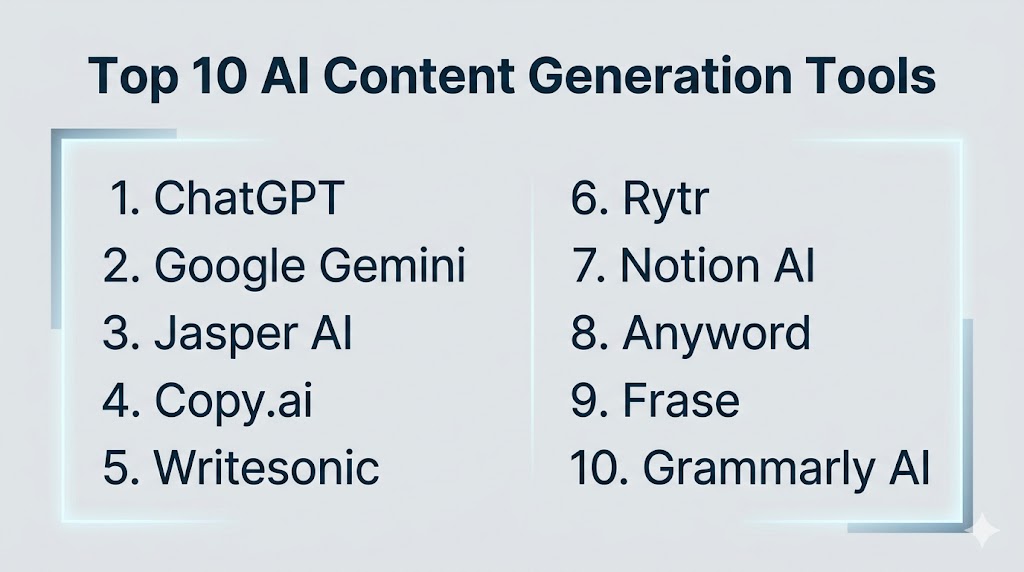
Top 10 AI Content Generation Tools
#1 — ChatGPT
Short description (3-4 lines): ChatGPT is a versatile AI writing assistant that generates blogs, emails, code, and conversational content with high flexibility and accuracy.
Key Features
- Blog and article generation
- Conversational AI
- Multi-language support
- Content rewriting and summarization
- Coding assistance
- Custom prompts
Pros
- Highly flexible
- Easy to use
Cons
- Requires prompt optimization
- Output may need editing
Platforms / Deployment
- Web / Cloud
Security & Compliance
- Encryption, access controls
Integrations & Ecosystem
- APIs, productivity tools
Support & Community
- Large user community
#2 — Google Gemini
Short description: Google Gemini is an AI-powered content generation tool offering text creation, summarization, and research assistance.
Key Features
- Content generation
- Summarization
- Research assistance
- Multi-language support
- Integration with Google ecosystem
Pros
- Strong research capabilities
- Scalable
Cons
- Cloud-based
- Limited customization
Platforms / Deployment
- Cloud
Security & Compliance
- Encryption, IAM
Integrations & Ecosystem
- Google Workspace
Support & Community
- Google support
#3 — Jasper AI
Short description: Jasper AI is a marketing-focused content generation platform for blogs, ads, and branded content.
Key Features
- Marketing copy generation
- SEO optimization
- Brand voice customization
- Templates for content
- Collaboration tools
Pros
- Strong marketing focus
- High-quality outputs
Cons
- Expensive
- Learning curve
Platforms / Deployment
- Cloud
Security & Compliance
- Encryption
Integrations & Ecosystem
- SEO tools, CMS
Support & Community
- Enterprise support
#4 — Copy.ai
Short description: Copy.ai provides AI-powered tools for generating marketing and business content quickly.
Key Features
- Marketing copy generation
- Social media content
- Email writing
- Workflow automation
- Multi-language support
Pros
- Easy to use
- Fast generation
Cons
- Limited advanced features
- Output may need editing
Platforms / Deployment
- Cloud
Security & Compliance
- Standard security controls
Integrations & Ecosystem
- APIs, marketing tools
Support & Community
- Active community
#5 — Writesonic
Short description: Writesonic is an AI writing tool focused on SEO-friendly content creation and marketing automation.
Key Features
- Blog writing
- SEO optimization
- Content templates
- AI chatbot integration
- Multi-language support
Pros
- SEO-focused
- User-friendly
Cons
- Subscription cost
- Limited customization
Platforms / Deployment
- Cloud
Security & Compliance
- Encryption
Integrations & Ecosystem
- SEO tools
Support & Community
- Community support
#6 — Rytr
Short description: Rytr is a lightweight AI writing assistant designed for quick content creation and small teams.
Key Features
- Blog and copy generation
- Tone customization
- Multi-language support
- Templates
- Fast output
Pros
- Affordable
- Easy to use
Cons
- Limited advanced features
- Basic outputs
Platforms / Deployment
- Cloud
Security & Compliance
- Standard controls
Integrations & Ecosystem
- APIs
Support & Community
- Community support
#7 — Notion AI
Short description: Notion AI integrates content generation directly into workspace tools for productivity and collaboration.
Key Features
- Content writing
- Summarization
- Task automation
- Collaboration tools
- Document editing
Pros
- Integrated workflow
- Easy collaboration
Cons
- Limited standalone features
- Requires Notion ecosystem
Platforms / Deployment
- Web / Cloud
Security & Compliance
- Encryption
Integrations & Ecosystem
- Notion ecosystem
Support & Community
- Active community
#8 — Anyword
Short description: Anyword is an AI copywriting platform focused on marketing performance and conversion optimization.
Key Features
- Marketing copy generation
- Predictive performance scoring
- A/B testing support
- Multi-channel content
- Data-driven insights
Pros
- Conversion-focused
- Data insights
Cons
- Paid platform
- Limited general writing
Platforms / Deployment
- Cloud
Security & Compliance
- Encryption
Integrations & Ecosystem
- Marketing tools
Support & Community
- Enterprise support
#9 — Frase
Short description: Frase is an AI content tool designed for SEO content research, writing, and optimization.
Key Features
- SEO content generation
- Research tools
- Content briefs
- Optimization suggestions
- SERP analysis
Pros
- Strong SEO capabilities
- Research-driven
Cons
- Learning curve
- Paid plans
Platforms / Deployment
- Cloud
Security & Compliance
- Standard controls
Integrations & Ecosystem
- SEO tools
Support & Community
- Community support
#10 — Grammarly AI
Short description: Grammarly AI enhances writing with grammar correction, tone suggestions, and content generation features.
Key Features
- Grammar correction
- Tone suggestions
- Content rewriting
- AI writing assistant
- Multi-platform support
Pros
- Easy to use
- Improves quality
Cons
- Limited content generation
- Paid features
Platforms / Deployment
- Web / Desktop / Mobile
Security & Compliance
- Encryption
Integrations & Ecosystem
- Browser, apps
Support & Community
- Strong user base
Comparison Table
| Tool | Best For | Platform | Deployment | Standout Feature | Rating |
|---|---|---|---|---|---|
| ChatGPT | General AI | Web | Cloud | Versatility | N/A |
| Gemini | Research | Cloud | Cloud | Google integration | N/A |
| Jasper | Marketing | Cloud | Cloud | Brand voice | N/A |
| Copy.ai | Quick content | Cloud | Cloud | Simplicity | N/A |
| Writesonic | SEO writing | Cloud | Cloud | Optimization | N/A |
| Rytr | Budget users | Cloud | Cloud | Affordability | N/A |
| Notion AI | Productivity | Web | Cloud | Workflow integration | N/A |
| Anyword | Marketing ROI | Cloud | Cloud | Performance scoring | N/A |
| Frase | SEO research | Cloud | Cloud | SERP insights | N/A |
| Grammarly | Editing | Multi | Cloud | Writing improvement | N/A |
Evaluation & Scoring
| Tool | Core | Ease | Integration | Security | Performance | Support | Value | Total |
|---|---|---|---|---|---|---|---|---|
| ChatGPT | 10 | 9 | 9 | 8 | 9 | 9 | 9 | 9.3 |
| Gemini | 9 | 8 | 9 | 8 | 9 | 8 | 8 | 8.5 |
| Jasper | 9 | 8 | 8 | 8 | 8 | 8 | 7 | 8.1 |
| Copy.ai | 8 | 9 | 7 | 7 | 8 | 7 | 8 | 7.9 |
| Writesonic | 8 | 8 | 7 | 7 | 8 | 7 | 7 | 7.7 |
| Rytr | 7 | 9 | 6 | 7 | 7 | 7 | 9 | 7.6 |
| Notion AI | 8 | 9 | 8 | 7 | 8 | 8 | 8 | 8.2 |
| Anyword | 8 | 8 | 7 | 7 | 8 | 7 | 7 | 7.7 |
| Frase | 8 | 7 | 8 | 7 | 8 | 7 | 7 | 7.7 |
| Grammarly | 7 | 10 | 8 | 8 | 8 | 8 | 8 | 8.1 |
Which AI Content Tool Is Right for You?
Solo / Freelancer
Rytr or ChatGPT is best for flexibility and affordability.
SMB
Writesonic or Copy.ai offers ease and scalability.
Mid-Market
Notion AI or Frase supports workflows and SEO.
Enterprise
Jasper or Google Gemini delivers advanced features and scale.
Frequently Asked Questions (FAQs)
What are AI content generation tools?
AI content generation tools use machine learning and NLP to create written content automatically. They analyze prompts, generate text, and assist users in writing blogs, emails, and marketing materials. These tools help reduce manual effort and speed up content production.
Are AI-generated contents accurate?
AI-generated content can be highly accurate, but it may require human review for context, tone, and correctness. Accuracy depends on the tool, input quality, and use case. It is recommended to edit and validate outputs before publishing.
Can AI tools replace human writers?
AI tools assist writers but do not fully replace them. They help generate drafts, ideas, and repetitive content, while humans provide creativity, context, and strategic thinking. The best results come from combining AI with human expertise.
Are AI content tools SEO-friendly?
Many AI tools are designed to generate SEO-friendly content with keyword optimization and structured formatting. Tools like Writesonic and Frase specifically focus on improving search rankings and content performance.
Do these tools support multiple languages?
Yes, most modern AI content tools support multiple languages and can generate content for global audiences. Some tools also provide translation and localization features for better reach.
Is AI content secure?
Most platforms provide security features such as encryption and data protection. However, users should avoid sharing sensitive information and review platform policies before use.
Can AI tools integrate with other platforms?
Yes, many AI content tools integrate with CMS platforms, marketing tools, and APIs. This allows seamless workflow automation and content publishing.
Are these tools suitable for businesses?
Yes, businesses use AI content tools for marketing, customer communication, and documentation. They help scale content production and improve efficiency.
What are the limitations of AI content tools?
Limitations include lack of deep context understanding, occasional inaccuracies, and dependency on prompts. Human oversight is necessary to ensure quality and relevance.
How to choose the right AI content tool?
Choose based on your use case, budget, content type, and integration needs. Testing multiple tools with real scenarios helps identify the best fit.
Conclusion
AI content generation tools are reshaping how individuals and organizations create and manage digital content, enabling faster production, improved consistency, and scalable workflows. Tools like ChatGPT and Rytr provide flexibility and affordability for freelancers, while platforms like Writesonic and Copy.ai offer user-friendly solutions for small and growing teams. Mid-market users benefit from integrated tools like Notion AI and Frase, which combine productivity and SEO capabilities. Enterprises requiring advanced features, brand control, and scalability can rely on platforms like Jasper and Google Gemini. Selecting the right tool depends on your content goals, workflow requirements, and budget. A practical approach is to experiment with multiple tools, refine prompts, and combine AI efficiency with human creativity to achieve the best results.