Introduction
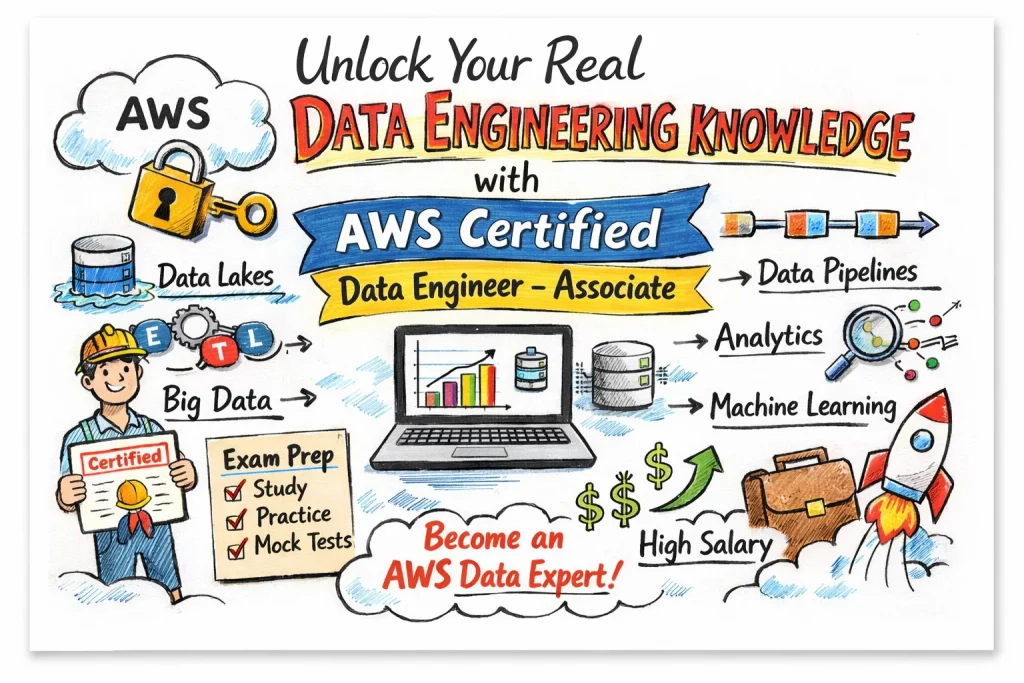
The value of data is understood by every modern business leader. However, raw data is often messy and disorganized, much like a library with books piled on the floor. The AWS Certified Data Engineer – Associate is a specialized certification that teaches the skills needed to pick up those books and put them on the right shelves. This program is designed to show how data is collected, cleaned, and stored using the powerful tools provided by Amazon Web Services.
For both individual engineers and technical managers, this certification is viewed as a solid foundation for career growth. As companies look for ways to save money and work faster, the ability to build automated data systems has become a highly respected skill. It is proven by this credential that a professional has a deep understanding of how to manage data at a large scale while keeping everything secure and efficient.
Certification Overview Table
| Track | Level | Who it’s for | Prerequisites | Skills Covered | Recommended Order |
| Data Engineering | Associate | Cloud Learners | Basic AWS | Data Flow, Storage | After Foundations |
Why Choose DevOpsSchool?
Choosing the right training partner is a decision that can change the speed of your career. DevOpsSchool is often selected because the lessons are built on real-world situations rather than just theory from a book. The training is designed to go beyond the exam questions, showing students exactly how these tools are used in a busy office environment.
At DevOpsSchool, students are guided by instructors who have spent many years working with the cloud. The focus is always kept on hands-on practice, which ensures that the concepts are not just memorized but actually understood. A helpful learning space is provided where even the most difficult technical topics are broken down into simple, manageable steps.
Certification Deep-Dive
What is this certification?
This is a professional certificate from Amazon that focuses on the work of a data engineer. It is used to show that a person knows how to move data from one place to another while making sure it stays clean and useful.
Who should take this certification?
This path is recommended for anyone who wants to start a career in data. It is also a great choice for software developers and cloud workers who want to specialize in building data pipelines for their companies.
Skills you will gain
- Data Gathering: Information is collected from many different sources like databases and website logs.
- Data Cleaning: Raw and messy information is transformed into a format that is easy for computers to read.
- Secure Storage: Data is stored in safe cloud folders where it cannot be lost or accessed by the wrong people.
- Workflow Management: The entire path of the data is managed automatically from the moment it is created.
- Monitoring: Systems are checked regularly to make sure the data is moving smoothly and without any errors.
Real-world projects you should be able to do
- Automated Processing: A system is built that starts working as soon as a new file is uploaded to the cloud.
- Data Validation: Automatic tests are created to make sure the data being moved is accurate and has no mistakes.
- Metadata Cataloging: A central list is made so that everyone in the company knows exactly what data is available.
- Cost-Saving Archival: Old data is moved to special low-cost storage areas to help the company save on monthly bills.
Preparation Plan
7–14 Days Plan (The Quick Review)
- The official list of exam topics is studied every single day.
- Important tools like AWS Glue and Amazon Redshift are reviewed for their main features.
- Several practice tests are completed to get comfortable with how the questions are asked.
30 Days Plan (The Standard Path)
- At least two hours are spent each day using the actual AWS console to build small projects.
- Reading materials regarding cloud safety and best practices are finished during the second week.
- One full practice exam is taken every weekend to measure progress and find areas that need more study.
60 Days Plan (The Complete Mastery)
- The first thirty days are used to build large, complex data systems from scratch.
- The second month is focused on learning how to fix systems when they break or slow down.
- The final ten days are dedicated to repeating practice tests until a high score is reached consistently.
Common mistakes to avoid
- Spending too much time reading and not enough time practicing with the actual cloud tools.
- Forgetting to learn about the security rules that keep data private and locked.
- Not paying attention to how much money is spent when running different data services.
- Skipping the study of how to move data from old, local servers to the modern cloud.
Best next certification after this
- Same Track: AWS Certified Data Analytics – Specialty.
- Cross-Track: AWS Certified Security – Specialty.
- Leadership / Management: AWS Certified Solutions Architect – Professional.
Choose Your Learning Path
1. DevOps Path This path is for those who like to make work happen automatically. The focus is on making sure that data systems are updated and deployed just like any other piece of software.
2. DevSecOps Path Keeping data safe is the main goal here. This path is meant for engineers who want to make sure every piece of information is encrypted and protected from hackers.
3. Site Reliability Engineering (SRE) Path This path is for people who want to make sure systems never stop working. It teaches how to build data pipelines that can handle heavy traffic without slowing down.
4. AIOps / MLOps Path This is a path for the future. It shows how to prepare very high-quality data so that smart programs and artificial intelligence can learn from it properly.
5. DataOps Path The whole life of data is studied in this path. It is ideal for people who want to make sure that clean data gets to business leaders as fast as possible.
6. FinOps Path This path is focused on the budget. It teaches how to look at cloud bills and find ways to make the data systems run for the lowest possible price.
Role → Recommended Certifications Mapping
- DevOps Engineer: AWS Certified DevOps Engineer – Professional
- Site Reliability Engineer (SRE): AWS Certified SysOps Administrator – Associate
- Platform Engineer: AWS Certified Solutions Architect – Associate
- Cloud Engineer: AWS Certified Developer – Associate
- Security Engineer: AWS Certified Security – Specialty
- Data Engineer: AWS Certified Data Engineer – Associate
- FinOps Practitioner: FinOps Certified Practitioner
- Engineering Manager: AWS Certified Solutions Architect – Professional
Next Certifications to Take
For Growing Your Career:
- Same-track: AWS Certified Data Analytics – Specialty
- Cross-track: AWS Certified Security – Specialty
- Leadership: PMP (Project Management Professional)
Training & Certification Support Institutions
DevOpsSchool Hands-on skills are taught by expert teachers who have worked in the industry for a long time. It is a great place to learn how to solve real problems with data.
Cotocus Training is provided that focuses on building very strong cloud systems. The lessons are kept simple so that everyone can understand how to be a better engineer.
ScmGalaxy A large library of guides and helpful tips is offered to all students. It is a very good place to find help when you are stuck on a difficult technical problem.
BestDevOps Clear steps are provided to help people get their first cloud certificate. The focus is on helping workers get better jobs in a short amount of time.
devsecopsschool.com Learning how to keep data safe from bad actors is the specialty here. It is the best place to learn about the security side of the cloud.
sreschool.com The rules for keeping systems online and fast are taught in great detail. Students learn how to build data systems that are very difficult to break.
aiopsschool.com The connection between smart machines and cloud work is explained. Training is given on how to use AI to make daily tasks much easier.
dataopsschool.com This is a school just for learning about the journey of data. Everything from collecting data to showing it in reports is covered in the lessons.
finopsschool.com Managing the cost of the cloud is the main focus. It helps people understand how to save their company money while still doing great technical work.
FAQs
1. Is this certificate good for my future?
Yes, having this certificate often leads to better job offers and higher salaries in the tech industry.
2. How hard is the actual test?
The test is considered moderate. It requires you to know exactly how different AWS tools work together.
3. Do I need to be a math expert?
No, you just need to understand how data is organized and how to use the cloud tools correctly.
4. Is the certificate accepted in other countries? Yes, Amazon certificates are recognized and respected by companies all over the world.
5. How much time is spent on safety?
A lot of time is spent on security because keeping data safe is one of the most important parts of the job.
6. Can I guess the answers if I am not sure?
Yes, you should answer every question because points are not taken away for wrong guesses.
7. What format are the questions in?
The questions are multiple-choice, where you pick the best answer from a list of options.
8. When will I know if I passed?
Most people receive their results in their email a few days after they finish the exam.
9. What happens if I do not pass the first time?
You are allowed to take the test again after waiting for a few weeks and paying the fee once more.
10. Do I need to write complex programs?
You should be able to read simple scripts, but you do not need to be a master programmer.
11. How much does it cost to take the exam?
The standard price for an Associate-level exam like this one is 150 USD.
12. Will I get a digital badge for my profile?
Yes, you will be given a badge that you can show on your LinkedIn profile to prove your skill.
Additional FAQs for AWS Certified Data Engineer – Associate
1. Which tool is used for fast data searching?
Amazon Athena is taught as the best tool for looking through data without having to set up a server.
2. Does the test cover moving data?
Yes, learning how to move data from old office computers to the cloud is a major part of the exam.
15. How are data lakes kept safe?
AWS Lake Formation is shown as the main way to control who can see and use the data in a lake.
4. Is the test about theory or actual work?
The test is very practical. It asks you how you would solve specific problems that happen in a real job.
5. Why is Redshift important?
Redshift is taught as the main place to store very large amounts of data so it can be studied by a business.
6 Are real-time data flows included?
Yes, learning how to handle data that is created every second is an important part of the lessons.
7 How is the quality of the data checked?
The exam covers the different ways to make sure data is not missing any pieces or filled with errors.
8. Does it talk about different storage types?
Yes, the test shows you how to pick the best storage type to keep your data safe and your costs low.
Testimonials
Karthik A very clear understanding of how to move data was gained during this training. My daily work has become much easier because I know the right tools to use.
Nisha As a manager, I now feel much more comfortable talking to my technical team. The training helped me see the big picture of how our data is handled.
Sameer The hands-on labs were the most useful part for me. I was able to practice with real AWS tools, which made the final exam feel very comfortable.
Aditi Confidence in keeping our company data safe was built through this course. I now know how to set up the right locks and keys for our information.
Varun This was a perfect way for me to move into a new role. My career growth has been very strong since I earned my certificate.
Conclusion
The AWS Certified Data Engineer – Associate is a very strong step for anyone looking to build a career in the cloud. It provides the skills needed to manage the data that powers the modern world. By learning these techniques, a clear path to a stable and successful career is established. Strategic planning and a commitment to learning remain the best ways to stay ahead in the technical industry.